
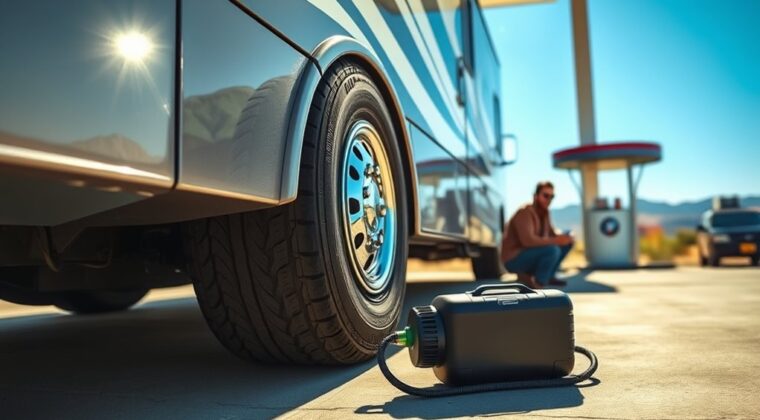
Yes, you can inflate RV tires with a tire inflator, but only if it’s built for the job. You need a unit whose max PSI runs about 20–25% above your tire’s target pressure, plus a duty cycle long enough for sustained use. RV tires often need 65–110 PSI, so weak portable inflators can overheat or stall. Cold checks and short bursts help. If you keep going, you’ll see which models work best and how to use them safely.
Key Takeaways
- Yes, a tire inflator can inflate RV tires if it is rated for the required PSI and duty cycle.
- RV tires usually need 65-110 PSI, so choose an inflator with 20-25% more maximum pressure.
- Standard car inflators may overheat or struggle, especially on larger RV tires or in cold weather.
- Heavy-duty compressors or high-PSI cordless inflators work best for reliable topping off and emergency inflation.
- Check tire pressure when cold, inflate in short bursts, and verify the final PSI with an accurate gauge.
Can a Tire Inflator Fill RV Tires?
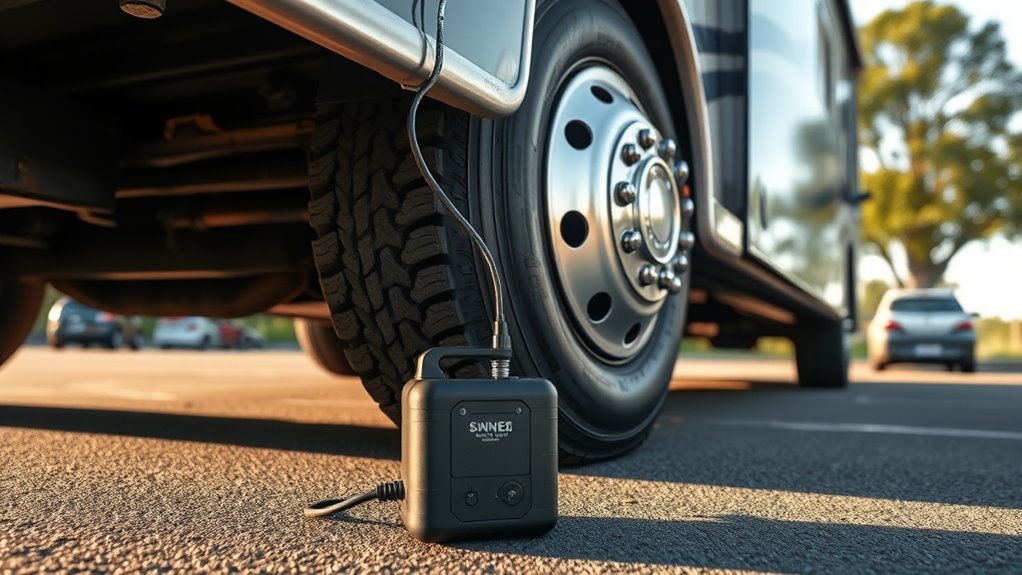
Yes—if you choose the right one. You can use a tire inflator to fill RV tires, but you need an air compressor built for real pressure demands. RV tires often require 80-110 PSI, so don’t rely on a basic passenger-car unit.
Choose the correct tire inflator with a max PSI at least 20-25% above your target tire pressure; that margin helps it work without strain and keeps the motor from burning out.
Choose an inflator with max PSI 20-25% above your target to avoid strain and burnout.
For heavy-duty use, check the duty cycle. A longer runtime, ideally over 7 minutes, lets you complete inflation more safely.
If you use a cordless model, a high-capacity battery helps, but cold storage can reduce output, so keep it warm before use.
Match the tool to the tire, and you’ll get controlled, reliable inflation without dependence on weak equipment.
What PSI and Duty Cycle Do You Need for RV Tires?
For RV tires, you need to match both pressure and runtime to the job. Your PSI requirements usually fall between 65 and 110, depending on the tire’s load rating.
Choose a tire inflator with Max Pressure at least 20-25% above your target; if you need 80 PSI, aim for 100 PSI or more. That margin helps the motor hold output and lets you efficiently inflate your RV without strain. Check the built-in pressure gauge against the tire sidewall spec, then stop at the correct pressure.
The duty cycle matters just as much. For each large tire, look for at least 7 minutes of continuous operation so the unit can keep up without overheating.
Heavy-duty Air Compressors are better suited here than standard models, especially when flexing leads and long fill times are involved. If you want dependable service and control, choose a model built for sustained output, not just quick bursts.
Why Are RV Tires So Hard to Inflate?
RV tires are hard to inflate because they demand more pressure than most passenger-car tires, often up to 80 PSI. Many standard inflators aren’t built to sustain that load for long. You need steady air pressure to reach the PSI Max without overheating the unit or stalling the fill rate.
A motorhome tire also carries much more mass, so low pressure lets the sidewall flex, build heat, and become a leading cause of failure under vibration while driving. Tire Inflation gets tougher in changing conditions, too: cold air drops pressure, and cordless tools often lose output as temperatures fall.
Uneven loading makes the job harder because one tire can need more support than another, so you can’t treat all tires the same. To stay free on the road, you have to verify specs, monitor pressure often, and correct imbalance before inflation.
Which Air Compressor Works Best for RV Tires?
Which air compressor works best for RV tires? You need an air compressor that meets RV PSI ratings, usually 65 to 80 PSI, with headroom for efficient inflation.
Look for heavy-duty models rated at 100 PSI or more and a strong flow rate, because inflating RV tires takes more volume than passenger tires. A 6-gallon pancake compressor often works well for topping off, since it gives you enough pressure and stored air without demanding a huge setup.
If you want portable air freedom, cordless inflators like DeWalt models can do the job without gas station dependence.
Check the continuous duty cycle too; at least 7 minutes helps you avoid overheating during repeated fills.
In practice, the best air compressor is the one that balances PSI ratings, airflow, and portability, so you can maintain your tires on your own terms, reliably and without surrendering time or control.
How Do You Inflate RV Tires Safely and Fast?
To inflate RV tires safely and fast, start with a heavy-duty tire inflator rated at least 20% to 25% above your target PSI, so it can reach the higher pressures common on RV tires, typically 65 to 110 PSI, without strain. Check pressure cold, ideally in the morning; temperature shifts change readings about 1 PSI per 10°F. Use a reliable tire pressure gauge, because a gauge onto a cheap pump can mislead you. Clear valve stems, then attach a hose specifically made for high-pressure air and fill in short bursts. In higher altitudes, verify PSI more often. To maintain your inflator’s battery health, charge it before trips and protect it from cold.
| Step | Action | Purpose |
|---|---|---|
| 1 | Inspect valve stems | Prevent blockage |
| 2 | Measure cold PSI | Get accuracy |
| 3 | Inflate in bursts | Control heat |
| 4 | Recheck with gauge | Confirm target |
| 5 | Top off air | Finish precisely |
That discipline is the essential element; it’s usually sufficient to keep you moving freely.
Frequently Asked Questions
Should RV Tires Be Inflated to Max PSI?
No, you shouldn’t always inflate RV tires to max psi. You should set tire pressure to the manufacturer’s rating for your load capacity, not the sidewall maximum, for better RV safety.
Your tire maintenance routine should include pressure monitoring, inflation frequency checks, and seasonal changes adjustments. Proper inflation methods reduce tread wear, heat, and blowout risk.
Use a reliable gauge, and inspect pressure before every trip and after major temperature shifts.
What Is the Best Inflator for RV Tires?
You’ll want a 100+ PSI, 2.0+ SCFM portable compressor like a Viair or DeWalt for RV tire maintenance.
If you choose wisely, the road won’t own you. Check inflator features, size compatibility, and digital pressure monitoring for ±1 PSI accuracy.
User reviews favor 6-gallon units for inflation speed and reliability.
Follow safety tips, keep a gauge handy, and pick recommended brands that match your tire load and travel freedom.
What Is the 4 PSI Rule on Tires?
The 4 PSI rule says you’ll see tire pressure change about 1 PSI for every 10°F temperature shift.
You should track pressure monitoring, because small drops or rises affect safety guidelines, tire maintenance, load capacity, handling stability, and RV performance.
Check inflation frequency before and after trips, since temperature effects can push you outside the manufacturer’s range.
Keeping tire pressure correct helps you drive with control and freedom.
What Is the Maximum PSI of a Portable Tire Inflator?
A portable tire inflator usually tops out at 100–150 PSI, so you can match tire pressure needs with some margin.
You should check inflator capacity, because an air compressor that barely meets the target raises safety concerns and can increase tire wear.
For RV maintenance, choose portable options rated above your goal, watch inflation frequency, and follow inflation tips.
If you need high-pressure service, don’t settle for undersized tools.
Conclusion
So, can a tire inflator fill RV tires? Yes—but only if you match the tool to the task. You need enough PSI, a strong duty cycle, and patience for the volume these tires demand. Otherwise, the compressor strains like an overworked pump in thin air. Choose the right unit, check your tire specs, and inflate in stages. That way, you keep your RV ready for the road and your tires safely pressurized.