

Yes—a tire inflator can overinflate a tire if you keep adding air past your vehicle’s recommended PSI or rely on an inaccurate gauge. The safe limit is the door placard or owner’s manual, with only a small margin above spec. Overinflation raises center tread wear, reduces grip, and can make braking harsher. Use a calibrated gauge, inflate in small steps, and recheck pressure cold; the details behind each limit matter more than you might expect.
Key Takeaways
- Yes, a tire inflator can overinflate a tire if it is not monitored or if the PSI target is set too high.
- The safe limit is the vehicle manufacturer’s recommended PSI, found on the driver’s door placard or owner’s manual.
- Automatic shut-off inflators reduce overinflation risk, while faulty gauges and manual inflators increase it.
- Overinflation causes center tread wear, harsher ride quality, reduced traction, and longer stopping distances.
- Check tire pressure with a reliable gauge when tires are cold, and recheck after temperature changes or before long trips.
What Counts as an Overinflated Tire?
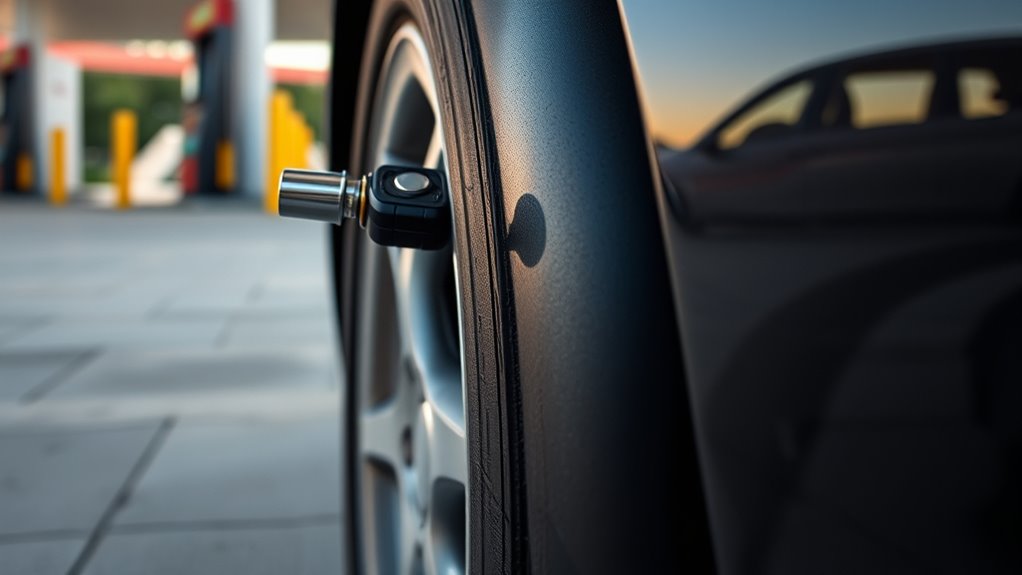
An overinflated tire is one whose air pressure exceeds the manufacturer’s recommended PSI, which you can usually find on the driver’s side door placard or in the owner’s manual. You should treat this tire pressure as the baseline for safe operation, not the sidewall maximum.
An overinflated tire exceeds the manufacturer’s recommended PSI, found on the door placard or in the owner’s manual.
If your inflation climbs above the recommended PSI, you’ve moved into overinflated tires territory; a small margin, up to about 10% above spec, can still fall within a limited safe range. Beyond that, you increase mechanical stress and reduce compliance.
You can identify symptoms of overinflated tires by checking for faster center tread wear, a harder ride, and reduced traction, especially on imperfect roads. These changes matter because the tire loses flexibility and contact patch control.
Overinflation also raises the risk of uneven wear, compromised braking, and, in extreme cases, a tire blowout. To keep control, compare measured pressure against the placard value, not assumptions or the sidewall alone.
Can a Tire Inflator Overinflate a Tire?
Yes, a tire inflator can overinflate your tire if you don’t monitor pressure closely, especially when it lacks an automatic shut-off.
Most inflators have a maximum pressure limit, but a faulty gauge or an incorrect PSI target can still push pressure beyond safe levels.
To prevent excess air, you should stop at the manufacturer’s recommended PSI and verify it with a reliable gauge.
Inflator Pressure Limits
Most tire inflators are built to shut off automatically once they reach the preset PSI, so they usually won’t overinflate a tire if you set them correctly. You still need to verify tire pressure against the manufacturer-recommended value before you inflate.
Manual inflators and faulty units can miss the limit, creating overinflation risk and reducing control.
- Set the target PSI from the door placard or owner’s manual.
- Use a calibrated inflator to limit error.
- Check readings with a pressure gauge, not the inflator alone.
- Stop if the tire pressure exceeds spec.
You control the process by measuring, not guessing. That precision protects your mobility, preserves handling, and keeps inflation within safe technical bounds.
Preventing Excess Air
Even with a preset cutoff, a tire inflator can still overinflate a tire if you don’t monitor pressure during the fill. You should verify tire pressure with a reliable gauge as the air pump runs, because preset settings aren’t always exact and some inflators lack true shutoff control.
Temperature shifts can also move readings, so a tire set in warm conditions may exceed the recommended tire pressure after cooling. Use a high-quality inflator with a built-in gauge, then pause and check PSI in intervals.
That method keeps the tire properly inflated and prevents you from overinflate a tire beyond the manufacturer’s range. Precision gives you control, and control keeps your vehicle free from unnecessary wear, reduced traction, and avoidable stress on the sidewalls.
Why Tires Get Too Much Air
You can get too much air in a tire when a faulty or miscalibrated gauge reports a higher pressure than the tire actually has, so you keep adding air past the target.
Heat, direct sun, and altitude can also raise internal pressure as the air expands, even if you didn’t add more.
If you assume overinflation improves efficiency, you may inflate beyond safe limits and create a measurable safety and wear risk.
Gauge Errors And Misreads
Gauge errors and misreads are a common cause of tire overinflation because a faulty or poorly calibrated pressure gauge can show a lower pressure than the tire actually holds, prompting you to add too much air. That error distorts tire pressure decisions and undermines control.
- Compare readings with a reliable gauge.
- Recheck after temperature changes.
- Inflate in shade, then verify.
- Replace worn gauges fast.
When you trust the wrong tool, you surrender precision and invite overinflation. A consistent, calibrated gauge gives you the data you need to stay within spec and keep your vehicle free from avoidable stress.
Check often, verify readings, and refuse guesswork.
Heat, Sun, And Altitude
Heat, sunlight, and altitude can all raise tire pressure without any change from the inflator itself.
When heat increases, the air inside your tires expands, and you can see tire pressure climb about 1 psi for every 10°F rise. If you park in direct sunlight, the tire carcass warms and the reading can spike temporarily, which can look like overinflation.
At higher altitude, atmospheric pressure drops, so the same trapped air occupies more space and the measured pressure can rise.
You still need to check cold pressures before using a tire inflator, because timing matters. If you skip that step, you may add air to a tire that’s already hot or elevated, pushing it beyond the recommended limit and denying yourself safe, controlled mobility.
Signs Your Tires Are Overinflated
Overinflated tires usually show a distinct wear pattern, with the center of the tread wearing faster than the edges, because excess pressure pushes more load onto the middle of the tire.
Overinflated tires wear the center tread faster, as excess pressure concentrates load in the middle of the tire.
You should check tire pressure regularly, because overinflated tires create uneven tread wear and reduce road contact. These signs of overinflation can also make vehicle handling less stable, especially during braking or cornering.
- Center tread wears faster than outer tread.
- Steering feels lighter, but grip drops.
- The ride feels harsher over bumps.
- Stopping distances increase in emergencies.
You’ll notice the car can feel skittish, since the smaller contact patch can’t transmit force as efficiently. A correctly inflated tire supports control, safety, and autonomy; an overinflated one narrows that margin.
If you spot these indicators, reduce pressure to the manufacturer’s specification and recheck with an accurate gauge.
What Overinflated Tires Can Do
When tire pressure climbs above the manufacturer’s specification, you reduce the tire’s contact patch, which cuts traction and can make the vehicle less stable, especially on wet roads.
In an overinflated tire, the center of the tread carries more load, so you get uneven wear that shortens service life and pushes replacement costs sooner. Higher tire pressure also stiffens the sidewall, making the tire less compliant over potholes and debris, so you’re more exposed to cuts and impact damage.
That rigidity can raise the chance of blowouts, and a blowout can trigger rapid loss of control at speed. Your safety features don’t fully erase that risk; anti-lock braking systems may have less grip to manage during emergency stops.
If you value autonomous control, keep tire pressure within spec so your vehicle responds predictably, brakes effectively, and preserves handling margins.
How to Deflate an Overinflated Tire Safely
If your tire pressure is above the manufacturer’s spec, you can bring it back down safely by venting air in a controlled way. You’ll deflate the tire through the valve stem, not by guessing.
- Remove the valve cap by turning it counterclockwise.
- Press the metal pin inside the valve stem with a flat-head screwdriver; air will escape gradually.
- Check tire pressure with a reliable gauge as you release air.
- Stop at the recommended PSI from the door placard or owner’s manual, then stay within about 10% to avoid underinflation.
You’re not surrendering performance; you’re restoring balance.
If you’re inflating the tire later, measure first and adjust in small steps. When the reading lands at target, reinstall the valve cap tightly to block dust and debris.
This controlled deflate process keeps pressure precise, preserves handling, and respects the tire’s designed load range.
How to Prevent Tire Overinflation
To prevent tire overinflation, you should inflate only to the vehicle’s specified PSI and let a high-quality inflator with automatic shut-off stop the fill at the target.
You keep tire pressure within the recommended range by reading the door sticker or owner’s manual before you add air. Use a reliable gauge before and after you inflate, because small errors can push pressure beyond safe limits.
You should also account for temperature shifts; a 10-degree change can move PSI by about 1 unit, so adjust intelligently instead of forcing extra air.
Track tread patterns for uneven wear, since it often signals improper inflation and demands correction.
This method gives you control, preserves handling, and protects the tire structure from stress.
Precise inflation isn’t restriction; it’s freedom from waste, premature wear, and avoidable risk.
When to Check Tire Pressure
Even perfect inflation means little unless you check it on a consistent schedule. You should verify tire pressure at least monthly and before long trips, because pressure drift changes handling, wear, and fuel efficiency.
Check when tires are cold; driving heats them and can falsely elevate readings. Temperature swings matter too: a 10-degree Fahrenheit drop can reduce pressure by about 1 psi.
- Use a tire pressure gauge on cold tires.
- Consult the owners manual and the placard on the driver’s side door.
- Recheck after seasonal temperature drops.
- If you inflate with a tire inflator, watch the gauge often.
That disciplined process keeps you within the recommended psi and prevents overinflation. You’re not just maintaining rubber; you’re preserving control, reducing risk, and refusing mechanical limits imposed by neglect.
Frequently Asked Questions
Will It Ruin Tires if You Inflate Them to 40 PSI Instead of 35 PSI When the Recommended PSI Is 35?
No, you probably won’t ruin them immediately, but 40 psi in a tire rated at 35 psi does create overinflation.
You’ll raise tire pressure, change inflation effects, and reduce contact patch grip. That can hurt handling performance, increase uneven wear, and shorten tire lifespan over time.
You should watch safety concerns, especially in wet conditions, and verify pressure with a reliable gauge.
Keep the tires at the manufacturer’s spec.
What Happens if I Overinflate My Tires by 1 PSI?
If you’ve ever found your car skating slightly in rain after a tire pressure check, 1 psi extra can feel subtle but real.
You’ll usually avoid immediate safety concerns, yet you may see a small performance impact, slightly better fuel efficiency, and faster tire wear over time.
You’re still near manufacturer limits, but repeated overinflation reduces contact patch and can weaken traction, especially in emergency braking.
Is 45 PSI Too High for Tires?
Yes, 45 psi is too high for most tires.
Your tire pressure should match the vehicle placard, usually 30-35 psi, because excess pressure creates safety concerns, reduces grip, and degrades performance impact.
You’ll also shorten tire lifespan through center tread wear.
Use accurate inflation techniques and a reliable gauge, since heat and tool error can push you beyond the safe range.
Check the sidewall maximum before you inflate.
Is 3 PSI Over Too Much?
No, 3 psi over usually isn’t too much—you’re still near the safe band.
You’ll feel the slight hiss, but tire pressure at 38 psi on a 35 psi spec rarely triggers safety concerns.
Different inflator types can drift, so verify with a gauge.
Temperature effects can change readings, too.
For maintenance tips, keep checking monthly, and don’t chase perfect numbers; you deserve controlled mobility, not fear.
Conclusion
So, yes, a tire inflator can overinflate your tire if you keep adding air past the recommended psi. Even a 5 psi overfill can reduce contact patch and alter handling, which matters more than most drivers realize. You protect yourself by checking pressure when tires are cold, using a reliable gauge, and stopping at the vehicle placard spec. If you notice a hard ride or center wear, let air out before damage builds.

