
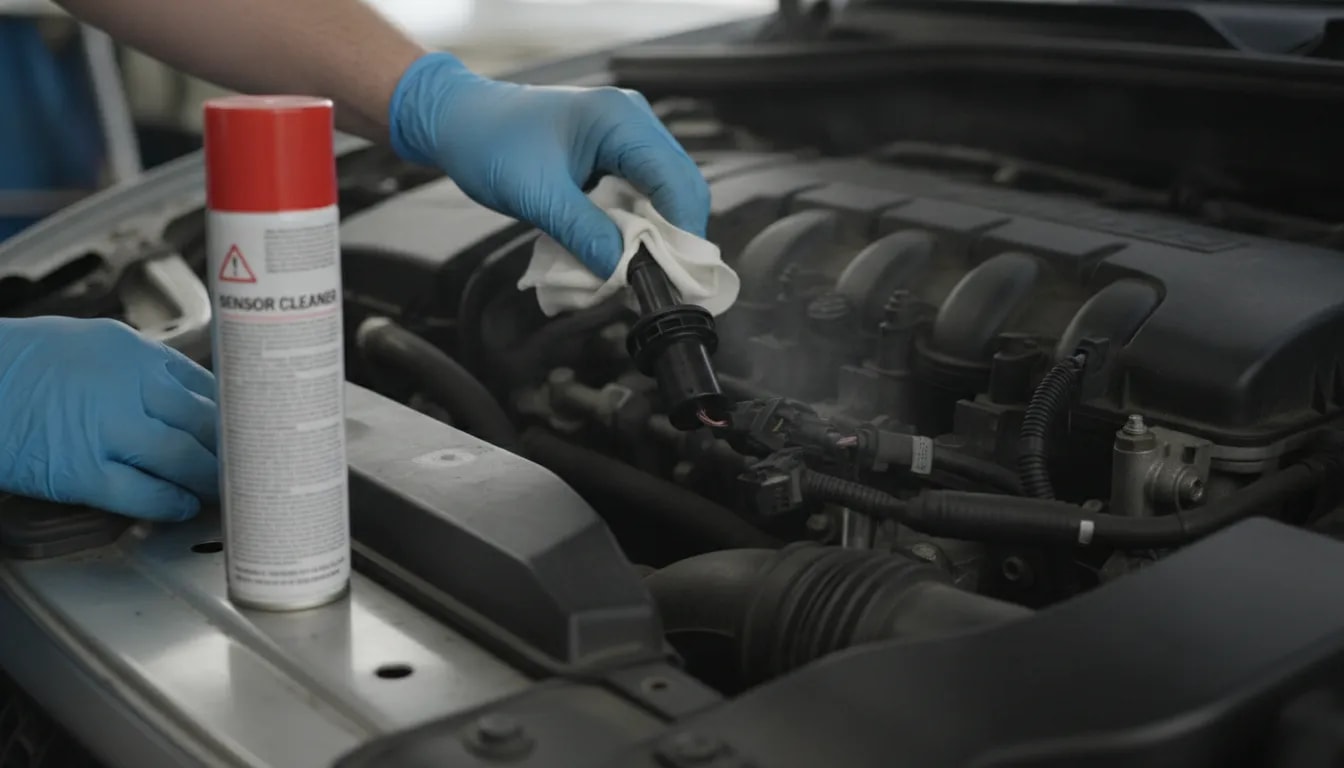
A dirty mass airflow sensor can contribute to sluggish acceleration, hesitant throttle response, rough idle, and increased fuel consumption in a diesel vehicle. Cleaning it may restore accurate airflow readings without replacing the sensor.
Cleaning is worth considering when contamination is the problem, but it is not a guaranteed cure for diesel power loss. A damaged sensor, an electrical fault, or another engine problem will still need diagnosis. The important distinction is knowing when cleaning is appropriate and how to do it without damaging the sensing element.
For an easily accessible sensor, the hands-on work may take about 10 to 15 minutes. A can of dedicated MAF sensor cleaner typically costs roughly $7 to $15. Allow additional time for complete drying and a short test drive.
Key Takeaways
- A contaminated MAF sensor can contribute to diesel power loss, hesitation, rough idle, and higher fuel consumption.
- Use dedicated MAF cleaner and never touch, scrub, or blow compressed air onto the sensing element.
- Allow complete drying and check seals, fasteners, and the electrical connector during reinstallation.
- Persistent symptoms require further diagnosis because cleaning cannot repair a damaged or electrically faulty sensor.
Table of Contents
- Dirty Diesel MAF Sensor Symptoms: When to Investigate
- What the MAF Sensor Does and Why Dirt Matters
- What You Need Before Cleaning
- How to Clean a Diesel MAF Sensor Step by Step
- Cleaning vs. Replacement: How to Judge the Result
- Preventing Repeat Contamination
- Common Mistakes to Avoid
- The Bottom Line
Dirty Diesel MAF Sensor Symptoms: When to Investigate
The mass airflow sensor, usually shortened to MAF sensor, measures the air entering the engine. If its readings become inaccurate, the engine control unit may adjust fueling incorrectly or detect an airflow discrepancy.
Symptoms that justify checking the MAF sensor include:
- Reduced power: acceleration feels weaker than before, particularly when trying to increase speed.
- Hesitation: the engine responds slowly or stumbles when you press the accelerator.
- Worse fuel economy: fuel consumption rises despite similar driving habits.
- Uneven idle: engine speed fluctuates or the engine feels unsettled at idle.
- A check engine light: stored faults relate to airflow measurement or MAF performance.
- Intermittent limp mode: the vehicle limits performance after detecting a fault.
- Black exhaust smoke: inaccurate airflow information can contribute to inappropriate fueling.
- Starting difficulty: this may occur alongside other symptoms, although it does not identify a MAF fault by itself.
These symptoms are clues, not proof. Several problems can produce similar behavior. Even an airflow-related fault code does not automatically mean the sensor needs replacement or cleaning.
A useful starting point is to record the symptoms and any fault codes before doing maintenance. That gives you a clear before-and-after comparison instead of relying only on whether the engine feels different.
What the MAF Sensor Does and Why Dirt Matters
The MAF sensor is generally located in the intake duct between the air filter housing and the engine. Its electrical connector distinguishes it from an ordinary section of intake pipe.
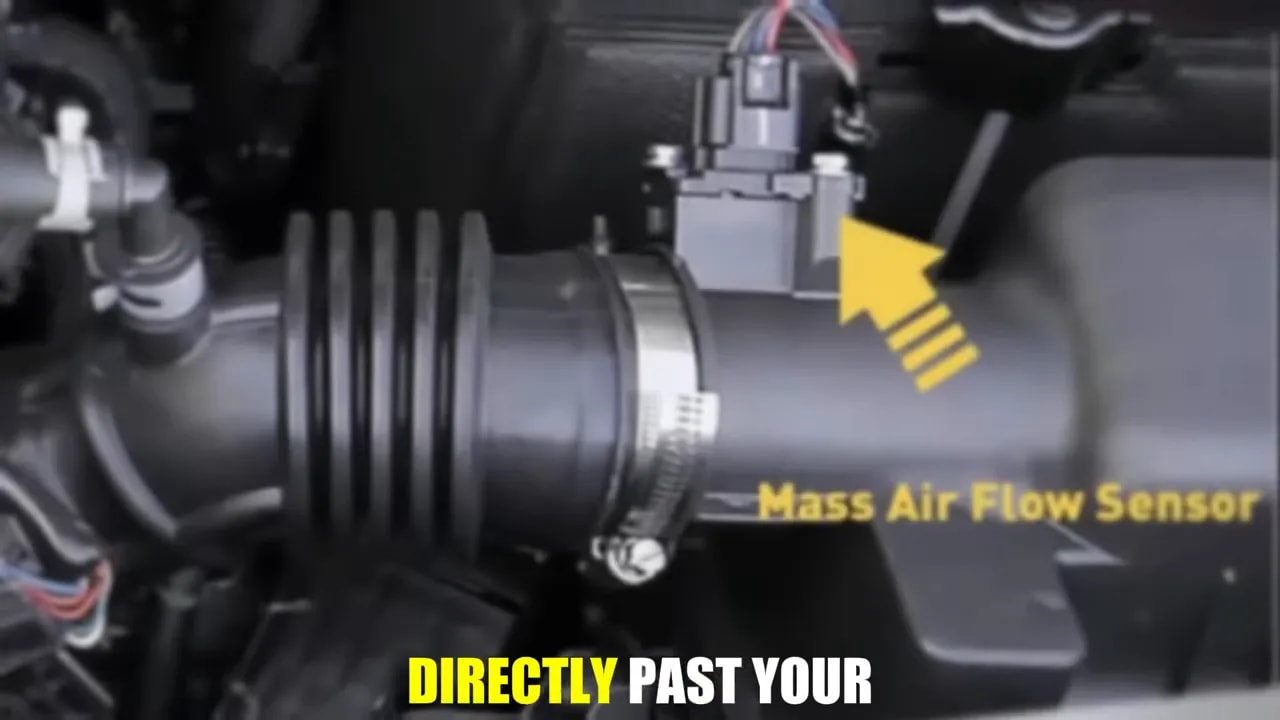
Many MAF sensors use a heated wire or film to measure airflow. The engine computer uses that measurement as part of its fueling calculations. For additional technical context, Bosch’s automotive sensor resources explain the role of sensors in engine management.
A thin coating on the sensing element can interfere with its measurement even when the sensor does not look obviously dirty. If the sensor reports less airflow than is actually entering, the computer may reduce fueling, leaving the diesel feeling underpowered.
The opposite error can also cause problems. Reporting too much airflow may contribute to excessive fueling and smoke. The result depends on the vehicle’s control strategy and the nature of the fault.
Why diesel intake contamination needs attention
Diesel intake systems can accumulate oil residue and combustion-related deposits. Crankcase ventilation returns gases containing oil vapor to the intake, while exhaust gas recirculation, or EGR, introduces exhaust gases into the intake system.
However, contamination elsewhere in the intake does not prove that it has passed over the MAF sensor. The position of the crankcase ventilation connection, EGR entry point, and MAF sensor matters. Do not assume every diesel routes all of these contaminants directly across the sensing element.
The practical lesson is to inspect the sensor and air filter system rather than treating every diesel performance problem as a dirty MAF.
What You Need Before Cleaning
- Dedicated MAF sensor cleaner: use a product specifically labeled for mass airflow sensors and compatible with your application.
- The correct hand tool: the sensor may be retained by screws or clips, depending on the vehicle.
- A safe place for removed hardware: keep screws and any rubber seals together.
- Vehicle-specific instructions: confirm the removal procedure and whether cleaning is permitted for your sensor.
Work with the engine and ignition off. Follow the cleaner’s safety, application, and drying instructions, as well as the vehicle’s service guidance.
Do not substitute another cleaning product
Do not use brake cleaner or carburetor cleaner. A solvent suitable for another automotive component may damage the delicate sensor element or its surrounding materials.
The same caution applies to physical cleaning. Do not scrub, wipe, or probe the sensing element. Keep fingers, brushes, cloths, and tools away from it, and do not use compressed air to speed up drying.
How to Clean a Diesel MAF Sensor Step by Step
1. Identify the sensor and its fasteners
Trace the intake duct from the air filter housing toward the engine. Look for a sensor body with an electrical connector. Depending on the design, you may remove a small sensor insert or a larger housing assembly.
Confirm the component before disconnecting anything. Use the vehicle’s service information if its location or removal method is unclear.
2. Disconnect the electrical connector gently
Release the connector’s locking clip or tab, then separate the connector without pulling on the wires. Avoid forcing a latch that has not fully released.
3. Remove the sensor
Undo the retaining screws or clips and carefully lift the sensor out. Keep track of any rubber seal or gasket so it can be correctly reinstalled.
Handle the sensor by its housing. Do not reach into the sensing area.
4. Find the sensing element without touching it
Look into the sensor’s airflow passage. The sensing element may appear as a small wire or film inside a protective structure. Designs vary, and not every element is equally exposed.

Do not use the absence of visible dirt as a reason to touch the element for a closer inspection. A light film may be difficult to see.
5. Apply the dedicated cleaner
Following the product instructions, spray the sensing area in short bursts. Approach from more than one angle where the design allows, so the cleaner reaches accessible surfaces.
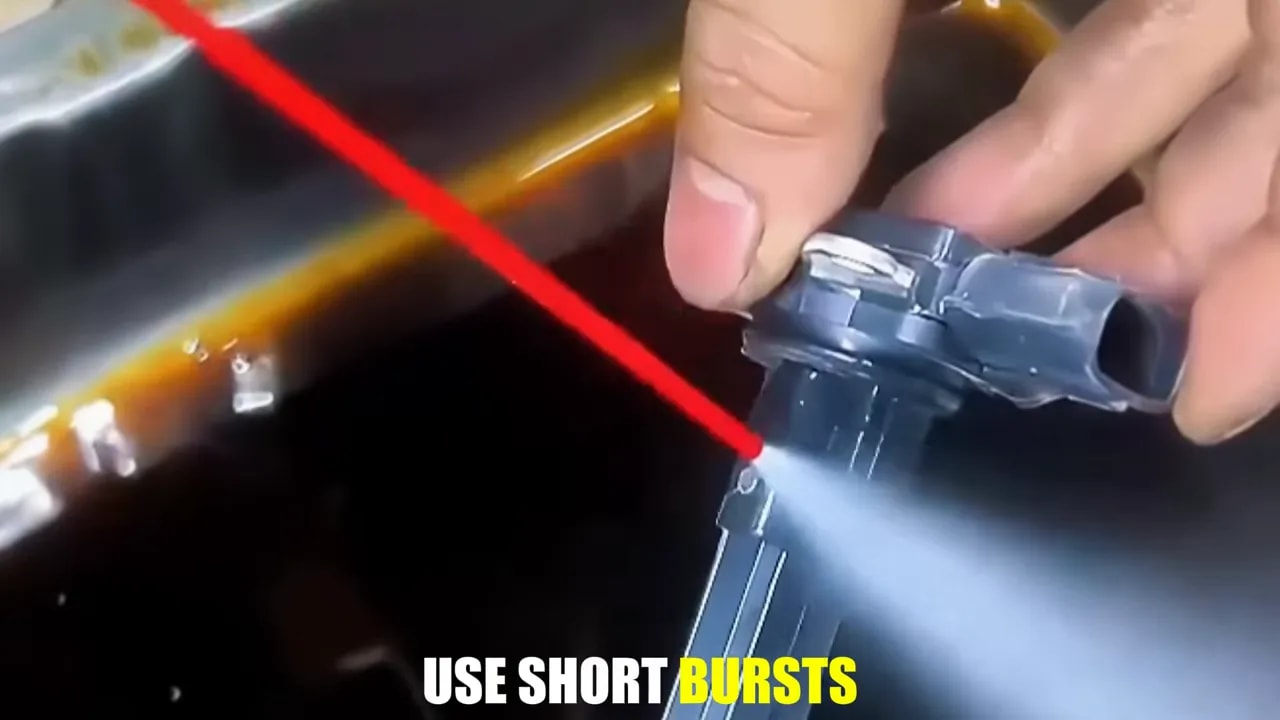
Keep the spray straw away from the element. Cleaning should rely on the approved spray, not contact or scraping. Use the amount specified by the product instructions rather than assuming more cleaner is always better.
6. Allow the sensor to air dry completely
Let the cleaner evaporate naturally. Although MAF cleaner can evaporate quickly, do not treat two or three minutes as a universal drying time. Follow the label and wait until the sensor is completely dry before reinstalling it.
Do not wipe the element or blow it dry with compressed air.
7. Reinstall the sensor and reconnect it
Refit the sensor in its original position, ensuring any rubber seal is properly seated. Secure the fasteners according to the vehicle’s instructions, then reconnect the electrical plug so its latch engages.
Before starting, check that the sensor is secure, the connector is fully attached, and any intake components disturbed during access have been reassembled.
8. Start the engine and evaluate the result
Observe idle quality and throttle response. A brief change in running behavior can occur after maintenance, but persistent rough running should not be dismissed as routine adaptation.
If the engine runs normally and the vehicle is safe to drive, take a short test drive of about 10 minutes. Compare its response under familiar driving conditions. Do not attempt highway driving if it remains in limp mode or cannot accelerate safely.
Cleaning vs. Replacement: How to Judge the Result
When contamination was affecting an otherwise functional sensor, cleaning may improve throttle response, power delivery, and idle stability. Fuel economy may also improve, but there is no dependable percentage gain that applies to every diesel.
Cleaning cannot repair a broken sensing element or an electrical failure. It also cannot establish that the MAF was the only source of the original symptoms.
| Result after cleaning | Practical next step |
|---|---|
| Performance improves and stays consistent | Monitor the original symptoms and check fuel consumption over comparable use. |
| Symptoms remain unchanged | Continue diagnosis rather than repeatedly cleaning or automatically replacing the sensor. |
| The engine runs worse immediately afterward | Check the connector, sensor seating, seals, and intake reassembly before further driving. |
| The warning light stays on or returns | Read the stored faults and investigate whether the airflow problem is still present. |
| The sensor is physically damaged | Cleaning is not a repair; have the damage assessed and replace the sensor if necessary. |
A warning light may go out after successful repair and subsequent drive cycles, but that is not guaranteed. Likewise, a light going out does not replace checking whether the symptoms have actually resolved.
How much can cleaning save?
As a rough comparison, a can of cleaner may cost $7 to $15, while workshop cleaning labor might be quoted around $50 to $100. Sensor replacement with labor may be quoted around $200 to $300.
These are approximate examples, not fixed prices. Access, vehicle model, parts choice, and local labor rates affect the total. The potential saving comes from avoiding an unnecessary replacement, not from assuming every sensor fault can be solved with a spray.
Preventing Repeat Contamination
Cleaning is more useful when you also consider why deposits developed.
- Inspect the air filter: replace it if it is dirty or damaged.
- Check reassembly: make sure the filter housing, intake connections, and sensor seal are correctly fitted.
- Review engine oil requirements: use the specification required for your diesel rather than selecting oil solely by marketing claims.
- Investigate rapid recurrence: if symptoms quickly return, repeated cleaning is not a substitute for finding the underlying cause.
How often should a diesel MAF sensor be cleaned?
A suggested preventive range is every 30,000 to 50,000 miles, with a shorter range of 20,000 to 30,000 miles sometimes considered for high-mileage vehicles, frequent idling, or repeated short trips.
These ranges should not be treated as a universal manufacturer service requirement. Follow the guidance for your particular vehicle and sensor. If symptoms appear, investigate them rather than waiting for a mileage interval.
Does a dirty MAF affect the DPF?
Inaccurate airflow information that contributes to excessive soot production can increase the burden on the diesel particulate filter, or DPF. However, cleaning the MAF sensor does not clean an already restricted DPF.
Do not assume that a DPF warning or an injector concern is caused by the MAF alone. Those problems need their own diagnosis, especially if they remain after airflow-related maintenance.
Common Mistakes to Avoid
- Replacing the sensor based only on symptoms: power loss and rough idle do not identify a single failed component.
- Assuming cleaning always works: deposits and component failure require different solutions.
- Using the wrong solvent: choose dedicated, compatible MAF cleaner.
- Touching the sensing element: even gentle physical cleaning can damage it.
- Rushing the drying stage: follow the product’s instructions and reinstall only when fully dry.
- Ignoring seals and connectors: careful reassembly is as important as cleaning.
- Accepting persistent rough running as normal: recheck the work and seek diagnosis if the problem continues.
The Bottom Line
Diesel MAF sensor cleaning is a relatively inexpensive maintenance option when contamination is interfering with airflow measurement. Use the correct cleaner, avoid all contact with the sensing element, allow complete drying, and reassemble carefully.
Judge success by whether the original symptoms improve and remain resolved. If they do not, the next step is further diagnosis, not another can of cleaner or an automatic sensor replacement.