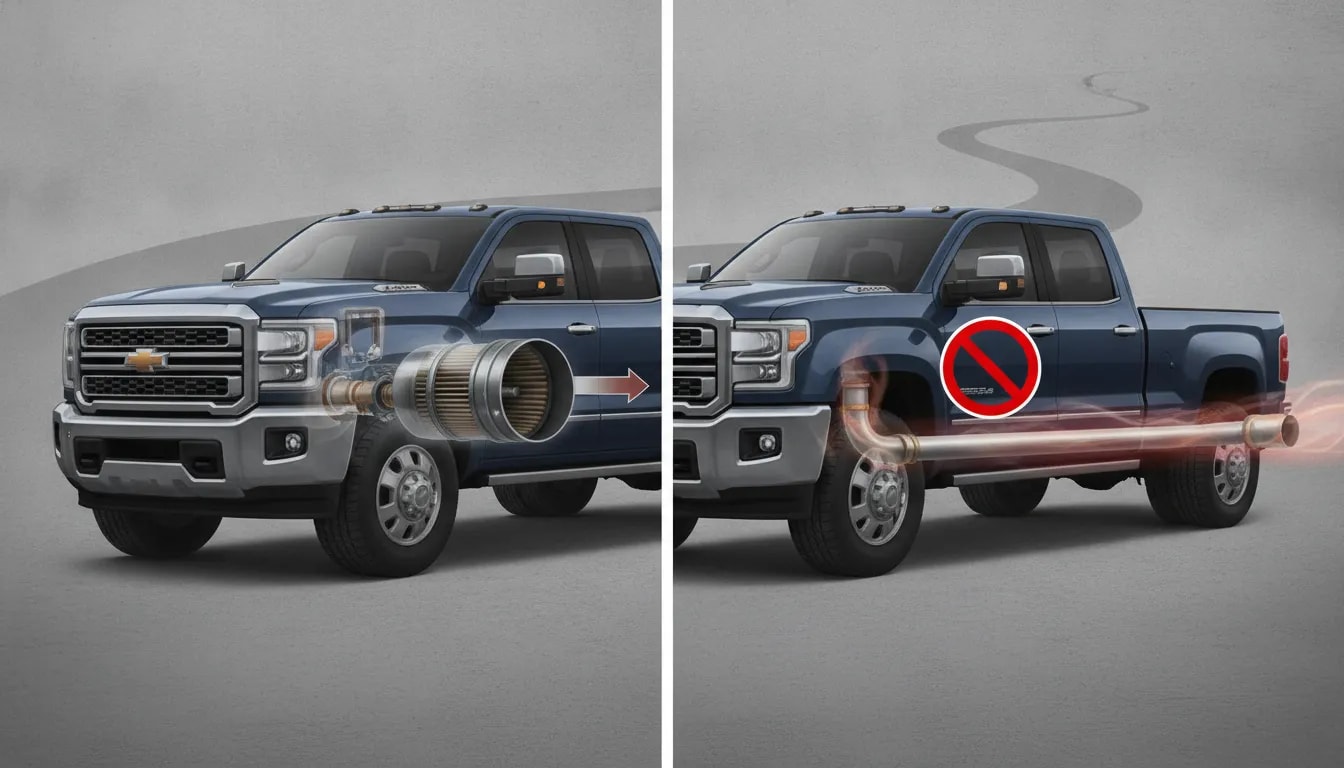
A DPF delete removes a diesel vehicle’s particulate filter and changes its engine software so it can operate without that emissions equipment. Owners usually consider it to avoid expensive repairs, stop regeneration problems, or improve fuel economy and performance.
The trade-off is substantial: removing emissions controls increases pollution and is prohibited for public-road use in many countries. It can also create warranty, inspection, servicing, and resale problems.
For a diesel car, SUV, or truck used on public roads, the most useful question is not simply whether a delete can improve performance. It is whether the problem can be solved legally without creating larger ownership costs.
Key Takeaways
- A DPF delete removes particulate filtration and usually includes changes to the engine’s software.
- Reported fuel economy and performance improvements do not make emissions-system removal legal for road use.
- Warranty risks, servicing restrictions, and resale complications can outweigh the modification’s apparent savings.
- Professional cleaning and better regeneration conditions can address DPF problems while retaining emissions equipment.
Table of Contents
- What Is a DPF Delete?
- Is a DPF Delete Legal?
- Why Owners Consider a DPF Delete
- What Does a DPF Delete Cost?
- The Downsides Beyond the Purchase Price
- Why Removing the Filter Without Software Changes Can Cause Problems
- Legal Alternatives to a DPF Delete
- Is a DPF Delete Worth It?
What Is a DPF Delete?
DPF stands for diesel particulate filter. It sits in the exhaust system and captures soot and particulate matter rather than allowing those particles to leave through the tailpipe. A functioning DPF can capture more than 90% of harmful particulate emissions.
A DPF delete generally involves two changes:
- Hardware removal: The particulate filter is removed and replaced with an exhaust pipe.
- Software modification: The engine control unit, or ECU, is recalibrated so it no longer expects the removed equipment to function.
This is not the same as cleaning or replacing a clogged filter. Cleaning preserves the emissions system; a delete eliminates its filtering function.
How DPF regeneration works
As the filter collects soot, it needs to clear that buildup through regeneration. Exhaust temperatures rise sufficiently to burn off accumulated soot. This process often completes during sustained highway driving, and active regeneration can consume additional fuel.
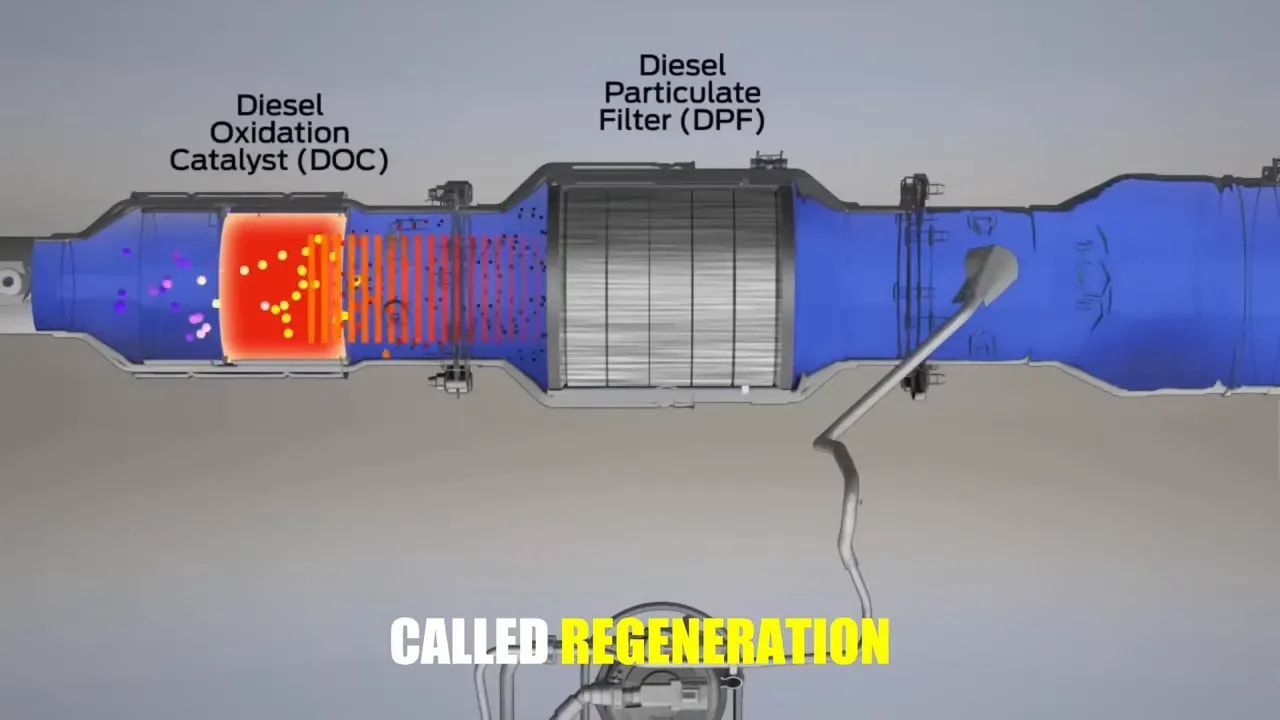
Frequent short trips can make regeneration difficult because the exhaust may not stay hot enough for long enough. Repeated incomplete regeneration can contribute to clogging, warning lights, reduced performance, and limp mode.
That explains why an otherwise useful emissions device can become a recurring frustration for someone who mainly uses a diesel for short urban commutes.
DPF delete vs. EGR delete vs. DEF delete
These terms describe different modifications, although owners sometimes combine them.
| Modification | System affected | What the original system does |
|---|---|---|
| DPF delete | Diesel particulate filter | Captures soot and particulate matter from exhaust. |
| EGR delete | Exhaust gas recirculation | Returns some exhaust to the intake to lower combustion temperatures and help control nitrogen oxide emissions. |
| DEF delete | Diesel exhaust fluid injection system | Supports exhaust treatment that reduces nitrogen oxide emissions. |
Removing one system does not necessarily mean the others have been removed. When assessing a modified vehicle, the specific equipment affected matters more than the general label “deleted diesel.”
Is a DPF Delete Legal?
Removing required diesel emissions equipment is generally prohibited for public-road use in places including the United States, Canada, the United Kingdom, the European Union, Australia, and New Zealand. Exact rules, inspection procedures, and enforcement vary by jurisdiction.
Possible consequences include:
- Failed emissions or roadworthiness inspections.
- Difficulty renewing registration where passing an inspection is required.
- Financial penalties for emissions tampering or operating a noncompliant vehicle.
Less frequent enforcement does not make a modification legal. Nor does an ECU calibration that suppresses fault codes establish emissions compliance.
Does off-road-only use make a delete permissible?
A vehicle used exclusively for competition, private-property work, or off-road recreation may fall under different rules. However, off-road use should not be treated as an automatic exemption. Whether a modification is permissible depends on the applicable rules and the vehicle’s status.
If an off-road-only exception applies, driving the vehicle on public roads, even briefly to refuel, is not consistent with that restriction. Documentation of its exclusive off-road use may also be necessary.
Before relying on any exemption, confirm the requirements with the relevant regulatory authority rather than assuming that a farm, competition, or recreational use label is sufficient.
Why Owners Consider a DPF Delete
The appeal usually comes from a combination of repair costs and reported operating improvements. Those motivations are understandable, but reported benefits need to be separated from guaranteed results.
Reported fuel economy improvements
Owner reports commonly describe gains of around 2 to 4 miles per gallon after a delete combined with tuning, with some reporting as much as 5 MPG during highway driving.
The explanations usually offered are the removal of fuel-consuming regeneration cycles and reduced exhaust restriction. However, these figures are not a guaranteed outcome for every engine or driving pattern, and they should not be treated as a verified universal average.
For context, an increase from 35 to 37 or 38 MPG means less fuel used over the same distance. A larger diesel moving from 20 to 23 or 24 MPG would show a more noticeable proportional improvement. These are illustrations of the reported changes, not predictions for a particular vehicle.
Power, torque, and responsiveness
Owners may report stronger acceleration, quicker turbo response, and easier-feeling towing or hauling. But the delete itself and the accompanying tune are not the same thing.
Much of the performance change comes from ECU adjustments to fuel delivery and boost, alongside any reduction in exhaust restriction. Removing the filter alone does not establish how much power a vehicle will gain.
Lower reported exhaust gas temperatures
Some owners report exhaust gas temperature, or EGT, reductions of approximately 150 to 250°F. Lower exhaust temperatures can reduce thermal stress, which is particularly relevant to vehicles that regularly work under heavy loads.
Still, an owner-reported temperature reduction is not proof that every deleted engine will run cooler or last longer. The calibration and operating conditions matter, and a reported EGT improvement should not be turned into a blanket reliability promise.
Avoiding emissions-system repairs
A clogged DPF that can no longer regenerate may cost $2,000 to $4,000 or more to replace. Other expensive problems can include cracked or leaking EGR coolers and failed DEF-system sensors or injectors.
Removing a component eliminates future failures of that removed component. It does not eliminate other engine or drivetrain problems, and it introduces legal and ownership risks that a repair bill alone does not capture.
Ending regeneration interruptions
Without a DPF, there is no DPF regeneration cycle. That is especially appealing to owners dealing with repeated regeneration attempts during short-trip driving.
However, removing the system bypasses the emissions function rather than making the vehicle’s original system work correctly. For a road vehicle, addressing the cause of repeated regeneration problems is the more practical starting point.
What Does a DPF Delete Cost?
Commonly quoted costs place a complete delete with tuning at roughly $1,500 to $3,000 for many diesel cars and SUVs. Custom ECU calibration alone may account for about $500 to $1,500.
These are broad estimates, not vehicle-specific quotes. They should not be assumed to apply to every diesel pickup or to every combination of DPF, EGR, and DEF modifications.
| Option | Approximate cost | Important distinction |
|---|---|---|
| Professional DPF cleaning | $300 to $600 | Retains the filter and may restore performance. |
| DPF replacement | $2,000 to $4,000 or more | Retains the required emissions function. |
| Custom delete-related ECU calibration | $500 to $1,500 | Software cost, separate from hardware expenses. |
| Complete delete with tuning | $1,500 to $3,000 for many cars and SUVs | Does not include potential legal, warranty, servicing, or resale consequences. |
The modification price is not the total ownership cost. Any claimed savings need to be considered alongside inspection restrictions, reduced warranty protection, and a potentially smaller resale market.
The Downsides Beyond the Purchase Price
Warranty coverage can be jeopardized
Deleting emissions equipment and changing engine software creates a serious risk to warranty coverage, particularly for affected emissions and powertrain claims. Major engine or transmission repairs can exceed $10,000, depending on the failure.
The exact scope of a warranty denial depends on the warranty terms, the claim, and applicable law. It is more accurate to treat a delete as a substantial coverage risk than to assume that every unrelated part of a vehicle’s warranty automatically disappears.
Resale and trade-in options can shrink
Many buyers do not want a vehicle with emissions-compliance complications. Some dealers may refuse a deleted vehicle as a trade-in, limiting the pool of potential buyers and putting pressure on resale value.
An enthusiast’s willingness to buy a modified diesel does not remove its road-use restrictions.
Finding service may become harder
Some repair shops decline work on deleted vehicles because of regulatory concerns. That can make routine ownership less convenient, particularly when an owner needs support away from a familiar shop.
Emissions increase
Removing the DPF allows substantially more soot and particulate matter into the exhaust. Removing EGR and DEF-related emissions controls increases nitrogen oxide emissions.
These systems address different pollutants. Better reported MPG does not mean a deleted diesel produces cleaner exhaust, and improved performance does not replace the pollution-control function of the missing equipment.
Why Removing the Filter Without Software Changes Can Cause Problems
The factory ECU expects the emissions equipment to be present and operating. Removing hardware without corresponding calibration changes can trigger:
- Check-engine lights and fault codes.
- Limp mode or restricted performance.
- Poor fuel economy.
- Rough running.
This explains why advertised delete packages often include tuning. It does not make those packages road legal. Suppressing an emissions-related warning is different from fixing the underlying system or meeting emissions requirements.
Legal Alternatives to a DPF Delete
Modern diesels are designed to deliver useful power and efficiency with their emissions equipment installed. For a road-going vehicle, consider the following options before treating removal as the answer.
1. Establish why regeneration keeps failing
Review the vehicle’s driving pattern and have recurring warnings assessed. Frequent short journeys may prevent regeneration from completing, but driving habits should not automatically be assumed to explain every DPF problem.
A useful starting checklist is:
- Is the vehicle mainly used for short commutes or city trips?
- Are regeneration attempts repeatedly interrupted?
- Have persistent warning lights or limp-mode events been investigated?
- Has cleaning been assessed before replacement is recommended?
2. Give regeneration an opportunity to complete
Regular longer highway journeys can help the exhaust reach conditions suitable for regeneration. For a vehicle mainly used on short trips, a longer drive once a week may help.
Use the vehicle manufacturer’s instructions rather than assuming one driving routine suits every diesel. A longer journey is not a guaranteed cure for a filter that is already severely clogged or unable to regenerate.
3. Keep maintenance appropriate to the engine
Use the correct diesel-rated oil, maintain regular oil changes, and use quality diesel fuel. Maintenance and suitable driving conditions are part of keeping the original emissions system functioning, not just measures to take after warning lights appear.
4. Ask about professional DPF cleaning
Professional cleaning can remove accumulated deposits while retaining the filter. At approximately $300 to $600, it may be substantially less expensive than replacement and can restore performance when cleaning is suitable for the filter’s condition.
Ask the repair provider whether cleaning is appropriate and what needs to change to prevent the same problem from returning.
5. Choose emissions-compliant performance options
Some manufacturers offer performance tuning that works with factory emissions equipment. Exhaust upgrades designed to retain those systems may also reduce some restriction without deleting the filter.
Confirm that the specific tune or exhaust is compliant for the vehicle and jurisdiction. Keeping the equipment physically installed is not, by itself, a guarantee that every modification is legal.
6. Reconsider a diesel for predominantly short trips
If most journeys are brief urban commutes, a petrol vehicle may be a better fit. Some owners use petrol for daily short trips and reserve their diesel for longer journeys.
This addresses the mismatch between the vehicle’s use and its regeneration needs rather than repeatedly paying to manage the same symptoms.
Is a DPF Delete Worth It?
Reported fuel savings, stronger performance, and avoiding certain repairs explain why diesel deletes remain popular. But those benefits do not remove the legal restrictions or the costs associated with warranty risk, increased emissions, servicing difficulties, and resale limitations.
For a diesel used on public roads, diagnosis, suitable maintenance, professional cleaning, and verified emissions-compliant upgrades are the better starting points. Compare those options using vehicle-specific quotes and local requirements, not just another owner’s MPG claim.