
Keeping a diesel engine healthy involves more than changing its oil. The oil specification, fuel filtration, cold-start routine, turbo cooldown, and response to a diesel particulate filter warning all affect components that can be expensive to repair.
The most useful preventive habits are straightforward: use the exact approved oil, maintain the fuel filter, refuel before the tank is nearly empty, drive gently while the engine warms up, and respond promptly to DPF warnings.
These principles are especially relevant to modern common-rail diesels equipped with a turbocharger and diesel particulate filter. Exact oil approvals, service intervals, and regeneration procedures vary by vehicle, so the owner’s handbook should guide the details.
Key Takeaways
- Match engine oil to the exact required approval, not just its viscosity grade.
- Respond promptly to DPF warnings because delayed action can make regeneration unavailable.
- Maintain fuel filtration and refuel early to protect the diesel’s precision fuel system.
- Use gentle cold-start driving and a suitable cooldown after demanding turbo use.
Table of Contents
- 1. Choosing Diesel Engine Oil by Viscosity Alone
- 2. Treating a DPF Warning Light as Something That Can Wait
- 3. Skipping the Diesel Fuel Filter and Water Separator
- 4. Regularly Driving With the Fuel Tank Almost Empty
- 5. Revving or Heavily Loading a Cold Diesel
- 6. Switching Off Immediately After Hard Turbo Use
- A Simple Diesel Maintenance Routine
1. Choosing Diesel Engine Oil by Viscosity Alone
An oil labeled 5W-30 is not automatically suitable for every diesel that requires that viscosity. Viscosity and manufacturer approval are separate requirements. The first describes the oil’s viscosity grade; the second identifies whether it meets the engine’s specified requirements.
For a diesel fitted with a DPF, the oil’s ash-forming additive content also matters. DPF-compatible oils use controlled levels of SAPS, meaning sulfated ash, phosphorus, and sulfur, to limit deposits in the exhaust aftertreatment system.
Why the wrong oil can shorten DPF life
A small amount of engine oil can enter the combustion process and eventually reach the exhaust. When that oil burns, some additives leave an ash residue that collects in the DPF.
This creates an important distinction:
- Soot is carbon-based material that regeneration can burn off.
- Ash is a noncombustible residue that regeneration cannot remove.
Using an unsuitable oil can accelerate ash accumulation. A longer drive or a forced regeneration cannot reverse that buildup. A filter with excessive deposits may need specialist off-car cleaning or replacement, depending on its condition. Ash remaining after regeneration does not, by itself, mean every filter is beyond specialist cleaning.
How to check the correct oil specification
- Find the oil requirements in the handbook. Note both the viscosity grade and the exact approval or specification.
- Check the bottle. Do not rely only on descriptions such as “diesel oil,” “fully synthetic,” or “low ash.”
- Verify the oil before a service. Ask the workshop which specification it intends to use.
- Apply the same check to top-ups. Oil added between services still enters the same engine and exhaust system.
- Keep the specification in your service records. This makes future checks easier.
Examples of approvals used by some diesel vehicles include VW 507 00, BMW Longlife-04, and Mercedes-Benz 229.51. ACEA C-category specifications, such as ACEA C3, are also relevant to certain applications. These are examples, not interchangeable recommendations. Use the requirement for your particular engine.
The common mistake is buying the right-looking viscosity while overlooking the approval printed elsewhere on the label.
2. Treating a DPF Warning Light as Something That Can Wait
The diesel particulate filter traps soot from the exhaust. Regeneration removes that soot by burning it off under suitable operating conditions.
Repeated short journeys can make it difficult for the vehicle to complete regeneration. If soot continues to accumulate, the response may progress from a warning light to restricted power and a repair that requires workshop intervention.

What to do when the DPF light comes on
Check the handbook and act promptly, rather than continuing your normal short-trip routine. If the vehicle’s instructions call for a regeneration drive and its condition allows one, follow that procedure.
For some vehicles, this involves a sustained drive of around 20 minutes at suitable road speeds. That is a general example, not a universal instruction. The required conditions depend on the vehicle.
| DPF condition | What it may mean | Appropriate response |
|---|---|---|
| Initial DPF warning | Soot loading has reached a level requiring attention. | Check and follow the handbook’s regeneration instructions promptly. |
| Persistent warning or reduced power | The vehicle may no longer permit normal regeneration. | Arrange workshop assessment rather than repeatedly attempting a clearing drive. |
| Excessive loading | Regeneration may no longer be safe or effective. | The filter may require off-car cleaning or replacement. |
A workshop may be able to perform a forced regeneration, but only if the filter’s condition allows it. Continuing to ignore the warning can turn a manageable soot problem into a much more expensive repair.
DPF replacement can reach roughly $1,500 to $4,000 in the examples discussed here, although actual costs depend on the vehicle and repair scope. Excessive exhaust back pressure can also put the turbocharger at risk.
Do not confuse soot loading with ash accumulation
A regeneration drive addresses soot. It does not remove oil-derived ash. That is why correct oil selection and prompt DPF attention are complementary maintenance habits, not substitutes for each other.
3. Skipping the Diesel Fuel Filter and Water Separator
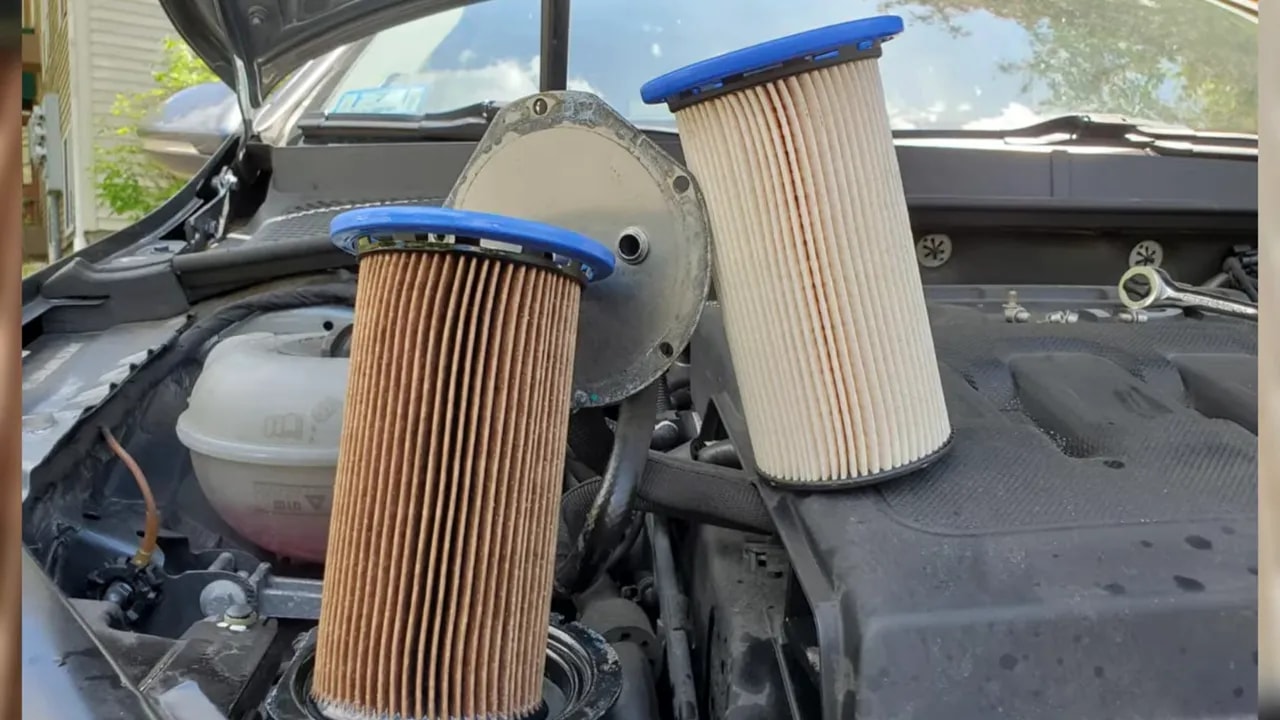
Common-rail diesel injection systems operate at extremely high pressures and use precision components. Dirt and water can damage the high-pressure pump and injectors, making fuel filtration an essential service item.
The fuel filter removes contaminants. Many diesels also have a water separator, sometimes with a manual drain, that requires attention according to the vehicle’s maintenance instructions.
Why filter neglect can become expensive
- A clogged filter can restrict fuel supply to the high-pressure pump.
- Water can cause corrosion in precision fuel-system components.
- Water contamination can compromise lubrication, because the pump depends on diesel fuel for lubrication.
Injector replacement can cost thousands. A high-pressure pump failure can be more extensive if it sends metal debris through the rest of the fuel system.
A practical fuel-filter maintenance checklist
- Find the replacement interval in the handbook or service schedule.
- Confirm that fuel-filter replacement appears in the service history.
- Check whether the vehicle has a water separator or manual drain.
- Follow the specified draining procedure rather than guessing how the system works.
Do not assume that an oil service also included the fuel filter. They are separate maintenance items, and the service record should make that distinction clear.
4. Regularly Driving With the Fuel Tank Almost Empty
Making a habit of driving past the fuel warning light leaves little margin before the diesel’s fuel supply becomes inadequate or the tank runs dry.
Diesel fuel helps lubricate and cool the high-pressure pump. If the pump loses an adequate fuel supply, the consequences can be much more serious than simply needing a refill.
Why a pump failure can affect the whole fuel system
Some high-pressure pump failures release metal particles into the fuel system. In that situation, replacing the pump alone may not solve the problem. The injectors, rail, lines, and sometimes the tank may also need cleaning or replacement.
Contamination is another reason to maintain the fuel filter properly. However, a low gauge reading should not be treated as proof that the pump is already damaged. The practical goal is to avoid fuel starvation and running out altogether.
What happens if a diesel runs out of fuel?
Air can enter the fuel system. Depending on the model, adding fuel may not be enough to restart it immediately. The system may require priming or bleeding, and some situations require recovery assistance.
Use a quarter tank as a conservative refueling trigger. It is a simple habit that reduces the temptation to gamble on the remaining range. It is not a guarantee against pump failure, but it gives you a useful buffer before empty.
5. Revving or Heavily Loading a Cold Diesel
Hard acceleration immediately after a cold start asks the engine and turbocharger to work heavily before they have warmed up. Cold oil is more viscous, and the engine is still establishing its normal operating conditions.
Diesels can produce substantial torque at low engine speeds. That means a modest RPM reading does not necessarily indicate gentle treatment: pressing the accelerator hard can place a large load on a cold engine even without high revs.
How to warm up a diesel engine
- Start the engine and allow a brief settling period, around 30 seconds as a general routine.
- Move off gently rather than repeatedly blipping the throttle.
- Keep engine speed and accelerator demand modest during the initial warm-up.
- Avoid hard acceleration until the engine has warmed up.
Follow any vehicle-specific cold-start instructions, particularly where the handbook gives different guidance.
The aim is gentle driving, not extended stationary idling or aggressive revving. Driving warms the engine while allowing you to limit the load.
Cold operation also encourages less complete combustion, which can produce additional soot. Fuel entering the engine oil during cold operation is another reason not to make repeated cold, heavily loaded running a habit.
6. Switching Off Immediately After Hard Turbo Use
A turbocharger uses engine oil to lubricate its bearings and carry heat away. After sustained high-load driving, such as a long hill climb or a hard motorway run, the turbo can retain considerable heat.
Switching off stops the engine-driven oil supply. Under sufficiently hot conditions, oil left in the turbo can form hard carbon deposits, a process often called coking. Those deposits can restrict passages and contribute to bearing wear.
Give the turbo a gentler end to the journey
Two practical options are:
- Drive gently for the last few minutes before parking.
- Allow a short idle period after a hard run, typically around 30 seconds to one minute, subject to the manufacturer’s guidance.
This does not mean every ordinary journey requires prolonged idling. The concern is shutting down immediately after substantial load, especially when the engine has been worked hard right up to the stopping point.
Water cooling on some modern turbochargers helps manage heat after shutdown, but it does not make the vehicle’s operating guidance irrelevant.
Turbo replacements can cost roughly $1,500 to $3,000 in the examples discussed here. Actual bills vary, but a gentle finish to a demanding journey costs little and avoids unnecessary thermal stress.
A Simple Diesel Maintenance Routine
The six mistakes become easier to avoid when the precautions are attached to things you already do.
| When | What to do |
|---|---|
| Before buying oil or booking an oil change | Verify the viscosity and exact manufacturer approval. |
| At a cold start | Allow a brief settling period, then drive gently. |
| After a demanding journey | Finish gently or use the recommended short cooldown. |
| At scheduled servicing | Check the fuel-filter interval and water-separator requirements. |
| When fuel approaches a quarter tank | Plan the next refueling stop. |
| When the DPF warning appears | Check the handbook and respond promptly. |
These habits reduce avoidable risks; they do not guarantee that a diesel will never fail. The useful distinction is between problems you cannot predict and maintenance or driving choices you can control.
Start with the service history and handbook: confirm the oil specification, check when the fuel filter was last replaced, and learn the correct response to your vehicle’s DPF warning before it appears.