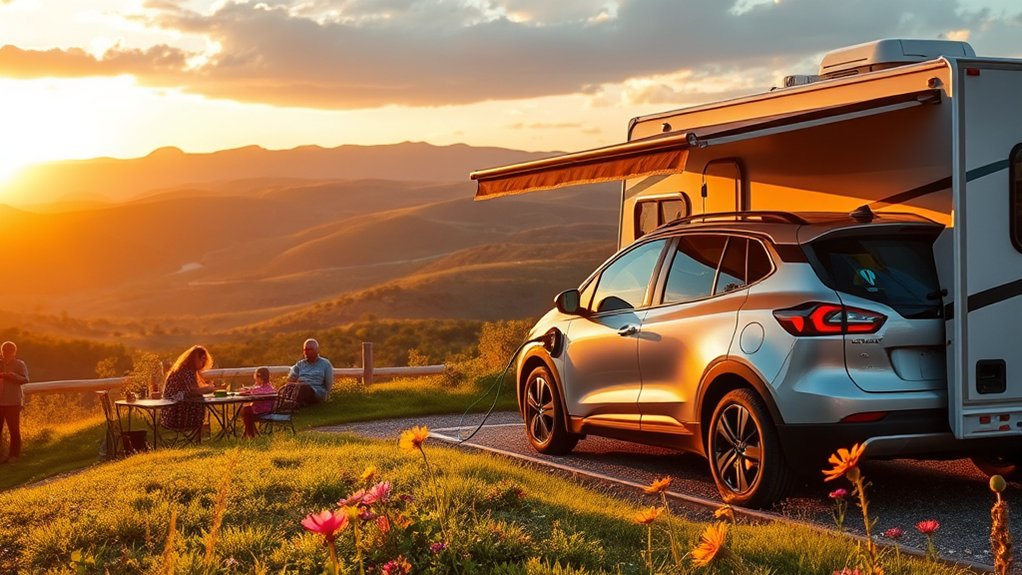
Charging an EV at an RV park can work well, especially on a road trip through areas with fewer public chargers. The key is to treat the campground pedestal as shared electrical infrastructure, not as a guaranteed public charging station. Before you book, confirm the park’s EV policy, the exact outlet at your site, any charging fee, and whether your portable charger and adapters are approved for that use.
Quick Answer
Yes, you can charge an EV at some RV parks, but only if the park allows it and your site has a compatible outlet. A 240-volt NEMA 14-50 outlet is usually the best RV-site option, while 120-volt outlets are much slower. Always ask first, bring approved equipment, and lower the amperage if needed.
Key Takeaways
- Call before booking because RV park EV charging policies vary from fully allowed to prohibited.
- A 50-amp NEMA 14-50 outlet is the most useful campsite outlet for EV charging, but your EVSE and vehicle may limit the actual current.
- A 30-amp TT-30 RV outlet is 120 volts, not 240 volts, so it is much slower and needs the right EVSE setup.
- Avoid extension cords unless your charger manual and the park both allow one, and the cord is outdoor-rated, short, uncoiled, and properly sized.
- Campsite EV charging is still uncommon industry-wide, so confirm the policy for your specific dates and keep a public charging backup in your route plan.
- Use RV-specific policy tools, EV charging apps, and a backup DC fast charger plan before arriving with a low battery.
At a Glance
| Time Required | Usually overnight for a meaningful charge at an RV site; much longer on 120-volt outlets. |
| Difficulty | Easy if the park allows EV charging and you have the right portable EVSE and adapter. |
| Tools Needed | Portable EVSE, vehicle-approved adapters, charging app, flashlight, and your vehicle owner’s manual or app-based amperage controls. |
| Cost | Varies by park. Some include power in the site fee, others charge a flat $5–$15 per night, meter the electricity separately, or don’t allow EV charging at all. |
Understanding EV Charging Options at RV Parks
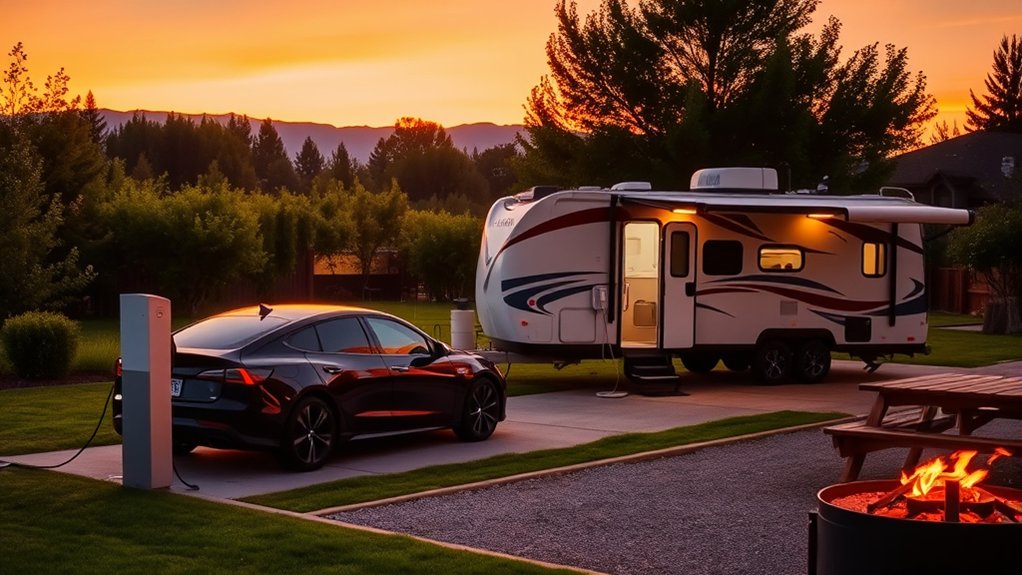
RV parks can be useful charging stops because many campsites already have electrical pedestals. Still, a pedestal is designed first for RVs. Your EV charging plan should respect the park’s rules, the site’s wiring, and the load other campers may be placing on the same electrical system.
According to the U.S. Department of Energy Alternative Fuels Data Center, AC Level 1 charging uses 120 volts and adds about 5 miles of range per hour, while AC Level 2 charging uses 240 volts or 208 volts and is often around 25 miles of range per hour for a typical EV. A 50-amp RV outlet can be useful because it may support Level 2 charging, but your vehicle, portable EVSE, adapter, and amperage setting determine the real charging speed.
Note: “50 amp” describes the RV pedestal circuit, not a promise that your EV can or should pull 50 amps continuously. Many portable chargers draw less. For example, Tesla’s current Mobile Connector with a NEMA 14-50 adapter lists a maximum 32-amp output and model-dependent speeds up to about 30 miles of range per hour.
Common RV Park Outlets for EV Charging
Before you reserve a site, ask which outlet type is available. These are the most common options you may hear about:
- NEMA 14-50, 240-volt, 50-amp RV outlet: Usually the best campsite outlet for EV charging. With a compatible portable EVSE, it can often add roughly 20 to 30 miles of range per hour, depending on the vehicle and amperage limit.
- TT-30, 120-volt, 30-amp RV outlet: Common at older or smaller RV sites. This is not a 240-volt outlet. It can work only with compatible equipment and proper current limits, and charging will be much slower.
- NEMA 5-15 or 5-20 household-style outlet: Useful only as a slow backup. Expect Level 1 charging speeds, often just a few miles of range per hour.
- Dedicated Level 2 charging station: Some parks now offer a charger separate from the campsite pedestal. This may be easier, safer, and billed through an app or flat fee.
Even with the right equipment, don’t assume every campground will say yes. Independent directories that track verified RV park EV policies, such as Camp and Charge, report that parks allowing direct campsite charging are still a small share of listings, while a growing number instead offer a separate paid station or prohibit EV charging outright. Treat any RV park as a possible campground EV charging stop, not a guaranteed one, until the park confirms its policy for your dates.
Warning: Do not force adapters together, use a damaged pedestal, run a cord through water, or charge if the plug, outlet, or cable feels hot. Stop charging and contact park staff if a breaker trips repeatedly, you smell heat, or the connector does not fit securely.
What to Ask Before Charging Your EV
The best time to solve charging questions is before you arrive. Some parks welcome EVs, some allow charging only at certain sites, some charge extra, and some do not allow campsite charging because of electrical capacity or billing concerns.
Charging Policy Inquiry
Call or message the park and ask direct questions. Do not rely only on the phrase “50-amp site” in the booking screen.
| Question to Ask | Why It Matters |
| Do you allow EV charging at campsites? | A 50-amp site does not automatically mean EV charging is permitted. |
| Is the site NEMA 14-50, TT-30, or household-style? | The outlet type controls which adapter and charging speed you can safely use. |
| Is there an EV charging fee? | Fees may be included, flat-rate, metered, or billed through a dedicated charging station. |
| Can I reserve a 50-amp site? | Some parks have limited 50-amp sites, especially during peak season. |
| Are extension cords or adapters restricted? | Park rules may prohibit them, and your EVSE manual may also restrict them. |
Outlet Compatibility Check
Check your portable EVSE before the trip. Make sure it supports the outlet you plan to use and that every adapter is approved for your vehicle and charger. If you drive a Tesla, the Tesla Mobile Connector support page lists supported adapters and estimated speeds. If you drive another EV, use your vehicle manufacturer’s charging guide and the charger manufacturer’s manual.
Be especially careful with TT-30 outlets. They are common at RV parks, but they are 120-volt outlets. A TT-30 plug should not be treated like a 240-volt dryer outlet. Use only equipment designed for that outlet and set the correct amperage limit.
Additional Fees Assessment
Ask how the park handles electricity costs. Some parks include power in the nightly site fee. Others add a flat EV charging fee, require a premium site, bill monthly guests for metered electricity, or direct EV drivers to a paid Level 2 station.
Based on data from RV park directories that track EV policies, flat charging fees commonly fall in the $5 to $15 per night range, and a growing share of parks now meter the pedestal and bill for actual electricity used instead of charging a flat rate. A few parks even let non-guests use a vacant electrical site for a short window, such as one hour, for a small fee. None of this is universal, so always confirm the specific number before you plug in.
Get the policy in writing when possible, especially for late arrivals. A note in your reservation can prevent confusion at check-in.
Essential Equipment for Safe Charging
Bring your own charging equipment unless the park confirms it has a dedicated charging station. At minimum, you should know your vehicle’s connector type, your portable EVSE limits, and how to lower charging current from your vehicle screen or mobile app.
Necessary Charging Cables
For most EV owners, the core equipment is a portable EVSE, not just a cable. The EVSE communicates with the car and controls the charging current. Your kit may include:
- A portable Level 1/Level 2 EVSE approved for your vehicle.
- A NEMA 14-50 adapter if you plan to use a 50-amp RV site.
- A standard 120-volt adapter for emergency slow charging.
- Vehicle-approved adapters for your specific EV brand and connector type.
- A weather-safe storage bag to keep adapters clean and dry.
Pro Tip: Test your portable charger and adapters at home before a long trip. It is much easier to solve a missing adapter or app setting in your driveway than at a campground with low battery.
Safety Equipment Inspection
Inspect your EVSE, plug, adapters, and cable before every trip. Do not use equipment with cracked plastic, bent prongs, corrosion, loose connections, burn marks, or exposed wiring.
Also inspect the campsite pedestal before plugging in. The receptacle should be secure, dry, and undamaged. If the cover is broken, the outlet is loose, or the pedestal looks overheated, ask for another site or use a public charger instead.
For a safer equipment choice, consider a charger that is safety-listed and properly rated. The ENERGY STAR certified EV charger product finder can help you compare certified Level 2 charging equipment.
How to Charge an EV at an RV Campsite
Once the park has approved EV charging, follow a simple process. This reduces the chance of tripped breakers, overheating, or a dispute over electricity use.
- Confirm permission at check-in. Ask staff to confirm your site number, outlet type, charging fee, and any amperage limit.
- Park close enough for the EVSE cord to reach without strain. Keep the cord out of drive lanes, puddles, and walking paths.
- Inspect the pedestal and your equipment. Do not plug in if anything looks damaged or wet.
- Connect the adapter to the EVSE first if your charger manual instructs that order. Follow your charger’s sequence exactly.
- Set a safe current limit. If the park asks you to limit amperage, set that limit before charging starts.
- Start charging and watch the first few minutes. Confirm the vehicle is charging normally and no breaker trips.
- Check for heat after 15 to 30 minutes. The plug and cable should not feel hot. Warm can be normal; hot is a warning sign.
- Stop at the charge level you need. For daily use, many EVs do best below 100%, but follow your owner’s manual. Use 100% before a long driving day only when needed.
- Unplug cleanly and store equipment dry. Leave the pedestal closed and the site safe for the next guest.
Effective Power Management Strategies for EV Charging
RV parks may have older wiring, shared electrical loads, and peak evening demand from air conditioners, water heaters, and other RV appliances. Your EV can draw power for hours, so managing current matters.
- Use a lower amperage when needed: If the park requests a limit or the breaker trips, lower the charging current from your vehicle or charger app.
- Charge overnight when demand is lower: Late evening through early morning is often easier on the park’s electrical system.
- Do not share one pedestal with an RV unless the park approves it: Running an RV and EV from the same pedestal can overload the site.
- Avoid coiled cords: A coiled cord can trap heat. Lay the EVSE cable out safely and loosely.
- Do not bypass safety controls: Never defeat ground protection, use a damaged adapter, or force an outlet that does not match.
Warning: Avoid extension cords for EV charging unless your EVSE manual and the RV park both allow one. If one is allowed, it must be outdoor-rated, properly sized for the current, fully uncoiled, as short as practical, and free of damage.
Ensure a Positive Charging Experience
Good charging etiquette helps EV drivers and RV parks get along. Ask before plugging in, follow the park’s fee policy, and do not assume staff will understand every EV adapter or current setting.
The safest RV park charging plan is simple: ask first, use approved equipment, limit current when needed, and stop immediately if anything overheats or trips repeatedly.
If the park offers a dedicated EV station, use it instead of a campsite pedestal when practical. A dedicated station is usually easier for billing, safer for the park’s electrical planning, and less likely to interfere with RV guests.
If you are staying multiple nights, tell the park how often you plan to charge. Long stays may be handled differently from one-night overnight charging, especially when electricity is metered separately.
Plan Your EV-Friendly Charging Road Trip
Do not make an RV park your only charging option unless you have confirmed the policy and outlet. Treat it as one part of a route plan.
- Use Camp and Charge to check RV parks with source-backed EV charging policies.
- Use PlugShare to review nearby public charging options and recent check-ins.
- Use your vehicle’s built-in route planner for battery preconditioning and charger arrival estimates when supported.
- Pick a backup DC fast charger within a comfortable range of the campground.
- Arrive with enough battery to leave if the pedestal is unavailable, damaged, or not approved for EV charging.
- Reserve early during holidays and peak travel seasons because 50-amp sites can sell out.
When towing with an electric truck or SUV, be more conservative. Towing can reduce range sharply, and campsite charging may not recover a large battery as quickly as a DC fast charger. Plan shorter driving days or longer overnight stops when needed.
Troubleshooting Common RV Park Charging Problems
If charging does not go as planned, use the safest fix first. Do not keep restarting a failed session without understanding why it stopped.
Breaker Trips When Charging Starts
Lower the amperage and try once more if the park allows it. If the breaker trips again, stop and contact park staff. Repeated breaker trips can point to overloaded circuits, pedestal problems, or incompatible equipment.
Charging Stops and Won’t Restart
Newer RV park pedestals are increasingly wired with ground-fault (GFCI) protected NEMA 14-50 outlets to meet updated electrical codes. Because most portable EVSEs already include their own built-in ground-fault protection, running both protections on the same circuit can occasionally cause the outlet to trip even though nothing is actually wrong with your vehicle or the site wiring. If this happens, reset the outlet once and try again. If it keeps happening, ask park staff whether a different pedestal or a non-GFCI-protected outlet is available, and never disable or bypass any ground-fault protection yourself.
Charging Is Much Slower Than Expected
Check the outlet type. A 120-volt outlet will be much slower than a 240-volt NEMA 14-50 outlet. Also check whether your vehicle or EVSE has automatically reduced current because of heat, voltage drop, or settings.
Plug or Adapter Feels Hot
Stop charging. Warmth can happen, but a hot plug, burning smell, discoloration, or soft plastic is not normal. Unplug only if it is safe to do so, then notify park staff.
Park Says EV Charging Is Not Allowed
Respect the policy. Ask whether the park has a dedicated EV station, then use a nearby public charger. Ignoring the rule can create safety concerns and may result in fees or removal from the park.
Frequently Asked Questions
How do you charge an EV at an RV campsite?
First, confirm the park allows EV charging. Reserve a compatible site, usually a 50-amp NEMA 14-50 site if available. Bring your portable EVSE and approved adapter, inspect the pedestal, set a safe current limit, start charging, and check the plug for heat during the first part of the session.
What is the 80/20 rule for EV charging?
The 80/20 rule is a common habit of keeping the battery roughly between 20% and 80% for routine driving. It can reduce time spent charging and may support battery health. It is not a universal law, though. Follow your vehicle owner’s manual, and charge to 100% before a long travel day when you need the range.
What is the 10-year rule at RV parks?
The 10-year rule is a policy some RV parks use to restrict older RVs, usually for appearance, safety, or maintenance reasons. It is not directly an EV charging rule, but it is another example of why you should read park rules before booking. Policies vary by park.
Should you charge your EV to 80% or 100% at an RV park?
For routine driving, many EV owners stop around 80% or 90% because charging slows near the top and full-charge storage may not be ideal for some batteries. For a long travel day, charging to 100% can make sense. Follow your vehicle’s battery guidance, especially if your EV has an LFP battery with different recommendations.
Can you charge an EV from a 30-amp RV outlet?
Sometimes, but only with compatible equipment and the right current limit. Many 30-amp RV outlets are TT-30 outlets, which are 120 volts. They are much slower than a 240-volt NEMA 14-50 outlet and should not be used with the wrong adapter.
Do RV parks charge extra for EV charging?
Some do and some do not. A park may include electricity in the site fee, charge a flat EV fee, require a premium 50-amp site, bill metered electricity, or prohibit campsite charging. Ask before booking and request that the policy be added to your reservation notes.
Do all RV parks allow EV charging at the pedestal?
No. Campsite EV charging is still a minority policy across RV parks. Many parks instead offer a separate paid Level 2 station, and some prohibit charging at the site altogether. Call ahead and confirm the policy for your dates rather than assuming a 50-amp site means EV charging is welcome.
Why does my EV keep stopping charging at an RV park pedestal?
This is often a ground-fault (GFCI) nuisance trip, not a real fault. Many EVSEs already have built-in ground-fault protection, and pairing that with a GFCI-protected pedestal outlet can cause the circuit to trip even when everything is working correctly. Reset once, and if it keeps happening, ask staff about a different outlet rather than bypassing any safety protection.
Conclusion
EV charging at RV parks can be convenient, but it is not automatic, and it is still the exception rather than the rule at most campgrounds. Confirm the park’s policy, reserve the right outlet, ask about fees, use approved charging equipment, and manage your amperage carefully. A 50-amp NEMA 14-50 site is usually the most practical campsite option, while 120-volt outlets are slow backups. With a confirmed reservation, safe equipment, and a backup charger nearby, an RV park can become a useful overnight charging stop instead of a stressful gamble.
Sources
- U.S. Department of Energy Alternative Fuels Data Center: Electric Vehicle Charging Stations — charging levels, charging-speed benchmarks, EVSE terminology, and station planning.
- Tesla Mobile Connector Support — NEMA 14-50 adapter output and model-dependent portable charging estimates.
- ENERGY STAR Certified EV Chargers Product Finder — certified Level 2 charger reference.
- Camp and Charge — RV park EV charging policy directory, campsite charging categories, and typical fee data.
- PlugShare — public charging map and user check-ins for route backup planning.