
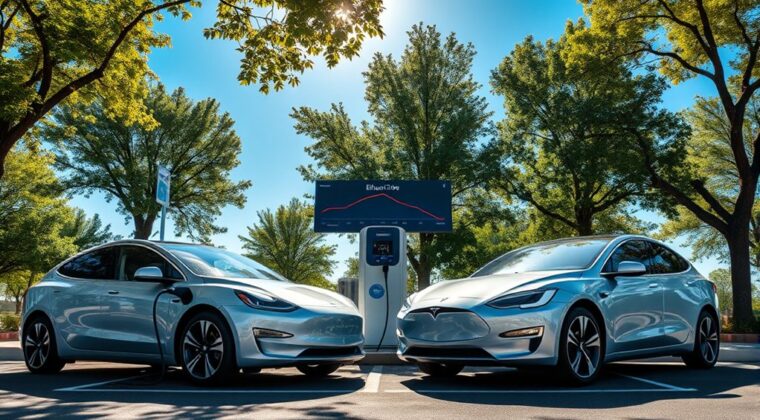
Switching to an electric vehicle can lower your fuel costs, but the exact savings depend on your electricity rate, the EV’s efficiency, gas prices, your current car’s MPG, and how often you use public fast charging. For many drivers who charge mostly at home, an EV costs much less per mile than a gas car. For drivers who rely heavily on paid DC fast charging, the savings can shrink.
Quick Answer
Home charging is usually cheaper than gasoline. Using a typical EV efficiency of 30 kWh per 100 miles and the U.S. residential electricity average of 18.83 cents per kWh, charging costs about 5.6 cents per mile. At $3.777 per gallon, a 30-mpg gas car costs about 12.6 cents per mile.
Key Takeaways
- EV savings are strongest when you charge at home, drive a lot, and replace a low-MPG gas vehicle.
- Use this formula for EVs: kWh per 100 miles ÷ 100 × electricity price per kWh = cost per mile.
- Use this formula for gas cars: gas price per gallon ÷ MPG = cost per mile.
- Public DC fast charging is convenient, but it can cost much more than home charging.
- Federal EV tax-credit rules changed, so check current IRS, state, and utility incentives before buying.
At a Glance
| Time Required | 5 to 10 minutes to estimate your own EV vs gas cost |
| Difficulty | Easy |
| Tools Needed | Utility bill, EV efficiency rating, gas price, current car MPG, calculator |
| Cost | Free to calculate; actual savings depend on your local rates and vehicle |
Understanding EV Charging Costs vs. Gasoline Prices
When you compare EV charging costs with gasoline costs, the key number is not the price per gallon or the price per kWh by itself. The useful number is cost per mile.
Electric vehicles use electricity more efficiently than gasoline vehicles use fuel. FuelEconomy.gov explains that EVs convert more than 77% of electrical energy from the grid to power at the wheels, while gasoline vehicles convert only about 12% to 30% of gasoline energy to wheel power.
That efficiency is why an EV can still be cheaper to drive even when electricity is not especially cheap. The U.S. Energy Information Administration listed the U.S. residential electricity average at 18.83 cents per kWh for April 2026, while U.S. regular gasoline was $3.777 per gallon for the week of July 6, 2026.
A 30 kWh-per-100-miles EV at 18.83 cents per kWh costs about 5.6 cents per mile. A 30-mpg gas car at $3.777 per gallon costs about 12.6 cents per mile.
Those numbers are national examples, not a guarantee. Your actual result can be lower or higher based on your utility plan, weather, tire pressure, driving speed, charging losses, public charging use, and vehicle efficiency.
How Much Does It Cost to Charge an EV?
The easiest way to estimate EV charging cost is to use your EV’s efficiency rating and your electricity price. Most EV window stickers and listings show efficiency as kWh per 100 miles.
Use this formula:
EV cost per mile = kWh per 100 miles ÷ 100 × electricity price per kWh
For example, if your EV uses 30 kWh per 100 miles and your home electricity costs $0.1883 per kWh:
- 30 ÷ 100 = 0.30 kWh per mile
- 0.30 × $0.1883 = $0.056 per mile
- 12,000 miles × $0.056 = about $678 per year
Here is how the same EV changes at different electricity prices:
| Electricity Price | EV Efficiency | Cost Per Mile | 12,000-Mile Annual Cost |
|---|---|---|---|
| $0.12/kWh | 30 kWh/100 miles | 3.6 cents | $432 |
| $0.1883/kWh | 30 kWh/100 miles | 5.6 cents | $678 |
| $0.25/kWh | 30 kWh/100 miles | 7.5 cents | $900 |
| $0.35/kWh | 30 kWh/100 miles | 10.5 cents | $1,260 |
Note: EPA efficiency ratings already estimate energy use from the wall for many consumer comparisons, but real-world costs can change with weather, speed, charging losses, tire pressure, and battery preconditioning.
Current Gas Prices and Cost Per Mile
Gasoline costs are also simple to calculate. Divide the current gas price by your vehicle’s MPG.
Gas cost per mile = gas price per gallon ÷ MPG
Using the EIA’s U.S. regular gasoline price of $3.777 per gallon for July 6, 2026, here is how different gas vehicles compare:
| Gas Vehicle MPG | Cost Per Mile at $3.777/Gallon | 12,000-Mile Annual Fuel Cost |
|---|---|---|
| 25 MPG | 15.1 cents | $1,813 |
| 30 MPG | 12.6 cents | $1,511 |
| 40 MPG | 9.4 cents | $1,133 |
Regional Price Variability
Gasoline and electricity both vary by location. The EIA’s July 6, 2026 gasoline data showed regular gas at $3.343 per gallon on the Gulf Coast and $4.831 per gallon on the West Coast. The same kind of regional gap exists with electricity. In April 2026, EIA residential electricity data showed North Dakota at 12.35 cents per kWh, California at 35.25 cents per kWh, and Hawaii at 46.62 cents per kWh.
Because the spread is so wide, national averages are useful only as a starting point. Your local math matters more.
Calculating Your EV Costs: A Step-by-Step Guide
To calculate your real EV savings, compare your actual home electricity price with your current gas car’s MPG and your annual mileage.
Step 1: Check Your Electricity Rate
Look at your latest utility bill and find the price per kWh. Include delivery charges if your bill separates supply and delivery. If your utility offers time-of-use rates, check both peak and off-peak prices.
For EV owners, off-peak charging can make a major difference. Charging overnight may cost much less than charging during high-demand afternoon or evening hours.
Step 2: Find Your EV Efficiency
Find the EV’s efficiency rating in kWh per 100 miles. Smaller EVs may use around 25 to 30 kWh per 100 miles. Larger electric SUVs and trucks may use 35 kWh per 100 miles or more.
Then use the EV formula:
kWh per 100 miles ÷ 100 × electricity price per kWh
Step 3: Compare Your Gas Car
Use the gas formula:
Gas price per gallon ÷ MPG
If you drive a 25-mpg SUV, the EV savings can be large. If you drive a 45-mpg hybrid, the EV may still be cheaper to fuel, but the savings gap will be smaller.
Step 4: Estimate Annual Driving Costs
Multiply each cost-per-mile number by your yearly mileage. Here is one national-average example:
| Vehicle | Assumption | Cost Per Mile | 12,000-Mile Cost |
|---|---|---|---|
| EV | 30 kWh/100 miles at $0.1883/kWh | 5.6 cents | $678 |
| Gas car | 30 MPG at $3.777/gallon | 12.6 cents | $1,511 |
| Estimated fuel savings | EV vs 30-mpg gas car | 7.0 cents | $833 |
Real-World Comparisons: EV vs. Gas for Different Drivers
EV savings are not the same for every driver. The more you drive and the less efficient your current gas vehicle is, the more you can usually save.
- Low-mileage driver: If you drive only 5,000 miles a year, fuel savings may be modest.
- Average commuter: If you drive 10,000 to 12,000 miles a year and charge mostly at home, the fuel savings can be meaningful.
- High-mileage driver: If you drive 20,000 miles or more per year, an EV can save well over $1,000 in fuel compared with many gas vehicles.
- Hybrid owner: If you already drive a very efficient hybrid, the fuel savings from switching to an EV may be smaller.
- Public-charging-heavy driver: If you cannot charge at home or work, compare local public charging prices carefully before assuming large savings.
Pro Tip: Do the math twice: once using your home electricity rate and once using your most likely public fast-charging rate. This gives you a best-case and worst-case fuel-cost range.
How Charging Methods Affect Costs
Where and how you charge your EV can change your total cost more than almost anything else.
Home Charging
Home charging is usually the cheapest and most convenient option. The Alternative Fuels Data Center notes that many EV owners do most of their charging at home, where the cost is typically lower than at public chargers.
Level 1 charging uses a standard 120-volt outlet and can work for light daily driving. Level 2 charging uses 240-volt service and is much faster. The AFDC charging guide says Level 2 can add about 25 miles of range per hour, while Level 1 adds about 5 miles of range per hour.
Workplace and Public Level 2 Charging
Some workplaces, stores, hotels, and parking garages offer free or low-cost Level 2 charging. If you can use these reliably, they may increase your savings. Always check posted prices, parking fees, and time limits.
DC Fast Charging
DC fast charging is useful on road trips, but it is often more expensive than charging at home. The AFDC says DC fast chargers can add roughly 100 to 200 or more miles of range in 30 minutes, depending on the vehicle and charger.
Warning: Do not assume public fast charging is cheaper than gas. Some stations charge high per-kWh rates, session fees, idle fees, or parking fees. Check the station price in the app before you plug in.
Maintenance Savings: EVs vs. Gas Vehicles
Maintenance is another reason EVs can cost less to own. EVs do not need engine oil changes, spark plugs, timing belts, fuel filters, or exhaust-system repairs. Regenerative braking can also reduce brake wear.
FuelEconomy.gov says electric motors provide quiet, smooth operation and require less maintenance than internal combustion engines. That does not mean EVs are maintenance-free. You still need tire rotations, tire replacement, cabin air filters, wiper blades, brake-fluid service, coolant checks when required, and software updates.
EV tires can also wear faster on some models because EVs are heavy and deliver instant torque. If you are comparing ownership cost, include tires, insurance, registration fees, and repair costs, not just fuel.
Battery Health: Why It Matters for Your EV Savings
Battery health affects range, charging frequency, resale value, and long-term ownership cost. The Alternative Fuels Data Center notes that several EV manufacturers offer 8-year/100,000-mile battery warranties and that battery life can be affected by climate, driving habits, charging patterns, chemistry, and thermal management.
To protect battery health:
- Use the manufacturer’s recommended daily charge limit.
- Avoid sitting at 100% charge for long periods unless your owner’s manual says otherwise.
- Use DC fast charging when you need it, but do not rely on it for every charge if home or Level 2 charging is available.
- Precondition the battery when your vehicle recommends it, especially before fast charging in cold weather.
- Keep tires properly inflated to reduce energy use.
A healthy battery helps your EV keep more usable range, which can reduce charging stops and protect resale value.
Incentives, Taxes, and Rebates
EV incentives can change the total cost of ownership, but you should verify current rules before buying. The IRS states that the New Clean Vehicle Credit is not available for vehicles acquired after September 30, 2025, with eligibility limited to vehicles acquired on or before that date and placed in service under the IRS rules.
That does not mean every incentive is gone. Some states, cities, air districts, and utilities may still offer rebates, charger discounts, off-peak EV rates, or used-EV programs. Check:
- IRS clean vehicle credit guidance
- AFDC federal and state incentives database
- Your state energy office or air-quality agency
- Your local electric utility’s EV rate plans and charger rebates
Note: Tax rules are time-sensitive. Verify eligibility before signing a purchase or lease contract, especially if you are counting on an incentive to make the EV affordable.
How to Minimize Your EV Charging Costs
Small charging habits can make a big difference over a full year. Use these strategies to lower EV operating costs:
- Charge at home when possible: Home electricity is usually cheaper than public fast charging.
- Use off-peak rates: Ask your utility whether it offers an EV plan or time-of-use pricing.
- Limit high-cost fast charging: Use DC fast charging mainly for road trips or urgent top-ups.
- Choose an efficient EV: A vehicle rated at 25 kWh per 100 miles will cost less to drive than one rated at 40 kWh per 100 miles.
- Keep tires inflated: Low tire pressure reduces efficiency and increases tire wear.
- Precondition smartly: Warm or cool the cabin while plugged in when your vehicle supports it.
- Plan road trips: Compare charger prices before you stop, not after you arrive.
When an EV May Save Less Than Expected
An EV is not automatically cheaper for every household. Savings can shrink if you:
- Drive very few miles each year.
- Already own a high-MPG hybrid.
- Live in an area with very high electricity prices.
- Cannot charge at home or work.
- Use DC fast charging for most of your energy.
- Buy a much larger or heavier EV than the gas car you are replacing.
- Pay higher insurance, registration, or tire costs.
This is why total cost of ownership matters. Compare purchase price, incentives, fuel, charging equipment, insurance, tires, maintenance, repairs, depreciation, and resale value.
Summarizing the Financial Benefits of EV Ownership
EV ownership can offer strong financial benefits, especially for drivers who charge mostly at home and drive enough miles to make fuel savings matter. At current national example prices, a 30 kWh-per-100-miles EV costs about $678 to drive 12,000 miles, while a 30-mpg gas car at $3.777 per gallon costs about $1,511. That is about $833 in annual fuel savings before maintenance differences.
The savings can be higher if you replace a 25-mpg gas car, drive more than 12,000 miles per year, or use a low off-peak electricity rate. The savings can be lower if you rely on expensive fast charging, drive very little, or replace a fuel-efficient hybrid.
Frequently Asked Questions
How do incentives affect the overall cost of owning an EV?
Incentives can lower the purchase price, charger installation cost, or charging cost. Federal rules changed, so do not assume a new EV qualifies for a federal credit. Check current IRS guidance, your state programs, and your utility’s EV rate or rebate offers before buying.
What financing options are available for purchasing an electric vehicle?
Common options include traditional auto loans, credit union loans, manufacturer financing, leases, and dealer-arranged financing. Leasing may be useful if you want lower upfront cost or worry about fast-changing EV technology, but compare mileage limits, fees, insurance, and buyout terms.
Are there tax benefits for EV owners?
Possibly, but federal rules are now more limited. The IRS says the New Clean Vehicle Credit is not available for vehicles acquired after September 30, 2025. Some state, local, and utility programs may still apply, so verify current incentives before you buy or lease.
How does home charging impact my electricity bill?
Home charging raises your electricity use, but it can still lower your total transportation cost. A driver using 30 kWh per 100 miles for 1,000 miles per month would use about 300 kWh. Multiply that by your actual electricity rate to estimate the monthly bill impact.
What are the resale values for electric vehicles compared to gas cars?
EV resale values vary by brand, battery health, range, charging standard, warranty, incentives, and used-market demand. A well-maintained EV with good battery health may hold value well, while older short-range EVs or models with rapid price cuts may depreciate faster.
Can an EV really save over $1,000 per year?
Yes, but not for every driver. Savings over $1,000 are realistic if you drive many miles, charge mostly at home, and replace a low-MPG gas vehicle. Savings may be smaller if you drive few miles, use expensive fast charging, or replace a high-MPG hybrid.
Conclusion
EV charging is usually cheaper than buying gasoline when you can charge mostly at home. The cleanest way to compare costs is to calculate cost per mile for both vehicles. Use your electricity rate, EV efficiency, gas price, gas MPG, and annual mileage. Then add maintenance, tires, insurance, incentives, and charger costs for a complete ownership picture.
For many drivers, especially commuters and high-mileage households, an EV can save hundreds to more than $1,000 per year in fuel. The best results come from choosing an efficient EV, using off-peak home charging, limiting expensive fast charging, and keeping the battery and tires in good condition.
Sources
- U.S. Energy Information Administration Gasoline and Diesel Fuel Update — current U.S. gasoline prices and regional gasoline price differences
- U.S. Energy Information Administration Electric Power Monthly Table 5.6.A — residential electricity prices by state
- FuelEconomy.gov All-Electric Vehicles — EV efficiency, maintenance, charging efficiency, and battery-life context
- Alternative Fuels Data Center Electricity Basics — charging at home, electricity as a vehicle fuel, and cost-effectiveness context
- Alternative Fuels Data Center Electric Vehicle Charging Stations — Level 1, Level 2, and DC fast charging details
- IRS Clean Vehicle Credit Guidance — current federal clean vehicle credit eligibility rules