
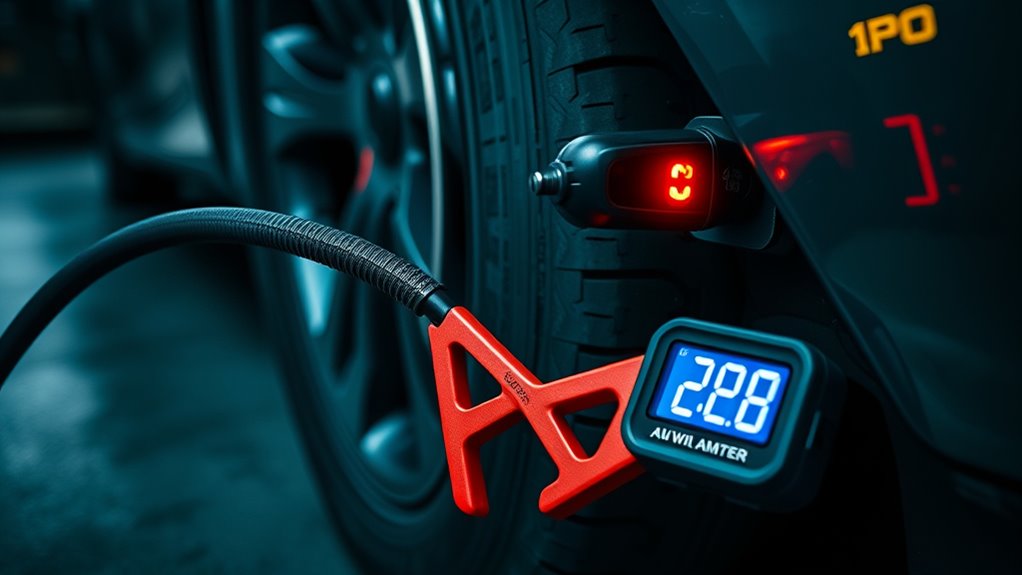
A 12V tire inflator usually draws 5 to 15 amps, with many plug-in models landing around 10 to 12.5 amps. You can estimate current with Amps = Watts ÷ Volts, so a 120W unit at 12V pulls about 10A. Motor efficiency, tire size, inflation speed, and temperature all change real-world draw. Higher-draw models may need direct battery clips. If you keep going, you’ll see how to choose the right power setup.
Key Takeaways
- Most 12V tire inflators draw about 5 to 15 amps, depending on size, motor efficiency, and inflation speed.
- A 120W inflator at 12V uses roughly 10 amps; a 150W model uses about 12.5 amps.
- Battery-powered inflators usually draw 5 to 7 amps, while plug-in 12V models often pull 10 to 15 amps.
- High-draw inflators can reach 15 to 30 amps and may require a direct battery connection instead of a cigarette lighter socket.
- Check the inflator’s duty cycle, keep the engine running, and use a gauge to inflate safely and accurately.
How Many Amps Does a 12V Tire Inflator Use?
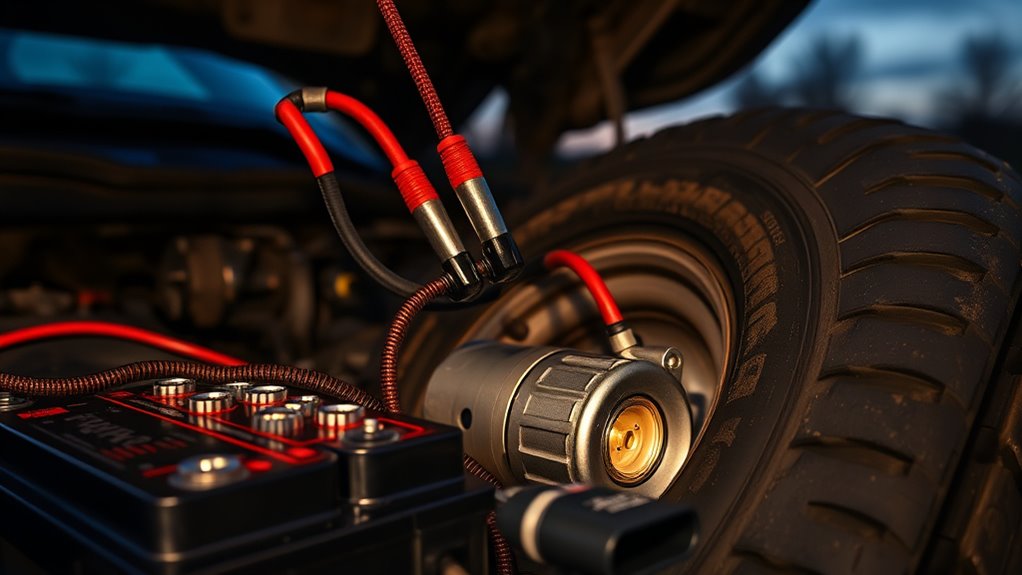
A typical 12V tire inflator draws about 5A to 15A, depending on its motor power, efficiency, and inflation speed. When you evaluate a tire inflator, you’re really checking its power consumption and power requirements against your vehicle’s supply.
A modest 120W unit on 12V pulls about 10A, so you can estimate current by dividing power by voltage. If you choose a higher-performance model, expect closer to 15A, especially when you want faster inflation and less waiting.
For example, the Woowind Ventus Pro reaches about 20–22L/min while drawing roughly 10A, which shows how design efficiency shapes demand.
You should also match the inflator to the power source: a direct battery connection can support higher amperage than many cigarette lighter sockets. That choice gives you more control, fewer limits, and a freer, more capable inflation setup.
How Voltage, Watts, and Amps Work
To understand why a 12V tire inflator typically draws 5A to 15A, you need to connect voltage, watts, and amps through the power formula: Amps (A) = Power (W) / Voltage (V).
In practice, you divide the inflator’s watts by the system voltage to predict current demand. If you run a 120W inflator on 12V, you get 10A. If you step up to 150W, the draw rises to about 12.5A.
That’s the direct relationship: more watts require more amps when voltage stays fixed. You should also recognize that motor efficiency matters, because a more efficient motor uses fewer watts to deliver the same work, so it pulls less current.
When you power the unit from a vehicle outlet, the outlet’s rating can cap usable amps, often near 10A for cab plugs. Understanding this lets you evaluate electrical load clearly and choose equipment that supports your freedom to inflate on demand.
What Affects a 12V Tire Inflator’s Amp Draw?
You’ll see a 12V tire inflator’s amp draw shift with motor efficiency, since a more efficient motor needs less current to produce the same output.
Inflation speed also matters: when you ask the unit to inflate faster, it typically pulls more amps.
The power source affects the load too, because battery-powered models often manage energy more efficiently than units running from a car socket.
Motor Efficiency
Motor efficiency has a direct impact on how many amps a 12V tire inflator draws, because a more efficient motor converts more electrical power into airflow with less wasted energy. You’ll usually see 5A to 15A, depending on motor efficiency and the power source. A 120W unit at 12V draws about 10A, since Amps = Power / Voltage. More efficient motors keep current lower for the same output, while larger motors often pull more amps.
| Motor type | Typical draw | Note |
|---|---|---|
| High-efficiency | 5A–8A | Less loss |
| Standard | 9A–12A | Balanced |
| Large | 13A–15A | More load |
Battery-operated inflators can stay leaner than car-socket models. Don’t confuse motor efficiency with inflation speed; faster systems usually need more power, which raises amp demand.
Inflation Speed
Inflation speed also affects how many amps a 12V tire inflator draws, because pushing air into a tire faster usually requires more power. When you choose a quick inflation setting, your portable air compressor often works harder and pulls toward the upper end of its 5A to 15A range.
A 120W unit at 12V, for example, draws about 10A, and faster models can exceed that as they chase speed. You’ll usually see lower amps when the motor runs efficiently and slower inflation is acceptable.
Tire size and ambient temperature also shape the load, so your real-world draw can shift during operation. If you want efficient, liberated use of power, match inflation speed to the job instead of demanding maximum output every time.
Power Source
The power source can change a 12V tire inflator’s amp draw more than many users expect. If you run portable compressors from a car socket, you’ll often see higher power loss than with direct battery-powered units.
Most 12V inflators draw 5A to 15A, and you can estimate current with amps = power ÷ voltage; a 120W model at 12V pulls 10A. Efficient motors reduce wasted energy, so you get the same pressure with fewer amps.
Larger motors usually demand more current, yet they move more air and finish faster. That tradeoff matters when you need rapid, independent inflation on the road.
Choose the source that matches your load, because weak wiring or low-capacity outlets can limit performance and slow your work.
What Amp Range Should You Look For?
For most 12V tire inflators, you should look for a draw between 5A and 15A, since that range covers both efficient portable units and faster, higher-output models.
If you want quick inflation, target tire inflators rated at 10A to 15A; they deliver more airflow and usually reduce fill time.
If you prioritize compact gear and lower electrical load, 5A to 7A units can still perform well, especially for lighter use.
Check the amps against the duty cycle, because sustained operation at the upper end can generate heat and limit runtime.
You should match the inflator’s draw to your vehicle’s outlet and your own use case, not to raw maximum power alone.
Models above 15A move into heavier-duty territory and may need direct battery connections.
Models above 15A shift into heavier-duty use and may require direct battery connection.
The right choice lets you keep mobility, control, and reliable performance without surrendering convenience.
Battery-Powered vs 12V Plug-In Inflators
Battery-powered inflators usually draw about 5A to 7A, so you get better portability and can use them away from a vehicle.
12V plug-in inflators typically pull 10A to 15A, which gives you faster inflation but depends on a car outlet or similar 12V source.
You should choose based on whether you need longer runtime and mobility, or higher power and quicker tire fill times.
Power Draw Differences
Power draw varies noticeably between portable battery inflators and 12V plug-in models, and that difference affects both runtime and inflation speed. When you monitor tire pressure, you’ll see battery units usually pull 5A to 7A, keeping them portable and efficient.
12V plug-in inflators often demand 10A to 15A, and a 120W unit already needs 10A at 12V. Power draw differences like these matter when you want control.
- Lower amp draw can feel liberating.
- Higher current can inflate faster.
- Direct battery connections may prevent losses.
- Weak plugs can limit performance.
If you choose a battery inflator like the Woowind LP1, you’re prioritizing lighter electrical load.
If you choose a plug-in model, you’re accepting greater power consumption for speed.
Portability Vs Runtime
When you compare portability against runtime, battery-powered inflators usually draw about 5A to 7A, so you get a lighter electrical load and the freedom to inflate tires without depending on the vehicle’s 12V outlet.
That battery vs plug-in tradeoff matters when you want mobility. A unit like the Woowind LP1 uses a 4000mAh pack and around 6A, so it supports quick, reliable inflation for a tire in remote or on-the-go conditions.
By contrast, 12V plug-in inflators often pull 10A to 15A and can deliver higher airflow, but they tie you to a live power source.
If you value independence, choose battery power; if you prioritize sustained output, choose plug-in power.
Best Use Cases
Your best choice depends on how and where you’ll use the inflator. Battery-powered units draw about 5A to 7A, so you gain freedom from a vehicle socket and can handle tire inflation anywhere. Choose them when you want quick, portable service for a sedan, bicycle, or emergency kit.
12V plug-in inflators usually pull 10A to 15A, which gives you faster inflation and better fit for routine car maintenance.
- Go battery-powered when independence matters.
- Choose 12V plug-in inflators when speed matters.
- Use higher-amp models for trucks and heavy-duty jobs.
- Match amps to the power source so you avoid failures.
A 4000mAh battery model, like the Woowind LP1, balances convenience and control.
How to Choose the Right Inflator for Your Vehicle
Choosing the right inflator starts with matching its amperage draw to the job and to your vehicle’s electrical capacity. To choose the right model, weigh speed, portability, and load. For truck tires, you’ll usually want a stronger unit with a motor that stays efficient under pressure. Check the label, then compare runtime demands against your 12V outlet’s limit.
| Need | Typical draw |
|---|---|
| Quick car top-offs | 10A–15A |
| Portable roadside use | 5A–7A |
| truck tires | Higher-capacity units |
| Motor efficiency | Lower draw, same output |
| Electrical fit | Match vehicle capacity |
If you travel light, a battery-powered inflator can free you from cords in remote places. If you inflate larger tires often, a wall-powered unit may suit your workload better. Don’t buy by size alone; judge performance per watt, because a more efficient motor can save energy without slowing inflation.
Why High-Draw Inflators Need Battery Power
High-draw 12V inflators typically pull 15–30 amps, so a direct battery connection is often necessary to supply enough current for efficient operation. When you rely on a cigarette lighter socket, you’re usually capped near 10 amps, and that bottleneck restricts performance.
High-draw 12V inflators often need direct battery power, since cigarette lighter sockets usually limit current and slow performance.
High-draw inflators need a direct battery connection because it lowers resistance, preserves voltage, and lets the motor run at rated output.
- You get faster inflation.
- You avoid weak, frustrating starts.
- You protect against stalled flow.
- You reclaim control over roadside repairs.
This current draw matters most with larger tires, where slow inflation wastes time and autonomy.
If you run the inflator with the engine off, you can drain the battery quickly and face a no-start risk. Many high-performance units are built for this setup, so you can use their full capability without compromise.
Real Examples of 12V Tire Inflator Amps
Real-world 12V tire inflators usually fall in the 5A to 15A range, with the exact draw depending on motor size, pressure output, and overall design. You can treat that range as a practical map for choosing a 12V tire inflator that matches your current demands and inflating multiple tires without needless strain.
| Example | Amps |
|---|---|
| Woowind LP1 | 6A |
| Woowind Ventus Pro | 10A |
| 70W class unit | 10A |
| 120W 12V unit | 10A |
| Efficient consumer models | 5A-15A |
The Woowind LP1 stays near 6A because it prioritizes portability. The Ventus Pro uses about 10A at 7.4V, showing how power and voltage interact. A 120W inflator on 12V also needs roughly 10A, so higher wattage doesn’t always mean extreme current. You get faster inflation when the design converts energy efficiently, not just when it pulls harder.
Tips for Safe, Fast Tire Inflation
You should monitor tire pressure continuously with the inflator’s gauge or a separate gauge so you don’t exceed the target pressure.
For high-draw models, connect the inflator directly to the battery to minimize voltage drop and deliver current more efficiently than a cigarette-lighter outlet.
Keep the engine running during use and respect the inflator’s duty cycle so you can inflate quickly without draining the battery or overheating the motor.
Safe Pressure Monitoring
For safe, fast inflation, keep a close eye on pressure throughout the process: check the tire with a built-in or separate gauge often enough to stop at the vehicle’s recommended PSI, and use an inflator with auto shut-off if available to reduce the risk of over-inflation.
You protect your freedom when you control tire pressure precisely and watch amps and heat buildup. Inflate only when the tire’s cold, because driving skews readings.
Keep the nozzle clean so airflow and measurements stay accurate. Monitor duty cycle; most 12V units need a cooldown after 10-15 minutes.
- Stay calm, stay precise.
- Trust the gauge, not guesswork.
- Stop at spec, not beyond it.
- Keep control, keep moving safely.
Fast Connection Methods
Once you’ve confirmed the target PSI and kept pressure monitoring tight, the next speed gain comes from how you power the inflator. For the fastest fill, connect straight to the vehicle battery; that path minimizes voltage drop and lets high-draw units move compressed air with less strain.
A cigarette lighter socket is convenient, but it usually tops out near 10 amps, so larger tires may inflate sluggishly. Keep the engine running when you can; the alternator will support the load and spare your battery during longer sessions.
Always use an inline fuse to guard the circuit, and if you’re on battery power alone, keep each run brief. That setup gives you clean, controlled airflow without giving up electrical freedom.
Common Power Problems and How to Fix Them
Common power problems usually trace back to low voltage, weak connections, or incorrect protection in the circuit. You can diagnose your inflator by checking amps, voltage, and poor connections before you blame the pump. Most 12V units draw 5A to 15A, so your source must match the load.
- If it won’t start, measure battery voltage; below 11.5 volts, performance drops hard.
- Inspect the fuse. A blown fuse stops current flow, and you should replace it with the correct amperage rating.
- Watch for slow inflation. Voltage drop across long leads steals power, so shorten cables or connect directly to the battery.
- Clean and tighten terminals. Poor connections waste current, heat the circuit, and rob you of control.
When you fix these faults, you reclaim reliable inflation and stop fighting avoidable electrical resistance.
Frequently Asked Questions
How Many Amps Does a Tire Inflator Use?
You’ll usually see a tire inflator draw 5 to 15 amps, depending on inflator types and voltage requirements.
A 120W 12V unit uses about 10 amps, while smaller battery-powered models may pull 5 to 7 amps.
You should match current draw to your power source for power efficiency and reliable operation.
Higher-amp inflators inflate faster, so you can choose speed, portability, and autonomy on your own terms.
Can I Run an Air Compressor on a 15 Amp Breaker?
Yes, you can, but only if your compressor’s power rating stays within the breaker’s limits.
A 15 amp breaker usually handles lighter units, yet a hungry compressor may gently overstep and trip it.
Check compressor power ratings, wiring, and outlet capacity before you run it.
For tire inflator safety, you’ll want proper electrical circuit considerations, especially if your tool draws near 15 amps or more.
Will a 3000W Inverter Run an Air Compressor?
Yes, you can run an air compressor on a 3000W inverter if you match the Power Requirements to the compressor’s running wattage and startup surge.
You’ll need to account for Inverter Efficiency, since usable output is lower than rated capacity.
Small Air Compressor Types usually work fine; heavy-duty models may overload the inverter.
Check surge ratings, battery capacity, and cable size so you keep your power independent and resilient.
What Is the Maximum Amp Draw of a 12V Air Compressor?
A 12V air compressor can draw as much current as a hungry beast: up to 30 amps for most single-motor units, and 40 to 60 amps for twin-motor models.
You should check Amp ratings before you buy, because Power consumption drives fuse size and wiring limits.
For better Air compressor efficiency, connect high-draw units directly to your battery, not a cigarette socket, so you keep control and stay free.
Conclusion
In the end, you can expect a 12V tire inflator to draw about 5 to 15 amps, though high-output models may pull more. You now know that voltage, wattage, and motor load all shape current demand, so you can match the inflator to your vehicle’s outlet. Don’t cut corners here; choosing the right amp range helps you avoid blown fuses, slow inflation, and power issues when you need reliable performance.

