
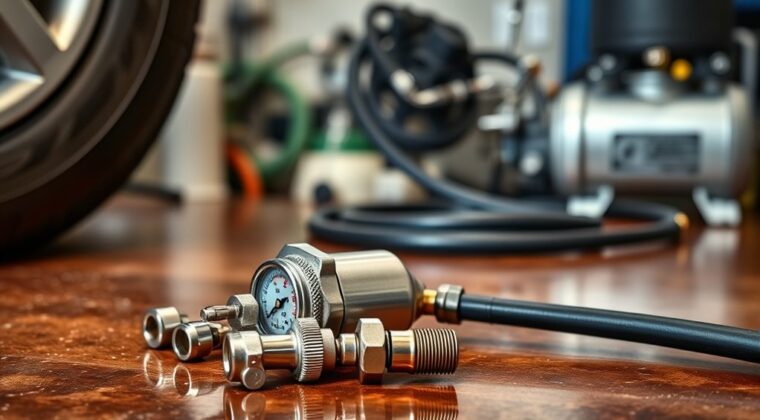
CFM on a tire inflator means cubic feet per minute, which tells you how much air the unit can move in one minute. The higher the CFM, the faster you can inflate a tire, especially at normal pressures around 30 to 35 PSI. You need to compare CFM and PSI, since airflow usually drops as pressure rises. For passenger tires, 3 CFM is a practical baseline, and more details can help you choose the right unit.
Key Takeaways
- CFM means cubic feet per minute, measuring how much air a tire inflator moves.
- Higher CFM usually means faster tire inflation.
- CFM and PSI work together: PSI is pressure, while CFM is airflow volume.
- Most passenger vehicles need about 3 CFM for efficient inflation.
- CFM often drops as PSI rises, so check performance at normal tire pressures.
What Does CFM Mean on a Tire Inflator?
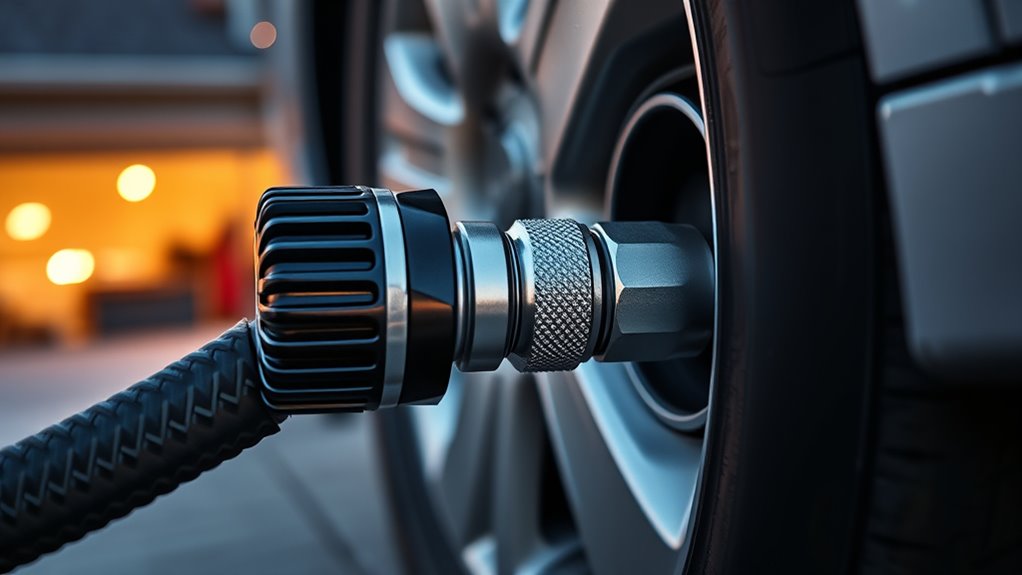
CFM, or Cubic Feet per Minute, is the air-flow rating that tells you how much volume a tire inflator can move in one minute, and it directly affects inflation speed.
When you read a tire inflator’s CFM, you’re seeing its air flow capacity, not just a marketing label. That number shows the air volume the unit can deliver, which helps you judge performance with precision.
A higher CFM rating usually means the inflator can move more air per minute, and a practical baseline is often 3 CFM for efficient service.
You should check the rating at the PSI you actually use, because performance changes as pressure rises.
By matching CFM to your tires’ demand, you avoid mismatched performance and keep inflation controlled.
That’s how you choose equipment that supports your mobility, your time, and your freedom.
Why CFM Matters for Tire Inflation Speed
CFM directly controls how quickly your tire inflator can move air, so it has a direct effect on inflation speed.
When you use a higher CFM unit, you’ll typically get a faster fill and less wait time.
That advantage becomes more noticeable as you inflate multiple tires or work at higher pressures, where airflow demand increases.
CFM Affects Inflation Speed
When you’re inflating tires, the inflator’s CFM rating determines how much air it can move per minute, which directly controls inflation speed.
CFM, or Cubic Feet per Minute, quantifies air volume, so your tire inflator’s air delivery becomes the key variable. Use it to assess performance:
- 3 CFM supports efficient inflation for all four tires.
- 4 CFM or more cuts inflation time sharply.
- At higher pressures, airflow usually drops, so you need reserve capacity.
You should read the rating as a system capability, not a headline number.
If you want faster, freer maintenance, match CFM to your tire size and pressure targets. That way, your inflator keeps enough throughput to move air decisively, even as resistance rises.
Higher CFM, Faster Fill
Higher CFM shortens tire fill time because the inflator can move more air each minute. When you choose a tire inflator with higher CFM, you increase the volume of air delivered against rising air pressure, so you get faster filling with less waiting.
A minimum of 3 CFM supports effective inflation, but 4 CFM or more gives you better performance for demanding inflation needs. Remember that airflow drops as pressure climbs; an inflator may start at 6 CFM and fall to 4.68 CFM near 29 psi.
That’s why you should look beyond peak numbers and assess sustained output. Higher CFM also helps maintain more consistent pressure and improves efficiency when you’re handling larger or multiple tires.
How CFM and PSI Work Together
You need to understand that CFM measures airflow volume, while PSI measures the pressure that airflow must overcome.
As PSI rises, your inflator usually delivers less CFM, so flow rate and pressure move in opposite directions.
To get efficient inflation, you’ve got to balance enough CFM at the PSI your tires require.
CFM and PSI Basics
CFM and PSI work together to determine how effectively a tire inflator fills a tire: CFM measures airflow volume, while PSI measures the pressure that air is delivered at. You use both to judge inflation performance, not just one.
A tire inflator with higher CFM moves more volume, so your inflation finishes faster. PSI tells you whether that airflow reaches the needed pressure.
- 4 CFM usually inflates quicker than 2 CFM.
- PSI confirms the tire reaches the correct pressure.
- 3 CFM or more helps you handle all four tires efficiently.
When you choose the right CFM and PSI, you control airflow with precision and keep inflation efficient, reliable, and free from unnecessary delay.
Pressure and Flow Balance
Pressure and flow move in opposite directions as pressure rises, so CFM usually falls at higher PSI. You need to read that relationship as a control problem: CFM sets air volume, while PSI sets delivery pressure for tire inflation. When you choose an inflator, match both variables to the tire’s demand.
| PSI | CFM |
|---|---|
| Low | Higher airflow |
| Moderate | Balanced output |
| High | Lower airflow |
A unit near 4 CFM at 29 PSI can serve most standard tires well, and 3 CFM is the minimum you should expect for inflating four tires at once. If you want faster, freer inflation, select more airflow so the system doesn’t choke under pressure.
What CFM Do You Need for Your Tires?
So, what CFM do your tires actually need? For most passenger vehicles, you’ll want a tire inflator with at least 3 CFM for efficient inflation and solid air delivery. That minimum supports all four tires without dragging out the process. If you want faster inflation, especially for larger tires or repeated use, target 4 CFM or more.
- Match tire pressure: Most tires run at 30-35 PSI, so check CFM output at that pressure, not just the headline rating.
- Account for pressure rise: As PSI climbs, CFM usually drops, so you need extra headroom for consistent performance.
- Verify manufacturer data: Compare CFM ratings across PSI levels to confirm the inflator can meet your real-world tire pressure needs.
When you choose based on actual inflation demand, you free yourself from underpowered tools and keep your setup precise, efficient, and ready for the road.
Tire Inflator vs. Air Compressor
A tire inflator and an air compressor serve different jobs, even though they both move air. You use a tire inflator for quick, occasional inflation; it’s portable, simple, and built for a narrow air supply. Its CFM rating is usually 1-4 CFM, so it handles tires well but can’t sustain pneumatic tools.
| Device | Typical CFM rating | Best use |
|---|---|---|
| Tire inflator | 1-4 CFM | Fast tire inflation |
| Air compressor | 3-30 CFM | Tools and repeated use |
| PSI range | 30-35 vs. 150+ | Fixed vs. adjustable |
An air compressor gives you more control: higher PSI, a wider output range, and enough flow for impact wrenches or paint sprayers. If you want independence from shop hoses and heavy infrastructure, a tire inflator frees you for roadside or garage work. If you need continuous air, choose the air compressor.
How to Read Tire Inflator Labels
Tire inflator labels usually list CFM as the key flow metric, and you should read it alongside PSI because airflow drops as pressure rises. When you read labels, compare the CFM rating at each PSI point, not just the headline number. That lets you judge real inflation speed, not marketing spin. A tire inflator with higher CFM pushes more air per minute, so it fills faster under equal conditions.
Read CFM with PSI to judge real inflation speed as airflow falls with pressure.
- Check the PSI value tied to the CFM figure.
- Note any maximum CFM listed at 0 PSI; that’s the free-flow benchmark.
- Match the airflow curve to your tire’s target pressure.
If you want efficient, autonomous maintenance, read labels as performance maps. The label tells you how much liberation from waiting you can expect, especially when pressure climbs and airflow falls.
Common CFM Mistakes to Avoid
Once you can read a tire inflator’s CFM and PSI ratings correctly, the next step is avoiding the errors that lead to poor performance.
You can’t assume any air compressor will handle your tire inflation needs; that’s one of the most common mistakes. Check CFM at the PSI you’ll actually use, because many units move more air volume at 0 PSI than under load. If you ignore that drop, you’ll get slow fills and weak output.
Don’t confuse CFM with PSI: PSI measures pressure, while CFM measures airflow. You need both for efficient operation.
Also account for simultaneous inflation. If you plan to fill all four tires together, low CFM will limit performance and extend inflation time.
For most vehicles, you should look for enough CFM to support the required tire size, with about 3 CFM as a practical minimum for steady, effective tire inflation.
How to Choose the Right Inflator
To choose the right tire inflator, match its airflow to the hardest job you expect it to handle, not just basic top-offs. You want a tire inflator with enough CFM to stay fast as PSI rises, because airflow rate drops under load. For most vehicles, target 30-35 PSI and verify the unit can still perform there.
- Check capacity: Aim for at least 3 CFM for efficient inflation of four tires; 4 CFM or more gives you better speed.
- Read pressure curves: A unit rated 6.16 CFM at 0 PSI may fall to 4.68 CFM at 29 PSI, so compare ratings at real-use PSI.
- Build in freedom: Choose portable inflators with a 25-50% safety margin above your total inflation tasks, especially for larger tires or multiple tools.
When you size the inflator this way, you avoid under-inflation, cut delays, and keep your system ready for demanding work.
Frequently Asked Questions
What Does 4 CFM at 90 PSI Mean?
4 CFM at 90 PSI means your inflator can move 4 cubic feet of air each minute while holding 90 pounds per square inch.
You’ll judge tire inflator efficiency by this airflow measurement importance, since CFM impact performance affects fill speed.
Use pressure regulation techniques and follow inflator usage guidelines for safer tire maintenance tips.
Check compressor specifications, because airflow drops as pressure rises, changing real-world output.
What Is the Best PSI for a Tire Inflator?
You’ll usually want a tire inflator set to your vehicle’s recommended tire pressure, often 30–35 PSI, for ideal inflation.
You should follow PSI guidelines from the manufacturer, then use pressure monitoring to verify accuracy.
Different inflator types and inflator features, like auto shutoff, help you control tire maintenance precisely.
Don’t guess—check each tire regularly, because correct tire pressure improves handling, efficiency, and safety while keeping you in command.
Can You Convert CFM to PSI?
No, you can’t convert CFM to PSI; apples and oranges don’t trade places.
You measure CFM calculations as airflow measurement, while PSI conversion tracks tire pressure.
Your air compressor efficiency and inflator performance depend on compressor specifications, not a single formula.
Check both values at the same operating point, then match them to your tire pressure needs.
That’s how you make informed choices and keep your setup independent and effective.
How Many CFM Is a Good Air Compressor?
You’ll want 3 to 5 CFM at 90 PSI for most compressor applications, including tire maintenance and light tools.
For heavier compressor types, target 7 CFM or more to keep airflow measurement steady and avoid pressure drops.
Check inflator features and pressure gauges, and add 25–50% extra capacity for safety tips.
That margin gives you control, reliability, and the freedom to work without waiting on weak output.
Conclusion
In short, you should read CFM as the airflow rate that shapes how fast your tire inflator works, while PSI determines the pressure it can deliver. When you match both ratings to your tires, you avoid slow fills, overheating, and underperformance. Think of it like the right tool for the right job: a chain is only as strong as its weakest link. Choose the inflator that balances CFM, PSI, and your tire’s real demand.
