
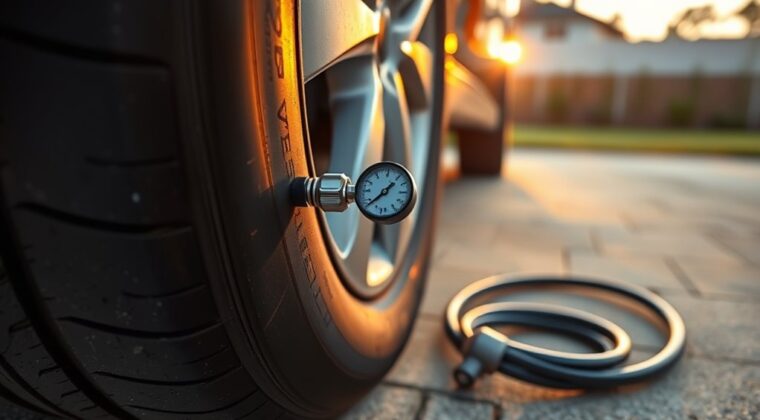
Check your tire pressure when the tires are cold, ideally before driving or after sitting for three hours. Use a reliable gauge, remove the valve cap, and press the gauge firmly onto the valve stem until the reading stabilizes. Compare each tire to the recommended PSI on the driver’s door jamb, not the tire sidewall’s max rating. Inflate or release air slowly as needed. Keep going, and you’ll learn the safest way to maintain it.
Key Takeaways
- Check the recommended PSI on the driver’s door jamb or owner’s manual, not the tire’s MAX PSI.
- Measure tire pressure when tires are cold, ideally before driving or after sitting several hours.
- Use a reliable, calibrated tire pressure gauge and inspect it for damage before use.
- Press the gauge firmly onto the valve stem, hold steady, and repeat if readings seem inconsistent.
- Compare each reading to the recommended PSI, then inflate or release air gradually until correct.
Find Your Recommended Tire Pressure
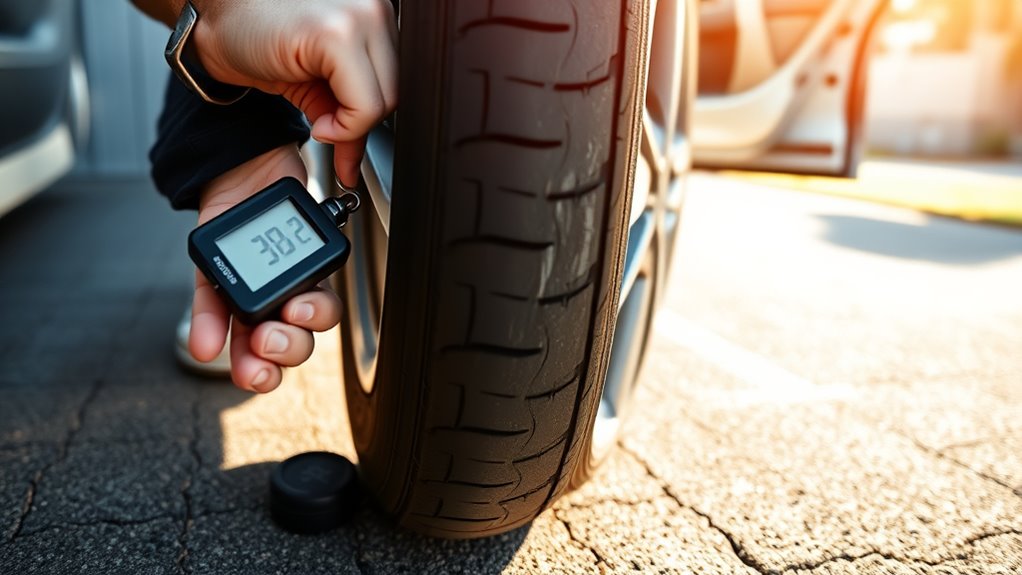
Start by checking the sticker on the driver’s side door jamb, then confirm the recommended tire pressure in the owner’s manual or near the trunk lid or fuel door.
You’re looking for the manufacturer’s recommended tire pressure, usually shown as a two-digit number followed by PSI, such as 35 PSI. Use that value as your target; it tells you the safe inflation level for your vehicle’s load and handling needs.
Don’t confuse it with the MAX PSI printed on the tire sidewall, because that number marks the tire’s upper limit, not the ideal operating setting.
When checking the pressure, verify each tire against the same specification unless your vehicle lists different front and rear values.
Keep the number handy so you can maintain control, reduce wear, and move with confidence.
Check this spec regularly, ideally monthly or before long trips, so you stay ahead of under-inflation and over-inflation.
Check Tire Pressure When Tires Are Cold
You should check tire pressure when the tires are cold, because heat from driving raises pressure and can mask the true reading.
The best time is before you drive or after the vehicle’s been parked for several hours, then compare the result to the manufacturer’s recommended PSI.
This gives you a safer, more accurate assessment and helps you avoid false high readings.
Why Cold Tires Matter
Checking tire pressure when the tires are cold gives you the most accurate reading, because driving warms the air inside the tires and can temporarily raise pressure.
“Cold” means the vehicle has been parked for at least three hours, or ideally overnight, which matches how manufacturers specify recommended pressure.
When you’re checking tire pressure on cold tires, you get accurate readings that reflect real inflation, not heat buildup. Use that value to compare against the recommended tire pressure and correct any deviation before you drive.
This helps you avoid under-inflated tires, which can reduce control, wear tires faster, and waste fuel.
Keep in mind that temperature drops can lower pressure by about 1 PSI for every 10°F, so regular checking tire pressure protects safety and preserves tire life.
Best Time To Check
The best time to check tire pressure is when the tires are cold—ideally first thing in the morning or after the vehicle has been parked for several hours—because driving heats the air inside the tires and can temporarily raise the reading.
You should check tire pressure with cold tires using a reliable tire gauge, then compare the result to your vehicle’s recommended tire pressure on the placard or manual.
Make monthly checks part of your routine, and inspect before long trips or temperature shifts. This habit keeps pressure readings accurate and helps you maintain safe handling, proper wear, and fuel efficiency.
Don’t forget the spare tire during these cold tire inspections, so you’re ready when freedom from roadside trouble matters most.
Avoid Warm Tire Readings
Warm tires can give you a false high reading because driving heats the air inside the tire, raising pressure by about 1 PSI for every 10°F increase.
To check your tire pressure safely, wait until cold tires have sat for a few hours, or measure them in the morning before you drive. Use a tire pressure gauge on each valve stem, compare the result with the recommended pressure on the driver’s side door sticker, and adjust only after you get accurate readings.
Monthly cold checks keep your car balanced, efficient, and ready to move with freedom.
- Park on level ground
- Let the tires rest
- Read each gauge carefully
- Match sticker specifications
- Recheck after inflation
Use a Reliable Tire Pressure Gauge
You should use a reliable tire pressure gauge so you can measure against the manufacturer’s recommended PSI with confidence.
Stick, dial, and digital gauges each work differently, but any gauge you choose needs to be in good condition and not knocked around, since impacts can reduce accuracy.
For the most accurate reading, use your own gauge on cold tires instead of depending on a gas station unit.
Gauge Types Compared
A reliable tire pressure gauge is essential, and the three main types—stick, dial, and digital—each have tradeoffs in accuracy and ease of use. You can choose the gauge that matches your needs while keeping your reliable tire checks disciplined.
Stick gauges are simple and compact, but they’re usually less precise. Dial gauges give a clear pressure reading and suit many types of tire, though they can be bulky. Digital gauges often provide the most exact reading for proper inflation, with backlighting and auto shut-off.
Whatever you pick, confirm calibration and inspect condition before use.
- Stick: quick, basic, portable
- Dial: readable, user-friendly, larger
- Digital: precise, bright, efficient
- Calibration: verify before each use
- Condition: check for damage
Getting Accurate Readings
For accurate tire pressure readings, use a reliable gauge and make sure it’s calibrated correctly, since even small errors can lead to unsafe inflation.
Choose a tire gauge that fits your routine—stick, dial, or digital—then remove the valve cap and press it firmly onto the valve stem to seal out leaks. Hold steady until the reading stabilizes, so you get accurate readings instead of a false drop.
Check the tire more than once if the number seems off, and compare it with the recommended PSI on the door placard or tire sidewall.
Inspect your gauge for cracks, bent parts, or drop damage, because a compromised tool can mislead you. Replacing a faulty gauge keeps you in control and supports safe, independent maintenance.
Check Tire Pressure the Right Way
Check tire pressure when the tires are cold, ideally first thing in the morning or after the vehicle has sat for a few hours, so the reading reflects true inflation pressure.
Then find the recommended proper tire pressure on the door jamb sticker or owner’s manual; ignore the tire sidewall’s MAX PSI.
Remove the valve cap, seat the gauge squarely on the valve stem, and check tire pressure with a firm press until the reading stabilizes.
Repeat the measurement 2-3 times for consistency.
- Inspect all four tires, not just one.
- Check the spare tire, too.
- Compare every reading with the specified PSI (pounds per square inch).
- Keep a record so you can spot leaks early.
- If you must use an air compressor, add air gradually and recheck often.
This routine gives you control, protects handling, and helps you drive with confidence.
Inflate Tires to the Correct PSI
Once you’ve confirmed the reading, inflate the tire gradually until it matches the recommended PSI listed on the driver’s door jamb sticker or in the owner’s manual.
Use a reliable gauge to monitor tire pressure as you inflate tires, and stop to recheck every few seconds so the reading stays accurate. Keep the tire cold if possible, since heat can skew results and hide the real pressure.
Don’t chase the MAX PSI on the sidewall; that number isn’t your target. If you’re correcting under-inflated tires, add air in small bursts, then measure again 2-3 times for consistency before you proceed.
This method protects you from over-correction, preserves freedom of movement on the road, and reduces the risk of blowouts, uneven wear, and wasted fuel.
When the pressure reaches the recommended PSI, disconnect the chuck cleanly and verify one last time.
Precise inflation gives you safer handling and longer tire life.
Let Air Out of Overinflated Tires
If your tire is overinflated, let air out slowly by pressing the metal stem in the valve with a small tool or your finger until the pressure drops to the recommended PSI on the driver’s side door jamb sticker.
Keep your body clear of the valve, and release air in short bursts so you can control tire pressure precisely.
- Read the sticker for the manufacturer’s recommended tire pressure.
- Use a reliable gauge to measure PSI (pounds per square inch).
- Stop bleeding air when the reading matches spec.
- Recheck after a few minutes for temperature shifts.
- Don’t drive on overinflated tires; correct them before any check and fill.
This controlled step protects traction and helps you keep command of your vehicle.
Spot the Signs of Wrong Tire Pressure
After you’ve set tire pressure to spec, watch for signs that it’s still off. Inspect the tread for uneven tire wear, including bald spots or irregular patterns; these are clear signs of wrong tire pressure.
When you drive, note whether the vehicle feels unstable, wanders, or resists steering, because under-inflated or over-inflated tires can change handling quickly. If stopping takes longer than usual, low tire pressure may be reducing braking efficiency, so check it at once.
Also watch for repeated top-offs: a tire that needs frequent air may have a slow leak or persistent under-inflation. Don’t ignore the Tire Pressure Monitoring System warning light; it means one or more tires are greatly under-inflated and need immediate checking.
Keep Tire Pressure Safe Year-Round
To keep tire pressure safe year-round, check it at least once a month and before long trips, using a reliable gauge on cold tires for an accurate PSI reading.
Measure each tire and match the recommended pressure on the door jamb or owner’s manual, not the sidewall max. When you check your tires, inspect the spare too, since freedom on the road depends on readiness.
Warm tires can read high, so wait until the vehicle sits for several hours. A reliable gauge helps you avoid bad station readings and protects handling, braking, and tread life.
Consistent tire pressure helps optimize performance in heat, rain, and cold, while reducing blowouts and drag.
- Check monthly
- Check before travel
- Use cold tires
- Verify spare inflation
- Follow recommended pressure
Frequently Asked Questions
What Are the Steps to Check Tire Pressure?
You remove the valve cap, press a calibrated gauge onto the stem, and read the PSI once it stabilizes. Compare it to the door-jamb spec, then repeat on every tire and the spare.
Use digital pressure gauges for accuracy, apply tire maintenance tips, schedule seasonal tire checks, ignore tire pressure myths, and follow proper inflation techniques.
If pressure’s low, inflate carefully and recheck to avoid overinflation and keep your vehicle free.
What Is the 5 PSI Rule?
The 5 PSI rule means you should keep your tires within 5 PSI of the manufacturer’s target; think of a steam-age gauge—precise, dependable.
For every 10°F temperature shift, pressure can change about 1 PSI, so your pressure monitoring should account for seasonal checks.
If you’re more than 5 PSI low, tire safety drops, handling worsens, and wear rises.
Follow your maintenance schedule and use inflation tips to stay free and secure.
What Is the 4 PSI Rule on Tires?
The 4 psi rule means you keep your tires within 4 psi of the manufacturer’s recommended pressure, so a 32 psi spec stays between 28 and 36 psi.
You should use tire pressure gauges during seasonal tire checks and follow tire maintenance tips, not common tire myths.
This range preserves the benefits of proper inflation, improves control, fuel economy, and safety, and lowers blowout risk from under- or overinflation.
How to Check Tire Pressure Without Losing Air?
You check tire pressure without losing air by placing the valve stem at the top, then snapping a snug air gauge onto it for a quick reading.
Keep contact brief, because less time means less air escapes. If moisture’s present, let it drain first. Replace the cap immediately.
Follow these tire maintenance inflation tips and safety guidelines to protect accurate tire pressure while keeping your vehicle ready for independent, liberated travel.
Conclusion
Before you add air, pause and check your tires with care. Use the right gauge, read the pressure when the tires are cold, and match each one to the recommended PSI. A quick, accurate check helps your tires sit firm on the road, like steady hands on a wheel in the dark. Stay alert for overinflation or soft spots, and you’ll protect handling, tread, and safety mile after mile.