
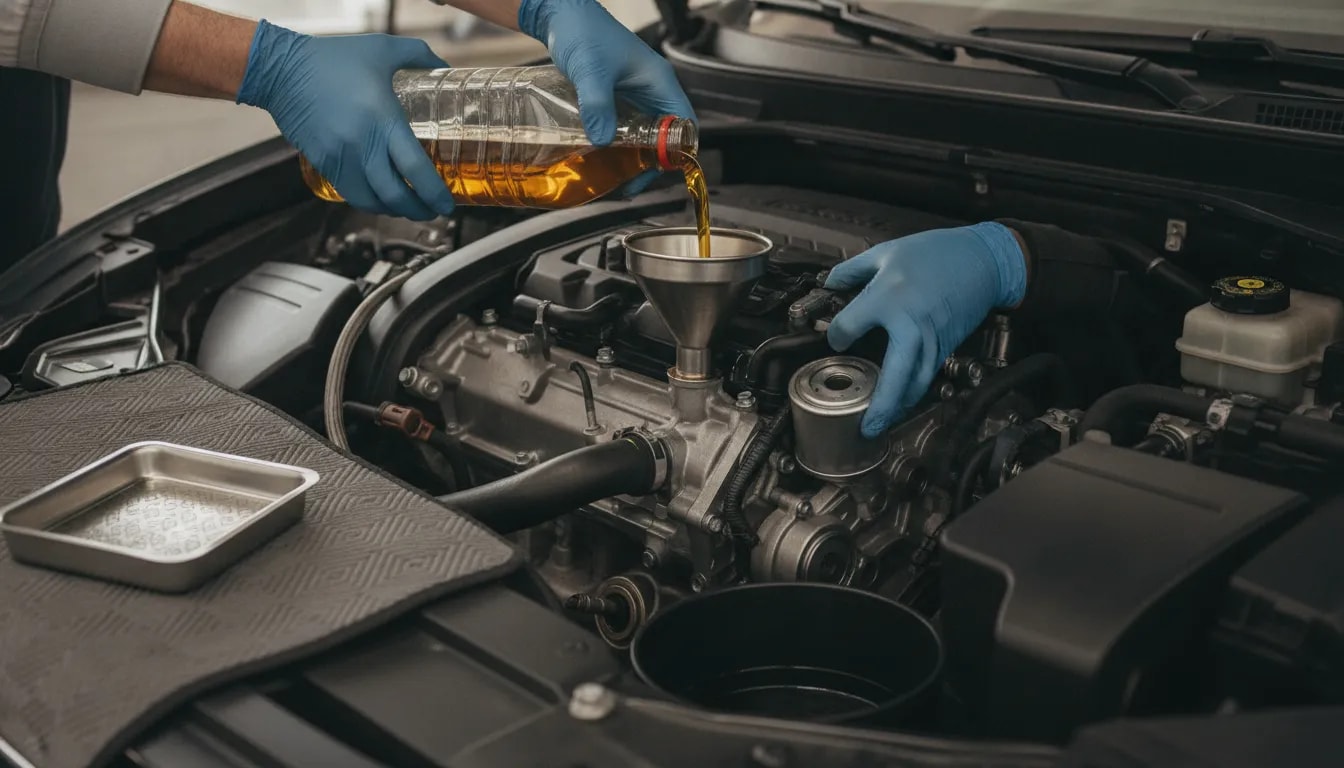
A good diesel oil change routine involves more than replacing the oil when a dashboard reminder appears. It means choosing the correct specification, matching the service interval to actual driving conditions, replacing the filter, and keeping a useful maintenance record.
These are the practical habits behind the Japanese-inspired approach to diesel oil maintenance. They do not guarantee that an engine will last twice as long or reach a particular mileage. Their value is simpler: they help protect the engine before its oil becomes excessively contaminated or loses its protective properties.
For a turbocharged diesel in mixed use, a conservative interval to consider is approximately 5,000 to 6,500 miles, or 8,000 to 10,500 km. That is general guidance, not a replacement for the vehicle’s required service schedule. The correct oil specification and any shorter manufacturer limits still come first.
Key Takeaways
- Choose diesel oil by the required performance specification as well as its viscosity grade.
- Short trips, heavy towing, and temperature extremes can justify earlier oil changes.
- Replace the oil filter with the oil rather than carrying it into another service interval.
- Keep detailed service records to track oil consumption and recognize developing maintenance concerns.
Table of Contents
- Start With the Correct Diesel Engine Oil, Not Just the Mileage
- What Happens to Diesel Oil Between Changes?
- How Often Should You Change Diesel Engine Oil?
- Make Each Oil Change a Complete Maintenance Checkpoint
- Common Diesel Oil Change Mistakes to Avoid
- A Simple Plan for Your Next Diesel Service
Start With the Correct Diesel Engine Oil, Not Just the Mileage
An early oil change cannot compensate for using the wrong oil. Before deciding how often to service your diesel, establish exactly what belongs in the engine.
Viscosity and oil specification answer different questions
Grades such as 5W-30 and 5W-40 describe viscosity characteristics. They do not, by themselves, establish that an oil has the required formulation for your engine and its exhaust aftertreatment system.
Two containers with the same viscosity grade can carry different performance specifications. Buying only by the large viscosity number on the front label can therefore overlook an important requirement.
Use this purchasing checklist:
- Read the owner’s manual: identify the required viscosity and oil performance specification.
- Check the actual product label: verify that the oil carries the required rating, rather than merely a matching viscosity.
- Account for the diesel particulate filter: if the vehicle requires an aftertreatment-compatible oil, do not substitute an unsuitable formulation.
- Record the product used: retain enough detail to identify it at the next service.
Why ACEA C specifications matter for diesels with a DPF
The ACEA C categories cover engine oils formulated for compatibility with exhaust aftertreatment systems. ACEA is the European Automobile Manufacturers’ Association; its oil sequences provide supporting context for these classifications.
A key consideration is SAPS: sulfated ash, phosphorus, and sulfur. Oil formulations control these characteristics to balance engine protection with the needs of particulate filters and catalytic converters.
ACEA C3, for example, is a mid-SAPS category. C3 and C4 are examples of specifications used by diesel vehicles, but the correct choice is the category required by the vehicle, not whichever C-rated product happens to be available.
An oil change protects more than the engine
When an engine consumes oil, residue associated with the oil’s additive chemistry can enter the exhaust system. Ash can accumulate inside the diesel particulate filter, or DPF.
DPF regeneration does not remove accumulated ash. That is why an unsuitable high-ash oil can create a problem that more frequent regeneration cannot solve.
The practical lesson is to treat the oil specification as part of both engine maintenance and emissions-system maintenance. A viscosity grade that looks right is not enough.
What Happens to Diesel Oil Between Changes?
Engine oil is a formulated chemical system, not simply a slippery liquid. It combines base oil with an additive package that helps it clean, suspend contamination, resist degradation, and protect metal surfaces.
The balance varies by formulation, but the useful distinction is between the base oil and the additives that make it suitable for demanding engine service.
| Additive function | Why it matters |
|---|---|
| Detergents | Help keep internal engine surfaces clean. |
| Dispersants | Help keep contaminants suspended instead of allowing them to collect into larger deposits. |
| Anti-wear additives | Help form protective films where metal surfaces need protection. |
| Antioxidants | Slow chemical breakdown of the base oil. |
| Acid-neutralizing chemistry | Helps protect internal components from acidic contamination. |
As the oil remains in service, contamination accumulates and its protective chemistry is consumed or degraded. An oil change removes used oil and replenishes that protection.
Blow-by introduces combustion byproducts into the oil
A small amount of combustion gas passes the piston rings and enters the crankcase. This is called blow-by, and some blow-by is normal.
Those gases can carry acidic combustion byproducts into the oil. Fresh oil contains an alkaline reserve that helps neutralize them before they damage internal surfaces.
This reserve is described by Total Base Number, or TBN, expressed in milligrams of potassium hydroxide equivalent per gram of oil. As neutralization occurs, that reserve declines.
If the oil’s ability to manage acidic contamination becomes inadequate, corrosion can contribute to bearing and component wear. The aim is to replace oil before its protection becomes insufficient, not merely after an arbitrary distance has elapsed.
Soot creates both contamination and lubrication problems
Soot is a particular challenge in diesel engines. Dispersants help keep soot particles separated and suspended in the oil, but the oil has a finite ability to manage that contamination.
As soot loading increases and the oil ages, particles can form larger clusters. Soot can also interfere with the protective action of anti-wear additives.
Another consequence is oil thickening. Excessively soot-loaded oil may flow less readily through narrow passages, affecting oil delivery to components such as turbocharger bearings and circulation through the oil cooler.
These processes explain why oil can become less protective even while there is still an apparently adequate quantity in the sump.
How Often Should You Change Diesel Engine Oil?
The most useful answer combines the vehicle’s prescribed schedule with the way it is actually driven. A diesel covering long, steady highway journeys does not subject its oil to the same conditions as one repeatedly used for short urban trips.
Condition-aware maintenance supplements the schedule; it does not mean ignoring it. Keep the manufacturer’s distance and time limits, and check whether a separate severe-use schedule applies.
A practical interval framework
| Driving pattern | Oil-change approach |
|---|---|
| Mixed driving in a turbocharged diesel | Consider approximately 5,000 to 6,500 miles, or 8,000 to 10,500 km, as conservative general guidance, subject to the vehicle’s requirements. |
| Mostly short urban trips | Favor earlier servicing and follow any applicable severe-use schedule. |
| Heavy towing or extreme temperatures | Favor the shorter end of the general range unless the manufacturer requires an even shorter interval. |
| Regular, steady highway journeys | Use the prescribed schedule, but do not assume favorable driving automatically permits an extension. |
There is no universal mileage at which every diesel oil becomes exhausted. The engine, oil formulation, and operating conditions all matter.
Why short journeys can require earlier changes
Repeated trips of around 10 to 15 minutes may end before the engine and its oil have fully warmed, depending on conditions. Moisture from combustion can condense in the crankcase and mix with the oil.
Short-trip operation can increase the burden on acid-neutralizing additives and contribute to soot contamination. Consequently, a low-mileage diesel is not necessarily an easy-use diesel.
For illustration, oil that remains suitable for 15,000 km, about 9,300 miles, during steady highway use might reach the end of its useful service much earlier during repeated short trips, potentially around 7,000 km, about 4,300 miles. Those figures illustrate the effect of operating conditions, not a universal replacement schedule.
Think about how the miles were accumulated, not just how many miles appear on the odometer.
Do not treat a service reminder as proof of oil condition
A service reminder is a useful prompt, but it should not replace understanding the maintenance requirements for your driving pattern.
Rather than assuming the reminder fully accounts for every aspect of oil contamination, check the owner’s manual and discuss frequent short journeys, towing, or temperature extremes with the workshop.
The goal is not to disregard the dashboard. It is to avoid treating a reminder as the only information needed to make a maintenance decision.
Make Each Oil Change a Complete Maintenance Checkpoint
The interval is only one part of the routine. A well-timed service should also include a fresh filter and an accurate record of what was done.
Replace the oil filter with the oil
The filter captures contaminants and wear particles during the service interval. Leaving an old filter in place retains a used component containing old oil and accumulated contamination.
Replacing the filter at each oil change is the straightforward approach. It avoids beginning the new interval with a filter that has already completed the previous one.
When booking a service, confirm that the quoted work includes both oil and filter replacement. Do not assume an intermediate oil change automatically includes a new filter.
Keep a log that reveals trends
A service record is more valuable when it contains useful details rather than just a date and the words “oil changed.” A notebook or digital log can both serve the purpose.
| Record | What it helps establish |
|---|---|
| Date and odometer reading | The elapsed time and distance between services. |
| Oil product, viscosity, and specification | Whether the correct formulation has been used consistently. |
| Filter identification | What was fitted and whether it was replaced. |
| Oil added between services | Whether oil consumption is changing. |
| Driving pattern | Whether short trips, towing, or other demanding use affected the interval. |
| Unusual observations | When warning signs appeared relative to maintenance. |
Over several years, these entries make it easier to identify increasing oil consumption, compare service intervals, and connect an emerging concern with recent maintenance.
The record also changes the purpose of the service: an oil change becomes a regular opportunity to notice problems rather than a task postponed until a reminder appears.
Common Diesel Oil Change Mistakes to Avoid
- Buying by viscosity alone: a matching 5W-30 label does not establish that the oil meets the required performance specification.
- Using unsuitable oil in a DPF-equipped vehicle: ash accumulation cannot be corrected by regeneration alone.
- Applying a highway interval to repeated short trips: identical mileage can represent very different demands on the oil.
- Skipping the filter to reduce the service bill: fresh oil deserves a fresh filter rather than a previously used one.
- Ignoring the time limit: condition-aware servicing is not permission to abandon the manufacturer’s calendar requirement.
- Keeping incomplete records: without product details and top-up information, developing trends are harder to recognize.
- Expecting oil changes to guarantee a lifespan: good lubrication maintenance supports longevity but does not promise a particular mileage.
A Simple Plan for Your Next Diesel Service
- Find the required oil viscosity, performance specification, and service limits in the owner’s manual.
- Review the driving since the previous change, especially short journeys, towing, and temperature extremes.
- Choose a service interval that meets the prescribed limits and accounts for demanding use.
- Confirm that the workshop will use the correct oil and replace the filter.
- Record the date, mileage, oil, filter, top-ups, and any unusual observations.
The lasting lesson is not a national maintenance secret or a guaranteed doubling of engine life. It is a repeatable routine: use the right oil, replace it before operating conditions undermine its protection, change the filter, and keep records that help you act early.