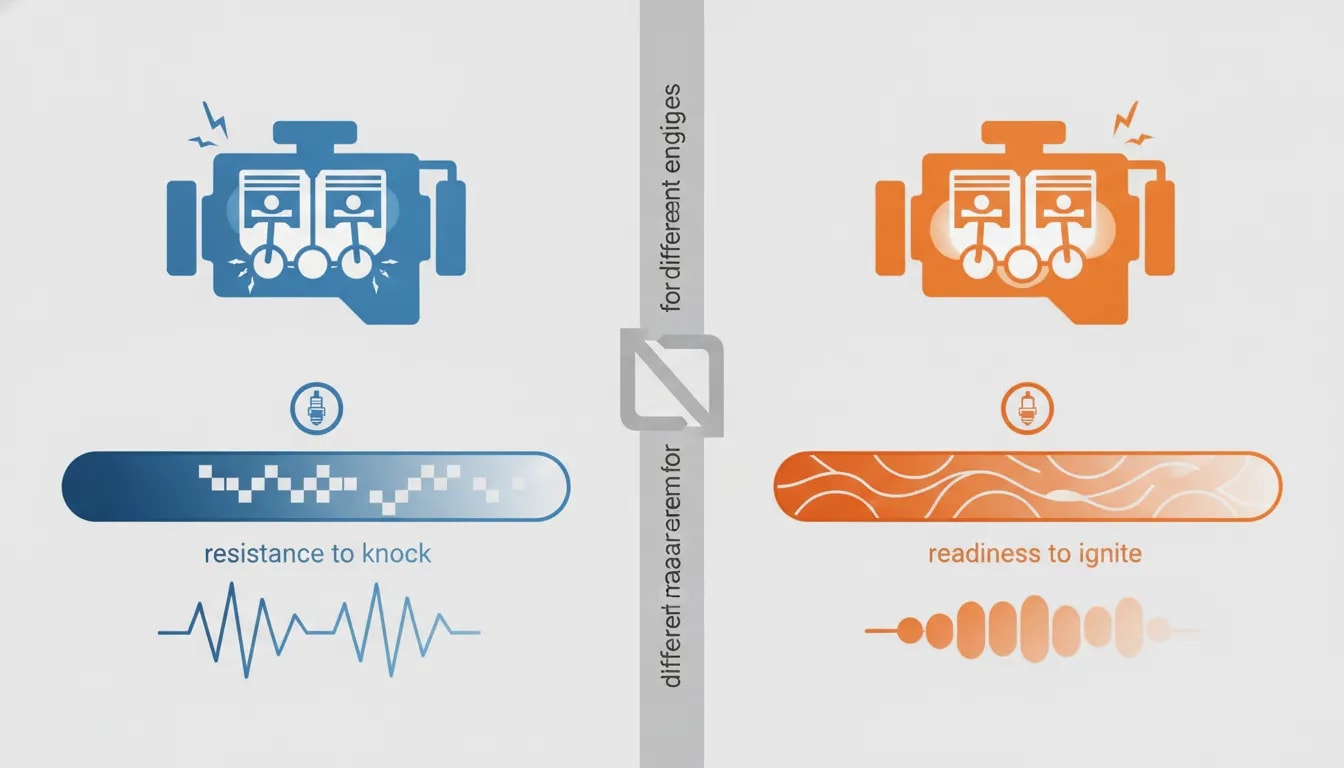
Octane measures gasoline’s resistance to engine knock. Cetane measures diesel fuel’s readiness to ignite under compression. A higher number serves a different purpose in each case because gasoline and diesel engines control combustion differently.
Neither rating is a simple measure of power, energy content, or overall fuel quality. Understanding the difference helps you choose the right grade, judge whether premium fuel is worth paying for, and avoid confusing a fuel specification with a marketing label.
Key Takeaways
- Octane measures gasoline knock resistance, while cetane describes diesel ignition quality.
- Premium fuel is useful only when its properties match an engine’s needs.
- Follow the owner’s manual rather than choosing fuel by the highest available number.
- Gasoline and diesel are not interchangeable, regardless of their fuel ratings.
Table of Contents
- Cetane vs Octane at a Glance
- Why Gasoline and Diesel Engines Need Different Ignition Properties
- How to Read Octane and Cetane Numbers at the Pump
- Is Premium Fuel Worth the Extra Money?
- Why the Wrong Fuel Can Damage an Engine
- A Practical Fuel-Selection Checklist
Cetane vs Octane at a Glance
| Feature | Octane | Cetane |
|---|---|---|
| Fuel normally rated | Gasoline, also called petrol | Diesel |
| Main property measured | Resistance to knock caused by unwanted autoignition | Ignition quality, related to the delay before combustion begins |
| Meaning of a higher number | Greater resistance to autoignition under demanding cylinder conditions | Shorter ignition delay under diesel combustion conditions |
| Engine ignition method | A spark plug initiates combustion | Fuel ignites in air heated by compression |
| Main practical benefit | Meets the knock-resistance needs of the engine | Can improve starting and combustion smoothness |
| Buying priority | Follow the manufacturer’s octane requirement | Use diesel that meets the manufacturer’s fuel specification |
The useful distinction is resisting unwanted ignition versus achieving prompt intended ignition. These are contrasting requirements, not interchangeable rating scales. There is no simple conversion that turns an octane number into a cetane number.
Why Gasoline and Diesel Engines Need Different Ignition Properties
Both engines use pressure from burning fuel to push pistons. The important difference is how they determine when that burning begins.
Gasoline engines use a spark to control combustion
In a gasoline engine, an air-fuel mixture is compressed before a spark plug initiates combustion. Fuel delivery varies by engine design, but the basic requirement remains the same: the mixture must tolerate the conditions inside the cylinder without uncontrolled autoignition.
Compressing the mixture increases its temperature and pressure. Under sufficiently demanding conditions, some of the unburned mixture can ignite on its own rather than burn progressively as the spark-initiated flame reaches it. The resulting pressure oscillations are called engine knock.
A higher octane rating indicates greater resistance to this behavior. It does not mean the fuel contains more energy or automatically produces more horsepower.
High-compression and heavily boosted engines can need greater knock resistance because of the pressures and temperatures they create. That is why some performance, turbocharged, and supercharged engines specify premium gasoline. However, the presence of a turbocharger alone does not tell you which grade to buy. The owner’s manual does.
Diesel engines use compression heat to ignite injected fuel
A conventional diesel engine compresses air before injecting fuel into the hot combustion chamber. It does not use a spark plug to initiate normal combustion. The timing of fuel injection helps determine when combustion occurs.
There is a brief interval between injection and the beginning of combustion. This is ignition delay, and it is central to understanding cetane.
- Higher-cetane diesel: Generally has a shorter ignition delay, helping combustion begin promptly.
- Lower-cetane diesel: Generally has a longer delay, allowing more injected fuel to accumulate before burning begins.
When more fuel burns rapidly at the start of combustion, cylinder pressure can rise more abruptly. This contributes to the characteristic diesel knock or clatter. A shorter delay can help reduce that harshness, particularly during cold starts.
Diesel engines’ high compression ratios also contribute to their efficiency and suitability for heavy-duty work. Those advantages come from the engine and combustion system, not from a high cetane number alone.
Knock and pre-ignition are not the same thing
These terms are often confused, but they describe different abnormal combustion events:
- Knock: Unburned mixture autoignites during a spark-initiated combustion event, creating damaging pressure oscillations.
- Pre-ignition: The mixture begins burning before the intended spark event.
Both can be harmful, but octane is specifically a knock-resistance rating. It should not be treated as a guarantee against every cause of abnormal combustion.
How to Read Octane and Cetane Numbers at the Pump
Gasoline octane: U.S. and European labels use different scales
U.S. gasoline pumps commonly offer regular at 87, midgrade around 89 or 90, and premium around 91 to 94. European stations commonly label regular gasoline as 95 and premium as 98, with some higher-rated products available.
Those numbers cannot be compared directly. U.S. pumps display the Anti-Knock Index, or AKI, calculated as the average of Research Octane Number and Motor Octane Number. European pumps generally display Research Octane Number, or RON.
The different test and labeling methods explain much of the apparent gap. A European 95 label does not, by itself, mean the fuel has dramatically greater knock resistance than U.S. regular gasoline.
When comparing specifications across countries, check both the number and the rating method. The U.S. Department of Energy’s guide to gasoline octane explains the labeling system and how to choose the appropriate grade.
Diesel cetane: Look for the fuel specification, not an octane sticker
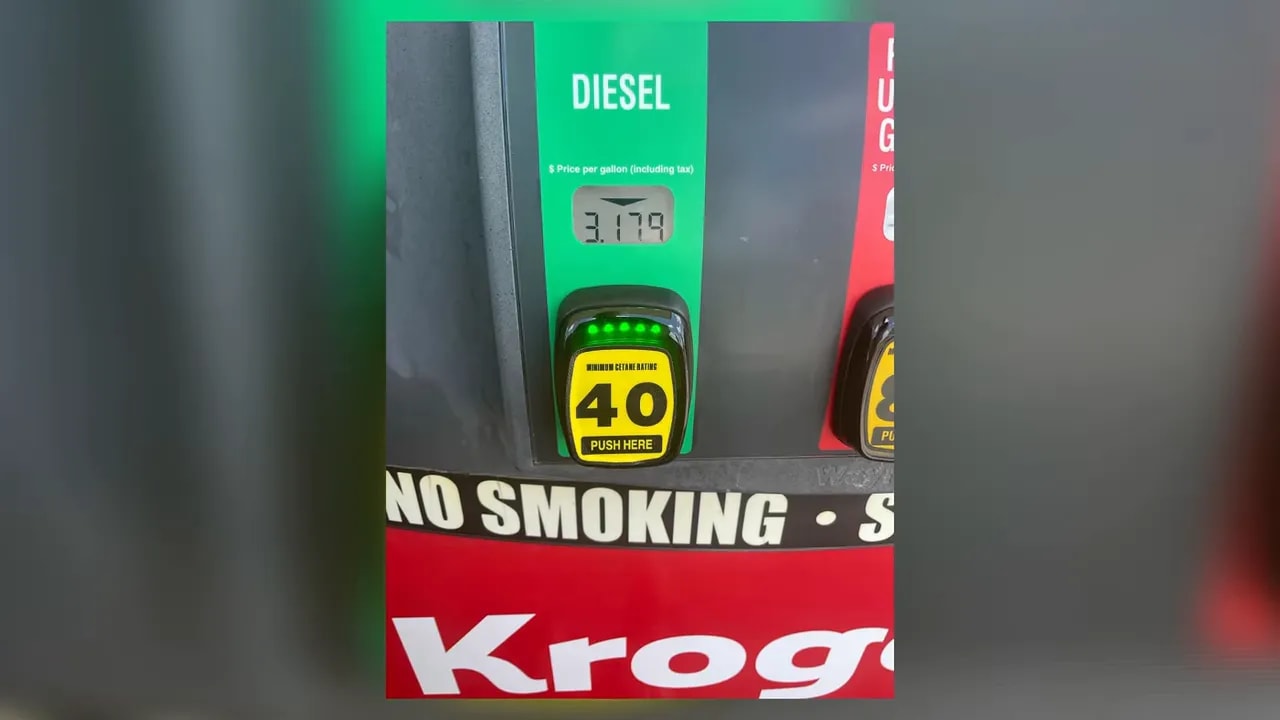
For conventional U.S. diesel fuel specifications, 40 is a commonly cited minimum cetane number. Ordinary pump diesel often falls around 42 to 45. European road diesel meeting the EN 590 specification has a minimum cetane number of 51.
Some premium diesel products offer cetane numbers around 50 to 55 or higher. The actual specification depends on the product and market, so the word “premium” alone does not tell you its cetane number.
Cetane is also only one part of diesel suitability. A fuel’s ability to ignite promptly does not make it a substitute for the complete fuel specification required by the vehicle.
Is Premium Fuel Worth the Extra Money?
The answer depends on whether the engine needs, or can benefit from, the property you are paying for. Premium gasoline and higher-cetane diesel should not be evaluated as though they offer the same improvement.
Premium gasoline: Separate “required” from “recommended”
If the manufacturer requires a particular octane rating, use at least that rating. Choosing a lower grade reduces the knock-resistance margin the engine was designed to have.
If regular gasoline is specified and no benefit from premium is identified, a higher octane number usually provides no useful performance advantage. An engine does not gain power simply because a more expensive fuel is in the tank.
However, “premium never helps an engine that can run on regular” is too absolute. Some engines accept regular but recommend premium for their best performance. Their controls can take advantage of the higher knock resistance. Follow the manufacturer’s wording rather than assuming all vehicles behave alike.
| Manufacturer’s guidance | Practical choice |
|---|---|
| 87 AKI specified, with no premium benefit stated | Use 87 AKI; do not expect extra power from 93 alone. |
| 91 AKI minimum required | Use 91 AKI or higher. |
| Regular permitted, premium recommended for best performance | Follow the manual’s explanation of the performance tradeoff. |
Likewise, using too little octane does not guarantee immediate engine failure. The outcome depends on engine controls and operating conditions. Nevertheless, protective adjustments are not a reason to disregard a required fuel grade.
Higher-cetane diesel: Most useful when ignition quality is a limitation
Higher cetane can offer practical benefits where starting and initial combustion are less smooth:
- Cold starts: A shorter ignition delay can help combustion establish more readily.
- Combustion noise: More prompt ignition can reduce the sharp initial pressure rise associated with diesel clatter.
- Older diesel engines: Some may show a more noticeable change in combustion smoothness.
These benefits have diminishing returns. A modern diesel running well in a warm climate may show little noticeable difference between suitable standard diesel and a substantially higher-cetane product.
For example, moving from cetane 40 to 50 may be more noticeable in an older engine during cold weather than moving from 45 to 55 in a modern engine under warm conditions. This is a useful comparison, not a guaranteed result for every vehicle.
Do not assume new or unusually loud clatter is merely a cetane problem. Fuel choice can affect combustion noise, but it does not establish the cause of a mechanical symptom.
Why the Wrong Fuel Can Damage an Engine
Gasoline and diesel are not interchangeable. Their ignition behavior matters, but misfueling damage cannot be explained by octane and cetane alone.
Gasoline in a diesel engine
Diesel fuel provides lubrication that parts of the diesel fuel system rely on. Gasoline contamination can reduce that lubrication and put fuel-system components at risk. It also creates an unsuitable fuel mixture for the engine’s intended combustion process.
The problem is not simply that gasoline refuses to burn because there is no spark plug. Its behavior in a contaminated diesel system is more complicated, and loss of fuel-system lubrication is a major concern.
Diesel in a gasoline engine
Diesel does not behave like gasoline in a spark-ignition engine. It can cause poor combustion, rough running, and loss of useful power. A high cetane number does not mean it will reliably ignite prematurely in every gasoline engine.
If you realize you have added the wrong fuel, do not start the engine. If it is already running, stop as soon as it is safe and seek professional assistance. Do not keep driving to test whether the vehicle can tolerate the mixture.
The extent of damage depends on the contamination and whether the fuel has circulated. Misfueling is not automatically an immediate engine-destruction event, but continuing to operate the vehicle can make the consequences worse. The AA’s wrong-fuel guidance explains the appropriate next steps.
A Practical Fuel-Selection Checklist
- Confirm the fuel type. Establish whether the vehicle uses gasoline or diesel before choosing a grade.
- Read the owner’s manual. Look for the required fuel specification and any distinction between minimum and recommended grades.
- Check the rating system. Do not compare AKI and RON numbers as though they use the same scale.
- Buy for a defined need. Higher octane addresses knock resistance; higher cetane addresses diesel ignition quality.
- Treat unexpected symptoms seriously. A premium fuel label is not a diagnosis or a repair.
The simplest rule is to match the fuel to the engine, rather than buy the highest number available. Octane helps gasoline withstand conditions that could cause knock; cetane helps diesel begin burning promptly after injection. The right rating is the one that meets your vehicle’s specification.