
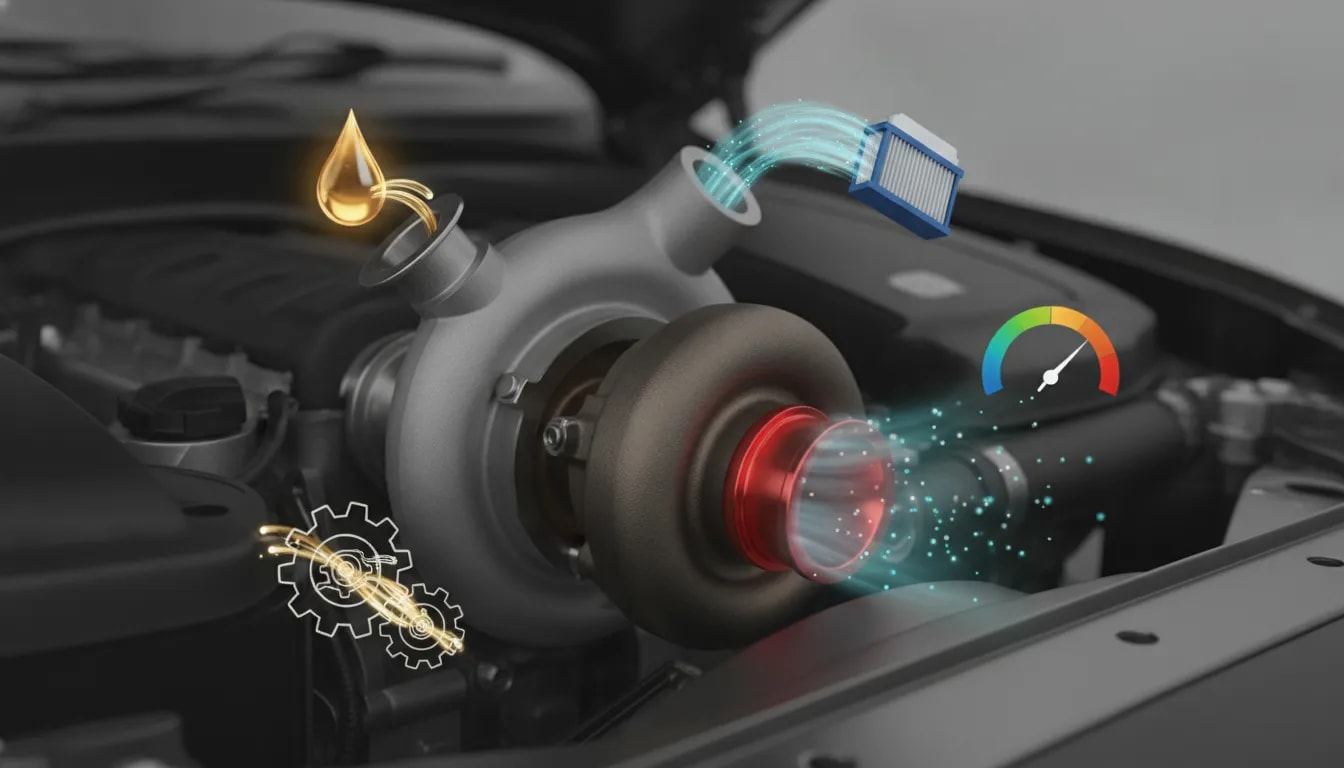
Diesel turbo maintenance comes down to clean oil, clean intake air, sensible warm-up and cool-down habits, and keeping variable geometry mechanisms working freely. These are more useful priorities than treating the turbocharger as a part that needs attention only when it fails.
A turbo can operate at speeds approaching 240,000 rpm, equivalent to 4,000 rotations per second. Its bearings depend on a thin lubricating film, while its turbine operates in hot exhaust gas. Small problems with oil supply, contamination, heat or debris can therefore become expensive damage.
The right routine helps reduce avoidable wear, but it is not a mileage guarantee. Use your vehicle’s handbook and engine-specific service requirements as the starting point, particularly for oil specifications, cold starts and shutdown procedures.
Key Takeaways
- Correct engine oil and appropriate service intervals are central to protecting turbo bearings.
- Avoid heavy load while cold and follow cool-down guidance after sustained demanding driving.
- Inspect the air filter and turbo inlet hose together to prevent unfiltered-air entry.
- Fully warmed driving supports VGT maintenance but cannot reliably repair seized vanes.
Table of Contents
- What Causes Premature Diesel Turbo Failure?
- 1. Make Engine Oil Your First Maintenance Priority
- 2. Keep Unfiltered Air and Debris Out of the Turbo
- 3. Avoid Heavy Boost Immediately After a Cold Start
- 4. Let the Turbo Cool After Sustained Heavy Load
- 5. Give a Variable Geometry Turbo More Than Short Trips
- A Practical Diesel Turbo Maintenance Checklist
- Mistakes These Habits Do Not Fix
- The Bottom Line
What Causes Premature Diesel Turbo Failure?
Several different problems can produce the same end result: worn bearings, excessive shaft movement and a turbo that no longer controls air or oil properly.
| Failure mechanism | What happens | Preventive priority |
|---|---|---|
| Insufficient lubrication | The bearings lose the oil film they need to support the rotating shaft. | Correct oil, timely servicing and gentle cold operation. |
| Oil contamination | Particles in degraded oil contribute to bearing wear. | Use the required oil specification and an appropriate change interval. |
| Oil coking | Heat causes oil to form hard deposits that can restrict lubrication. | Allow cooling after sustained heavy load. |
| VGT carbon buildup | Soot deposits interfere with movable turbine vanes. | Avoid an exclusively short-trip routine and maintain related engine systems. |
| Foreign-object damage | Debris damages compressor blades and can upset rotor balance. | Inspect the air filter, housing and hose leading to the turbo inlet. |
For additional manufacturer guidance on troubleshooting, see Garrett’s turbo replacement resources. The important principle is to identify the underlying problem rather than assume a replacement turbo alone will solve it.
1. Make Engine Oil Your First Maintenance Priority
The turbocharger relies on engine oil for lubrication and heat removal. Oil that is contaminated, degraded or unsuitable for the engine can compromise that protection.
As bearing wear increases, shaft movement can increase too. That can lead to further damage and oil leakage into the intake or exhaust. Protecting the lubricating system is therefore central to preventing turbo failure.

Choose oil by specification, not just viscosity
A full synthetic oil that meets the engine manufacturer’s requirements is the recommended approach. However, the words full synthetic are not a substitute for the correct approval.
Check the required viscosity, manufacturer approval and applicable ACEA category. ACEA categories describe oil performance requirements, including characteristics relevant to diesel operation and deposit control. The European Automobile Manufacturers’ Association provides information on its oil sequences.
Match oil-change intervals to how the vehicle is used
A conservative interval to discuss with your mechanic is 8,000 to 10,500 km, approximately 5,000 to 6,500 miles, particularly for frequent short trips, cold-weather use or towing.
This is not a universal replacement for the service schedule. Check whether your vehicle has a severe-use schedule and follow any shorter applicable requirement. A long advertised service interval should not automatically become the target for every driving pattern.
- Confirm the exact oil specification before servicing.
- Consider short trips, towing and cold conditions when choosing the interval.
- Record the oil used and the mileage at each change.
- Use each service as an opportunity to inspect the intake system.
2. Keep Unfiltered Air and Debris Out of the Turbo
The compressor wheel turns fast enough that small debris can damage its blades. Blade damage can disturb the wheel’s balance and place additional stress on the bearings.
The air filter is only part of the protection. A split hose between the filter housing and turbo inlet can allow air to enter without passing through the filter at all.

Inspect the complete filtered-air path
At each oil change, inspect the hose connecting the air filter housing to the turbo inlet. Look for:
- Cracks or splits in the hose.
- Loose clamps or poorly seated connections.
- Damage around hose ends and joints.
- An air filter that is damaged or not seated correctly.
Older hoses deserve particular attention because exposure to nearby engine heat can contribute to deterioration.
A practical inspection benchmark is 15,000 km, roughly 9,000 miles, with filter replacement around 30,000 km, roughly 18,000 miles. Follow the vehicle’s schedule and inspect or replace sooner in dusty or unpaved-road conditions.
A new filter cannot compensate for a leaking hose downstream of it. Treat the filter, housing and inlet hose as one protective system.
3. Avoid Heavy Boost Immediately After a Cold Start
Cold-start care is about giving the lubrication system time to establish normal circulation before demanding substantial turbo output. Cold oil flows differently from warm oil, making immediate hard acceleration an unnecessary load.
A cautious routine uses a brief initial idle, followed by gentle driving:
- Follow the vehicle’s starting procedure. Observe any required glow-plug indication before cranking.
- Let the engine settle without revving it. A conservative initial idle recommendation is 60 to 90 seconds, subject to the handbook.
- Allow for colder conditions. Around two minutes is a suggested benchmark below 5°C or 41°F, rather than a requirement for every diesel.
- Drive gently afterward. A short idle does not mean the engine and oil are fully warm.
Do not confuse a pause with the ignition switched on with turbo pre-lubrication. Waiting before cranking is not, by itself, evidence that oil is circulating through the turbo. The useful habits are correct starting procedure, no unnecessary revving and limited load while cold.
4. Let the Turbo Cool After Sustained Heavy Load
After towing, a sustained climb or other demanding driving, the turbine housing retains substantial heat. Switching off ends engine-driven oil circulation, but the stored heat continues moving into surrounding components.
This heat soak can contribute to oil coking, where oil forms hard carbon deposits. Deposits in the bearing area or oil passages can interfere with lubrication.
When is a cool-down idle useful?
A commonly suggested precaution is about two minutes at idle after a sustained loaded run, allowing exhaust temperatures to fall while oil continues circulating.
- After towing or sustained hard driving: Follow the handbook’s cool-down procedure rather than shutting down immediately.
- After highway driving under significant load: Consider how hard the engine was working near the end of the journey.
- After a short, slow town trip: An additional two-minute idle is generally not the same priority.
The distinction is recent load, not simply road type. A gentle trip and a demanding towing run do not leave the turbo in the same thermal condition. Treat two minutes as a conservative benchmark, not an identical rule for every vehicle and journey.
5. Give a Variable Geometry Turbo More Than Short Trips
A variable geometry turbocharger, or VGT, uses movable vanes to regulate exhaust flow toward the turbine. Changing their position helps the turbo respond across different engine speeds and loads.
Those vanes work in a hot, soot-containing environment. Repeated low-load operation and short trips can encourage deposits that interfere with their movement.
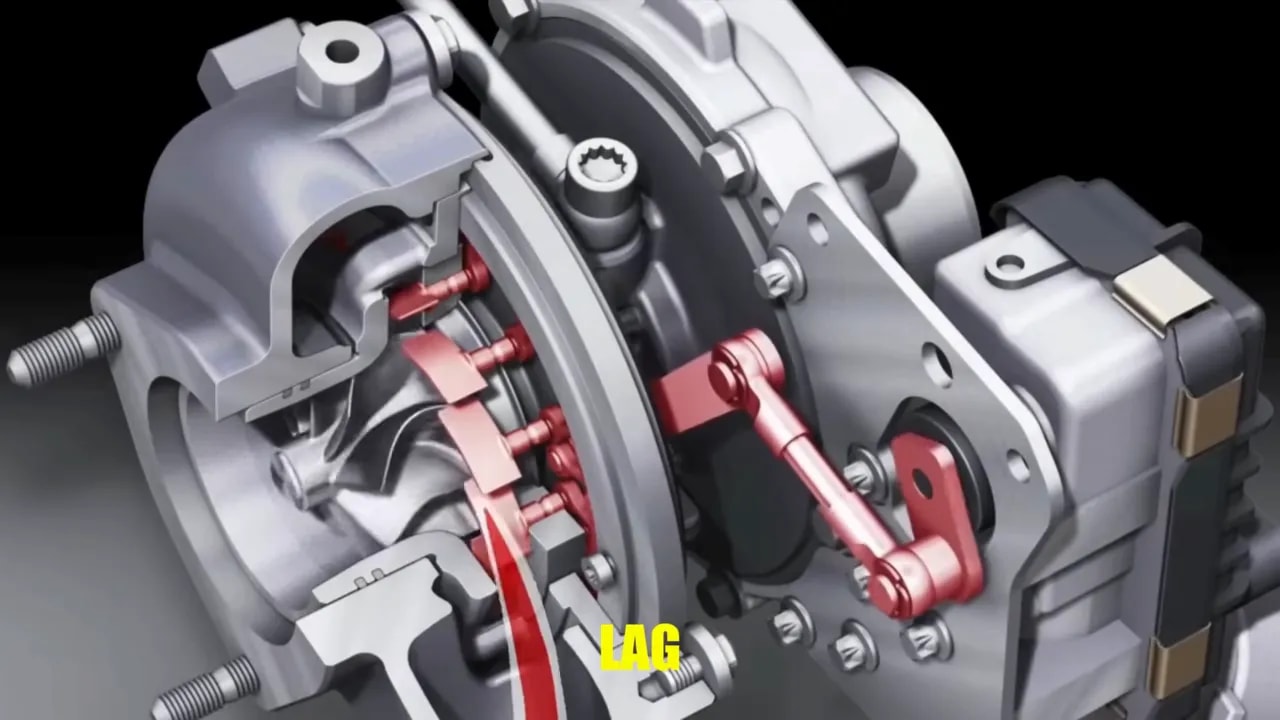
Vanes that stick toward a closed position can restrict exhaust flow and increase backpressure. Vanes stuck open can reduce low-speed boost and power.
Build in occasional fully warmed driving
For a diesel used mainly around town, a suggested preventive routine is a longer open-road drive every two to three weeks.
- Bring the engine to full operating temperature.
- Choose a route suitable for sustained driving.
- Use moderate load and vary demand rather than keeping every journey at very low load.
- Allow appropriate cooling afterward if the drive finishes under substantial load.
A proposed benchmark is 10 to 15 minutes at 2,500 to 3,500 engine rpm. Use it only if appropriate for the engine, gearing, handbook and road conditions. Never exceed speed limits or engine limits to meet an rpm target.
This is a preventive driving habit, not a guaranteed cleaning treatment for seized vanes. It is also not a substitute for the vehicle’s diesel particulate filter regeneration instructions. Higher-temperature operation may help reduce deposit accumulation, but an existing boost-control fault needs diagnosis.
Keep the EGR system in good condition
The exhaust gas recirculation system is another maintenance consideration. A sticking EGR valve or deteriorating cooler warrants attention rather than being ignored as unrelated to overall diesel operation.
If the EGR system has not been assessed for around 80,000 km or 50,000 miles, consider discussing an inspection with your mechanic. That is a suggested review point, not a mandatory replacement interval. EGR layouts vary, so avoid assuming recirculated exhaust follows the same route in every engine.
A Practical Diesel Turbo Maintenance Checklist
| When | What to do |
|---|---|
| At a cold start | Follow the starting procedure, avoid revving and keep initial driving gentle. |
| After sustained heavy load | Use the handbook’s cool-down guidance; about two minutes is a conservative benchmark. |
| Every few weeks, if mostly driving short trips | Plan a fully warmed open-road drive suitable for the vehicle. |
| At every oil service | Use the correct oil and inspect the hose from the filter housing to the turbo inlet. |
| Around 15,000 km or 9,000 miles | Inspect the air filter, earlier if conditions are dusty. |
| Around 30,000 km or 18,000 miles | Review air-filter replacement against the service schedule and its condition. |
Mistakes These Habits Do Not Fix
Preventive maintenance cannot reverse every fault. Avoid these common misunderstandings:
- Assuming every turbo failure is the owner’s fault. Maintenance matters, but failure requires diagnosis rather than blame.
- Choosing oil only by brand or viscosity. The required performance specification and approvals matter too.
- Treating high rpm as a cure. A hard drive is not a repair for a mechanically stuck VGT.
- Inspecting the filter but ignoring the inlet hose. Unfiltered air can bypass an otherwise good filter.
- Expecting a fixed lifespan. Claims of 400,000 to 500,000 km are not a guarantee for an individual turbo.
Oil appearing in the exhaust or a marked loss of low-end power should not be dismissed as a reason to try a harder drive. These are reasons to investigate the fault.
The Bottom Line
The most useful diesel turbo care is consistent and uncomplicated: use the approved oil, service it for your actual driving conditions, keep the intake sealed, avoid heavy cold-engine load and allow cooling after demanding use. For a VGT-equipped diesel, occasional fully warmed driving and attention to EGR condition complete the routine.
Start with the handbook, then make these checks part of normal servicing. Preventing the conditions that damage a turbo is more effective than relying on a promised mileage figure.