
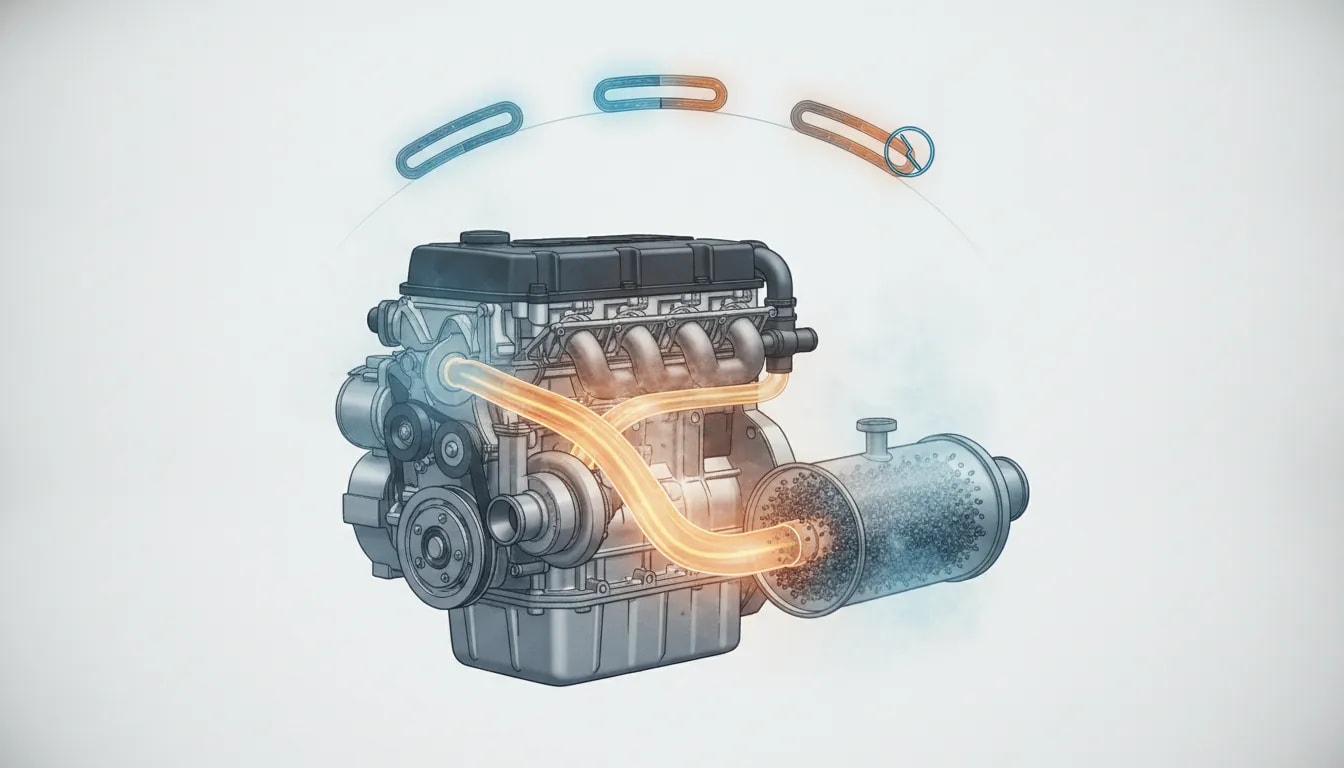
Fuel-efficient driving is not inherently harmful to a diesel engine. The problem is a pattern of repeated cold starts, short journeys, heavy acceleration at very low RPM, prolonged idling and interrupted DPF regeneration. Together, these habits can leave a modern diesel producing soot faster than its exhaust system can remove it.
For drivers whose daily routine consists of school runs, a five-minute commute or quick shopping trips, the consequences can extend beyond a blocked diesel particulate filter. Repeated regeneration attempts can also contribute to fuel dilution in the engine oil, while carbon deposits can affect the EGR system and intake.
The solution is not aggressive driving or abandoning fuel economy. It is giving a DPF-equipped diesel enough warm, sustained running time to complete its cleaning cycles, while monitoring its oil and following its maintenance requirements.
Key Takeaways
- Repeated short trips can load the DPF without providing enough heat or time for regeneration.
- Frequent regeneration attempts can contribute to fuel dilution, making an unexpected oil-level rise important.
- Avoid heavy acceleration at very low RPM and unnecessary prolonged idling.
- Regular sustained warm driving and suitable oil-service intervals help protect a short-trip diesel.
Table of Contents
- How to Protect a Diesel Used Mainly for Short Trips
- Why Short Trips Cause DPF Problems
- How to Recognize an Active DPF Regeneration
- Rising Oil Level: The Less Obvious Risk of Repeated Regeneration
- Low RPM Is Not the Same as Efficient Driving
- Why Long Periods of Idling Do Not Help
- What a Useful Longer Drive Looks Like
- When Maintenance or Workshop Diagnosis Is Needed
- The Bottom Line: Avoid False Economy, Not Fuel Economy
How to Protect a Diesel Used Mainly for Short Trips
If most of your journeys end before the engine is thoroughly warm, start with these practical changes:
- Make room for a regular longer journey. A useful general routine is 20 to 30 minutes of sustained highway driving with the engine fully warmed up, weekly or every couple of weeks.
- Learn your vehicle’s regeneration signs. A higher idle, increased fuel consumption, a running cooling fan or temporarily unavailable stop-start can indicate an active cleaning cycle.
- Allow regeneration to finish when practical. An active cycle commonly needs about 10 to 20 minutes of continuous driving, although the requirements vary by vehicle.
- Avoid loading the engine heavily in too high a gear. Downshift rather than demanding strong acceleration at very low RPM.
- Check the oil level and review the service interval. Persistent short-trip use may justify more frequent oil changes under the vehicle’s severe-use maintenance guidance.
Your owner’s manual takes priority over generic driving advice. A longer drive is a preventive habit, not a guaranteed remedy for an already blocked filter, contaminated oil or an engine fault.
Why Short Trips Cause DPF Problems
A diesel particulate filter, or DPF, captures soot in the exhaust. To avoid becoming overloaded, it periodically burns off that soot through a process called regeneration.
The key requirement is sufficient exhaust heat. A short journey may use little fuel, but it often finishes before the exhaust system reaches and maintains the conditions needed to clean the filter.
Passive versus active DPF regeneration
| Regeneration type | How it works | Why driving conditions matter |
|---|---|---|
| Passive regeneration | Soot burns off when normal driving produces suitable exhaust temperatures. | Sustained warm running provides a better opportunity than repeated cold, short journeys. |
| Active regeneration | The engine management system deliberately raises exhaust temperature, often using additional fuel. | The cleaning cycle needs enough uninterrupted running time to complete. |
Indicative exhaust temperatures for passive regeneration are roughly 350 to 500°C, or about 660 to 930°F. Active regeneration can raise temperatures to around 600°C, or 1,110°F. These are approximate figures, not universal operating targets for every diesel.
A five-minute commute followed by another brief journey later in the day can repeatedly add soot without providing much opportunity to remove it. As loading increases, the engine management system may initiate active regeneration.
That creates an important fuel-economy tradeoff: operating conditions that appear economical on individual trips can lead to additional fuel being used for filter cleaning.
What happens when regeneration keeps getting interrupted?
Switching off during an active regeneration stops the cycle before it has finished removing soot. The system may attempt another cycle on a later journey.
One interruption is not the same as immediate component failure. The concern is a recurring pattern: the filter remains loaded, another regeneration begins, and another short trip ends before completion.
If that continues, a DPF warning may appear and the vehicle can enter limp mode, restricting engine power. At that stage, workshop diagnosis and possibly a forced regeneration may be necessary. A sufficiently damaged or overloaded filter may need replacement.
How to Recognize an Active DPF Regeneration
Not every diesel clearly announces regeneration on the dashboard. Changes in normal behavior can provide clues:
- Idle speed is higher than usual.
- The exhaust sounds different, sometimes with a deeper note.
- The cooling fan runs even when the weather is cool, or continues after parking.
- A hot smell comes from the exhaust area.
- Automatic stop-start is temporarily unavailable.
- Displayed fuel consumption increases without an obvious change in driving.
These signs are clues rather than proof. A fan running or stop-start being unavailable does not, by itself, confirm a regeneration cycle.
If you recognize your vehicle’s usual regeneration behavior and conditions allow, continue driving safely so the cycle has time to finish. Around 10 to 20 minutes may be sufficient, but use the instructions for your particular model.
Do not treat prolonged driveway idling as an equivalent substitute. Normal idle operation generally produces much less exhaust heat than sustained driving.
Rising Oil Level: The Less Obvious Risk of Repeated Regeneration
A blocked DPF is a visible concern once a warning appears. Diesel fuel mixing with the engine oil can be less obvious because the dipstick may show more fluid rather than less.
How diesel fuel gets into the oil
Many passenger-car diesel engines use late fuel injection during active regeneration to help raise exhaust temperature. Some of that fuel can reach the cylinder walls, pass the piston rings and enter the oil sump.
This is called fuel dilution. Repeated regeneration attempts, particularly alongside cold operation and short trips, can increase the opportunity for fuel to accumulate in the oil. The risk depends on the engine’s regeneration strategy and operating conditions.
Diesel fuel reduces the oil’s viscosity and can weaken the lubricating film protecting bearings and other loaded components. Severe dilution can therefore turn an exhaust-system problem into an engine-lubrication problem.
Why a full dipstick is not always reassuring
If the oil level rises without oil being added, it deserves investigation. Fuel dilution is a possible cause, especially on a diesel experiencing frequent regeneration attempts.
Oil-level increases associated with dilution have been reported on certain diesel engines, including Mazda’s 2.2-liter diesel. That example illustrates why the trend matters, but it does not mean every rising oil level has the same cause.
- Check levels consistently using the procedure specified for your vehicle.
- Notice changes over time, rather than treating a single reading as a complete assessment.
- Seek service advice if the level rises unexpectedly or exceeds the permitted maximum.
- Take oil-pressure warnings seriously and follow the vehicle’s warning instructions.
A warm, longer drive may help some fuel already in the oil evaporate, but it is not a dependable repair for significantly diluted oil. Suspected contamination needs assessment, an appropriate oil change and attention to the underlying cause.
Low RPM Is Not the Same as Efficient Driving
Diesels can deliver useful torque at relatively low engine speeds. That does not mean the lowest possible RPM is appropriate for every situation.
The distinction is between light-load cruising and lugging. Lugging means asking the engine to produce substantial power at very low RPM in a high gear.
For example, gently maintaining speed is different from pressing the accelerator hard to climb a hill without downshifting. Under heavy load at low engine speed, combustion can produce more soot, adding to the DPF’s workload.
How carbon buildup affects the EGR and intake
The exhaust gas recirculation system, or EGR, routes some exhaust gas back into the intake. Carbon deposits can accumulate in the EGR valve and intake passages, restricting airflow and contributing to poor response or reduced performance.
A driving pattern that repeatedly produces soot while offering little sustained warm running can contribute to these problems.
The practical correction is straightforward: select a gear that lets the engine respond comfortably. If acceleration demands rise, downshift instead of forcing the engine to pull hard at very low RPM.
Gentle driving during warm-up remains sensible. Avoiding lugging does not require harsh acceleration, racing the engine or exceeding speed limits.
Why Long Periods of Idling Do Not Help
Leaving a diesel idling to warm up may feel protective, but it is generally a poor way to create the exhaust heat needed for DPF cleaning.
Normal idle exhaust temperatures can be around 200 to 300°C, depending on conditions. That is below the indicative temperatures associated with passive regeneration.
Extended cold idling can also encourage incomplete combustion and fuel washdown, adding to concerns about soot and oil dilution.
Rather than routinely leaving the engine running for a long driveway warm-up, follow the manufacturer’s start-up instructions and drive gently once ready. The aim is to warm the engine through normal operation without applying heavy load while it is cold.
Likewise, avoid unnecessary engine-running time while waiting in parking lots. Ordinary idling is not a reliable DPF-cleaning routine.
What a Useful Longer Drive Looks Like
The purpose of a longer drive is sustained operating temperature and appropriate engine load, not speed for its own sake.
- Warm the engine gently. Do not begin with hard acceleration on a cold engine.
- Choose a route with continuous running. A highway or similar road is more useful than repeated stop-and-go traffic.
- Allow 20 to 30 minutes of sustained warm driving. A brief burst of acceleration does not provide the same conditions.
- Use an appropriate gear. Around 2,500 to 3,000 RPM is a general suggested range for this routine, not a requirement for every diesel.
- Follow model-specific regeneration guidance. The prescribed speed, gear and duration may differ.
For a vehicle that otherwise makes mostly short journeys, scheduling this weekly or every couple of weeks can provide regular opportunities for regeneration. It does not guarantee that passive regeneration will occur on every outing.
Nor should it be expected to restore a worn turbocharger, repair damaged bearings or remove every established EGR deposit. Prevention and repair are different jobs.
When Maintenance or Workshop Diagnosis Is Needed
Persistent short-trip use calls for an oil-service review
If your driving pattern cannot change, discuss a shorter oil-change interval with a qualified technician and check the manufacturer’s severe-use schedule.
Some owners under severe short-trip conditions reduce the normal interval by roughly half. That is an example of a maintenance adjustment, not a universal recommendation for every engine. The appropriate interval depends on the vehicle and its use.
More frequent oil changes can address contaminated lubricant, but they do not remove the need to investigate repeated regeneration failures.
Warnings and reduced power should not be ignored
A DPF warning or limp mode is not simply a reminder to drive harder. Follow the manual’s instructions and obtain diagnosis when required rather than repeatedly attempting generic regeneration drives.
A restricted DPF increases exhaust back pressure and can place additional stress on the turbocharger. Continuing to ignore the problem risks expanding the repair beyond the filter itself.
Illustrative repair costs show why prevention matters:
- DPF replacement: approximately $1,500 to more than $4,000, with some models costing considerably more.
- Turbocharger replacement: approximately $1,500 to $3,000.
- Major bearing or bottom-end damage: potentially expensive enough to exceed the value of an older vehicle.
These are broad examples, not quotations. Actual costs depend on the vehicle, parts, labor and extent of damage.
The Bottom Line: Avoid False Economy, Not Fuel Economy
A modern DPF-equipped diesel needs more than a low fuel-consumption reading. It needs suitable operating conditions for regeneration and oil that remains fit to protect the engine.
Keep gentle cold-engine driving, but avoid lugging, unnecessary idling and a routine made entirely of brief journeys. Give the vehicle regular sustained warm running, learn its regeneration behavior, check for unexpected oil-level increases and adjust maintenance to match its use.