
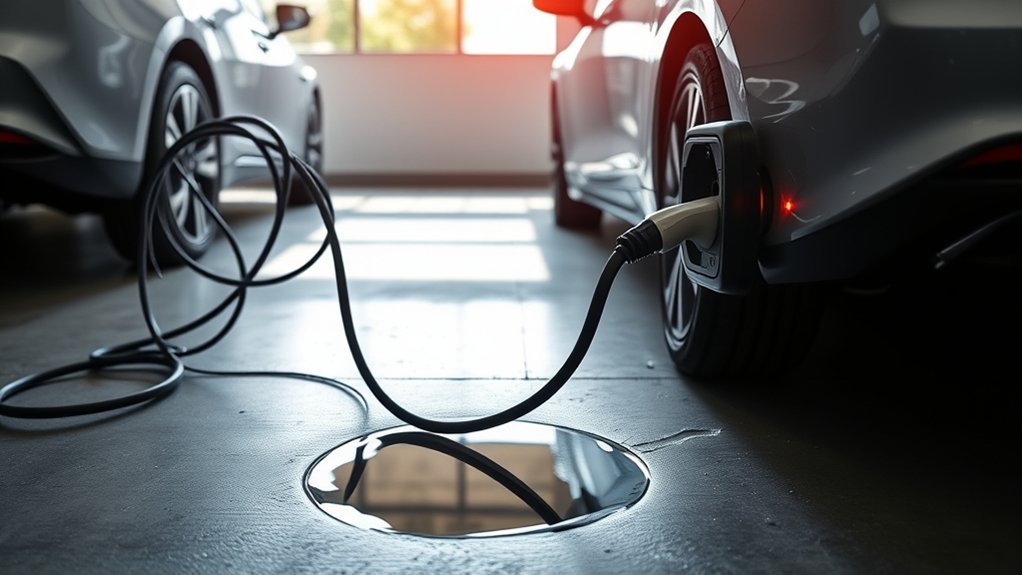
If your EV charger keeps tripping a GFCI outlet or GFCI breaker, do not keep resetting it and hoping it goes away. A trip can point to water in the plug or receptacle, damaged insulation, a loose connection, an undersized circuit, or a mismatch between the charger’s built-in protection and the circuit’s GFCI. The safest fix starts with identifying what actually tripped.
Quick Answer
An EV charger usually trips a GFCI because it senses current leakage, moisture, damaged wiring, or a ground fault. Some chargers also include their own ground-fault protection at a higher threshold than a standard GFCI breaker, so pairing the two can trip the breaker even when nothing is actually wrong.
Key Takeaways
- A GFCI trip means the circuit may be detecting leakage current or a ground fault, while an ordinary breaker trip means the circuit may be overloaded.
- Common causes include moisture, damaged cords, loose wiring, a worn NEMA 14-50 receptacle, a shared circuit, or charger ground-monitoring faults.
- Many EV chargers have built-in ground-fault protection set higher than a standard GFCI breaker’s trip point, and some manufacturers specifically advise against pairing the two.
- Do not bypass GFCI protection, use extension cords, or keep resetting a breaker that trips repeatedly.
- A hardwired EV charger often reduces receptacle-related problems, but it still must be installed according to the charger manual and local electrical code.
At a Glance
| Time Required | 10 minutes for basic visual checks; 1–3 hours for a licensed electrician to inspect the circuit. |
| Difficulty | Basic for visual checks; advanced and professional-only for panel, breaker, wiring, or receptacle work. |
| Tools Needed | Flashlight, charger app, owner’s manual, and electrician testing tools for any live-circuit diagnosis. |
| Cost | Free for basic checks; electrician diagnosis, receptacle replacement, breaker replacement, or hardwiring varies by location and panel condition. |
Why an EV Charger Trips a GFCI Breaker or Outlet
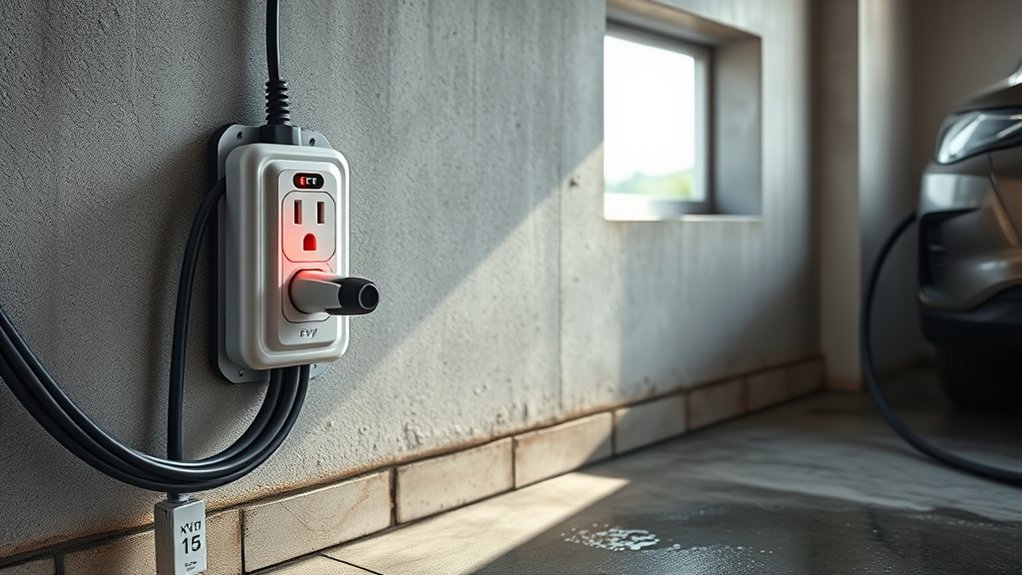
A GFCI, or Ground Fault Circuit Interrupter, is designed to shut power off when it senses current leaving the intended path. OSHA explains that a GFCI compares the current going to equipment with the current returning from it, and it can interrupt power when the difference is about 5 milliamps. OSHA’s GFCI guidance also notes that GFCIs help reduce shock hazards from ground faults.
That matters because an EV charger is a high-current device that may run for hours. If the charger, plug, receptacle, cord, vehicle inlet, or branch circuit has a leakage path, the GFCI may trip even though the vehicle seems to charge normally for a short time. It also matters because many EV chargers carry their own ground-fault protection at a different sensitivity than the panel’s GFCI, which is a separate and very common cause covered below.
A GFCI trip is not the same as a normal overload trip. GFCI protection responds to current imbalance; breaker overload protection responds to too much current for the circuit.
The most common causes include moisture in an outdoor receptacle, a damaged EVSE cable, a loose terminal, a worn NEMA 14-50 outlet, an undersized or shared circuit, a sensitivity mismatch between the charger and the breaker, or a charger self-test that detects a poor ground. Some wall chargers also have built-in ground fault protection and ground monitoring. For example, Tesla’s Universal Wall Connector manual describes integrated ground fault circuit interruption and says the unit can look for issues such as water ingress after a ground fault. Tesla’s ground fault circuit interruption guidance explains this behavior.
Warning: Do not defeat, remove, bypass, or repeatedly reset GFCI protection on an EV charging circuit. If the breaker or outlet trips more than once, stop charging until the cause is found.
Know What Actually Tripped Before You Troubleshoot
Before you replace parts, identify the device that opened the circuit. This one detail changes the likely cause.
| What Tripped? | What It Usually Means | First Safe Step |
|---|---|---|
| GFCI outlet button pops out | Current leakage at the outlet, downstream wiring, charger cord, or connected equipment. | Unplug the EVSE and inspect for water, heat marks, or damage. |
| GFCI breaker trips in the panel | Ground fault, leakage current, a sensitivity mismatch with the charger’s own protection, or sometimes overload if it is a combination GFCI breaker. | Check charger error codes, reduce charge current, and call an electrician if it repeats. |
| Standard breaker trips | Overload, short circuit, heat, loose connection, or wrong breaker size. | Stop charging and have the circuit load and wiring checked. |
| Charger faults but breaker stays on | The EVSE may be detecting ground, vehicle, temperature, communication, or internal faults. | Read the charger app or manual before resetting. |
Common Causes of EV Charger GFCI Tripping
Moisture in the Plug, Receptacle, or Charging Cord
Outdoor charging exposes plugs and receptacles to rain, snow, condensation, and wash water. Even a small amount of moisture inside a worn outlet, adapter, or connector can create enough leakage to trip GFCI protection.
Look for wet covers, cracked weatherproof boxes, damaged gaskets, corrosion, or water inside the plug face. If you see moisture, stop charging until the equipment is dry and the enclosure is repaired or replaced.
Loose Wiring or a Worn NEMA 14-50 Receptacle
A plug-in Level 2 charger can place a steady load on a 240V receptacle for hours. Loose terminals, weak contacts, and low-grade receptacles can heat up under that load. Heat damage may appear as browning, melting, a burnt smell, or a plug that feels hot to the touch.
Do not keep using a receptacle that shows heat damage. A licensed electrician should inspect the receptacle, wire size, breaker, torque, enclosure, and grounding path.
The Circuit Is Shared or Undersized
A Level 2 EV charger should normally be on a dedicated branch circuit sized for continuous use. The U.S. Department of Energy’s Alternative Fuels Data Center explains that AC Level 2 charging uses 240V service in typical residential applications or 208V service in commercial applications, and many Level 2 units run at high amperage. DOE AFDC charging equipment guidance also notes that charging speed depends on charger output, vehicle capacity, and the electrical service.
If other devices share the same circuit, the breaker may trip from overload. That is not a nuisance GFCI trip. It is a sign the circuit may not be suitable for EV charging.
Built-In Charger Protection Detects a Ground Problem
Many EVSE units include internal protection that checks for ground faults or grounding problems. Tesla’s Wall Connector, for example, continuously checks for a safe ground connection and can stop charging if it detects high impedance. Tesla’s ground assurance documentation describes this monitoring function.
If your charger shows a ground, water, or wiring fault code, treat the code as a real warning until proven otherwise. But if the charger reports no fault at all and only the panel breaker trips, the cause may not be a wiring problem — see the next section.
A Sensitivity Mismatch Between the GFCI and the Charger’s Own Protection
This is one of the most common — and least explained — reasons a healthy EV charger trips a GFCI breaker with no actual fault present. A standard Class A GFCI is built to protect people and trips at a very low current imbalance, around 5 milliamperes. Many EV chargers also include their own internal ground-fault detection, called a charging circuit interrupting device (CCID), but it is commonly set to a higher threshold, often around 20 milliamperes, specifically to avoid shutting down charging over normal, harmless leakage current from the vehicle. When both devices are on the same circuit, the more sensitive 5 mA breaker can trip first, even though the charger’s own protection never detected a problem.
Charger manufacturers document this directly. ChargePoint’s official installation guide for its Home Flex charger states that it does not recommend a GFCI breaker because the unit already has CCID protection, and that using a GFCI breaker in the panel causes nuisance tripping. ChargePoint’s Home Flex installation guide recommends a hardwired installation instead when local code requires GFCI protection on a plug-in circuit.
If your charger reports no fault, no water, and no ground problem, but the panel breaker still trips, ask an electrician whether the breaker’s sensitivity is simply mismatched with the charger’s own protection rather than assuming a wiring defect.
This does not mean you should remove required GFCI protection on your own. It means the fix, if one is needed, usually involves an electrician confirming what your local code actually requires, then choosing a compliant configuration — such as a hardwired installation, if your charger’s manual supports it — rather than replacing wiring that was never the problem.
Charger Current Is Set Too High for the Installed Circuit
Some wall chargers allow the installer to set the breaker size and maximum output. Tesla’s Universal Wall Connector, for example, lists a 60A breaker with 48A maximum output and lower outputs for smaller breakers. Tesla’s circuit breaker and output table shows these settings.
If the charger is configured above the circuit’s safe capacity, the breaker can trip, the wiring can overheat, or the charger may fault. The breaker size, conductor size, charger setting, and local code must match.
Safe Troubleshooting Checklist
- Stop after repeated trips. One trip can be temporary. Repeated trips are a warning.
- Check what tripped. Note whether it was the GFCI outlet, GFCI breaker, standard breaker, or charger fault.
- Read the charger error code. Use the charger app, LED pattern, or manual before resetting.
- Check the charger’s GFCI guidance. If the charger has its own built-in ground-fault protection, the manual may specifically say whether it should be paired with a GFCI breaker at all.
- Inspect only what you can see safely. Look for water, corrosion, burn marks, a loose plug, cracked insulation, or a hot receptacle.
- Reduce the charge current temporarily. If the charger app allows it, try a lower current setting. If lower current stops an overload trip, the circuit may be undersized or misconfigured.
- Remove unrelated loads. EV charging should not share a general-purpose circuit with tools, appliances, or garage equipment.
- Test the GFCI using its built-in test button. If it does not trip and reset correctly, stop using it and replace it through a qualified electrician.
- Call an electrician for live testing. Do not open the panel, pull the receptacle, or test energized conductors unless you are qualified to do so.
Pro Tip: If the charger only trips during rain, snow, or after washing the vehicle, focus first on water ingress at the receptacle, plug, wall box, cord, and vehicle charge port.
NEMA 14-50 Outlet vs. Hardwired Installation
A NEMA 14-50 outlet can be convenient if you need to unplug or move the EVSE. A hardwired EV charger is usually the cleaner, more durable choice for a permanent home charging location.
| Option | Best For | Main GFCI Consideration | Tradeoff |
|---|---|---|---|
| NEMA 14-50 outlet | Portable EVSE use, rental situations, or occasional relocation. | The 2023 NEC’s Article 625.54 requires GFCI-for-personnel protection on receptacles installed for EV charging. This can increase the chance of a sensitivity mismatch with the charger’s own protection. | More plug/receptacle wear, more exposure points, and more chance of heat, moisture, or nuisance-trip problems. |
| Hardwired charger | Daily home charging, outdoor installs, and higher reliability. | Hardwired EVSE is generally not subject to the 625.54 receptacle rule, though it can still require GFCI under a separate outdoor-outlet rule at one- and two-family dwellings. An electrician confirms which applies. | Less portable and usually requires professional installation. |
Hardwiring does not mean skipping safety protection. It means removing the plug and receptacle as possible failure points. The charger still needs the correct breaker, conductor size, grounding, torque, weatherproof fittings, commissioning, and permits where required.
GFCI Tips for a Safe and Compliant EV Charger Installation
For U.S. installations, EV charging work is generally covered by the National Electrical Code, published as NFPA 70. NFPA’s NEC page is the main code reference, but your city, county, state, utility, and inspector determine the exact edition and rules that apply to your home. A new 2026 edition of the NEC has now been published, and industry discussion has continued around whether GFCI or special-purpose GFCI protection should also apply more broadly to hardwired EV chargers — another reason to confirm the specific edition and any local amendments your jurisdiction has adopted before you install or troubleshoot.
- Use a dedicated circuit. Do not share an EV charger circuit with garage outlets, freezers, tools, lights, or appliances.
- Match the charger setting to the breaker and wire. A charger set too high can trip the breaker or overheat the circuit.
- Confirm GFCI compatibility with the manufacturer. Check the charger’s manual before assuming any GFCI breaker will work with it — some chargers explicitly recommend against pairing their built-in protection with an external GFCI.
- Use listed equipment. Choose EVSE and circuit components that are listed for the application and environment.
- Choose a hardwired installation for permanent daily charging. This reduces wear at the plug and receptacle and can avoid some GFCI sensitivity conflicts.
- Use weather-rated equipment outdoors. Outdoor wiring, fittings, enclosures, and covers must be suitable for wet or damp locations.
- Avoid adapters and extension cords. They add heat, resistance, and failure points.
- Keep firmware and commissioning settings current. Smart EVSE units may use software settings for breaker size, access, load management, and diagnostics.
Note: If your charger worked for months and suddenly starts tripping, suspect a new condition such as water intrusion, a loosening connection, a worn receptacle, a firmware or setting change, vehicle-side fault, or added load on the same electrical system.
When to Call an Electrician Immediately
Stop charging and call a licensed electrician if you notice any of these signs:
- The breaker or GFCI trips more than once.
- The plug, receptacle, breaker, or wall plate feels hot.
- You smell burning plastic or see discoloration.
- The charger reports a ground fault, missing ground, high impedance, or water fault.
- The receptacle is loose, cracked, corroded, or buzzing.
- The charger is plugged into an adapter, extension cord, or shared circuit.
- The panel, breaker, wire size, or charger current setting is unknown.
A qualified electrician can test leakage current, inspect torque on terminals, verify conductor size, confirm grounding, check for moisture intrusion, replace a damaged receptacle, and confirm the charger is installed under the code your jurisdiction uses — including whether a GFCI/CCID mismatch, rather than a wiring fault, explains a repeated trip.
Frequently Asked Questions
Why do EV chargers trip GFCI breakers?
EV chargers can trip GFCI breakers when the breaker detects leakage current or a current imbalance. Common causes include water ingress, damaged insulation, a loose connection, a worn receptacle, poor grounding, a charger self-test that detects a ground fault, or a sensitivity mismatch between the breaker and the charger’s own built-in protection.
My charger reports no fault, but the GFCI still trips. Why?
This is often a sensitivity mismatch rather than a wiring problem. Many EV chargers include their own ground-fault protection set to a higher threshold than a standard GFCI breaker, so the breaker can trip on normal current before the charger ever detects an issue. Some manufacturers specifically advise against pairing a GFCI breaker with a charger that already has this protection. An electrician can confirm whether your local code requires the GFCI breaker and, if so, what compliant options exist.
Why does my EV charger keep tripping the breaker?
If the standard breaker trips, the circuit may be overloaded, undersized, overheating, or shorted. If the GFCI breaker trips, it may be detecting leakage, a ground fault, or a sensitivity mismatch with the charger. Check the charger error code, reduce the charge current if the app allows it, and have the circuit inspected if the trip repeats.
Does an EV charger need a GFCI?
Under the 2023 NEC, Article 625.54 requires GFCI-for-personnel protection on receptacles installed for EV charging. Hardwired EVSE is generally not subject to that specific rule, though a separate outdoor-outlet rule can still apply at one- and two-family dwellings. Ask your electrician or inspector which edition and amendments your jurisdiction has adopted.
How do I stop a GFCI from tripping with an EV charger?
Start by finding the cause instead of bypassing protection. Inspect for moisture, heat, plug damage, charger error codes, shared loads, incorrect current settings, and check whether the charger’s manual advises against a GFCI breaker. If the trip happens again, stop using the charger and have an electrician check the receptacle, breaker, wiring, grounding, and EVSE installation.
Is it safe to keep resetting a GFCI breaker?
No. A single trip may be temporary, but repeated trips can point to leakage current, water, overheating, damaged insulation, or a wiring fault. Repeatedly resetting the breaker can hide a serious problem and should be avoided.
Will hardwiring my EV charger stop GFCI trips?
Hardwiring can reduce trips caused by a worn plug, loose receptacle, heat, or moisture at a NEMA outlet, and it can remove the specific 625.54 receptacle-GFCI requirement in many cases. It will not fix a damaged charger, poor ground, undersized circuit, vehicle-side fault, or incorrect installation, and some jurisdictions may still require GFCI protection outdoors. The circuit still needs proper protection and code approval.
Conclusion
An EV charger tripping a GFCI is a warning, not just an annoyance — but it isn’t always a wiring problem. The cause may be simple, such as moisture in an outdoor outlet, or serious, such as a damaged cord, loose terminal, overheated receptacle, or overloaded circuit. It can also be a sensitivity mismatch between a standard GFCI breaker and the charger’s own built-in ground-fault protection, a cause many owners never hear about until an electrician explains it. Start by identifying whether the GFCI, the breaker, or the charger itself is tripping. Then follow safe visual checks, check the charger’s manual for GFCI guidance, reduce charging current only as a diagnostic step, and call a licensed electrician if the trip repeats. For permanent home charging, a properly installed hardwired EVSE is often the most reliable setup.
Sources
- OSHA Ground-Fault Circuit Interrupters — explains how GFCIs detect current imbalance and reduce shock hazards.
- U.S. Department of Energy Alternative Fuels Data Center: Electric Vehicle Charging Stations — supports Level 1, Level 2, and charging equipment details.
- NFPA 70, National Electrical Code — code reference for electrical installations, including EV charging requirements adopted by local jurisdictions.
- Tesla Universal Wall Connector: Ground Fault Circuit Interruption — manufacturer example of integrated EVSE ground fault protection.
- Tesla Universal Wall Connector: Circuit Breaker Rating / Maximum Output — supports breaker-size and maximum-output examples.
- ChargePoint Home Flex Installation Guide — manufacturer documentation of built-in CCID protection and GFCI nuisance-tripping guidance.