
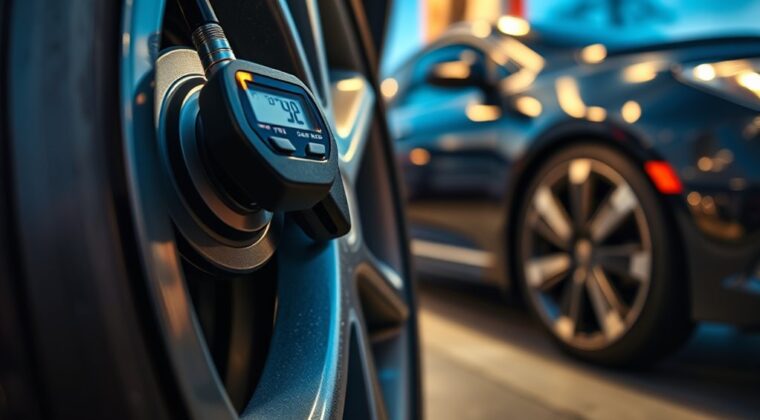
Your tire pressure rises after driving because heat builds up from road friction and sidewall flexing, which warms the air inside the tire and makes it expand. You’ll often see about a 1 psi increase for every 10°F of temperature rise, and a normal hot-to-cold change can be around 4 psi. That’s why cold pressure is the accurate baseline, and consistent changes can reveal leaks, underinflation, or other issues you should understand further.
Key Takeaways
- Driving heats tire air from friction and road contact, causing the pressure to rise.
- Tire pressure typically increases about 4 psi after normal driving.
- A 10°F temperature rise can add about 1 psi inside the tire.
- Hot readings can mask the tire’s true cold pressure and hide slow leaks.
- Check tires when cold for the most accurate pressure and safety baseline.
Why Tire Pressure Rises After Driving?
Tire pressure rises after driving because the tires heat up from friction and road contact, causing the air inside to expand. As the temperature increases, you’ll see measurable pressure changes in psi, and a typical drive can raise tire pressure by about 4 psi from cold to hot.
For every 10°F increase, expect roughly 1 psi more. That shift doesn’t mean your tires are failing; it’s a normal physical response that affects grip, response, and load support. When your tires warm, the air molecules move faster, occupy more space, and push harder against the casing.
If you check your tire pressure after driving, you may read higher than the true cold baseline. To protect your freedom on the road, check your tire pressure when tires are cold, so you can identify underinflated tires accurately and keep your vehicle performing safely and efficiently.
How Heat Changes Tire Pressure?
Heat changes tire pressure by expanding the air inside the tire as the temperature rises. When you drive, friction flexes the sidewall and warms the carcass, so the gas molecules move faster and occupy more volume.
That raises the air pressure inside the tire, and you’ll usually see tire pressure climb by about 1 PSI for every 10°F increase in temperature. Under normal driving conditions, that heat buildup can push pressure readings several PSI above the cold inflation pressure.
This isn’t a fault; it’s the expected thermodynamic response of a sealed pneumatic system working in motion. You should read tire pressure when the tires are cold, because driving heat distorts measurements and hides the manufacturer’s target.
How Much Pressure Change Is Normal?
When you drive, a pressure increase of about 4 psi is normal as the tire warms and the air inside expands. You’ll usually see tire pressure rise by roughly 1 PSI (pound per square inch) for each 10°F temperature rise, so modest pressure increases aren’t a fault. Check pressures against the manufacturer’s spec, then compare the hot reading to the cold baseline.
| Condition | Typical Change | Meaning |
|---|---|---|
| Normal drive | +4 psi | Expected expansion |
| 10°F rise | +1 psi | Thermal response |
| Cold weather | -1 to -2 psi | Ambient contraction |
Your tire warms, the gas energy climbs, and the gauge follows. Monthly drift of 1–2 psi can also happen from slow air loss, so a small shift doesn’t mean damage. For accuracy, check pressures when the tire’s cold, after several hours parked. That way, you get a clean measurement and keep control of your machine.
Why Cold Tire Pressure Matters?
You should check tire pressure when the tires are cold because that gives you an accurate baseline before heat from driving expands the air inside.
When you measure after driving, the reading can be artificially high, so it won’t reflect the tire’s true state.
Temperature also shifts pressure directly, with roughly 1 PSI lost for every 10°F drop, so you need cold readings to make correct adjustments.
Cold Reading Accuracy
Cold tire pressure readings give you the most accurate baseline because driving quickly warms the air inside the tire, causing pressure to rise as the air expands.
When you check cold tires, you measure true inflation in PSI, not a heat-altered value. That precision lets you act with freedom and confidence, because manufacturer specs assume cold conditions and consistent temperature.
- Park several hours before measuring.
- Use a reliable gauge.
- Compare the reading to the door placard.
- Record repeated cold checks to catch slow leaks.
If you inspect when tires are cold, you’ll get stable data that supports handling, safety, and fuel efficiency.
A cold pressure check also reveals gradual loss before it’s masked by driving-related heating.
Temperature-Based Pressure Changes
Tire pressure doesn’t stay fixed after a drive because heat changes the air volume inside the tire: as temperature rises, pressure typically climbs about 1–2 psi for every 10°F increase. That expansion of air is normal, but you shouldn’t chase the hot reading. Check cold tire pressure after the vehicle sits for hours, because pressure drops when the tires cool.
| Condition | Effect | Action |
|---|---|---|
| Cold tire pressure | Accurate baseline | Measure before driving |
| Temperature rise | Higher tire pressure | Expect temporary increase |
| Seasonal fluctuations | Larger pressure shifts | Recheck regularly |
You protect handling, reduce rolling resistance, and keep wear even when you maintain the specified cold tire pressure. In fall, seasonal fluctuations can quickly push tire pressure below target, so inspect often.
When Pressure Changes Mean Trouble?
If you see one tire losing pressure faster than the others, you’re likely dealing with a leak or puncture that needs immediate attention.
A TPMS warning that stays on for a specific tire usually means air loss is continuing, not just a temporary fluctuation.
You should inspect the tire, valve stem, and tread area for leaks or damage whenever pressure changes remain inconsistent or unexplained.
Uneven Tire Pressure Loss
When one tire consistently loses pressure faster than the others, you’re likely dealing with more than normal fluctuation; a puncture, slow leak, or valve stem issue may be present. Track your tire pressures with a monitoring system and note any uneven tire pressure loss after driving. If the TPMS light or pressure warning appears for one wheel, don’t ignore it.
- Check my tire for embedded nails or cuts.
- Inspect the valve stem and cap for cracks or corrosion.
- Compare pressures when the tires are cold and stable.
- Recheck after a short drive to confirm the pattern.
Consistent loss in one tire, despite similar temperatures, signals mechanical damage that deserves prompt, independent diagnosis.
Persistent TPMS Warnings
A persistent TPMS warning usually means more than a momentary pressure swing, so you should treat it as a diagnostic signal and not just a dashboard nuisance. If one wheel keeps flashing, your tire pressure may be losing air faster than the others, or an underlying issue may exist. TPMS warnings often trigger after a 25% drop, so manual checks with a pressure gauge matter.
| Check | Meaning | Action |
|---|---|---|
| Same wheel | Likely localized fault | Compare readings |
| Cold morning | Temperature fluctuations | Recheck later |
| Stable conditions | Unexplained variation | Investigate further |
| Repeated alerts | Underlying issue | Seek service |
Monitor pressures regularly to prevent false alarms and keep your mobility free from avoidable risk.
Inspect For Leaks
A pressure change that persists after driving often points to a leak rather than normal heat expansion, especially when one tire reads markedly lower in its cold state than after warming up.
You should inspect tires for punctures, sidewall cuts, and rim corrosion. A slow leak can cause air loss and pressure fluctuations that heat alone won’t explain.
Watch for a TPMS light that stays on for one wheel; that’s a technical signal, not noise. Check the valve stem and cap, because damage or a missing cap can let tire pressure escape.
If one tire drops faster than the others, act now and measure cold tire pressure again.
- Compare cold and warm readings.
- Look for visible damage.
- Examine the valve stem.
- Repair the leak promptly.
How to Check Tire Pressure Correctly?
To check tire pressure correctly, you should measure it when the tires are cold—ideally after the vehicle has sat for several hours or overnight—so the reading matches the actual inflation level. Use a tire pressure gauge to check tire pressure at the valve stem, and compare the result with the PSI (pound per square inch) specified in your manual or on the drivers door jamb sticker. When tires are cold, the reading reflects true inflation, not heat expansion.
| Step | Action | Purpose |
|---|---|---|
| 1 | Remove valve cap | Access stem |
| 2 | Press gauge firmly | Prevent air loss |
| 3 | Adjust pressure | Match spec |
If pressure is low, add air with a compressor, then recheck. The importance of proper tire inflation is measurable: tires lose 1-2 psi monthly, and more in cold weather. Make regular monthly checks and inspect before trips.
Frequently Asked Questions
Why Does My Tire Pressure Increase After I Drive?
Your tire pressure increases after you drive because tire heat builds from rolling resistance and road flex, and that heat drives air expansion inside the casing.
Driving conditions, tire materials, and ambient temperature all shift the reading, often by 2–4 psi.
You should check pressure cold, then use regular pressure monitoring to catch real losses.
That’s safer, because inflated readings after driving can hide safety implications and underinflation risks.
Why Is My Tire Pressure Losing Even Though There Is No Leak?
Your tire pressure can drop with no visible leak because temperature effects, air humidity, and seasonal changes quietly alter tire inflation.
You’re also losing air naturally, about 1–2 PSI monthly, and driving conditions can accelerate that through tire wear or imperfect valve seals.
Keep pressure monitoring consistent, especially after cold snaps or altitude shifts.
If one tire falls faster, inspect the stem, bead, and wheel for hidden faults.
Why Did My Tire Pressure Go up All of a Sudden?
Your tire pressure likely jumped because tire temperature rose, causing air expansion inside the tire.
Driving conditions, like speed, load, and duration, can heat the casing fast, and ambient temperature shifts can add another psi or two.
You should check for uneven tire wear and keep pressure monitoring consistent.
If one tire rises more than the others, you may face safety implications that need inspection.
Is 40 PSI Too High for Tire Pressure?
Yes, 40 psi is usually too high for your tires unless your vehicle’s pressure recommendations call for it.
You should check the ideal tire pressure on the doorjamb sticker, then verify it with accurate tire pressure gauges.
Temperature effects and driving conditions can raise readings, but overinflation hurts tire maintenance, reduces traction, and creates safety implications.
You’ll get better control and efficiency by matching the manufacturer’s spec, not guessing.
Conclusion
So, when you drive, your tires warm up, and the air inside expands, raising pressure by about 2 to 5 PSI in many cases. Think of it like a balloon left in the sun: it gets firmer without any extra air. You should check tire pressure when the tires are cold, because that’s the number manufacturers use. If you ignore hot readings, you can misjudge inflation and compromise handling, wear, and safety.