
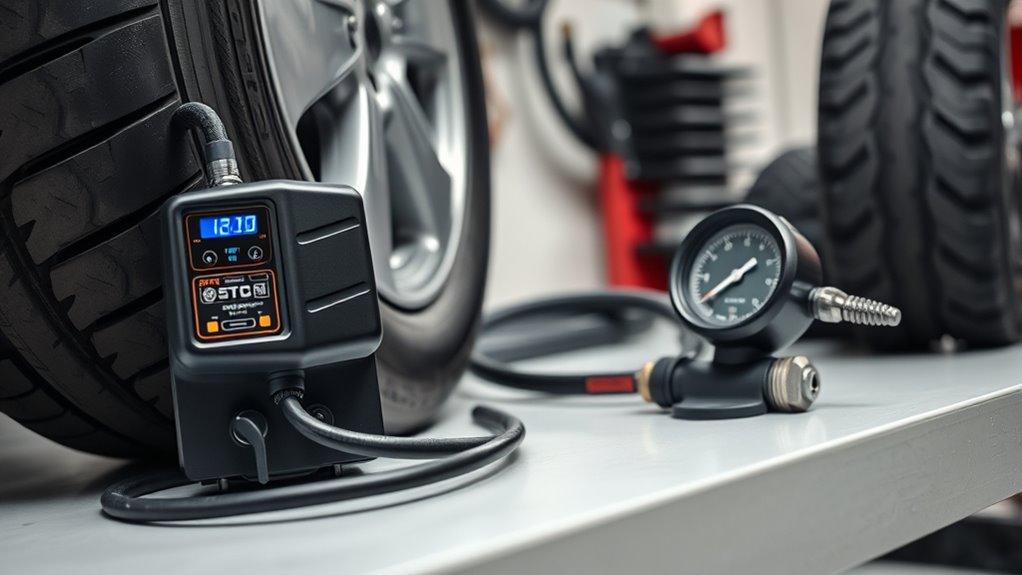
Auto shutoff tire inflators let you set a target PSI, then stop automatically, so you get faster inflation, less effort, and better overinflation protection. They usually fill a standard tire in about 3-7 minutes and show live pressure on a digital display. Manual inflators need constant pumping and frequent gauge checks, which takes longer and demands more attention. If you want the right match, the details below clarify which setup fits your tires and routine best.
Key Takeaways
- Auto shutoff inflators fill tires faster, usually in 3–7 minutes, while manual inflators can take 10–20 minutes.
- Auto shutoff models stop at the target PSI, reducing overinflation risk; manual inflators need frequent gauge checks.
- Auto shutoff inflators require little effort and offer hands-free use; manual inflators need constant pumping.
- Auto models provide real-time pressure monitoring with digital displays; manual inflators have limited or separate pressure feedback.
- Auto shutoff inflators suit routine car maintenance, while manual inflators work better for bikes, sports gear, and backup use.
Auto Shutoff vs. Manual Inflators: Which Is Better?
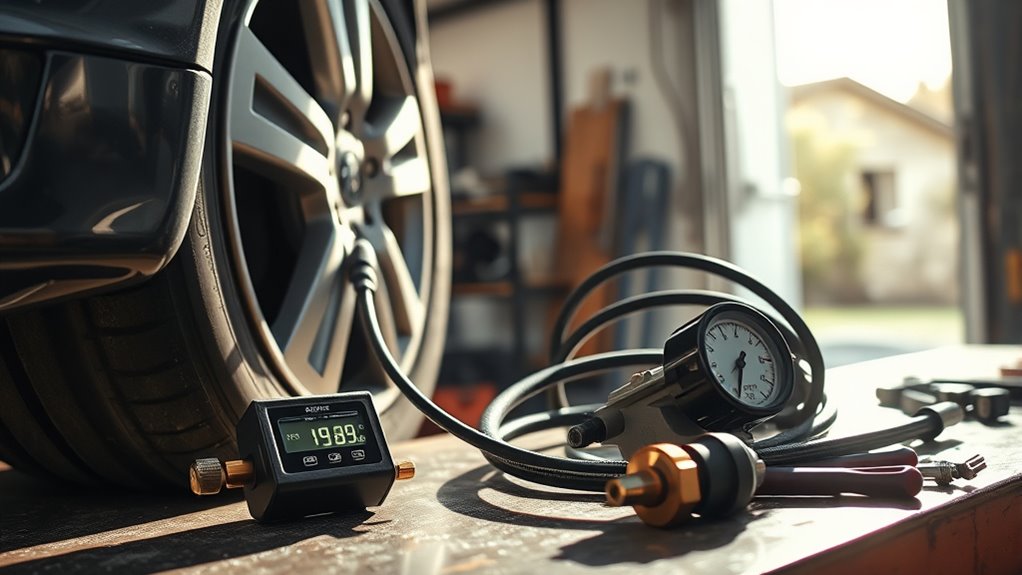
Auto shutoff inflators are generally the better choice if you want speed, accuracy, and less effort. You get built-in pressure gauges, auto-shut-off control, and accurate inflation without constant watching. That means you can set your target tire pressure and let the tool stop at the right PSI, reducing overinflation risk.
Auto shutoff inflators deliver speed, accuracy, and less effort with built-in gauges and automatic shut-off control.
For regular use, especially if you commute, this convenience matters: cordless models often finish a standard tire in 3-7 minutes.
Manual inflators give you control, but they demand continuous effort and close monitoring. You’ll spend more inflation time pumping, checking, and adjusting, which makes them slower and more labor-intensive.
They can work for occasional emergencies, yet they don’t free you from the process.
If you check tire pressure often, the higher price of auto shut-off models usually pays off through efficiency, consistency, and ease.
Manual inflators still have a place, but auto shut-off wins for most practical driving needs.
How Auto Shutoff Inflators Work
You set the target PSI on the inflator, and its pressure sensor tracks the air level in real time through the built-in gauge.
When the tire reaches that preset value, the control circuit triggers the automatic stop feature and cuts off airflow.
This prevents overinflation and lets you fill the tire without constant monitoring.
Pressure Detection
Built-in pressure sensors let auto shutoff inflators continuously monitor tire pressure as air is added, so you can set the target PSI and let the device do the rest.
This pressure detection keeps the inflation process controlled and accurate, while the automatic shut-off kicks in the moment the preset level is reached. A digital display gives you real-time readings, so you don’t have to guess or stop and check manually.
That precision helps you avoid overinflation, which can reduce safety and tire performance. Because the system handles monitoring for you, the inflator stays user-friendly and low-effort.
You stay in control without standing over the tool, and that kind of hands-free operation gives you more freedom, less hassle, and a cleaner, safer way to inflate tires.
Target PSI Setting
Once the inflator is reading tire pressure in real time, setting a target PSI lets it handle the rest automatically. You enter the target psi setting, and auto shutoff inflators track pressure with digital pressure gauges, so you get accurate inflation without watching the hose.
That frees you from constant checks and removes the guesswork that comes with a manual inflator. Most models make adjustments simple, letting you set different PSI values for cars, bikes, or light trucks in seconds.
For regular use, this control saves time and reduces error. Typical inflation times for a standard car tire run about 3-7 minutes, which gives you fast, dependable results and more freedom to move on.
Automatic Stop Feature
How does an auto shutoff inflator know when to stop? You connect it to the valve, and the built-in pressure gauge tracks tire pressure in real time.
When you set your desired PSI, the unit lets you choose the desired pressure level, then it powers the compressor until that value is reached. At that point, the automatic stop feature kicks in and the inflator will automatically shut off, so you don’t have to watch it constantly.
This pressure gauge for accurate readings keeps inflation controlled and consistent. For you, tire inflators provide a practical, efficient solution that saves time, prevents overinflation, and reduces guesswork.
If you want reliable performance with less manual labor, this design gives you more control and more freedom.
How Manual Inflators Work
You connect the manual inflator to the tire valve, then pump the handle to compress air into the tire.
Because it doesn’t use external power, you rely on your own effort, and a fully deflated tire will take more force to fill.
You also need to watch the pressure gauge closely while pumping so you don’t overinflate or underinflate the tire.
Pumping Mechanism
Manual tire inflators work by using a simple pumping mechanism that demands physical effort: each stroke compresses air and forces it into the tire through a securely attached valve connection. You control the manual pump, so the inflation process stays direct and transparent.
To inflate a tire efficiently, keep steady rhythm and watch the pressure gauge closely.
- You press down.
- Air moves through the hose.
- Pressure builds inside the tire valve.
A fully deflated tire needs more strokes, so expect greater exertion and more time, often 10 to 20 minutes for a car tire.
Because you must stop manually at target PSI, precision matters. This setup suits occasional use, giving you independence without relying on powered automation.
Valve Connection
A secure valve connection is essential when using a manual tire inflator, because the nozzle must stay firmly attached to the tire valve to prevent air leaks during pumping. Remove the valve cap, align the nozzle, and lock in a secure connection before you work the air pump. That stable fit lets you push air efficiently with each stroke. | Step | Action | Result |
| — | — | — |
|---|---|---|
| 1 | Attach nozzle | Tight seal |
| 2 | Pump steadily | Air enters |
| 3 | Check PSI | Target reached |
A manual inflator demands your effort, so consistent strokes matter, especially with a fully deflated tire. Smaller tires respond faster, while larger ones take longer. Keep the pressure gauge in view so you can stop at the recommended PSI and stay in control.
Pressure Monitoring
While inflating with a manual tire pump, you need to monitor pressure with a separate gauge, since these models don’t show real-time readings or shut off automatically. Your pressure monitoring routine must stay disciplined: stop pumping, read the tire pressure gauge, then resume until you hit the desired pressure.
Manual inflators demand your effort, so the inflation process can take 10–20 minutes for a standard tire. To keep control and avoid over-inflation, check often:
- Pump steadily.
- Pause and measure.
- Adjust for even air distribution.
Without automatic shut-off, you decide when to stop, which gives you direct control and practical freedom. Consistent technique keeps readings accurate and helps you reach safe, precise inflation without wasting energy or air.
Speed and Effort Compared
Speed and effort are the biggest differences between auto shutoff and manual tire inflators.
With automatic inflators, you get speed: a standard car tire usually reaches target pressure in 3-7 minutes, and the unit keeps a steady airflow as it works. That means less downtime and more convenience when you need to get moving.
Manual inflators demand more effort from you, and inflation time often stretches to 10-20 minutes, especially if the tire is large or nearly flat. You must keep pumping or watching the gauge, so your hands and body do the work the machine won’t.
Automatic inflators let you set the pressure and walk away while they finish the job.
Manual inflators still have value for occasional, low-volume tasks, but for regular car tire maintenance, automatic inflators free you from repetitive labor and give you a cleaner, more efficient routine.
Accuracy and Overinflation Risks
Accuracy is where auto shutoff inflators have a clear advantage, because their built-in gauges and preset shut-off settings stop airflow at the target PSI and reduce the chance of overinflation.
With AUTO SHUTOFF control, you gain repeatable accuracy and steadier pressure management.
MANUAL inflators depend on your judgment, so if you miss the gauge or react late, overinflation can creep in fast.
- Target PSI: set it, lock it, walk away.
- Steady airflow: 15-35 L/min supports precise filling.
- Final check: verify pressure with a separate gauge.
When you use automatic inflators regularly, you can keep tire pressure closer to spec, which helps vehicle performance and fuel efficiency.
Manual pumps can work, but they demand constant attention and precise timing.
For liberation from guesswork, choose the tool that controls pressure for you, then confirm the result with a trusted gauge before you drive.
Power, Portability, and Setup
Beyond pressure control, the next practical difference is how each inflator gets power, travels with you, and sets up at the tire.
Automatic inflators draw power from rechargeable batteries or your vehicle’s 12V outlet, so you don’t supply the muscle. That gives you real portability, especially with cordless models you can carry anywhere.
Manual inflators need no external power, but you provide every stroke, which limits freedom and adds fatigue.
For setup, automatic inflators usually need only a valve connection and a pressure setting, so you can start fast and let the unit manage the work.
Manual inflators take more effort to attach and operate, and inflation time depends on your strength.
In practice, automatic inflators can fill a standard car tire in 3-7 minutes. Manual inflators often need 10-20 minutes.
If you want a lighter, simpler, more liberated tire-care routine, power, portability, and setup all favor automatic inflators.
Best Uses for Each Inflator
Auto shutoff inflators are the better choice when you need routine tire maintenance, quick top-offs, or a fast fix on larger tires, since they stop automatically at the preset pressure and usually finish a car tire in 3–7 minutes with little effort from you.
AUTO SHUTOFF INFLATORS deliver efficiency and convenience when you want steady pressure without babysitting the gauge. Their best uses are clear:
- A driveway check before work, where you plug in and walk away.
- A roadside refill on a low SUV tire, where tire size demands speed.
- A weekly pressure reset, where consistency keeps handling predictable.
MANUAL INFLATORS fit smaller jobs better. You can use them for bike tires, sports gear, or inflatable toys, where slower pumping doesn’t drain you and power access may be absent.
In short, your best uses depend on task scale: choose auto shutoff for regular automotive freedom, and manual tools for light, occasional inflation.
How to Choose the Right Inflator
To choose the right inflator, start with how and where you’ll use it: corded models draw power from your vehicle’s battery, while cordless inflators give you better portability and convenience for driveway or roadside use.
If you inflate often, choose a CORDLESS unit with strong INFLATION SPEED; it can fill a standard tire in 3–7 minutes, far faster than a MANUAL INFLATOR’s 10–20 minutes.
For control, prioritize PRESSURE ACCURACY through a digital gauge and AUTO SHUTOFF, which stops inflation at your target PSI and helps prevent overinflation.
Match the tool to your TIRE SIZE COMPATIBILITY too: larger tires need higher PSI ratings and greater output capacity.
If you only need emergency backup, a MANUAL INFLATOR may be enough. But if you want less waiting, less effort, and more freedom from guesswork, pick a cordless model with AUTO SHUTOFF and the PSI range your tires require.
Frequently Asked Questions
What Is the Best Portable Tire Inflator According to Consumer Reports?
Consumer Reports often points you to the Milwaukee M12 Compact Inflator as the best portable tire inflator. You get strong inflation speed, an easy digital gauge, and auto shutoff for accuracy.
Its portability features suit roadside use, while consumer reviews praise user satisfaction and durability.
If you compare price comparison and power source options, the DeWalt DCC020IB and Ryobi P737 also give you flexible, practical alternatives.
What Are the Common Problems With Car Tire Inflators?
You’ll often face air leaks, pressure accuracy errors, overheating, weak battery power, and hard manual pumping.
Inflator durability suffers when you run units beyond duty cycle or ignore maintenance tips. Check hose length and valve seals for leaks, and watch noise level during use.
Your power source can drop performance if batteries’re low. To stay free from bad fills, inspect gauges, cool units, and clean fittings regularly.
What Are the Different Types of Auto Air Tire Inflators?
You’ll find corded 12V units, cordless battery inflators, digital gauges, preset models, portable kits, and heavy-duty industrial units. Each type differs in power sources, inflation speed, noise levels, and price range.
You can choose compact designs for emergencies or larger compressors for repeated use. Digital gauges give precise readings, while preset inflators stop automatically.
Pick the tool that lets you stay mobile, independent, and in control.
Do Tire Air Pumps Turn off Automatically?
Yes, many tire air pumps do turn off automatically. You’ll get slick, smart stopping with automatic shutoff when the preset PSI’s reached. That boosts safety features, improves inflation accuracy, and saves you from manual operation.
If you choose a cordless model, your power source and digital controls add user convenience. Some pumps still need you to monitor pressure and stop them yourself, so check the specs before you buy.
Conclusion
In the end, you should choose an auto shutoff inflator if you want consistent pressure control and less risk of overinflation, especially for daily driver tires. A manual inflator can work well if you need a simpler, lower-cost tool and you can monitor pressure closely yourself. For example, if you’re inflating a tire to 35 psi before a commute, auto shutoff lets you set it and stop accurately without guessing, saving time and reducing error.

