
Yes, you can use a tire inflator on trailer tires if it can reach the tire’s max cold PSI and run long enough to finish the job. You’ll usually need to inflate trailer tires to the pressure on the sidewall, often around 65 PSI, not a passenger-car setting. Choose a high-PSI inflator with an accurate gauge, good duty cycle, and automatic shut-off. Cold weather can slow cordless units, and the details matter.
Key Takeaways
- Yes, a tire inflator can inflate trailer tires if it supports the tire’s required PSI, often around 65 PSI or higher.
- Choose an inflator with a max PSI about 20–25% above your target tire pressure for faster, safer inflation.
- Check trailer tire pressure when cold, because driving heat can raise readings and hide under-inflation.
- Trailer tires should be inflated to the sidewall’s maximum cold PSI, not the lower pressure used for passenger tires.
- Use a high-quality inflator with an accurate gauge and suitable duty cycle to avoid overheating or incomplete fills.
Can a Tire Inflator Inflate Trailer Tires?
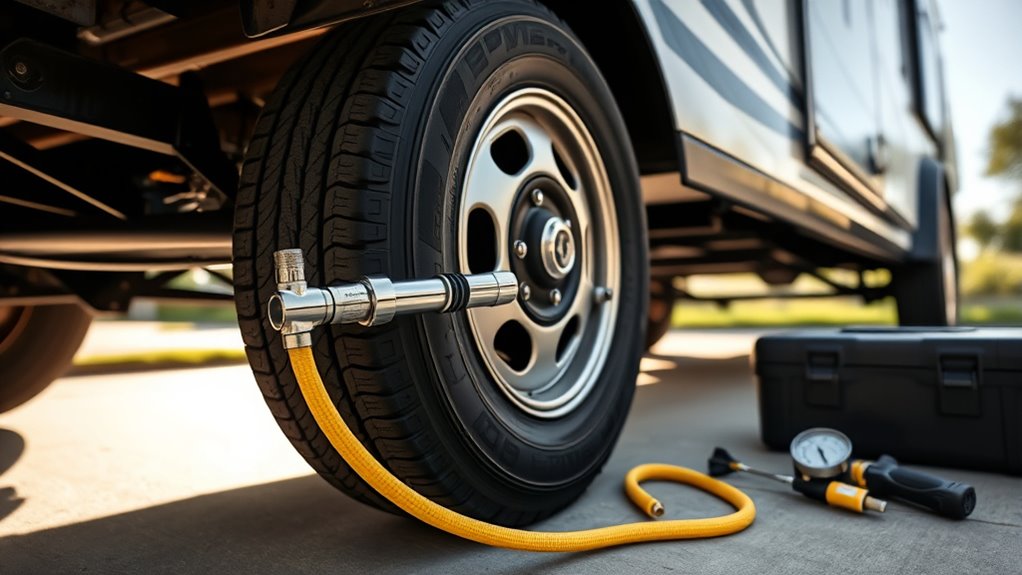
Yes—a tire inflator can inflate trailer tires, but only if it’s built for the higher pressures these tires require. You need a tire inflator rated for high-pressure applications, not a unit sized for standard passenger vehicles.
Many small inflators for heavy use claims still fail if their maximum PSI is too low or their duty cycles are too short. Choose a model with a safety buffer of 20–25% above your target PSI so it can run efficiently without overheating. Otherwise, you risk slow fills, motor burnout, and wasted time.
Before you connect it, check the valve stem for debris; a blocked valve can distort readings and slow inflation. If you want reliable, efficient inflation, match the inflator’s capacity to the job, not the marketing. That’s how you keep control, protect your gear, and stay ready to roll.
What PSI Do Trailer Tires Need?
Trailer tires should be inflated to the maximum cold PSI listed on the tire sidewall, which is typically around 65 PSI for many trailer tires. You should treat that maximum PSI as the target tire pressure for each cold reading, because under-inflation reduces safety and load capacity.
Check pressure before driving, since heat buildup changes the reading; if the tire’s warm, add about 3 PSI to estimate the cold value. Use a reliable gauge and verify every tire, not just one. Proper inflation keeps trailer tires stable under load, limits sidewall flex, and helps prevent blowouts.
Check pressure before driving, and verify every tire—proper inflation stabilizes the load and helps prevent blowouts.
It also improves fuel efficiency, treadwear, and tire lifespan. For trailer owners who value freedom on the road, consistent pressure checks are a small task with major payoff. Don’t guess or run them soft.
Stay within the sidewall specification, monitor tire pressure regularly, and you’ll protect your rig, your cargo, and your safety on every haul.
Why Trailer Tires Need Max Cold PSI
You should inflate trailer tires to the max cold PSI on the sidewall because that pressure sets the tire’s safe operating limit.
At max PSI, you reduce sidewall flex, which helps control heat buildup and lowers the risk of failure while towing.
You also preserve load-carrying capacity, so the tire can support the trailer as designed.
Max Cold PSI Matters
Pressure matters most on trailer tires because they’re engineered to run at the maximum cold PSI stamped on the sidewall, often 65 PSI.
You should inflate trailer tires to that max PSI before towing, not chase lower numbers for comfort. At the proper cold PSI, you get ideal performance, full load capacity, and better safety.
Maintaining that pressure reduces sidewall flex, which limits heat buildup and lowers the chance of blowouts and premature wear.
Don’t underinflate in hopes that heat will raise pressure later; manufacturers design these tires for max PSI operation from the start.
Check pressure when the tires are cold, then adjust with a tire inflator as needed. That simple habit keeps trailer tires ready for controlled, reliable travel and protects your freedom on the road.
Prevent Sidewall Flex
Keeping trailer tires at their maximum cold PSI minimizes sidewall flex and helps them do the job they’re built for. When you hold the maximum PSI, you prevent sidewall flex, reduce heat buildup, and lower the chance of tire failure on the road.
Tire manufacturers design trailer tires to work at this air pressure, so they can absorb normal towing heat without losing control. If you run lower pressure, you weaken load-carrying capacity and stress the casing, which hurts towing safety.
You also cut longevity because the tire works harder with every mile. Check pressure when the tires are cold, and use a gauge you trust. Staying at spec keeps your trailer stable, your tires disciplined, and your travel freer.
Support Trailer Load Capacity
Trailer tires support their rated load only when they’re inflated to their maximum cold PSI, often 65 PSI, because that’s the pressure the casing is designed to carry.
When you inflate to maximum PSI, you protect trailer load capacity and keep tire pressure within spec. That reduces sidewall flex, limits overheating, and improves towing performance.
- Check tire pressure cold before every trip.
- Match inflation to the tire’s maximum PSI, not the tow vehicle’s feel.
- Watch for underinflation, which cuts capacity and safety.
Proper inflation also extends longevity by reducing stress and uneven wear.
If you run lower pressure, you invite blowouts, faster failure, and less control. For safe towing, keep every tire at its rated maximum PSI and carry the load the tire was built to support.
How to Choose a Trailer Tire Inflator
To choose the right trailer tire inflator, start by matching its output to your tire’s required PSI with some headroom: pick a unit rated about 20–25% above your target, so an 80 PSI trailer tire calls for an inflator rated to at least 100 PSI.
That extra pressure margin helps the inflator work efficiently on trailer tires without strain. Choose a high-quality portable inflator built for these loads, not a passenger-car model.
Check the duty cycle too; some budget units run only 3–4 minutes, which can leave you short on larger tires.
Watch environmental factors as well: cold can cut performance, so store the inflator in a heated space when you can.
Prioritize features like an accurate pressure gauge and automatic shut-off to stop over-inflation. Those controls protect tire safety, preserve tread life, and give you cleaner, more independent control over maintenance.
Why Duty Cycle Matters for Trailer Tires
Even with the right PSI rating and a solid gauge, the inflator’s duty cycle determines whether it can actually finish the job without overheating. For trailer tires, you need continuous use long enough to match real inflation times, not just a quick burst.
Budget units may stop after 3-4 minutes, but your tires can need 8-12 minutes, so short runtimes invite friction heat and weak airflow.
- Choose a duty cycle that supports about 75% capacity operation.
- Buy a unit rated 20-25% above your target PSI.
- Protect safe towing by avoiding equipment failure.
When you match the inflator’s duty cycle to the load, you get reliable performance instead of stalled progress. That means you can hold pressure, finish the fill, and keep your trailer ready for the road without waiting on a hot motor to recover.
How Cold Weather Affects Cordless Inflators
Cold weather can cut a cordless inflator’s performance faster than you’d expect: lithium-ion batteries often lose 20-30% of their effective capacity below 40°F (4°C), which can cause voltage sag, lower torque, and reduce maximum pressure by 10-15 PSI. When the temperature drop hits, cordless inflators work harder and deliver less tire inflation, so you may see slower fill times and performance issues.
| Condition | Effect |
|---|---|
| Cold weather | Battery capacity drops |
| Voltage sag | Torque and speed fall |
| Reduced pressure | Maximum pressure decreases |
For peak performance, keep the unit fully charged and stored in a heated environment before use. You’ll preserve battery capacity, limit voltage sag, and hold closer to rated maximum pressure. That matters when you need clean, efficient tire inflation without waiting around. If you’re relying on cordless inflators in winter, plan for the cold instead of assuming summer specs still apply.
How to Prevent Trailer Tire Blowouts
Trailer tire blowouts are usually preventable when you keep pressure, load, and tire condition under control. You should check tire pressure before every trip and inflate trailer tires to the maximum PSI marked on the sidewall. Use a quality tire pressure gauge so you get accurate readings, and read them when the tires are cold.
Under-inflated tires flex too much, build heat, and fail faster, so proper inflation matters.
- Inspect for cracks, cuts, and tread wear that signal damage.
- Stay within the Gross Axle Weight Rating to avoid overload stress.
- Correct low tire pressure before towing, not after heat builds.
When you maintain trailer tires this way, you reduce blowouts and keep the load moving with more control. This routine isn’t complicated, but it does demand discipline.
Consistent inspection and inflation help you protect your gear, preserve freedom on the road, and avoid preventable roadside breakdowns.
When to Check Trailer Tire Pressure
You should check trailer tire pressure before every trip so you can catch under-inflation before it becomes a safety issue.
Always measure the tires when they’re cold, since heat from driving can raise pressure and distort the reading.
Use a gauge rated for the higher PSI your trailer tires require, and compare the result to the manufacturer’s specification.
Check Before Every Trip
Before every trip, check trailer tire pressure with a reliable gauge when the tires are cold, since driving heat can raise readings by about 3 PSI and lead to inaccurate inflation checks.
You should check before every trip to keep tire pressure at the maximum PSI marked on the sidewall, which helps you avoid under-inflation and related safety issues.
Verify load limits too, because overloading can push GAWR past its rating and stress the tires.
Use pre-trip checks to inspect for cracks or bulges before you inflate trailer tires.
- Confirm each tire’s maximum PSI.
- Compare cargo weight to load limits.
- Record readings with a reliable tire pressure gauge.
Measure Tires When Cold
For accurate trailer tire pressure readings, check the tires when they’re cold, since driving heat can raise pressure by 3 PSI or more and give you a false sense of proper inflation.
You’ll get the most reliable measure before movement, ideally after the trailer has sat for several hours. Read the maximum cold PSI printed on the sidewall, then set each tire to that spec unless the trailer maker says otherwise.
This simple check protects load capacity, reduces sidewall flex, and limits heat buildup that can damage the tire.
Correct pressure improves towing performance, stability, and safety, while under-inflation can trigger blowouts.
Make this cold-pressure routine part of your pre-trip process, and you’ll keep your trailer rolling with more control, less stress, and better freedom on the road.
Trailer Tire Maintenance That Extends Life
Keeping trailer tires in top condition starts with consistent pressure checks when they’re cool, with inflation set to the maximum PSI listed on the sidewall for safe, stable towing.
Check trailer tire pressure when cold and inflate to the sidewall’s maximum PSI for safe towing.
You keep tire pressure exact, inspect tires for cracks, bulges, and uneven tread, and act fast to prevent potential failures. If you need to inflate trailer tires, use a reliable inflator that reaches the maximum PSI without guessing.
Rotate trailer tires on a schedule to correct wear caused by improper loading or axle mismatch, and always verify proper loading before departure. Store spares in a cool, dark place with minimal inflation to reduce dry rot and extend lifespan.
- Check tread and sidewalls before every trip.
- Replace trailer tires every 3–4 years, even if tread looks fine.
- Record pressure, wear, and service dates so you can replace trailer tires on time.
Frequently Asked Questions
What Psi Should I Inflate My Trailer Tires?
Inflate your trailer tires to the PSI listed on the sidewall, usually the maximum cold pressure, often 65 PSI.
You should check it with a tire pressure gauge when the tires’re cool, then adjust for weather effects and load capacity.
Keep up trailer tire maintenance, monitor inflation frequency, inspect valve stem care, and watch tire wear.
Proper pressure recommendations improve towing safety, and emergency inflation can help you stay mobile.
Do Trailer Tires Really Take 80 Psi?
Yes, some trailer tires do take 80 psi, and you’ll see that number when the tire’s weight capacity demands it. You should check the sidewall, then match tire pressure to load distribution, temperature effects, and tire age.
During trailer maintenance, inspect tread depth, valve stems, and inflation frequency. Keep tires at cold max PSI, because underinflation raises heat and risk.
Follow safety tips, and you’ll tow with control, not coercion.
Is 65 Psi Too Much for Trailer Tires?
No, 65 psi isn’t too much if your trailer tires are rated for it. You should match tire pressure to the sidewall’s max cold rating for load capacity and trailer safety.
Use accurate pressure gauges, follow inflation tips, and check tire maintenance regularly. Seasonal changes can shift psi, so adjust before trips.
Proper air compressors help you keep road stability, reduce tire wear, and avoid blowouts.
Is 90 Psi a Safe Tire Pressure for a Trailer?
Yes, 90 psi can be safe if it matches your trailer tire’s sidewall max and load capacity.
You should verify tire safety with pressure monitoring, check inflator compatibility, and follow towing guidelines.
Keep up maintenance tips, inflation frequency, and cold readings to limit tire wear.
Don’t trust common misconceptions; overpressure raises failure risk.
For emergency preparedness, carry a reliable gauge and inflate only to the manufacturer’s specification.
Conclusion
So, yes, you can use a tire inflator on trailer tires, as long as it can reach the required PSI and run long enough for the job. Trailer tires often need their maximum cold PSI, and underinflation can sharply raise heat and failure risk. One useful stat: tire pressure can drop about 1 PSI for every 10°F of temperature loss. Check your tires before every trip, and you’ll help extend tire life and reduce blowout risk.