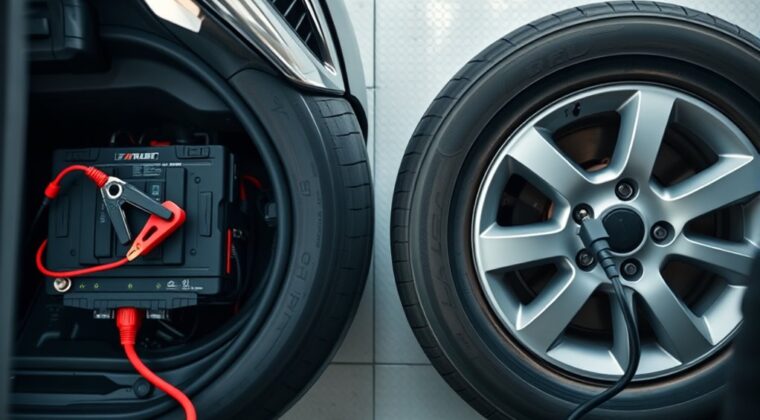
Battery-clamp tire inflators clip to your vehicle’s battery, so you get higher current, faster inflation, and more independence from the engine. 12V socket inflators plug into the accessory outlet, stay simpler and cheaper, but they rely on the vehicle running for steady power. If you need roadside readiness, battery-clamp models are stronger; if you want routine top-offs, a 12V unit is usually enough. The details below show which design fits your use case best.
Key Takeaways
- Battery-clamp inflators connect directly to the vehicle battery and can run without the engine, while 12V socket models need the vehicle powered on.
- Battery-clamp inflators usually deliver faster inflation and handle larger tires better, but 12V socket inflators are simpler and more budget-friendly.
- Battery-clamp models are better for roadside emergencies, especially with a dead battery, because they can work independently.
- 12V socket inflators are best for routine top-offs and garage use when vehicle power is available.
- Battery-clamp inflators are more portable and cord-free, while 12V socket inflators are tethered by cords and can be less convenient.
What’s the Difference Between Battery-Clamp and 12V Socket Tire Inflators?
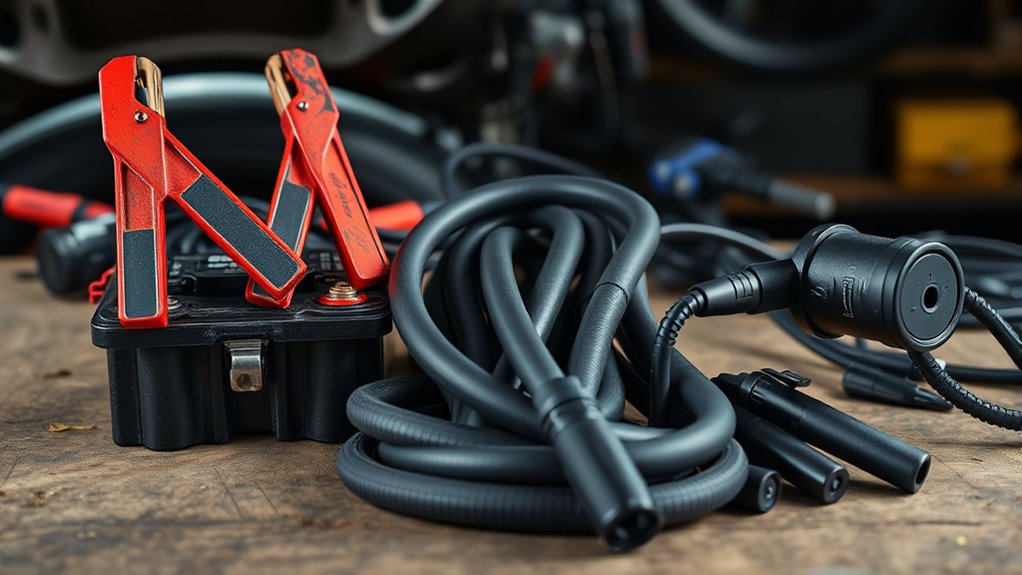
Battery-clamp tire inflators connect directly to your vehicle’s battery with alligator clips, while 12V socket inflators draw power from the cigarette lighter or accessory outlet.
You choose a different power source, and that choice changes how you work. A battery-clamp inflator can run without the vehicle started, so you gain a portable tire solution for remote or emergency use.
A 12V socket unit depends on the vehicle’s electrical system, so it’s most practical when the engine is already on. In practice, you trade independence for convenience.
If you need a battery-powered tire tool that can operate when roadside access is limited, clamps give you more freedom. If you want a compact inflator for routine top-offs during normal driving, the socket model stays simpler.
Both types inflate tires, but they’re engineered around different access points, operating assumptions, and use cases, so your choice should match your mobility needs and your vehicle’s available power source.
Why Battery-Clamp Tire Inflators Deliver More Power
Because they connect directly to your vehicle’s battery terminals, battery-clamp tire inflators draw a steadier, higher-current supply than most 12V socket models. You get more amperage, so the motor spins faster and moves more air per minute.
That extra electrical headroom makes the inflator powerful enough to raise tire pressure quickly, often in under five minutes for standard car tires. Because the unit isn’t tightly limited by the socket circuit, it keeps performance stable even when your vehicle is off.
You also reduce strain on the accessory outlet and preserve battery life by avoiding prolonged draw through lighter wiring. Larger motors translate that current into usable pressure for trucks and SUVs, where volume and higher target pressure demand more output.
Built-in overload protection helps you keep control, preventing damage while you inflate on your terms. In practice, direct-battery connection gives you a cleaner power path and more decisive inflation performance.
When a 12V Socket Tire Inflator Makes Sense
A 12V socket tire inflator makes sense when you want simple, continuous power without managing battery connections. You plug it into the 12V socket, start the vehicle, and get steady output that lets you inflate tires with minimal setup.
For routine roadside use, that direct supply keeps the motor running consistently, so you can handle flats or low-pressure checks without monitoring charge levels like you’d with battery-powered inflators. It’s especially effective on larger tires, where sustained airflow and pressure matter more than portability.
Because the vehicle supplies power, you reduce the chance of draining a standalone pack during inflation. In an emergency, that immediacy matters: you can deploy, connect, and work quickly.
The main constraint is cord length, which can limit reach to every wheel. If your priority is reliable, practical inflation with fewer variables, this design gives you clear operational freedom.
Battery-Clamp Tire Inflator Pros and Cons
You get strong portability and convenience with a battery-clamp tire inflator because it’s compact, lightweight, and easy to carry in a vehicle or backpack.
It also gives you more power and flexibility since it can operate without the vehicle’s 12V socket and may deliver higher amperage for faster inflation.
However, you’re still limited by the rechargeable battery’s capacity, so you’ll need to keep it charged if you want it ready in an emergency.
Portability And Convenience
Battery-clamp tire inflators stand out for portability and convenience, since they’re cordless, lightweight, and easy to store or carry for roadside use. You can deploy one anywhere, which gives you real freedom when a flat interrupts your route. Their battery life usually supports multiple tires per charge, so you can handle most emergencies without immediate recharging.
| Trait | Effect | Value |
|---|---|---|
| Cordless | No outlet needed | Total mobility |
| Light weight | Easy to carry | Less fatigue |
| Compact size | Simple storage | Rapid access |
| Digital display | Exact PSI feedback | Better control |
| Preset PSI | Automatic stop point | Faster setup |
That combination improves portability, convenience, and confidence when you need fast, independent inflation.
Power And Limitations
Drawing power directly from the car’s battery gives battery-clamp tire inflators a clear advantage in output and speed, especially when you need a fast roadside repair. You get higher inflation power, and you can run the unit even with the engine off, which adds real freedom in remote or stalled situations.
That advantage comes with limitations, though: extended use can drain your battery, leaving you with a dead vehicle if you don’t manage runtime carefully. Compared with 12V socket models, these inflators usually cost more and demand more maintenance.
You gain versatility and faster response, but you must monitor load, connection quality, and engine state. If you want autonomous tire service, this design delivers; if you want simplicity, its limits matter.
12V Socket Tire Inflator Pros and Cons
A 12V socket tire inflator offers a practical mix of convenience and performance, since it draws continuous power from the vehicle and can run without interruption as long as the engine is on. You get a 12V socket tire inflator that’s easy to use: plug it in, start the vehicle, and inflate with minimal setup.
Its stronger motor usually handles larger tires more efficiently, so you spend less time waiting and more time moving. It’s also cost-effective, because simpler electronics and lower production costs usually reduce the purchase price.
The tradeoff is dependence on the vehicle’s electrical system. If your car battery is dead, the unit won’t operate, which removes its utility until power returns.
Cord length can also limit reach, making access to every tire less flexible. You may need to manage storage carefully, too, since cords can tangle and occupy space.
For you, this design favors efficiency, but it’s not fully independent.
Which Tire Inflator Works Best in Emergencies?
In emergencies, portability and power independence usually matter more than continuous runtime, which gives battery-powered tire inflators a clear advantage over 12V socket models. You can deploy them anywhere, even if your car won’t start.
12V socket inflators, by contrast, depend on an operational vehicle and lose value when the battery is dead.
- Use battery-powered inflators when you need freedom from the vehicle.
- Choose 12V socket inflators only if the engine still runs.
- Favor models with LED lights and digital displays for control.
- Check battery charge before you travel.
Many battery-powered inflators also work fast enough for roadside relief, and their cordless design reduces setup time.
That said, you should remember their limited battery life; after a few uses, they need recharging.
For true emergencies, the best choice is usually the tool that stays usable when your vehicle doesn’t.
How Fast Each Inflator Fills a Tire
When speed matters, battery-powered inflators usually have the edge, with some models like the Vortex S6 taking a standard tire from flat to 35 psi in about 1 minute. You get rapid inflation because these units can move air at roughly 1.5 CFM, so inflating tires feels immediate and controlled.
In practical terms, that speed lets you restore pressure fast and stay mobile without waiting around. By comparison, 12V socket inflators typically need 10 to 30 minutes to fully fill larger tires, depending on size and starting pressure. Their output is often lower, so each psi takes longer to build.
Battery-powered inflators restore pressure fast, while 12V units can take 10 to 30 minutes for larger tires.
You also face a power constraint: if your vehicle’s battery is weak or dead, a plug-in inflator may slow down or fail outright.
Battery-powered inflators can remain efficient across multiple fills, with some handling up to 8 tires on one charge, which gives you more independent tire service.
Key Factors: Power, Speed, and Portability
Power source shapes almost every tradeoff here: battery-clamp inflators pull direct power from the vehicle’s battery, so they can deliver steadier output for larger tires and keep working even if the car is off, while 12V socket inflators depend on the vehicle’s electrical system and may struggle if the battery is weak or dead.
- You get stronger power delivery with battery-clamp units, which supports more consistent operation under load.
- You usually get better inflation speed from clamp models because higher amperage reduces drop in output.
- You gain portability with 12V socket inflators, since they’re smaller, lighter, and easier to stash.
- You sacrifice some freedom with clamp models because they’re bulkier and need battery access, but they stay functional in more constrained emergencies.
If you value self-reliance, weigh power against portability, then choose the design that matches how quickly and independently you want to inflate tires.
Best Uses for Each Tire Inflator Type
At home or in the garage, a 12V socket inflator usually gives you the fastest, most efficient fill-ups as long as your vehicle’s power outlet is available.
For roadside emergencies, you’ll want a battery-clamp inflator because it can run even if your car battery is dead, and its LED light and preset controls improve low-light use.
If portability and compact storage matter most, the battery model is easier to keep in your trunk or glove box, while the 12V unit fits better in a vehicle-based setup.
Home Garage Use
For home garage use, the better choice depends on how you plan to work: a 12V socket inflator is usually the faster option for topping off multiple tires, especially if you can keep the engine running for continuous power, while a battery-clamp inflator is more flexible if you want a compact tool you can move freely around the garage or use away from the vehicle.
- Choose 12V socket inflators for higher inflation speed.
- Use battery-clamp inflators when cord freedom matters.
- Keep a 12V cord routed cleanly to avoid tangles.
- Store battery-clamp units compactly for fast access.
If you value efficiency, the socket model suits repetitive garage tasks. If you value mobility, the clamp model gives you more control and fewer constraints.
Roadside Emergency Needs
When you’re dealing with a roadside emergency, a battery-clamp inflator is usually the stronger choice because it can jump-start the vehicle while inflating a tire, and it doesn’t depend on the car’s battery being healthy or the engine already running. That independence matters when you need control, speed, and options.
| Type | Best use |
|---|---|
| Battery-Clamp Inflators | Dead battery, flat tire |
| 12V Socket Inflators | Running vehicle, routine top-off |
| Battery-Clamp Inflators | Fast inflation in roadside emergencies |
| 12V Socket Inflators | Continuous power when the car’s live |
You get quicker recovery with Battery-Clamp Inflators, often under 2 minutes, which reduces exposure and restores mobility. By contrast, 12V Socket Inflators suit you when the vehicle is already operational. In roadside emergencies, choose the tool that keeps you free, not trapped.
Portability And Storage
Portability often decides which tire inflator earns a place in your vehicle kit.
Battery-powered inflators give you true portability: they’re lightweight, compact, and easy to stow in a trunk or glove box.
- You can carry them anywhere, even without a vehicle.
- Their storage is simpler because no cords tangle.
- They suit emergency use away from home.
- They support multiple tires per charge.
Which Tire Inflator Should You Buy?
Which tire inflator should you buy? Choose by failure mode, tire size, and autonomy. If you want maximum independence, battery-clamp inflators suit you when the car battery is dead, when you need faster inflation, or when you’re serving larger tires and multiple jobs. If you want a simpler, lower-cost tool for routine top-offs, 12V socket inflators fit that role, though they can run slower and depend on vehicle power.
| Need | Best Choice | Result |
|---|---|---|
| Dead battery | Battery-clamp | Freedom |
| Fast fill | Battery-clamp | Less waiting |
| Budget use | 12V socket | Lower cost |
Battery-clamp inflators give you technical leverage and mobility; 12V socket inflators give you economical convenience. For tire inflators, the right purchase depends on whether you prioritize liberation from the vehicle’s electrical limits or you’re comfortable staying tethered to them.
Frequently Asked Questions
What Is the Best 12V Portable Tire Inflator?
The best 12V portable tire inflator is a reliable 12V socket model like the Ryobi-style unit, because you get strong power source continuity, fast inflation speed, and practical inflator features.
You’ll want a built-in gauge, auto shut-off, and enough hose length for easy access.
If you value autonomy on the road, choose one that inflates larger tires in under 10 minutes and won’t leave you dependent on batteries.
What Are the Common Problems With 12 Volt Air Compressors?
You’ll usually face weak power source reliability, slow inflation speed, and limited air compressor durability.
Think of a tethered lantern: it works, but only where the cord reaches. A 12-volt compressor depends on your vehicle, so a dead battery stops inflation.
Long runs can overheat the motor, and tangled cords restrict mobility. You gain portability only within the car’s electrical limits, which reduces freedom and operational efficiency.
What Is the Best Battery-Operated Tire Inflator?
You’ll likely want the Vortex S6 as the best battery-operated tire inflator.
It gives you wireless convenience, a compact design, and strong battery life, letting you fill multiple tires on one charge. Its digital PSI presets improve accuracy, and its fast inflation speed reduces downtime.
You get portable, vehicle-independent operation, so you’re free from cords and sockets. If you value autonomy and efficiency, this model’s a top technical choice.
What Is the Best Portable Tire Inflator According to Consumer Reports?
According to Consumer Reports, you’ll likely choose a battery-powered model like the Vortex S6: quick, compact, and untethered.
Like a sprinter off the blocks, it delivers fast inflation, digital PSI presets, and strong battery life—often enough for several tires.
For tire maintenance tips, compare inflator features comparison, especially portability and accuracy.
With portable power sources, you’re free to inspect, inflate, and move on without relying on a vehicle outlet.
Conclusion
When you compare battery-clamp and 12V socket tire inflators, the trade-off is clear: power versus convenience. Battery-clamp models can draw higher current, so they often inflate faster under load, while 12V socket units are limited by the vehicle’s accessory circuit. One useful statistic: many 12V outlets are fused at 10 to 15 amps, which constrains output. Choose the clamp model for speed and heavy-duty use, and the socket model for compact, everyday portability.