
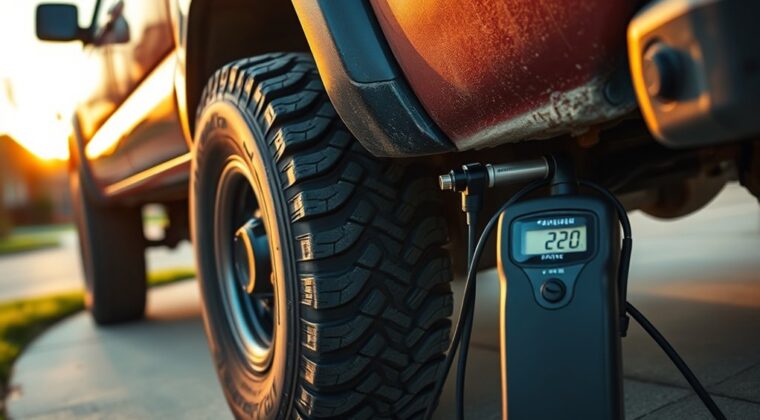
Yes, you can inflate pickup truck tires with a portable tire inflator, but you’ll want a heavy-duty model built for larger tire volume. Check your truck’s recommended PSI on the door jamb label, usually 35 to 80 PSI, and inflate tires when they’re cold. Airflow, duty cycle, and cooling matter more than raw pressure alone. Smaller units can overheat or slow down, while stronger inflators can handle truck tires much better and faster.
Key Takeaways
- Yes, a portable tire inflator can inflate pickup truck tires if it is heavy-duty enough for the tire size and volume.
- Pickup truck tires typically need 35 to 80 PSI, so always confirm the correct pressure on the door jamb label or owner’s manual.
- Faster inflation depends on airflow, so choose an inflator with strong L/min or CFM ratings for larger truck tires.
- A 100% duty cycle is best for continuous use, since lower-duty models may overheat and need cooling breaks.
- Most portable inflators are better for topping off tires, not filling completely flat truck tires from 0 PSI.
Can a Portable Tire Inflator Fill Pickup Truck Tires?
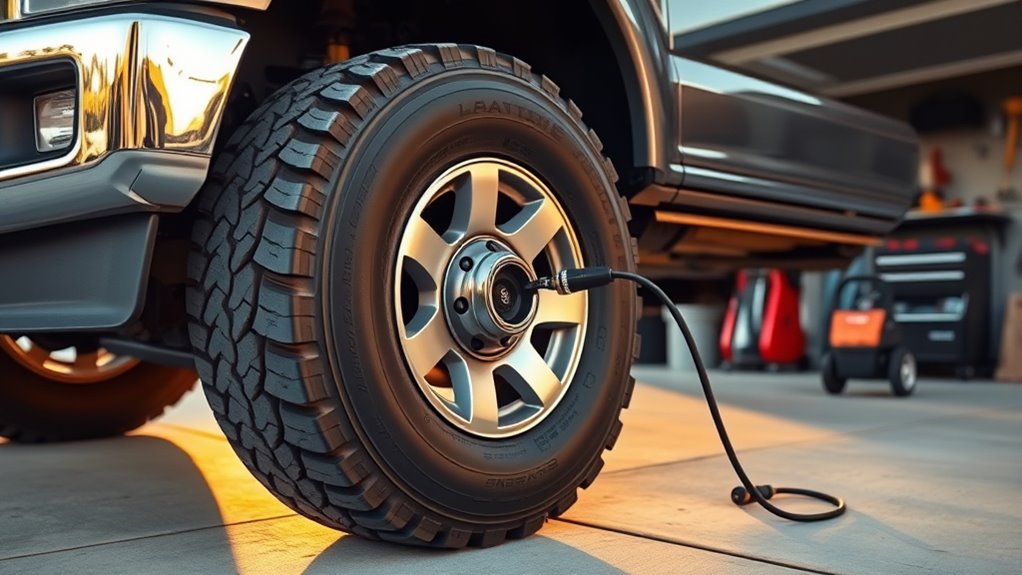
Yes—a portable tire inflator can fill pickup truck tires**, but only if it’s built for the job. You need a portable tire inflator with enough airflow and cooling capacity** to keep up with larger tire volumes.
Light-duty models often struggle because pickup truck tires demand more air and can push weak compressors into overheating. That slows you down and wastes energy.
Choose a heavy-duty unit with a strong motor, a robust cooling system, and a 100% duty cycle so you can inflate without constant shutdowns.
Models engineered for trucks, such as the ETENWOLF Vortex S7, can move serious air and fill a 30-inch tire in about 30 seconds.
You should also check your truck manufacturer’s recommended tire pressure before you start. That keeps you precise, protects the tire, and lets you use your equipment with confidence.
What PSI Do Pickup Truck Tires Need?
Pickup truck tires typically need anywhere from 35 PSI to 80 PSI, depending on the truck’s model, tire size, and load rating. You should confirm your exact target PSI on the door jamb label or in the owner’s manual, because that spec matches your vehicle’s engineering and safety limits.
Use a tire pressure gauge to measure pressure when the tires are cold; driving heats the air and can raise readings by several PSI, which can mislead you. If you inflate beyond the recommended PSI, you risk reduced traction, uneven tread wear, and even blowouts.
Keep the tires at the specified pressure to support safe handling, stable braking, and better fuel efficiency. Check all four tires regularly, and adjust them as needed after temperature changes or heavy hauling.
When you stay on top of PSI, you keep your truck responsive, efficient, and ready for the work you choose.
Why Does Airflow Matter More Than PSI?
When you’re inflating pickup truck tires, airflow matters more than PSI because it determines how fast the inflator can move air into the tire. PSI tells you the target pressure; airflow tells you the delivery rate. For larger tires, that rate is what keeps you moving freely instead of waiting.
| Factor | Practical effect |
|---|---|
| High airflow | Faster inflation |
| Low airflow | Slower fill time |
| High PSI only | May still feel weak |
| Heavy-duty tires | Need more air volume |
You want an inflator with strong airflow in liters per minute or CFM, especially if you’re servicing heavy-duty tires. A unit that only reaches high PSI can still underperform if it can’t deliver air quickly enough. Prioritize airflow, because it reduces downtime and keeps your work efficient. That’s the technical edge that helps you stay ready, independent, and in control.
How Fast Does a Tire Inflator Work on Truck Tires?
How fast a tire inflator works on truck tires depends mostly on airflow, pressure capacity, and duty cycle.
When you choose the right tire inflators, you can top off a 30-inch pickup tire in about 30 seconds with a heavy-duty unit like the ETENWOLF Vortex S7.
Faster performance comes from higher airflow, measured in L/min; quality models can reach 52 L/min, which moves air into larger tires efficiently.
Higher airflow, measured in L/min, helps quality inflators fill larger tires faster and more efficiently.
- Check airflow first: more L/min usually means faster fills.
- Match pressure capacity: truck tires often need 35 to 80 PSI.
- Favor a 100% duty cycle: you can inflate multiple tires continuously.
- Expect slower results from consumer-grade inflators: they use smaller motors and may need breaks.
If you want speed and freedom from delays, pick tire inflators built for truck loads, not compact models made for lighter jobs.
Why Do Small Inflators Overheat on Truck Tires?
Small inflators overheat on truck tires because they’re built for lower air volumes and shorter run times than heavy-duty units. When you push them to fill larger tire cavities, their small motors and cylinders work harder, creating heat faster than they can shed it. Truck tires often need 50-110 PSI, so you demand sustained output and high airflow that these units can’t maintain without strain. Consumer-grade cooling is usually modest, so temperature climbs quickly and the inflator may shut down.
| Factor | Effect | Result |
|---|---|---|
| Small motor | Limited compression | Faster heat build-up |
| High PSI demand | Longer workload | More stress |
| Low airflow | Slow filling | Extra runtime |
| Weak cooling | Poor heat removal | Overheat risk |
| Continuous use | Thermal limit reached | Shutdown |
If you want reliable inflation, match the tool to the job and avoid forcing small inflators beyond their design envelope.
What Is Duty Cycle on an Inflator?
Duty cycle tells you how long an inflator can run before it needs to cool down, usually shown as a percentage or time ratio.
If you use a unit with a 50% duty cycle, you might get 10 minutes of inflation time and then need 10 minutes off to prevent overheating.
For pickup truck tires, you’ll want a higher duty cycle so you can work longer with fewer cooling breaks.
Duty Cycle Basics
If you’re shopping for a tire inflator, duty cycle tells you how long it can run before it needs to cool down, usually as a percentage of continuous operation. You need this spec to match your workload and keep your gear working free and strong.
- A 50% duty cycle means 10 minutes on, 10 minutes off.
- A 100% duty cycle means continuous operation without overheating.
- Lower-duty consumer units often struggle with larger pickup tires.
- Heavy-duty inflators use stronger motors and cooling systems.
When you choose a higher duty cycle, you reduce heat stress and performance loss during repeated inflations. That matters when you’re airing up truck tires or handling multiple jobs.
Check the rating before you buy, because the right duty cycle helps your inflator stay reliable, efficient, and ready for real work.
Run Time Limits
An inflator’s duty cycle tells you how long it can run before it needs a cooling break, usually shown as a percentage of continuous operation. You should read this spec before you start inflating pickup truck tires, because it sets the limit on safe run time.
A 50% duty cycle means 10 minutes on, 10 minutes off; a 100% duty cycle lets you run continuously. Lower-duty cycle consumer inflators often can’t keep pace with multiple large tires, so you may waste time waiting.
If you exceed the duty cycle, you risk overheating, thermal shutdown, or motor damage. Choose an inflator with a duty cycle that matches your load, so you keep control, save effort, and move freely without unnecessary stops.
Cooling Break Needs
When you see an inflator’s duty cycle, you’re looking at how long it can run before it needs a cooling break; for example, a 50% duty cycle means 10 minutes of operation followed by 10 minutes off. That limit protects the motor from overheating and shutdown.
You’ll make better choices when you check it before inflating truck tires.
- Match the duty cycle to your workload.
- Use cooling breaks when the inflator isn’t 100%.
- Choose 100% duty cycle units for repeated truck tire jobs.
- Avoid pushing past the rating, or you risk damage.
For pickup trucks, a higher duty cycle gives you freedom to inflate larger tires efficiently, especially when you need multiple tires done without interruption.
Which Tire Inflator Features Matter Most?
Which tire inflator features matter most for pickup trucks? You should prioritize airflow rate first: tire inflators rated at least 1.85 CFM at 0 PSI move enough air to fill larger truck tires without wasting time.
Next, demand a 100% duty cycle so the unit can run continuously while you service multiple tires; that keeps you in control instead of waiting on cooling breaks.
Demand a 100% duty cycle so it runs continuously while you service multiple tires without cooling breaks.
Pressure accuracy matters just as much. You need reliable readings to avoid overinflation or underinflation, both of which can hurt handling, tread life, and safety.
A strong cooling system helps the inflator manage heat during long sessions and prevents thermal shutdown.
If you want portability, choose a model with high battery capacity, such as 38,400mAh, so your tire inflators stay ready when you’re away from power.
Focus on these specs, and you’ll pick tools that support practical, self-reliant truck care.
Can a Portable Tire Inflator Handle a Flat Tire?
A portable tire inflator can sometimes get you out of a bind, but most models aren’t built to inflate a flat truck tire from 0 PSI.
Most portable tire inflators only top off tires because they can’t sustain the airflow or pressure a dead tire needs. To gauge whether yours can do the job, check the specs:
- Airflow: target at least 1.5 CFM for practical flat-tire inflation.
- Pressure output: verify the unit can reach your truck’s required PSI.
- Duty cycle: choose a model that can run long enough without overheating.
- Use case: many consumer units are for topping off, not full recovery.
If you’re stuck, a sealant-plus-inflator combo can temporarily restore mobility, but it’s not a permanent fix.
For real freedom on the road, match the tool to the job and don’t expect every portable tire inflator to revive a completely flat pickup tire alone.
How Do You Use a Tire Inflator Safely?
You should check that the inflator matches your pickup’s required PSI and watch the built-in gauge as you fill the tire.
Compare the reading to the pressure listed on the door jamb or in the owner’s manual, and stop when you reach the target.
Limit continuous use to about 10 minutes, then let the unit cool to avoid overheating and shutdown.
Check Tire Pressure
Checking tire pressure with a tire inflator starts with a secure connection: fit the hose straight onto the valve stem to prevent air leaks, then power the unit from the correct source, whether that’s a wall outlet, battery, or 12-volt vehicle outlet.
Watch the built-in gauge as you inflate and compare tire pressure to the PSI on your door jamb or manual. Stay in control:
- Connect the hose firmly.
- Start the inflator.
- Check pressure often.
- Stop at the target PSI.
When you reach spec, remove the hose quickly and replace the cap to block debris and limit air loss.
If you need more air, use short sessions and let the inflator rest after about 10 minutes of continuous use. That keeps your setup efficient, safe, and ready for the road.
Watch Heat Limits
Because most small tire inflators have limited duty cycles, watch the clock and don’t run the unit continuously for more than about 10 minutes or it can overheat.
You should pause tire inflators between uses, especially when you’re servicing multiple pickup tires, so the motor can cool and avoid thermal shutdown or damage.
Keep an eye on the built-in gauge while you inflate; stopping at the door-jamb or owner’s-manual pressure gives you control and prevents over-inflation. That precision protects the tire and preserves your vehicle’s freedom to move safely.
After each fill, replace the valve stem cap immediately to block dirt and debris from entering the valve.
If the housing feels hot, stop and wait.
How Do You Choose a Heavy-Duty Inflator?
How do you choose a heavy-duty inflator for pickup trucks? Start by matching performance to your truck’s load. A true heavy-duty inflator should move air fast, run long, and keep pressure accurate so you stay mobile and in control.
Match inflator performance to your truck’s load for fast, reliable, and accurate inflation on the road.
- Airflow: Choose a heavy-duty inflator with at least 52 L/min. Higher airflow cuts inflation time on large tires.
- Duty cycle: Pick a 100% duty cycle model so you can inflate continuously without cooling breaks.
- Battery capacity: Look for 38,400mAh or more if you’ll inflate multiple tires on one charge.
- Cooling and pressure monitoring: Use efficient cooling to resist overheating, and verify accurate gauges or digital sensors to prevent under- or over-inflation.
This setup gives you practical freedom on the road and fewer delays off it.
A well-built heavy-duty inflator keeps your truck ready, your tires safe, and your maintenance routine efficient.
Frequently Asked Questions
What Should Pickup Truck Tires Be Inflated To?
You should inflate your pickup truck tires to the Tire Pressure listed on your door jamb or owner’s manual, usually 35 to 80 PSI depending on load and tire spec.
Check them when they’re cold, before driving, so you get an accurate reading.
Don’t guess—underinflation hurts efficiency and handling, while overinflation increases blowout risk.
Set the pressure precisely, and you’ll keep control, safety, and performance on your side.
What Size Air Compressor to Fill Truck Tires?
You’ll want an air compressor with at least 4–5 CFM at 90 PSI and 70–150 PSI output to fill truck tires efficiently.
For better Compressor Capacity, choose a 6-gallon or larger tank, especially for heavy-duty tires.
Check your tire’s sidewall for the exact PSI, and use a continuous-duty compressor if you need repeated inflation without overheating.
That setup gives you practical, reliable air power and real mobility.
How to Properly Use a Tire Inflator?
You properly use a tire inflator by attaching the hose straight onto the valve stem, then powering it with the right source.
You’ll watch the built-in gauge, compare it to the PSI on your door jamb, and add air in short bursts. That’s smart Tire Maintenance and keeps you in control.
After about 10 minutes, let the unit cool. Recheck pressure, then release or add air until it’s exact.
Is It Worth Buying a Tire Inflator?
Yes, if you value freedom on the road, it’s worth it; a tire inflator can be your toolbox lightning bolt. You’ll cut fuel stop detours, manage pressure at home, and protect tire life.
For a solid Cost Comparison, weigh purchase price against repeated station fees, time lost, and wear from underinflation.
Choose a heavy-duty model with high airflow and continuous duty cycle if you handle pickup truck tires regularly.
Conclusion
So, yes—you can use a portable tire inflator for pickup truck tires, but you need the right tool for the job. Check the PSI, airflow, duty cycle, and heat limits before you start. A small unit may top off a tire, but it’ll struggle with large volumes or a flat. Choose a heavy-duty inflator, follow safe use steps, and you’ll avoid a steam-age headache when your truck needs air.