
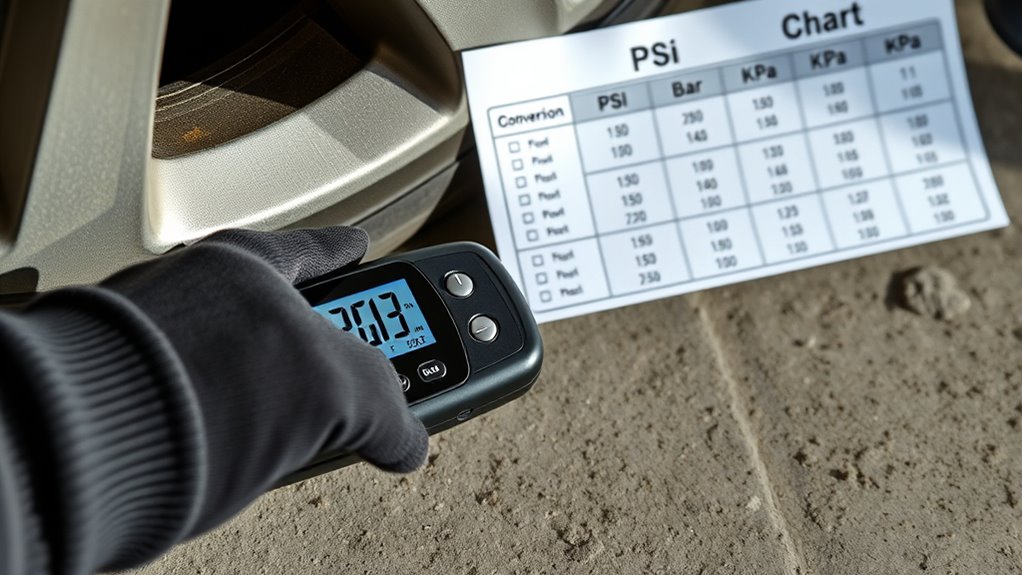
To convert tire inflator PSI to bar or kPa, first check your vehicle’s cold-pressure spec on the door label or owner’s manual. Then multiply PSI by 0.0689 to get bar, or by 6.895 to get kPa. For example, 30 PSI equals about 2.07 bar or 206.9 kPa. Use a calibrated gauge, confirm the unit on your inflator, and recheck after small adjustments. A quick chart makes the process even easier.
Key Takeaways
- Check the tire placard or owner’s manual for the manufacturer’s recommended pressure in PSI, bar, or kPa.
- Use the conversions: 1 PSI = 0.0689 bar and 6.895 kPa for accurate tire inflator readings.
- Convert PSI by multiplying by 0.0689476 for bar or 6.895 for kPa before adjusting inflation.
- Measure tires when cold, then inflate or deflate gradually and recheck after each small adjustment.
- Choose a calibrated gauge or digital inflator with clear unit display to avoid underinflation or overinflation.
What PSI, Bar, and kPa Mean?
PSI, bar, and kPa are all pressure units used to measure tire inflation, but they come from different systems. You’ll see PSI in the U.S.; it measures pound-force per square inch. You’ll see BAR in metric settings; 1 bar equals about 14.504 PSI. You’ll also see kPa, the kilopascal, used in many countries; 1 kPa equals 0.145 PSI.
Each unit tells you the same thing: tire pressure. When you check or set inflation, match the unit on your gauge, inflator, or placard to avoid error. Correct tire pressure supports traction, limits wear, and helps you drive with control instead of guesswork.
If you understand PSI, BAR, and kPa, you can read manufacturer specs clearly and keep your tires within the intended range. That knowledge gives you freedom from confusion and protects your vehicle’s performance.
How to Convert Inflator PSI
To convert inflator pressure from PSI into BAR or kPa, use a simple multiplication formula so you can read the gauge in the unit you need.
On your pressure gauge, take the PSI value and multiply it by 0.0689476 for PSI to BAR, or by 6.895 for kPa. For example, 30 PSI converts to about 2.07 BAR and 206.84 kPa.
You don’t need guesswork; you need exact tire pressure readings that support control, safety, and mobility.
Keep a conversion table near your inflator if you work with different units often. This lets you switch quickly without wasting time or surrendering accuracy.
Before you inflate or verify a tire, confirm the target unit on the gauge and calculate first. That habit keeps your readings consistent and helps you maintain the pressure you actually want, not the one the display defaults to showing.
How to Convert PSI to Bar and kPa
To convert PSI to bar, multiply the PSI value by 0.0689476; for example, 30 PSI equals about 2.069 bar.
To convert PSI to kPa, multiply the PSI value by 6.895; for example, 30 PSI equals about 206.84 kPa.
Use a quick conversion table when you need fast, accurate pressure readings across units.
PSI To Bar Formula
When you need to convert tire inflator pressure readings, multiply PSI by 0.0689475729 to get BAR, so 1 PSI is about 0.0689 BAR. Use this pressure conversion to keep your readings exact and your tire setup under your control.
If your gauge shows 14.5 PSI, you’ve reached 1 BAR, a useful reference point for quick checks. For example, 30 PSI becomes about 2.069 BAR, so you can verify the setting without guesswork.
Always apply the same formula consistently: PSI × 0.0689475729 = BAR. That gives you a precise result and helps you maintain safe tire pressure for dependable vehicle performance.
When you know the PSI-to-BAR conversion, you act with clarity, not uncertainty, and you keep your maintenance routine firmly in your hands.
PSI To kPa Formula
Once you’ve got the BAR value from PSI, you can also convert the same reading to kPa for a different gauge or spec sheet. For tire pressure, use the conversion factor 6.895: multiply psi by this number to get kPa.
So, 30 psi equals about 206.84 kPa, and the math stays direct and repeatable. This helps you match your equipment’s scale and keep inflation accurate.
- Read the psi value exactly.
- Multiply it by 6.895 to get kPa.
- Compare the result with your vehicle manual.
When you verify kPa, you reduce guesswork and protect performance. Precise conversion supports safe tire pressure, prevents overinflation or underinflation, and gives you more control over your vehicle’s freedom on the road.
Quick Conversion Table
A quick conversion table helps you switch between PSI, BAR, and kPa without doing the math each time. Use it for fast tire pressure conversion when you need exact pressure in BAR or pressure in kPa.
| PSI | BAR/kPa |
|---|---|
| 1 | 0.0689 BAR / 6.895 kPa |
| 30 | 2.07 BAR / 206.84 kPa |
| 50 | 3.45 BAR / 344.74 kPa |
For PSI to BAR, divide by 14.504. For kPa, multiply by 6.895. So, 50 PSI equals about 3.45 BAR and 344.74 kPa. Keep this chart near your inflator so you can set pressure confidently, avoid guesswork, and protect your freedom to maintain tires on your own terms.
When You Need PSI, Bar, or kPa
Depending on your vehicle, you may need to read tire pressure in PSI, Bar, or kPa, since tire inflators often show PSI by default while many international specs use Bar or kPa.
You can use tire pressure conversion to match the unit shown on your gauge with the unit printed on your vehicle label. PSI, Bar, and kPa all measure the same pressure; 1 Bar is about 14.504 PSI, and 1 PSI is about 6.895 kPa.
Use the right unit when you inflate, so you stay in control of handling, wear, and efficiency.
- Check your inflator’s display unit before you start.
- Convert PSI to Bar by dividing by 14.504, or to kPa by multiplying by 6.895.
- Confirm the reading against your manual or tire label.
When you speak the same pressure language as your vehicle, you make precise, independent decisions and keep your tires properly set.
Find Your Vehicle’s Recommended Pressure
Check the Tire and Loading Information Label on the driver-side door jamb to find your vehicle’s recommended tire pressure.
Note the specified units, since the value may be listed in PSI, bar, or kPa.
Then consult your owner’s manual for any pressure adjustments based on load or driving conditions.
Locate Door-Jamb Label
Start by locating the door-jamb label on the driver’s side door frame, or check the fuel cap area if your vehicle places it there, because this label lists the manufacturer’s recommended tire pressure.
You’ll usually see PSI, BAR, or kPa, depending on the vehicle’s origin, and the metric values help you convert accurately.
Read both front and rear specs, since they can differ under load. Use the cold tire pressure figure only.
- Find the label.
- Record the front and rear recommended pressure.
- Match the numbers to your inflator before you adjust.
This quick check keeps your tires within design limits, supports fuel efficiency, and gives you the freedom to drive confidently without guessing.
Check Owner’s Manual
If the door-jamb label is missing or unclear, open your owner’s manual and look for the tire pressure or Tire and Loading Information section to find the recommended PSI, BAR, or kPa for your vehicle.
You’ll usually see separate values for front and rear tires, plus notes for load, towing, or other operating conditions. Use these specifications exactly, because tire pressure changes with vehicle type and payload.
Check pressures only when tires are cold, since driving heats air and skews readings. If the manual lists bar or kPa, convert with confidence: 1 bar is about 14.5 PSI, and 100 kPa is about 14.5 PSI.
Read the owner’s manual carefully so you can set tire pressure accurately and drive with control, safety, and autonomy.
Pick a Gauge That Matches Your Units
Choose a tire inflator with a gauge that matches the units you use most, whether PSI, BAR, or kPa, so you can read pressures quickly and accurately. A gauge that displays your preferred tire pressure scale keeps you in control and reduces conversion friction.
If you work with multiple vehicles, pick a dual-unit or multi-unit gauge so you can switch between PSI and BAR without mental math. Digital models often give sharper readings and let you change units with a button, which speeds setup and supports precise inflation.
- Confirm the gauge shows PSI, BAR, or kPa clearly.
- Prefer dual-display or digital readouts for fast unit switching.
- Verify the selected unit before you inflate.
When the gauge matches your workflow, you gain cleaner readings, better consistency, and more freedom to service any vehicle confidently.
Avoid Common Tire Pressure Mistakes
Even with the right gauge, you can still make costly tire pressure mistakes, so always verify the manufacturer’s recommended pressure in your owner’s manual or on the Tire and Loading Information Label before inflating.
Use a calibrated tire pressure gauge, because inaccurate readings can leave you underinflated or overinflated. Don’t assume every vehicle uses the same unit; confirm whether your target is PSI, BAR, or kPa, especially on imported models. If you convert PSI to BAR, divide by 14.504 for a precise result.
Never exceed the specified tire pressure, since overinflation reduces traction, causes uneven wear, and raises blowout risk. Check all tires regularly when they’re cold, then adjust in small increments and recheck.
Quick PSI to Bar and kPa Chart
Use this quick reference chart to convert tire inflator readings fast: 1 PSI equals 0.0689 Bar and 6.895 kPa.
Keep this tire pressure conversion chart near your inflator so you can act with confidence and freedom, without guesswork. If you read 30 PSI, you can verify it as about 2.069 Bar or 206.84 kPa.
Use the same logic for any value: divide PSI by 14.504 to get Bar, then multiply PSI by 6.895 to get kPa.
- Read the inflator display in PSI.
- Convert PSI to Bar by dividing by 14.504.
- Convert PSI to kPa by multiplying by 6.895.
This method helps you confirm the right tire pressure quickly and accurately.
When you understand PSI, Bar, and kPa together, you control your maintenance routine with precision and less dependence on estimates.
Frequently Asked Questions
How Do I Convert Tire Air Pressure From PSI to kPa?
Multiply your PSI reading by 6.895 to get kPa. For example, 30 PSI becomes about 206.85 kPa. You can also divide kPa by 6.895 to convert back.
With PSI measurement basics, you’ll handle converting units easily and avoid common tire myths. Tire pressure importance isn’t optional; correct inflation supports safety, handling, and freedom on the road.
Check your gauge carefully, then adjust your tires with confidence.
How Do I Convert Tire Pressure From PSI to BAR?
To convert tire pressure from PSI to bar, multiply your PSI by 0.06895, or divide by 14.5. A 30 PSI reading becomes about 2.07 bar—like turning one key to open another door.
You’ll use this conversion method to bridge unit differences quickly. Check your manual, then verify tire pressure against the sidewall.
Follow these safety tips, and you’ll keep control, precision, and freedom on every road.
How to Switch Tire Pressure From kPa to PSI?
Switch your tire pressure gauge to PSI, or multiply kPa by 0.145038 to convert readings. You’ll see 200 kPa equals about 29 PSI.
Use trusted measurement tools, then compare your tire pressure with the vehicle manual or sidewall spec.
Avoid common mistakes like guessing or using the wrong unit. Follow these safety tips, and you’ll keep your tires accurate, stable, and ready for freer, safer driving.
Is 2.5 BAR the Same as 250 kPa?
Yes—2.5 bar is the same as 250 kPa. You multiply by 100, and you get the exact pressure measurement you need.
For tire pressure, this unit conversion stays linear: 1 bar equals 100 kPa, so 2.5 bar equals 250 kPa.
Check your vehicle’s specs, follow safety guidelines, and verify both units before you inflate. You’ll keep control, stay accurate, and move freely with confidence.
Conclusion
In the end, you can convert tire inflator PSI to bar or kPa safely by using the right formula, checking your vehicle placard, and setting pressure with a matched gauge. A 35 PSI tire equals about 2.4 bar or 241 kPa, so the math is simple when you stay consistent. Think of it like measuring a recipe: if you switch units halfway, you’ll spoil the result. Verify, adjust, and recheck before you drive.