
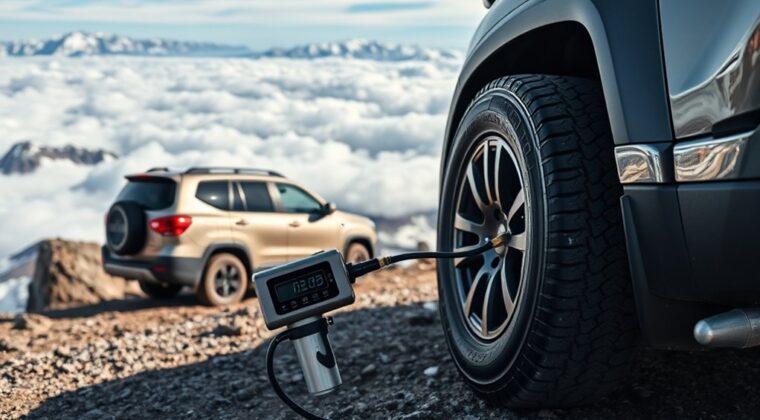
Altitude lowers ambient air pressure, so your tire inflator has less dense air to compress. As a result, it works harder, fills more slowly, and may deliver less output than it does at sea level. You’ll often need longer run times to reach the same PSI, and underinflation risk goes up if you don’t account for elevation. Proper gauges and high-altitude-rated inflators help maintain accuracy, and the details get more interesting from there.
Key Takeaways
- Higher altitude lowers air pressure, so tire inflators work harder and inflate more slowly.
- Thin air reduces the amount of air each compressor stroke can intake.
- Inflator output and CFM often drop as elevation increases.
- High-altitude-rated inflators compensate better for reduced air density.
- Check tire pressure after reaching elevation, since readings and inflation needs can change.
What Changes in Tire Inflator Performance at Altitude?
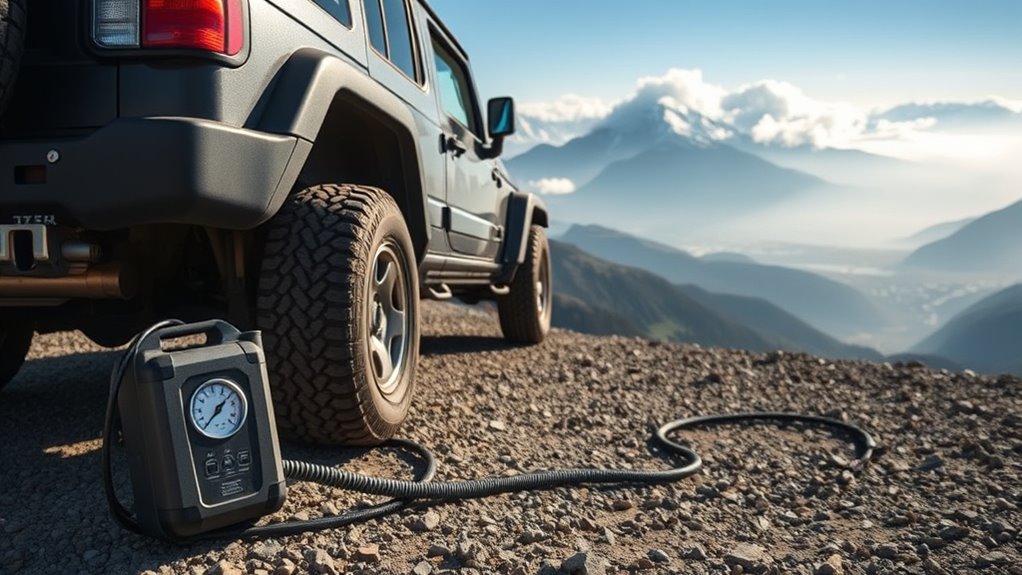
At higher altitudes, lower atmospheric pressure reduces air density, so a tire inflator has to work harder to reach the same tire pressure it would achieve at sea level. You’ll see this as reduced performance, because the inflator’s output drops as ambient pressure falls.
A unit that can deliver 30 PSI at sea level may struggle at 10,000 feet, where thinner air limits compression and lengthens inflation time. In practice, your tire inflation pressure can lag behind target, and under-inflation becomes more likely unless you account for altitude.
Air compressors, including compact tire inflators, can lose about 15% performance around 2,000 meters, so you need equipment rated for high-altitude use if you want consistent results. That rating helps maintain effective pressure delivery despite the lower atmospheric pressure.
Why Do Tire Inflators Pump Slower in Thin Air?
Because thin air lowers atmospheric pressure, your tire inflator has less dense air to draw in and compress, so the pump cycle becomes less efficient and inflation slows.
At high altitude, the drop from 14.7 psi at sea level to about 10.1 psi near 10,000 feet cuts air density, and your tire inflators must work with fewer molecules per stroke. That reduced supply limits flow, weakens compression dynamics, and stretches the time needed to reach target tire pressure.
At high altitude, thinner air means fewer molecules per stroke, slowing tire inflation and extending fill times.
In practical terms, performance falls because each intake delivers less mass, so the compressor can’t build pressure as quickly or consistently.
You’ll notice the slowdown more as altitude rises, since output can drop about 15% for every 1,500 meters gained.
If you want reliable inflation in thin air, you need tire inflators designed for high altitude conditions, so they can preserve performance and keep your tires properly pressurized.
How Does Altitude Affect Tire Inflator Power and Output?
How does altitude change a tire inflator’s power and output? As altitude rises, ambient pressure drops, so your inflator works against a weaker air column and delivers less effective output.
At sea level, a unit might move 1,000 CFM, but near 2,000 meters it can fall to about 850 CFM, so tire filling takes longer. The thinner air also forces inflators to use more power to reach the same psi, and some units can’t sustain target pressure efficiently.
That means your tire may end up underinflated if you rely on standard equipment at high altitude. Because pressure recovery slows, you should expect less output and more runtime to achieve the same air pressure.
High-altitude inflators compensate for reduced air density, preserving performance and helping you maintain safe, precise pressure. For you, that means better control, less waste, and more freedom on every road.
How Do You Choose a Tire Inflator for High Altitude?
Choosing a tire inflator for high altitude means matching the unit to thinner air, lower ambient pressure, and the reduced airflow available above 5,000 feet.
You should prioritize a tire inflator engineered for high altitude, because air density falls and performance drops. Select a model with a high-pressure rating and a robust motor so it can sustain tire pressure without strain.
Verify its CFM at elevation, not just at sea level; a unit rated at 1,000 CFM may deliver far less above 2,000 meters. Favor portable inflators with automatic altitude compensation, since manual tuning isn’t always practical when you’re remote.
Turbocharged or advanced designs often keep output more stable, giving you reliable inflation and less dependence on thin-air conditions.
- Check high-altitude performance data.
- Compare rated CFM at elevation.
- Choose strong motors and pressure capacity.
- Prefer adaptive, portable inflator technology.
How Do You Inflate Tires Correctly in the Mountains?
Once you’ve picked an inflator that can handle elevation, the next step is inflating the tires correctly for mountain conditions. You need to understand that altitude affects readings because atmospheric pressure drops as you climb.
At about 5,000 feet, a tire that shows 100 PSI at sea level may indicate around 102 PSI, so don’t chase a sea-level number blindly. Use a reliable tire pressure gauge, and set tire pressures cold after you arrive uphill; that gives you the cleanest baseline.
Then account for temperature, since pressure can move about 1 PSI for every 10-degree Fahrenheit change. Check all four tires, compare them to the load you’re carrying, and avoid defaulting to the sidewall maximum if your load is light.
Frequently Asked Questions
Does Altitude Mess With Tire Pressure?
Yes—altitude can mess with your tire pressure. As you climb, lower air density reduces ambient pressure, so your gauge reads differently and your tires can seem overinflated or underinflated.
You’ll need inflation adjustments because performance changes of about 0.48 PSI per 1,000 feet can occur. Check cold tire pressure after elevation shifts, and watch safety considerations closely so you keep control, efficiency, and freedom on the road.
Does 1000 Ft Elevation Make a Difference in Breathing?
Yes, you’ll usually notice only a slight change at 1,000 ft. Your oxygen levels dip a bit, so you may feel mild shortness of breath during exertion, especially if your lung capacity is limited.
Use breathing techniques, monitor physical performance, and account for health considerations if you have respiratory issues.
Altitude adaptation usually happens within days, and your body should compensate with little disruption to daily function.
What Is the 4 PSI Rule on Tires?
The 4 psi rule says you’ll see tire pressure rise about 4 psi for every 1,000 feet of altitude gain, because outside pressure drops while your tire’s air stays nearly constant.
You should factor altitude effects into inflation techniques, since performance variations can overinflate tires and reduce grip.
Use safety measures and maintenance tips to check pressure often, especially in mountains, so you keep control, efficiency, and liberation on the road.
How High Is Too High for Air Pressure in Tires?
Too high means anything above your tire’s sidewall max; never exceed it.
About 0.48 PSI rises for every 1,000 feet, so altitude effects can push readings upward. You should aim for ideal inflation within tire pressure limits, because lower air density changes gauge behavior and performance impact.
For safety considerations, check cold pressures after climbs, and you’ll keep control, efficiency, and liberation from avoidable tire failure.
Conclusion
At high altitude, you’ll see tire inflators work against thinner air, which can reduce airflow, slow pumping, and increase cycle times. You should choose a unit with strong pressure capability, thermal protection, and verified output at elevation. When you inflate tires in the mountains, monitor pressure carefully and compensate for temperature changes. In thin air, performance can feel like a race against the wind, so use the right inflator and stay exact.