
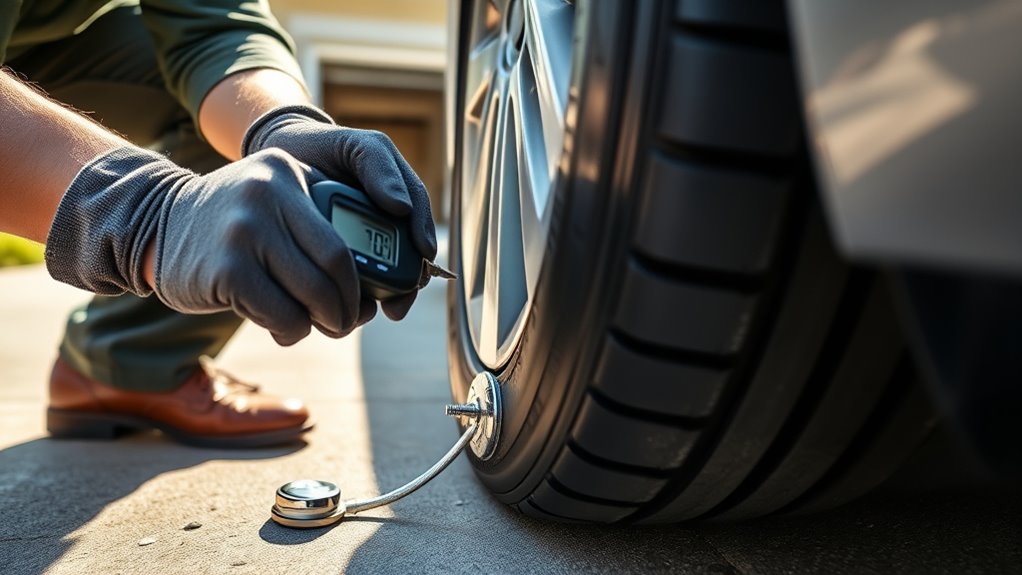
After inflating a tire, verify the final pressure with a reliable tire pressure gauge. Check the tires when they are cold whenever possible—ideally after the vehicle has been parked for at least three hours—and compare each reading with the recommended PSI on the driver-side tire placard or in the owner’s manual. Do not use the tire sidewall’s maximum-pressure number as your target. Add or release air in small amounts, recheck the pressure, and reinstall the valve cap when you are done.
Key Takeaways
- Check tire pressure with an accurate gauge after inflation instead of relying only on the inflator’s display.
- Use the vehicle manufacturer’s recommended cold PSI from the tire placard or owner’s manual, not the tire sidewall maximum.
- For the most accurate baseline, check tires when cold, generally after the vehicle has been parked for at least three hours.
- Add or release air in small amounts and recheck after every adjustment.
- Check all four road tires and the spare if the vehicle has one; front, rear, and spare pressures may differ.
- If the TPMS light remains on, verify pressure with a gauge before assuming the system needs a reset.
Check Tire Pressure After Inflation
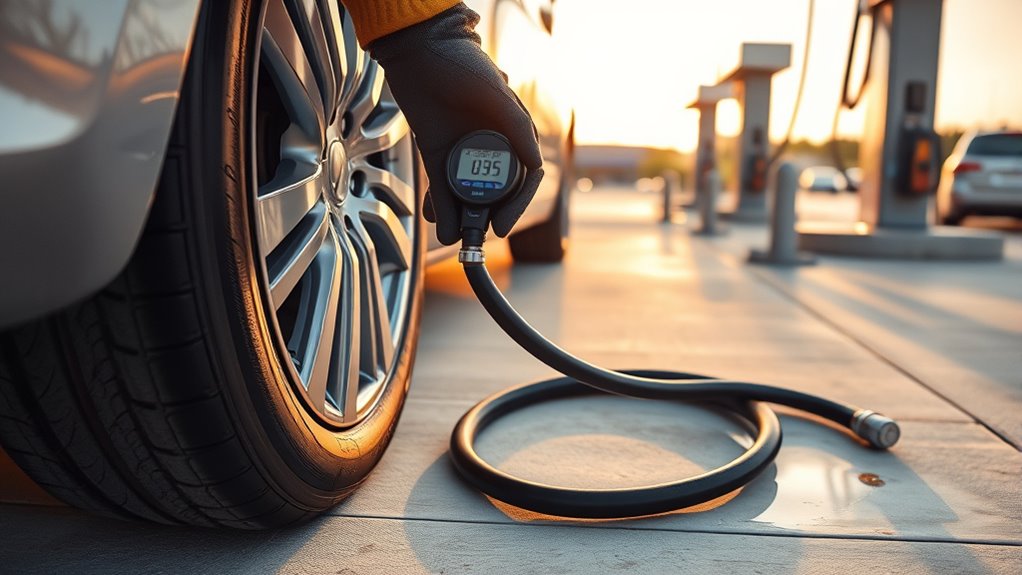
After inflation, use a tire pressure gauge to confirm the final reading. A portable inflator’s built-in gauge can be useful, but a separate accurate gauge gives you a second check before you drive.
Remove the valve cap, press the gauge squarely onto the valve stem, and hold it firmly enough to stop air from escaping around the connection. A brief hiss while the gauge seats can be normal, but continuous hissing usually means the gauge is not sealed correctly.
Compare the reading with the vehicle’s recommended cold tire pressure. If the tire is low, add air in short bursts. If it is high and the tire is cold, release a small amount of air, then measure again.
Use the vehicle placard or owner’s manual as the pressure target, then make small adjustments and recheck with a gauge.
Once the pressure is correct, reinstall the valve cap. The cap helps protect the valve from dirt and moisture, but it should not be used as a substitute for repairing a leaking valve or tire.
Choose a Reliable Tire Pressure Gauge
A reliable tire pressure gauge should give a clear, repeatable reading and cover the pressure range required by your vehicle. Digital, dial, and stick gauges can all work when they are accurate and in good condition.
Choose a gauge that is easy to read in the conditions where you normally check your tires. If your vehicle has a high-pressure temporary spare, make sure the gauge’s range is high enough for that tire as well.
Press the gauge straight onto the valve stem. An angled connection can leak air and produce an unstable or falsely low reading.
If a gauge gives inconsistent readings, has been dropped or damaged, or disagrees significantly with another trusted gauge, replace it or have its accuracy checked rather than assuming either reading is correct.
Find the Correct PSI on the Door Jamb
The correct inflation target normally comes from the vehicle manufacturer. Look for the Tire and Loading Information placard on the driver-side door jamb, door edge, or nearby pillar, or check the owner’s manual.
The recommended front and rear pressures may be different. Some spare tires also require a different pressure, so read every applicable value instead of assuming all tires use the same PSI.
Do not use the pressure molded into the tire sidewall as your normal inflation target. That marking identifies the tire’s maximum inflation specification, not the vehicle manufacturer’s recommended operating pressure.
Locate Door Jamb Sticker
Open the driver’s door and look for the tire-information placard. On many U.S. vehicles it is attached to the door jamb or B-pillar and lists the original tire size plus the manufacturer’s recommended cold tire pressure.
If the placard is missing, damaged, or unreadable, use the owner’s manual or manufacturer information for your exact vehicle. Do not substitute a generic PSI value based only on vehicle type or tire size.
Match PSI To Label
Compare the gauge reading with the placard value while the tires are cold. NHTSA describes cold tires as tires that have not been driven for at least three hours.
If a tire is below its specified pressure, add air until it reaches the placard value. If a cold tire is above the specified pressure, release air gradually and recheck.
Do not bleed a warm tire down to the cold placard value simply because the reading rose after driving. Tire pressure normally increases as the tire warms, and lowering a warm tire to the cold specification can leave it underinflated after it cools.
Add or Release Air to Reach PSI
If a cold tire is low, attach the inflator securely and add air in short bursts. Stop periodically and check with the gauge until the pressure matches the vehicle’s specified cold PSI.
If you add too much air, use the gauge’s bleed button if it has one, or briefly press the valve core with a suitable tool. Release only a little air at a time, then measure again.
If you had to add air while the tire was warm because it was clearly underinflated, treat that as a temporary correction. Recheck and adjust the tire again when it is cold.
Repeated pressure loss is different from a one-time adjustment. If the same tire keeps losing air, inspect it for a puncture, valve leak, bead leak, wheel damage, or other fault rather than repeatedly topping it off.
Check Pressure in All Four Tires
Check every road tire after inflation. A vehicle can have one tire that is low even when the others are correct, and some vehicles specify different pressures for the front and rear axles.
Also check the spare if your vehicle carries one. A spare can lose pressure while sitting unused, and its required PSI may be much higher than the road tires.
Check All Four Tires
Work around the vehicle systematically so you do not miss a tire. Record the readings if that helps you spot a recurring loss on one wheel.
| Tire | Target PSI | What to Confirm |
|---|---|---|
| Front left | Vehicle spec | Matches placard |
| Front right | Vehicle spec | Matches placard |
| Rear left | Vehicle spec | Matches placard |
| Rear right | Vehicle spec | Matches placard |
| Spare, if equipped | Spare-tire spec | Matches specified pressure |
Check pressures at least monthly and before long trips. Temperature changes also affect pressure; a drop of about 10°F can reduce tire pressure by roughly 1 PSI, so seasonal changes are a good reason to recheck.
Use A Tire Gauge
For the best baseline, use the gauge when the tires are cold. Remove the valve cap, press the gauge straight onto the valve stem, wait for a stable reading, and record the result.
Repeat the same process on each tire. If one reading looks unusual, check it again to rule out a poor seal or a misread gauge.
After measuring, reinstall each valve cap securely. If you discover a tire that is repeatedly low, investigate the cause instead of relying on the cap to stop the leak.
Compare To Recommended PSI
Compare every reading with the pressure specified for that axle on the vehicle placard or in the owner’s manual. Do not assume the left and right tires are the only values that matter; front and rear targets can differ.
If a cold tire is low, add air and recheck. If it is high, release air in small increments and recheck. Stop when the reading matches the specified cold pressure.
Keeping the tires at the manufacturer’s recommended pressure supports predictable handling, even tire wear, and efficient operation.
Why Tire Pressure Changes After Filling
Tire pressure can appear different after filling because pressure changes with temperature, a small amount of air may escape when you disconnect a hose or gauge, and different gauges can read slightly differently. The most important comparison is the cold tire pressure measured with a reliable gauge.
| Cause | Typical Effect |
|---|---|
| Driving warms the tire | Pressure rises temporarily |
| Ambient temperature drops | Pressure falls; roughly 1 PSI per 10°F drop is a common rule of thumb |
| Small air loss during gauge or hose removal | Final reading may be slightly lower |
Do not treat the normal pressure increase after driving as a reason to bleed air from a warm tire. If the cold pressure was correct before driving, let the tire cool before making a fine adjustment.
If pressure drops again after the tire has been set correctly, check for a leak. A puncture, damaged valve, bead leak, or wheel problem can cause repeated air loss.
Watch for the TPMS Light
The TPMS light is a warning system, not a replacement for a pressure gauge. A steady low-pressure warning generally means one or more monitored tires are significantly underinflated, so check the tires as soon as practical and inflate them to the vehicle’s specified cold pressure.
On U.S. vehicles covered by the federal TPMS standard, a warning lamp that flashes for about 60 to 90 seconds and then stays on indicates a TPMS malfunction. That is different from a steady low-pressure warning.
Correct the tire pressure first. If the TPMS warning persists or flashes, follow the vehicle-specific procedure in the owner’s manual or have the system inspected.
After proper inflation, some systems update automatically, while others require an initialization or relearn procedure. Do not assume every vehicle needs a manual reset.
Recheck Tire Pressure Later
You can verify the pressure immediately after an adjustment, but the most useful follow-up is another cold-tire check. Recheck after the vehicle has been parked long enough for the tires to return close to ambient temperature.
If the pressure is correct when cold, no further adjustment is needed. If the same tire is low again, look for a leak or damage instead of continuing to add air indefinitely.
As routine maintenance, check all tires at least monthly and before long trips. Recheck sooner after a major temperature change, tire service, a pothole impact, or any TPMS warning.
Frequently Asked Questions
How to Verify Tire Pressure?
Check the tire when it is cold, remove the valve cap, press an accurate gauge firmly onto the valve stem, and compare the reading with the vehicle’s tire placard or owner’s manual.
Add or release air in small amounts, rechecking after each adjustment. Replace the valve cap when the pressure is correct, and repeat the process for every road tire and the spare if equipped.
Will It Ruin Tires if You Inflate Them to 40 PSI Instead of 35 PSI When the Recommended PSI Is 35?
Not immediately, but if the manufacturer specifies 35 PSI cold, leaving the tire at 40 PSI cold means it is overinflated for that vehicle. Chronic overinflation can contribute to a harsher ride, reduced grip, greater impact sensitivity, and faster wear in the center of the tread.
Let the tire cool, then bleed it back to the vehicle manufacturer’s recommended cold pressure. Do not use a warm post-drive reading as the basis for lowering pressure.
Do I Need to Reset the TPMS After Filling Tires?
Not always. Many TPMS systems update automatically after the tires are properly inflated, while some vehicles require an initialization, calibration, or relearn procedure.
First set all tires to the specified cold pressure and check them with a gauge. If the warning does not clear, follow the exact TPMS instructions in your owner’s manual. A light that flashes before staying on can indicate a system fault rather than low pressure.
What Is the 5 PSI Rule?
There is no universal tire-maintenance rule that says being within 5 PSI of the placard is always acceptable. The correct target is the vehicle manufacturer’s specified cold tire pressure.
If a tire is 5 PSI below the placard value, inflate it to the specified pressure and recheck it later. If it loses that much pressure again, inspect for a leak or tire damage.
Conclusion
After inflating your tires, verify every tire with a reliable gauge and compare the readings with the cold PSI on the vehicle placard or in the owner’s manual. Make small adjustments, check the spare if equipped, and do not bleed warm tires down to the cold specification.
Use TPMS as a warning system rather than your only measurement tool. Monthly cold-pressure checks, prompt leak investigation, and vehicle-specific TPMS procedures are the safest way to keep tire pressure accurate and predictable.
”’
# Count words and images
visible = re.sub(r’<[^>]+>’, ‘ ‘, fixed)
visible = html.unescape(visible)
len(re.findall(r”\b[\w’’-]+\b”, visible)), fixed.count(‘