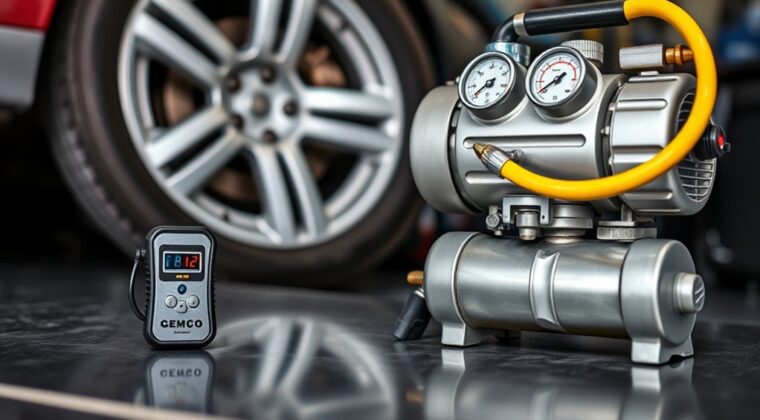
A tire inflator is a compact, portable tool you use for quick top-ups on car, bike, or light truck tires, usually from a 12-volt outlet or battery. An air compressor is bulkier, stores air in a tank, and delivers higher PSI and sustained airflow for larger tires and pneumatic tools. You’d choose an inflator for roadside convenience and a compressor for heavier, repeated jobs. The details get clearer when you compare power, portability, and cost.
Key Takeaways
- Tire inflators are compact tools for quickly topping off car, bike, and small truck tires.
- Air compressors provide higher pressure and sustained airflow for larger tires and pneumatic tools.
- Tire inflators are more portable, often using a 12-volt outlet or battery power.
- Air compressors are bulkier, need more storage, and usually require a dedicated power source.
- Tire inflators are cheaper, while air compressors cost more but offer greater versatility.
What Is a Tire Inflator?
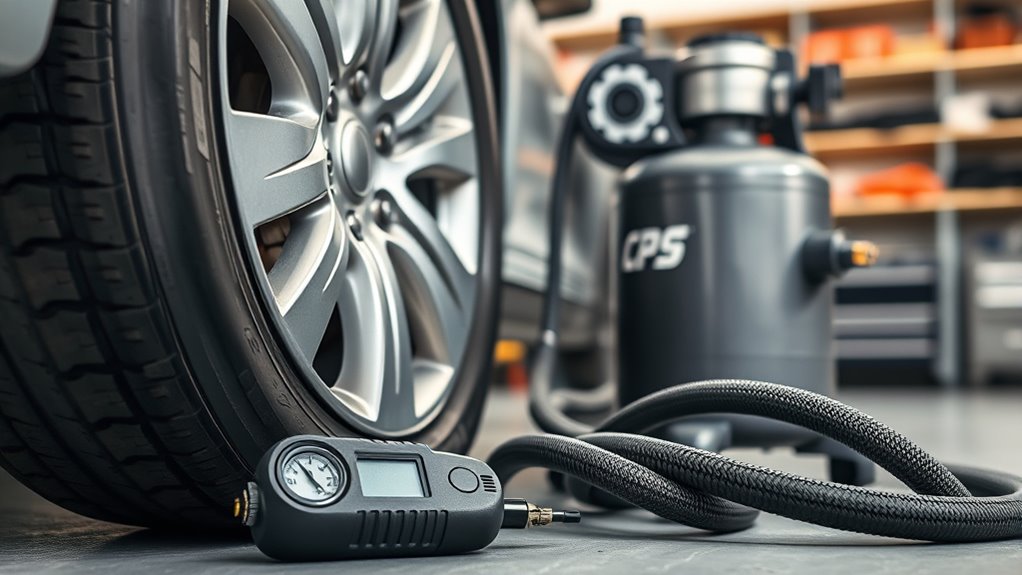
A tire inflator is a compact, portable device designed specifically to add air to tires, and it usually runs from a vehicle’s 12-volt outlet or a wall outlet.
You use tire inflators to inflate tires on cars, bikes, and small trucks without relying on larger compressors. Their maximum pressure rating usually falls around 50 to 150 PSI, so you can match the tool to your tire’s needs.
Tire inflators quickly fill cars, bikes, and small trucks, with pressure ratings that suit your tire’s needs.
Many models include automatic shut-off, which stops airflow when you reach the preset pressure, reducing overinflation risk and saving time. Because they’re lightweight, often under 5 pounds, you can store one in your vehicle for emergency use and keep your mobility intact.
Some tire inflators also ship with attachments for sports equipment, air mattresses, and other inflatables, giving you practical versatility.
In short, you get a portable pressure tool that helps you act quickly, maintain control, and keep your journey moving.
What Is an Air Compressor?
An air compressor converts electrical or engine power into stored air pressure by drawing in ambient air, compressing it, and holding that air in a tank for later use. You can think of it as a machine that lets you compress air and reclaim work on demand.
Unlike simple handheld devices, it uses a storage tank to maintain pressure, so you get steady output after the motor cycles off. Most units operate above 100 pounds per square inch, which gives you enough force for pneumatic tools and larger tire inflation.
When you compare air compressors vs smaller inflators, tank size in gallons and air volume in CFM shape performance. Those numbers tell you how long you can work and how fast the system recovers.
In manufacturing, construction, and automotive repair, you benefit from its versatility and ability to power varied tasks with one controlled pressure source.
Tire Inflator Vs Air Compressor: Key Differences
You’ll notice the main split starts with power and pressure: tire inflators usually top out below 50 PSI, while air compressors can exceed 100 PSI for heavier tasks.
You’ll also see a difference in portability and use, since inflators are lightweight and built for quick tire fills, while compressors are bulkier and can run pneumatic tools.
Inflators offer simple, convenient operation with features like auto shut-off, but compressors give you more capability at a higher cost and with more monitoring.
Power And Pressure
Power and pressure are where tire inflators and air compressors diverge most clearly: tire inflators typically top out below 50 PSI, which is enough for car and bike tires, while air compressors can exceed 100 PSI for heavier-duty work.
You get a lower maximum PSI with a tire inflator, but that’s a tradeoff for portability and ease of use. An air compressor’s tank stores air, so you can maintain pressure and support power tools that demand steady output.
Its higher airflow rate, measured in CFM, lets you run jobs beyond inflation. A tire inflator skips storage and delivers direct inflation, so it’s simpler, lighter, and better for precise tire checks.
If you want control without complexity, choose the tool that matches your pressure needs and frees you from unnecessary bulk.
Portability And Uses
Portability is where a tire inflator really pulls ahead for everyday convenience, since it’s lightweight, compact, and easy to store in a trunk or under a seat. You can power many tire inflators from a 12-volt outlet or battery, so you’re ready for roadside inflation without relying on a workshop.
They handle everyday tasks like topping off car tires, bicycles, and sports equipment, usually under 50 PSI, with automatic shut-off for accuracy.
Air compressors, by contrast, are bulkier, need more storage, and often demand a stable household outlet. You’d choose them when your specific needs include higher pressure and pneumatic tools such as nail guns or impact wrenches.
In practice, portability gives you freedom; compressors give you capability.
Which Has Better PSI Output?
Your tire inflator usually tops out below 50 PSI, which is enough for standard car, bike, and small truck tires.
An air compressor commonly exceeds 100 PSI, so you can use it for larger tires and other high-pressure jobs.
Check your tire’s required PSI before you choose, because the compressor gives you more output and faster inflation.
PSI For Inflators
When it comes to PSI output, air compressors generally have the clear advantage because they can exceed 100 PSI, while most tire inflators top out around 50 PSI. For you, that means tire inflators handle everyday pressure jobs, while air compressors deliver more headroom.
The key differences are clear:
- Tire inflators usually match standard car and bike needs.
- Their PSI rating should align with your tire’s recommended pressure.
- They’re practical for quick, light inflation.
- Air compressors suit higher-pressure, heavier-duty demands.
If you want to inflate tires safely and efficiently, check the spec label before you plug in. That simple step keeps you free from guesswork and guarantees the tool fits the task.
PSI For Compressors
Air compressors usually deliver the better PSI output, often exceeding 100 PSI and handling larger tires or pneumatic tools with ease.
You get faster inflation because air compressors maintain steady psi, while tire inflators usually cap maximum pressure around 30-50 psi. That makes tire inflators fine for car or bicycle tires, but not ideal for heavy-duty work.
When you need freedom from slow fill times, choose air compressors with a higher cubic feet per minute rating; more CFM means stronger airflow and better sustained performance.
Check the maximum pressure label before you buy, since your task determines the right tool. If you’re inflating truck tires or running tools, air compressors give you the headroom and consistency you need without compromise.
How Portability Affects Your Choice
Portability can be the deciding factor when you choose between a tire inflator and an air compressor. For vehicle owners, tire inflators offer clear portability advantages because they’re lightweight, compact, and easy to store in a trunk or cargo area. You can power them from a 12-volt outlet or batteries, so they support quick inflation tasks without locking you to a wall socket.
- Carry them easily.
- Store them with minimal space.
- Use them on the road.
- Deploy them without fixed power.
Air compressors deliver more output, but their size and weight reduce portability. You’ll usually need dedicated storage and a stable electricity source, which limits freedom in remote settings.
Air compressors deliver more output, but their size and weight reduce portability.
If you want a tool that moves with you, tire inflators fit that role. If you need stationary power and volume, air compressors make more sense. Your choice depends on whether mobility or raw capability matters more.
Best Uses for Tire Inflators
You can use a tire inflator for quick tire top-ups when you need to restore pressure on a car, bike, or small truck without setting up a larger compressor.
It’s especially useful for roadside emergency inflation because it runs from a 12-volt outlet or battery and is easy to keep in your vehicle.
You can also rely on it for portable everyday use, including inflating sports balls and air mattresses.
Quick Tire Top-Ups
When a tire only needs a quick top-up, a tire inflator is usually the most practical tool for the job. For everyday use, you can keep vehicle tires at the right PSI without hauling heavy gear.
A portable tire inflator stays compact, fits in your trunk, and works from a 12-volt outlet, so you’re not tied to a shop. Many models include preset pressure controls, which lets you set the target and walk away. That makes inflation quick and hassle-free while reducing guesswork.
You’ll usually get a standard tire back to spec in about 5-10 minutes, depending on size and model.
- Check pressure fast
- Set the desired PSI
- Inflate with control
- Store it easily
Roadside Emergency Inflation
A tire inflator is one of the best tools to keep in your vehicle for roadside emergencies because it’s lightweight, compact, and runs from your car’s 12-volt outlet. You can use it for fast roadside inflation without hunting for shop air. Most inflators handle standard Tire pressures, and preset controls help you set the target PSI, then stop automatically.
| Feature | Benefit | Result |
|---|---|---|
| Portable size | Fits in trunk | Always ready |
| Auto shut-off | Prevents overfill | Accurate inflation |
| Extra nozzles | Handles more items | More utility |
You get freedom from dependency and can restore mobility on your terms. Keep one stored securely, and you’ll have a practical backup when a low Tire becomes an emergency. Portable inflators deliver control, speed, and reliable roadside response.
Portable Everyday Use
For everyday inflation tasks, a tire inflator is the more practical tool because it’s lightweight, compact, and easy to store in a vehicle trunk. You can use tire inflators to keep car, bike, and small truck tires at target pressure without carrying bulky equipment.
Their lightweight and portable build supports quick, independent maintenance for everyday items. Many units include automatic shut-off functions, so you won’t need to watch the gauge constantly. They usually run under 50 PSI, which suits routine use and limits over-inflation risk.
- Top off tires
- Inflate pool toys
- Fill air mattresses
- Pack for travel
Because these tools are compact and designed for easy storage, you stay prepared without giving up space or control.
Best Uses for Air Compressors
Air compressors excel in heavy-duty jobs where sustained air delivery matters, from running pneumatic tools like nail guns and impact wrenches to supporting construction, automotive repair, and manufacturing work.
Air compressors excel in heavy-duty jobs where steady air delivery keeps tools and projects moving efficiently.
You’ll rely on them when your heavy-duty tasks demand pressure above 100 PSI and steady airflow. In air compressors and tire service, the notable differences show up fast: large units can inflate objects like truck and tractor tires, where volume and pressure both matter.
A tank lets you store air, so you can work quietly after the motor cycles off, then release continuous air without waiting. When you choose one, check tank size in gallons and airflow in CFM, because those specs control how efficiently you can power tools and finish jobs.
If you want practical freedom on demanding tasks, an air compressor gives you the reach and muscle to move work forward.
Tire Inflator Vs Air Compressor Cost
When you compare tire inflator vs air compressor cost, the price gap is clear: tire inflators usually run about $30 to $150, while air compressors often fall between $100 to $500 depending on power, tank size, and features.
You get a budget-friendly tool with tire inflators, especially if you only need portable inflation. Air compressors demand a higher upfront cost, but they support heavy-duty tasks and broader use.
- Tire inflators: lower entry price.
- Air compressors: higher cost, more capability.
- Fanttik X8 Apex: about $129.97, often $89.97.
- CRAFTSMAN compressor: around $184 for versatile output.
If you want simple tire care, tire inflators keep your spending lean. If you need compressed air for more than tires, air compressors justify the extra investment.
Either way, your choice controls how much freedom you spend to gain.
How To Choose The Right One
Choosing the right tool comes down to how you’ll use it. If you mainly top off car tires, bikes, or sports gear, tire inflators give you fast, simple service without excess bulk.
If you need sustained output for larger tires or pneumatic tools, air compressors deliver the higher airflow and pressure you need.
Prioritize portability if you travel, keep an emergency kit, or want easy storage; compact tire inflators fit that role better.
Check maximum PSI ratings before you buy, because the unit must meet your tire requirements, and air compressors usually exceed 100 PSI.
Review power source considerations too: many tire inflators run from a 12-volt vehicle outlet, while air compressors often need stronger electrical support.
For convenience, choose tire inflators with automatic shut-off so you can set pressure and move on.
The right match helps you stay self-reliant, efficient, and in control.
When To Own Both
You’ll get the most flexibility by owning both tools: a tire inflator for quick top-offs, roadside emergencies, and light-duty jobs like sports gear or air mattresses, and an air compressor for higher-demand tasks that need sustained airflow or pressures above 100 PSI.
For vehicle owners, this setup keeps you free to match the right tool to the task without delay.
- Use tire inflators for portable, under-50 PSI jobs.
- Use air compressors for filling large tires and pneumatic tools.
- Keep one for travel and one for garage work.
- Cover daily use, repairs, and seasonal maintenance.
Tire inflators stay lightweight and ready in your trunk, while air compressors handle robust tasks at home or on the job.
Owning both means you can move from a flat on the shoulder to automotive maintenance with no compromise. That versatility gives you control, speed, and readiness wherever you go.
Frequently Asked Questions
Should I Get an Air Compressor or a Tire Inflator?
You should get a tire inflator if you want a portable option for quick roadside fixes and simple tire maintenance. It runs from your car’s 12-volt power source, usually costs less, and offers easier inflation speed with automatic shutoff.
Choose an air compressor if your usage scenarios include tools or heavy-duty work, since it delivers higher PSI. That price comparison reflects broader capability, but it’s bulkier and less liberated.
Can a Tire Inflator Be Used as an Air Compressor?
No, you can’t realistically use a tire inflator as a full air compressor. You’ll get decent tire inflator features for quick top-offs, but it lacks tank storage, sustained pressure, and the output needed by most air compressor types.
In a portability comparison, the inflator wins, though inflation speed drops on larger jobs. It’s also quieter, but that doesn’t replace capacity when you need real pneumatic power.
What Is the Best Tire Inflator to Buy?
The best tire inflator to buy is the Fanttik X8 Apex.
You get a portable option with a 1.1 lb body, digital gauges, and automatic shut-off for precise pressure control. Its 150 PSI rating covers cars, bikes, and motorcycles.
You can choose among power sources, and its inflation speed stays practical for emergencies. Noise levels remain manageable, so you move freely, without dependence, and keep your tires ready.
Can I Use an Air Compressor to Inflate My Car Tires?
Yes, you can use an air compressor to inflate your car tires, and you should follow air pressure guidelines closely.
You’ll need to monitor PSI yourself, unlike inflator portability benefits you may expect from a compact unit. Check compressor safety features before use, and avoid overfilling to protect tire lifespan factors.
For reliable tire maintenance tips, set the exact pressure, confirm with a gauge, and stop when you hit spec.
Conclusion
In the end, you’ll choose between a tire inflator and an air compressor based on your needs. If you want quick, portable top-offs, a tire inflator is your best tool. If you need higher PSI, longer runtimes, or multi-purpose air power, an air compressor gives you more muscle. Think of it like choosing a scalpel or a sledgehammer: each has its place. Pick the one that matches your jobs, and you’ll work faster and smarter.