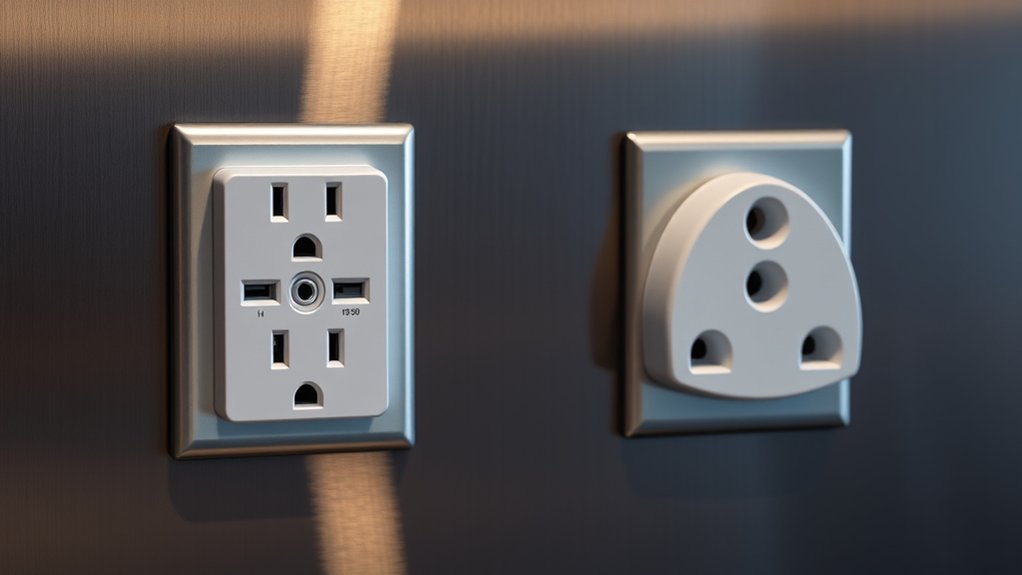
Choosing between a NEMA 14-50 and a NEMA 6-50 outlet for EV charging is less about raw speed and more about compatibility, wiring, cost, and future use. Both can work well for Level 2 home charging when the outlet, breaker, wiring, and EV charger are matched correctly. The safest choice depends on your charger plug, your electrical panel, and local code.
Quick Answer
For most new plug-in EV charger installs, NEMA 14-50 is the more common and versatile choice. A NEMA 6-50 can charge just as fast if your EVSE supports it. On a 50-amp circuit, practical EV charging is usually up to 40 amps, or 9.6 kW at 240 volts.
Key Takeaways
- NEMA 14-50 is not automatically faster than NEMA 6-50. Charging speed depends on the EVSE, circuit rating, and vehicle onboard charger.
- NEMA 14-50 has four prongs: two hot legs, neutral, and ground. This makes it more versatile for RVs and some non-EV loads.
- NEMA 6-50 has three prongs: two hot legs and ground. It is a strong 240V option for EV chargers, welders, and shop equipment that do not need neutral.
- A 50-amp EV charging circuit is normally treated as a 40-amp continuous load, which equals about 9.6 kW at 240V.
- Hardwiring may be better for a permanent, higher-output EV charger, especially where local code requires extra protection for receptacles.
Choosing Between NEMA 6-50 and NEMA 14-50 for EV Charging
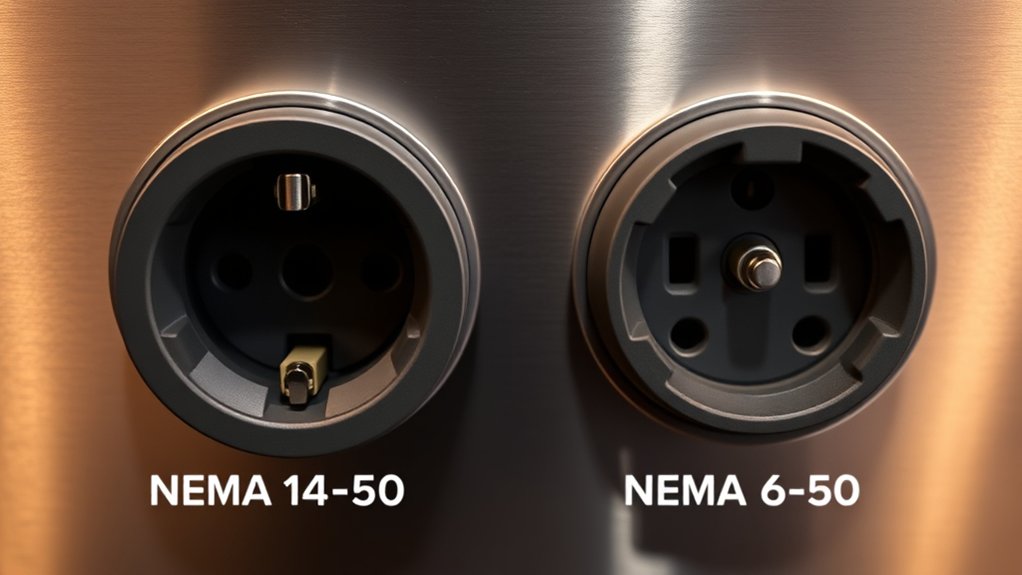
When you compare NEMA 6-50 vs NEMA 14-50 for EV charging, start with one key point: both are commonly used on 240V Level 2 charging circuits, and both can support similar EV charging speeds when the circuit and charger are rated the same.
The main difference is the neutral wire. A NEMA 14-50 outlet has four conductors: two hot legs, one neutral, and one equipment ground. A NEMA 6-50 outlet has three conductors: two hot legs and one equipment ground. Most EV chargers use 240V power and do not need the neutral, so the extra neutral in a 14-50 outlet usually does not make the EV charge faster.
The NEMA 14-50 is still popular because many plug-in Level 2 chargers ship with a 14-50 plug. It is also common at RV parks and can support some 120V/240V equipment that needs a neutral. The NEMA 6-50 is common for welders, shop equipment, and EV chargers that only need 240V.
Warning: Do not install or modify a 240V EV charging outlet yourself unless you are qualified and legally allowed to do so. A licensed electrician should confirm panel capacity, conductor size, breaker size, grounding, permitting, GFCI requirements, and local code before the outlet is used.
NEMA 14-50 vs 6-50 Comparison Table
| Feature | NEMA 14-50 | NEMA 6-50 |
| Prongs / conductors | Four: hot, hot, neutral, ground | Three: hot, hot, ground |
| Typical voltage | 120V/240V when wired from a split-phase supply | 240V only in most residential EV charging installs |
| EV charging speed | Up to 40A continuous on a typical 50A circuit if the EVSE supports it | Up to 40A continuous on a typical 50A circuit if the EVSE supports it |
| Common EVSE support | Very common for plug-in Level 2 EV chargers | Supported by some EV chargers, but less common than 14-50 |
| Typical wiring cost | Often higher because it needs a neutral conductor | Often lower because it does not need neutral |
| Best for | Most new plug-in EV charger installs, RV use, and broader outlet flexibility | EVSEs and 240V shop tools that specifically use a 6-50 plug |
How Fast Can a NEMA 14-50 or 6-50 Charge an EV?
A 50-amp receptacle does not mean your EV should draw 50 amps for hours. Home EV charging is treated as a continuous load, so a 50-amp circuit is commonly used for up to 40 amps of continuous charging. At 240 volts, that equals about 9.6 kW.
Some portable chargers draw less. For example, Tesla lists both its NEMA 14-50 and NEMA 6-50 Mobile Connector adapters as 240V options on a 50-amp breaker with a maximum 32-amp output. That is about 7.7 kW at 240 volts. In that case, the 14-50 and 6-50 charge at the same rate.
A NEMA 14-50 outlet is usually more versatile, but it is not automatically faster. Charging speed comes from the EVSE amperage, circuit rating, and the vehicle’s onboard charger limit.
If you want more than 40 amps of Level 2 charging, you usually move away from plug-in receptacles and use a hardwired EV charger on a larger properly sized circuit. Many 48-amp home chargers, for example, are installed on a 60-amp circuit and are hardwired instead of plugged into a NEMA outlet.
Benefits of NEMA 14-50 for EV Charging Needs
The NEMA 14-50 outlet is the most common plug-in choice for many home EV chargers because it is widely supported and easy to understand. If you buy a plug-in Level 2 EVSE, there is a good chance the 14-50 version is available.
The biggest advantage is versatility. Because a 14-50 has two hot legs, a neutral, and a ground, it can support both 240V loads and certain 120V/240V loads when it is wired correctly. That matters if the outlet might ever be used for an RV or another approved appliance that needs neutral.
For EV charging alone, though, the neutral wire usually does not improve charging speed. Your charger still needs to match the circuit, and your vehicle must be able to accept the charging current.
Note: If your goal is maximum long-term EV charging performance, a hardwired charger can be more future-ready than either a NEMA 14-50 or NEMA 6-50 receptacle.
Devices and Scenarios for NEMA 6-50 Usage
A NEMA 6-50 outlet is a strong fit when you only need 240V power and your EV charger has a 6-50 plug. It is also common for welders, plasma cutters, air compressors, and other shop equipment that does not need a neutral conductor.
Because a 6-50 circuit does not include neutral, installation may use less cable than a 14-50 circuit. That can lower material cost, especially on a longer run from the electrical panel. The final cost still depends on panel location, conduit, wall access, permit rules, wire type, labor, and whether your local code requires extra protection.
Choose NEMA 6-50 when your charger manufacturer supports it, you do not need RV-style 120V/240V flexibility, and you want a dedicated 240V outlet for a known load. Do not choose it if the equipment you plan to plug in requires neutral.
What to Know About Installing NEMA Outlets Safely
A safe EV outlet installation starts before the receptacle goes on the wall. Your electrician should confirm the home has enough electrical capacity, perform any required load calculation, choose the correct conductor and breaker, and follow the electrical code adopted in your city or state.
For a NEMA 14-50, the circuit commonly needs two hot conductors, one neutral conductor, and one equipment grounding conductor. For a NEMA 6-50, the circuit commonly needs two hot conductors and one equipment grounding conductor. Do not rely on a simple “6/3” or “6/2” rule without a professional review, because conductor size and wiring method depend on the installation details and code requirements.
- Use a dedicated circuit. EV charging should not share a circuit with random garage loads.
- Use a quality receptacle. Cheap receptacles can loosen or overheat under frequent plug-in EV charging use.
- Use safety-certified EVSE. Look for equipment listed or certified by a recognized testing lab, such as UL, ETL, or CSA markings.
- Check GFCI and permit rules. Local code may require GFCI protection for garage, outdoor, basement, or other receptacle locations.
- Match the charger setting to the circuit. The EVSE output must be set no higher than the circuit can safely support.
- Use outdoor-rated equipment outdoors. The outlet box, cover, EVSE, and mounting location must be suitable for weather exposure.
Pro Tip: If you plug and unplug often, ask your electrician about an industrial-grade receptacle and inspect the plug area for heat, discoloration, looseness, or buzzing. Stop using the outlet if anything looks or smells wrong.
Safety and Compatibility of NEMA Outlets
Compatibility starts with the plug on your EVSE. A NEMA 14-50 plug will not fit a NEMA 6-50 receptacle, and a NEMA 6-50 plug will not fit a NEMA 14-50 receptacle without an adapter. The fact that both can be used for 240V charging does not make them interchangeable.
Be very careful with adapters. A 6-50 receptacle has no neutral, so it cannot safely power a true 14-50 load that needs neutral. Some adapter setups may be acceptable only when the EVSE manufacturer specifically approves them and the adapter is properly rated, listed, and used within its limits.
The safest path is simple: install the receptacle that matches your EV charger plug, or choose a hardwired charger if you want a cleaner permanent setup. If you already have an outlet, buy an EVSE that is designed for that outlet type rather than forcing a mismatch.
When Hardwiring Is Better Than a NEMA Outlet
A plug-in NEMA outlet is convenient when you want portability or may move the charger later. A hardwired EV charger is often better when you want a permanent installation, cleaner outdoor setup, fewer plug-contact heat issues, or higher amperage than a receptacle-based charger normally allows.
Hardwiring can also simplify some code and nuisance-tripping issues in certain locations, depending on your local requirements and the charger model. It still needs a licensed electrician, correct breaker sizing, proper grounding, and setup according to the charger manufacturer’s installation guide.
For many drivers, a 32A or 40A plug-in EVSE is more than enough for overnight charging. For high-mileage drivers, larger battery packs, or multiple EVs, a hardwired charger with load management may be the better long-term choice.
How to Decide Which Outlet You Need
Use this simple decision path before spending money on an outlet:
- Check your EVSE plug first. If the charger comes with a NEMA 14-50 plug, install a 14-50 receptacle. If it comes with a 6-50 plug, install a 6-50 receptacle.
- Check your daily driving needs. A 32A or 40A Level 2 charger usually adds enough range overnight for most drivers.
- Check your panel capacity. Your electrician may recommend a lower-amp charger, load management, panel upgrade, or hardwired EVSE.
- Think about future use. Choose 14-50 if you want the most common plug-in EV outlet and possible RV flexibility. Choose 6-50 if you only need 240V and your equipment supports it.
- Consider hardwiring. If the charger will stay in one place for years, hardwiring may be safer, cleaner, and better for higher output.
Frequently Asked Questions
Is NEMA 14-50 better than 6-50 for EV charging?
NEMA 14-50 is usually better if you want the most common plug-in EV charging outlet and broader non-EV flexibility. NEMA 6-50 is just as capable for EV charging when your EVSE supports it. The 14-50 is not faster by itself.
What is the best outlet for EV charging?
For a new plug-in Level 2 charger, NEMA 14-50 is often the best default because it is widely supported by EVSE makers. If your charger uses a NEMA 6-50 plug, a 6-50 outlet is also a good choice. For a permanent higher-output installation, a hardwired charger may be better than either outlet.
How many kilowatts can a NEMA 14-50 outlet provide for EV charging?
On a 50-amp circuit, EV charging is commonly limited to 40 amps continuous, which is about 9.6 kW at 240 volts. Some portable chargers are lower. Tesla’s Mobile Connector, for example, lists a maximum 32-amp output for both NEMA 14-50 and NEMA 6-50 adapters.
Are 6-50 to 14-50 adapters safe?
Do not use a generic adapter just because the plugs appear similar. A NEMA 6-50 circuit has no neutral, so it cannot power a device that truly needs a 14-50 neutral. Use only manufacturer-approved, properly rated adapters for EV charging, and never exceed the circuit or EVSE rating.
Can you plug a NEMA 6-50 into a NEMA 14-50?
No. A NEMA 6-50 plug does not physically fit a NEMA 14-50 receptacle. You would need an adapter, and that adapter should only be used if it is properly rated and approved for your EVSE and circuit.
Does an EV charger need the neutral wire in a NEMA 14-50 outlet?
Most 240V Level 2 EV chargers do not use the neutral conductor. They use the two hot legs and equipment ground. The neutral in a 14-50 outlet is useful for other approved 120V/240V loads, but it usually does not change EV charging speed.
Conclusion
If you are installing a new plug-in EV charging outlet, NEMA 14-50 is usually the safest default because it is widely supported and more versatile. If your EV charger uses a NEMA 6-50 plug, that outlet can charge just as well and may cost less to wire because it does not need a neutral conductor.
The better choice is the one that matches your EVSE, your circuit, and your local code. Do not choose 14-50 because you think it is automatically faster. On the same properly sized circuit, charging speed is controlled by the EVSE amperage and your vehicle’s onboard charger. For a permanent, higher-output setup, ask your electrician whether a hardwired charger is the better long-term option.
Sources
- U.S. Department of Energy Alternative Fuels Data Center: Charging Electric Vehicles at Home — supports Level 2 home charging, code compliance, continuous-load guidance, permits, and certified equipment recommendations.
- Tesla Support: Mobile Connector — supports NEMA 14-50 and NEMA 6-50 adapter output examples and 32-amp maximum output details.
- Tesla Support: Installing a Wall Connector — supports hardwired charger installation, commissioning, breaker size, and output amperage setup considerations.
- OSHA: Nationally Recognized Testing Laboratory Program — supports the meaning of NRTL safety certification marks for electrical equipment.