
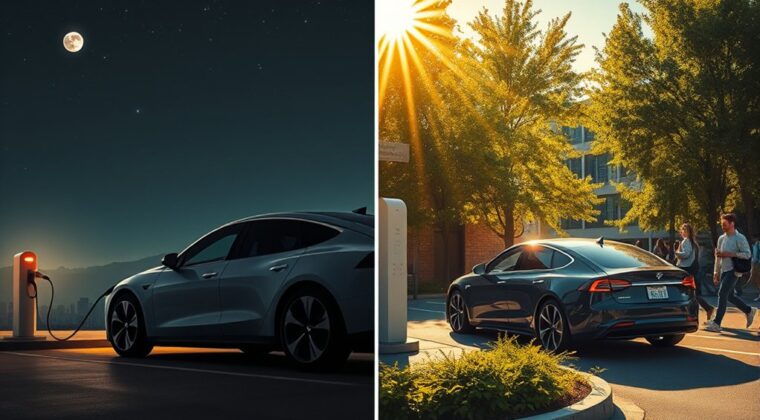
Choosing between daytime and nighttime EV charging is not just a matter of convenience. The best time depends on your utility rate plan, whether you have solar panels, where you park, how far you drive, and how clean your local electricity is at different times of day. For many drivers, overnight home charging is the cheapest and easiest routine. For others, daytime charging at work, from solar, or during cleaner grid hours can be the smarter choice.
Quick Answer
Nighttime EV charging is usually cheaper if your utility offers off-peak rates and you charge at home. Daytime charging can be better when you have solar panels, free workplace charging, or a cleaner midday grid. The best choice is the time that matches your utility rate, daily mileage, charger access, and local electricity mix.
Key Takeaways
- Nighttime charging is often best for home charging when your utility has lower off-peak rates.
- Daytime charging can be better if you use solar power, workplace charging, or a public station that is convenient during errands.
- Carbon impact depends on your grid. Midday can be cleaner in solar-heavy regions, while other areas may differ.
- Do not guess your savings. Check your utility’s time-of-use schedule and multiply your EV’s kWh needs by the actual rate.
Day vs. Night at a Glance
| Best Fit for Daytime Charging | Solar owners, workplace charging users, short public top-ups, and drivers in areas with cleaner midday electricity. |
| Best Fit for Nighttime Charging | Home charging, long commutes, overnight parking, and utility plans with low off-peak rates. |
| Main Cost Check | Battery energy needed in kWh × your actual electricity rate, plus any public charging session fees or parking fees. |
| Best Next Step | Look up your utility’s EV or time-of-use plan, then set your car or charger schedule to match the lowest practical charging window. |
The Benefits of Daytime EV Charging
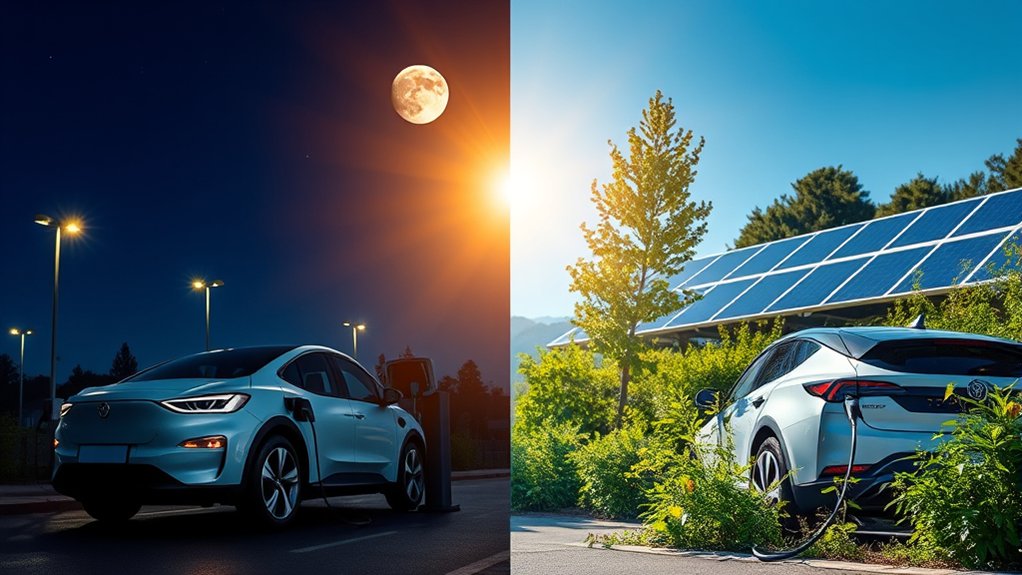
Daytime EV charging works especially well when your car is parked for several hours at work, at home with solar panels, or near a reliable public charger. Instead of thinking of daytime charging as automatically cheap or expensive, treat it as a charging window that can be very useful in the right situation.
If you have rooftop solar, charging while the sun is producing power can reduce how much electricity you pull from the grid. That can lower your charging cost when your solar setup and utility billing rules make self-consumption more valuable than exporting power. It can also help you use more renewable electricity directly.
Daytime charging can also make sense at workplaces. The U.S. Department of Energy notes that public and workplace charging can increase the daily useful range of EVs. If your employer offers free or discounted charging, daytime charging may beat home charging even if your home utility has a decent overnight rate.
Daytime charging is strongest when it lines up with solar power, workplace parking, or a cleaner local grid. It is not automatically cheaper, but it can be the better choice for the right driver.
There is also a grid benefit in some regions. A Nature Energy study found that daytime charging scenarios can align better with solar generation and reduce some future grid impacts compared with heavy home charging in the evening. That does not mean every driver should charge only during the day. It means the cleanest and most grid-friendly time depends on local electricity supply.
Note: Public charger availability changes by location, time, and network. Check your charging app for live status, pricing, connector type, and parking rules before you count on a daytime public charging stop.
Why Nighttime EV Charging Could Save You Money
Nighttime charging is popular because your EV is usually parked for many hours, and many utility plans price electricity lower during off-peak periods. The U.S. Department of Energy says many EV drivers charge overnight at home with Level 1 or Level 2 equipment.
The main advantage is simple: you plug in when you get home, set a charging schedule, and wake up with enough range for the next day. This routine is convenient for commuters, families, and anyone who does not want to wait at public chargers.
Lower Electricity Rates
Nighttime charging may save money if your utility offers a time-of-use plan, EV-specific rate, or other off-peak charging incentive. The actual savings vary, so avoid assuming that night is always cheaper. Some utilities have different peak windows in summer and winter, and some areas with heavy solar generation may offer low-cost periods at midday or on weekends.
Use this simple formula:
- Energy needed: miles driven ÷ your EV’s miles per kWh = kWh needed.
- Charging cost: kWh needed × your electricity rate for that time period.
- Public charging cost: kWh price + session fee + parking fee, if any.
For example, if your EV uses 30 kWh to replace the range you used and your off-peak rate is $0.12 per kWh, that charging session costs about $3.60 before taxes and fees. If the same energy costs $0.28 per kWh during peak hours, it costs about $8.40. Your local rates may be higher or lower, so check your bill or utility website.
Reduced Grid Strain
Nighttime charging can help utilities when it shifts demand away from the busiest evening hours. It can also reduce your need for public fast charging, which is usually more expensive than home charging. Still, grid impact is not the same everywhere.
The U.S. EPA explains that EV grid impact depends on charging time, power level, and other factors. In regions with strong solar output, some daytime charging can be useful because it lines up with renewable generation. In other places, overnight charging may still be the best off-peak option.
Understanding Key Factors for Your Charging Schedule
Your best EV charging schedule depends on five things: cost, convenience, charger access, battery needs, and local electricity mix. Start with cost, but do not stop there.
- Your utility plan: Look for EV rates, time-of-use rates, demand charges, and weekend pricing.
- Your daily mileage: If you drive short distances, you may not need to charge every day.
- Your home setup: Level 1 can work for low daily mileage, while Level 2 is faster for longer commutes or larger batteries.
- Your solar setup: Daytime charging can make sense when it uses your own solar power efficiently.
- Your parking routine: Home, work, apartment, street, and public charging all create different options.
If your EV or charger has a scheduling feature, use it. Set the start time to match your lower-rate window, but avoid setting every charge to begin exactly when the off-peak period starts if your utility warns against timer spikes. A delayed or randomized start time can still save money while spreading demand more smoothly.
Pro Tip: Set your EV to finish charging shortly before you normally leave. This is convenient, and in cold or hot weather it may let you precondition the cabin while the car is still plugged in.
How Charging Times Affect Your Electricity Costs
Charging time affects your cost only if your electricity price changes by time of day or if you are choosing between home, work, and public charging. If you pay a flat residential rate, plugging in at noon or midnight may cost the same. If you have a time-of-use plan, the difference can be large.
The DOE Alternative Fuels Data Center notes that residential charging costs depend on the equipment installed, the time of day, and how long the charging station is used. It also notes that some utilities offer residential time-of-use rates or incentives for charging equipment owners.
To compare your options, write down three prices:
- Your home off-peak rate for the hours you can charge.
- Your home peak rate for the hours you want to avoid.
- Your public or workplace charging price after fees.
Then compare those prices against your real driving needs. A driver who only uses 8 kWh per day may not need to chase every low-rate window. A driver who uses 40 kWh per day can save much more by scheduling carefully.
How EV Charging Timing Affects Your Carbon Footprint
EVs have no tailpipe emissions, but the electricity used to charge them can create emissions depending on how local power is generated. The EPA says EVs typically have a smaller carbon footprint than gasoline cars, even when electricity production is included, but the amount varies by local power mix.
Daytime charging can lower your carbon footprint when it uses rooftop solar or when your regional grid has cleaner midday electricity. This is common in areas with high solar generation. Nighttime charging may still be clean in areas with strong wind, hydro, nuclear, or other low-carbon overnight resources.
The most accurate answer is local. Use the EPA and DOE Beyond Tailpipe Emissions Calculator to compare EV emissions by ZIP code and vehicle model. For real-time or hourly decisions, some utilities and regional grid operators also publish carbon-intensity or energy-mix data.
For most drivers, the practical rule is this: charge when it is affordable, reliable, and not during a grid-stressed peak period if you can avoid it. If you have solar or workplace charging, daytime can be a strong choice. If your utility rewards overnight charging, night can be the best balance of cost and convenience.
Is Daytime Charging Safe and Convenient?
Daytime charging can be safe and convenient, but the charging location matters more than the clock. A busy, well-maintained public charger in a visible area can be comfortable during the day. A poorly lit, isolated, or unreliable charger can be frustrating at any hour.
Daytime Charging Accessibility
Daytime charging is easiest when your car is already parked for work, shopping, appointments, or errands. Level 2 public chargers are best for longer stops, while DC fast chargers are better for road trips or quick top-ups.
If you rely on public charging, check charger speed, connector type, price, parking limits, and live availability before you drive there. Public charging networks are improving, but a station can still be occupied, out of service, blocked, or priced higher than expected.
Solar Energy Utilization
Solar owners should compare two values: the value of sending excess solar back to the grid and the value of using that solar to charge the car. If your export credit is low, charging during solar production can be financially attractive. If your utility gives strong net-metering credits, the cost advantage may be smaller.
Daytime solar charging works best when your car is home during sunny hours or when you have workplace charging powered by onsite solar. If your car is away during the day, a home battery or a weekend charging routine may help, but the economics depend on equipment cost and utility rules.
Safety at Public Stations
For public charging, choose visible stations with good lighting, clear payment instructions, working cables, and enough space around the vehicle. Keep the charging cable flat enough that it does not create a tripping hazard, and follow any posted parking rules.
For home charging, use equipment rated for the location. Outdoor charging can be safe, including in rain, when the charger and installation are designed for outdoor use. The DOE recommends safety-certified charging equipment, and Level 2 installation should be handled by a qualified electrician.
Warning: Do not use damaged charging cords, loose outlets, undersized extension cords, or non-certified equipment. For Level 2 home charging, have a licensed electrician confirm that your panel, wiring, breaker, outlet, and charger meet local code.
Understanding Time-of-Use Rates
Time-of-use rates charge different prices for electricity at different times. A common pattern is higher pricing when demand is high and lower pricing when demand is low. However, the exact hours are set by your utility, not by a universal EV rule.
Before choosing a charging schedule, check:
- Peak hours: The most expensive times to avoid when possible.
- Off-peak hours: The lower-cost window for scheduled charging.
- Super off-peak hours: Some plans include an even cheaper window.
- Seasonal changes: Summer and winter pricing may differ.
- Demand charges: Some plans charge extra based on your highest power draw.
If your charger or vehicle app lets you set a schedule, enter the lower-cost window and confirm that the car has enough time to reach your target charge level. For daily use, follow your vehicle manufacturer’s guidance on routine charge limits. Many EV owners reserve 100% charging for longer trips, but the right setting depends on the vehicle and battery chemistry.
Comparing Daytime and Nighttime Charging at Home and Work
Home, work, and public charging each change the day-versus-night decision.
Home Charging
Home charging is usually the most convenient option. It is often cheaper than public charging, especially when paired with an off-peak utility rate. Level 1 charging can work if your daily driving is modest, while Level 2 charging is better for faster overnight charging or larger batteries.
Workplace Charging
Workplace charging can make daytime charging the best option if it is free, discounted, solar-supported, or simply available while your car is parked for hours. It also helps drivers who cannot easily charge at home, including renters and apartment residents.
Public Charging
Public charging is useful for road trips, errands, and drivers without home charging. It may cost more than home charging, especially for DC fast charging. Use public stations strategically rather than relying on them for every charge unless you have no home or workplace option.
Solar Home Charging
If you have solar panels and your car is home during daylight, daytime charging can be both clean and cost-effective. If your car is gone during the day, you may still benefit from solar on weekends or by scheduling charging when you are home during peak sunlight.
How to Choose Your Best EV Charging Time
Use this quick decision path:
- Check your utility rate. Find the cheapest charging hours and any EV-specific plan.
- Check your daily mileage. Estimate how many kWh you need to replace each day.
- Check your charger access. Compare home, work, public, and solar options.
- Check your departure time. Make sure the car is ready when you need it.
- Check your battery guidance. Follow your owner’s manual for daily charge limits and fast-charging advice.
If nighttime is cheaper and your car sits at home, schedule overnight charging. If daytime solar or workplace charging is cheaper or cleaner, use that instead. If both options are similar, choose the one that is easier and more reliable.
Frequently Asked Questions
Is it cheaper to charge an EV overnight?
It is often cheaper to charge overnight if your utility offers off-peak or EV-specific time-of-use rates. It is not guaranteed, though. Check your utility’s actual rate schedule and compare the overnight price with daytime, weekend, workplace, and public charging prices.
What drains an EV battery the most?
High speeds, hard acceleration, cold weather, cabin heating, towing, steep hills, heavy cargo, and aggressive climate-control use can reduce range. Battery age and tire pressure also matter. Charging time of day does not drain the battery by itself.
Is it better to charge a car at night or during the day?
Night is often better for low-cost home charging. Day can be better if you have solar panels, workplace charging, or a local grid with cleaner midday electricity. The best option is the one that gives you enough range at the lowest practical cost while following your utility and vehicle guidance.
Is it better to slow charge an EV overnight?
For daily home charging, AC Level 1 or Level 2 charging is usually convenient and gentle enough for routine use. Level 2 is faster and more practical for many drivers. DC fast charging is helpful on trips, but most drivers do not need it for everyday charging.
Should I charge my EV every night?
You can charge every night if it fits your routine, but you may not need to if your daily mileage is low. Many drivers plug in regularly and let the vehicle or charger stop at a chosen charge limit. Follow your owner’s manual for the recommended daily charge target.
Does daytime EV charging reduce emissions?
It can, especially if you charge from rooftop solar or in a region where midday electricity is cleaner because of solar generation. In other regions, the cleanest time may differ. Use local utility or EPA tools to compare your electricity mix.
Conclusion
The best EV charging time is the one that fits your real life. Nighttime charging is usually the easiest choice for home charging and can be the cheapest when off-peak rates apply. Daytime charging can be better when you have solar power, workplace charging, or a cleaner midday grid.
Do not rely on a generic rule. Check your utility rate, estimate your kWh needs, compare home and public prices, and use your EV or charger schedule to automate the best window. With a little planning, you can lower charging costs, reduce hassle, and support a cleaner energy routine without changing how you drive.
Sources
- U.S. Department of Energy, Alternative Fuels Data Center: Charging Electric Vehicles at Home — home charging equipment, cost factors, safety-certified equipment, and time-of-use rate context.
- U.S. Department of Energy, Alternative Fuels Data Center: Charging Electric Vehicles in Public — public and workplace charging context.
- U.S. Environmental Protection Agency: Electric Vehicle Myths — EV emissions, grid impact, charger availability, and charging strategy context.
- Nature Energy: Charging infrastructure access and operation to reduce the grid impacts of deep electric vehicle adoption — daytime charging, grid storage, renewable alignment, and emissions findings.
- ENERGY STAR: Electric Vehicle Chargers — certified charger safety, energy savings, Level 1 and Level 2 charging guidance.
- EPA and DOE: Beyond Tailpipe Emissions Calculator — ZIP-code-based EV and plug-in hybrid emissions estimates.