
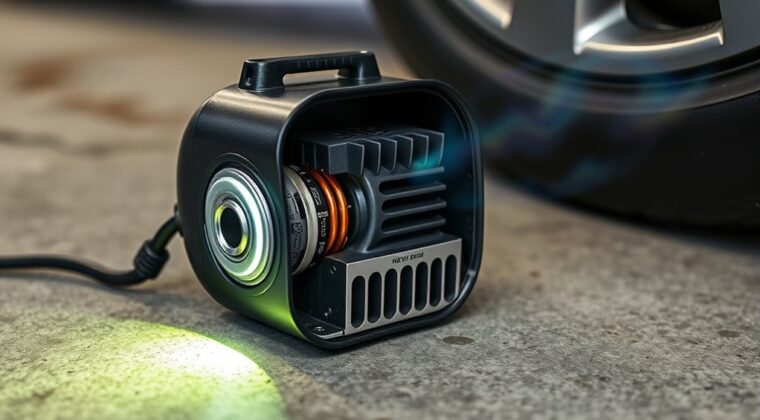
A tire inflator’s thermal protection cuts power when internal temperature rises above a preset limit, so you don’t burn out the motor. Sustained use, hot ambient air, blocked vents, or inflating beyond rating can trigger it faster. After a cutoff, let the unit cool for 5–10 minutes before restarting. Repeated trips usually mean overload or poor airflow. If you keep going, you’ll see how to prevent nuisance shutdowns and keep inflation accurate.
Key Takeaways
- Tire inflators overheat from sustained use, poor ventilation, hot ambient air, or exceeding their rated capacity.
- A thermal cutoff protects the motor by opening the circuit when internal temperature rises too high.
- After shutdown, let the inflator cool for 5–10 minutes before using it again.
- Repeated thermal trips suggest overload, blocked vents, or a faulty unit needing inspection.
- Hot inflation can skew pressure readings, so verify tire pressure with a separate gauge after cooldown.
What Causes Tire Inflator Overheating?
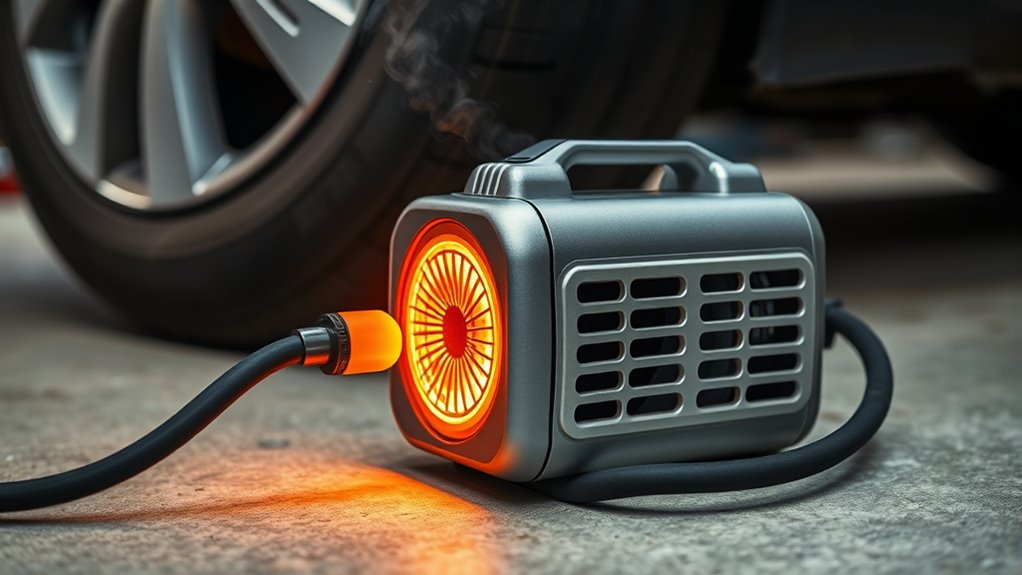
Tire inflator overheating usually starts when you run the unit too long without a cooldown, because sustained use builds thermal load faster than the housing can dissipate it.
You push the tire inflator through repeated fills, and the motor’s heat accumulates into heat soak, especially if you keep it active beyond 3-4 minutes for two tires.
Hot ambient air makes the problem worse because the unit inhales warmer intake air and loses cooling margin.
If you ask the inflator to exceed its rated capacity, current draw rises and so does internal temperature.
Poor ventilation adds another fault line: dust, lint, or blocked vents trap heat inside the shell.
After that, the unit can drift thermally, and you may see pressure readings slip out of spec after the session.
To keep control, you need disciplined duty cycles, clear airflow, and respect for the machine’s limits.
How Tire Inflator Thermal Protection Works
You rely on a thermal cutoff that opens the power circuit when the inflator motor reaches a preset temperature, preventing burnout and limiting heat-related damage.
After the unit cools, the protector either resets automatically or requires manual reset, depending on the design and safety requirements.
If you see repeated cutoffs, you should treat them as a diagnostic signal, because they often point to overload, restricted airflow, or another fault that needs correction.
Thermal Cutoff Mechanism
A thermal cutoff mechanism continuously monitors the inflator’s internal temperature and automatically disconnects power once a preset limit is exceeded. You get immediate protection because the thermal cutoff mechanism blocks excess heat before it can damage the motor or insulation. This reduces thermal fatigue, improves reliability, and keeps your inflator operating with precision under load.
- It senses rising heat in real time.
- It interrupts power at the threshold.
- It preserves motor life and safety.
You should respect the limits in your user manual and avoid back-to-back inflation cycles that push the unit past its design range.
Proper maintenance and cooldown discipline help prevent nuisance trips, so you stay in control and keep your equipment ready for safe, efficient use.
Reset And Cooldown
After a thermal cutoff event, the inflator won’t resume safely until its thermal protector has reset and the motor has cooled for the manufacturer’s specified interval, typically 5–10 minutes.
You should respect that pause, because heat saturation can keep contacts unstable and the motor vulnerable to burnout. If your unit uses an automatic reset, wait for it to clear only in a safe, open setting; manual systems require you to reset it yourself after cooldown.
Check the housing, vents, and cord for heat stress, then verify normal function before reapplying power. Regularly inspect the protector to prevent nuisance tripping and preserve reliable output.
How to Prevent Tire Inflator Overheating
To prevent tire inflator overheating, use a round-robin inflation strategy: inflate one tire on each vehicle, then return for the next, so the unit gets passive cooling during walk-time and doesn’t accumulate excessive thermal load.
You can prevent overheating by keeping each duty cycle short and deliberate. Run the inflator for 3–4 minutes when servicing two tires, then enforce a 5–7 minute cooldown before restarting.
Operate in open, well-ventilated space; hot ambient air cuts heat rejection and raises risk. After cooldown, verify pressure with a separate gauge, because thermal drift can skew readings.
Operate in open, ventilated space; after cooldown, verify pressure with a separate gauge to catch thermal drift.
- Alternate vehicles instead of finishing one car at a time.
- Respect cooldown windows; don’t override them for speed.
- Inspect battery charge and hose integrity each quarter.
This protocol preserves thermal margin, stabilizes output, and keeps you in control without surrendering efficiency to heat.
Why Heat Shortens Tire Inflator Motor Life
When you expose a tire inflator motor to excessive heat, you degrade its insulation. The Arrhenius effect means each 10°C rise can cut service life roughly in half.
Repeated overheat cycles create thermal fatigue, so the windings and internal components wear faster with each heat-soak event. As insulation weakens and cutoffs occur more often, motor efficiency drops and failure risk climbs.
Heat Damages Motor Insulation
Heat is one of the main reasons tire inflator motors wear out early, because excessive temperature degrades the insulation around the windings and weakens the motor’s electrical integrity. When heat damages motor insulation**, you lose dielectric strength**, and the motor draws harder, runs hotter, and resists repair.
- Higher temperature can cut lifespan sharply.
- Ambient heat reduces cooling efficiency.
- Thermal cutoffs signal internal stress.
You need to treat cooldown time as protection, not delay. If you keep the inflator running too long, you accelerate thermal fatigue and expose the windings to cumulative damage.
That means more interruptions, lower efficiency, and less freedom from failure when you need air now. Manage run time tightly, and let the motor breathe.
Repeated Overheat Cycles Wear
Repeated overheat cycles progressively break down tire inflator motor insulation, and under the Arrhenius Rule, every 10°C rise can roughly halve its service life.
You’re not just losing output; repeated overheating cycles drive thermal fatigue in windings, bearings, and joints.
When you run a compact inflator nonstop, friction and heat accumulate faster than the motor can shed them, so stress compounds with each cutoff event.
Those thermal cutoffs protect you in the moment, but they also mark damage already underway inside the unit.
Over time, efficiency drops, failure risk climbs, and your inflation task becomes less predictable.
To stay in control, limit run time, let the motor cool fully, and treat heat management as a nonnegotiable condition for durable, liberated use.
How to Use the Round-Robin Method for Multi-Car Prep
To keep a tire inflator within safe operating limits during multi-car prep, use a round-robin pattern: inflate one tire on each vehicle, then move to the next vehicle and let the unit cool during the walk time. This Round-Robin method spreads load across cars, so your air compressor avoids sustained stress while you protect time and money.
- Inflate one tire, then switch vehicles.
- Pause 5-7 minutes between runs when ambient temperature climbs.
- Stop if motor temperature rises or temperature exceeds the safe threshold.
You keep continuous run time near 3-4 minutes per two tires, which helps the inflator stay accurate and prevents sensor drift.
That means you can hit manufacturer pressure targets without babysitting a hot unit. In practice, you’re not slowing prep; you’re preserving output, limiting thermal buildup, and keeping the tool ready for the next cycle.
How Ambient Heat and Voltage Drop Affect Inflation
When ambient temperatures climb, your inflator’s cooling margin shrinks, so the same duty cycle produces more internal stress and a higher overheating risk.
In high air temperature, convection removes less heat, and the motor sits closer to its thermal limit with every minute you run it.
If you power a 12V unit with the engine off, voltage drop can starve the motor, reduce efficiency, and force it to draw longer under load. That extra inefficiency converts directly into heat, not freedom.
You should treat 3-4 minutes for two tires as a hard operating window, then give the unit 5-10 minutes to recover.
In hot conditions, that rest isn’t optional; it preserves torque, lowers winding temperature, and prevents thermal fatigue.
Manage ambient heat and keep supply voltage stable, and you’ll extend life while keeping inflation performance predictable.
Why Tire Pressure Readings Drift After a Hot Run
After a hot inflation run, the inflator’s pressure reading can drift upward even if the tire hasn’t actually reached that value. You’re seeing thermal bias: internal sensors heat up, resistance changes, and the display overstates pressure. As air temperature rises inside the hose and pump, the reading can keep climbing while the tire itself lags behind.
That’s why you shouldn’t trust the last number from a stressed unit.
- Continuous use beyond 3-4 minutes can push internal temperatures high enough to distort sensing.
- The Arrhenius Rule shows heat damage compounds fast; every 10°C rise can halve insulation life.
- Verify the tire with a separate gauge after a hot run, or you may drive away under-inflated.
You keep control by treating the inflator as a heated instrument, not a neutral judge.
Thermal drift isn’t freedom; it’s noise.
How Long to Cool Down a Tire Inflator
How long should you let a tire inflator cool down? After you’ve inflated two tires, stop and give the unit 5-7 minutes of rest so heat can leave the motor and head.
Keep each continuous run to 3-4 minutes; beyond that, internal parts absorb too much thermal load. If you’re working in extreme heat, double the cooldown window to protect the insulation and keep the compressor free from premature failure.
You’re not losing control by pausing; you’re preserving it. Let the machine shed heat before you push more air through the hose.
After cooldown, verify pressure with a separate gauge, because hot operation can drift sensors and distort readings. Recheck only when the inflator has stabilized.
Follow this protocol every session, and you’ll cut wear sharply: every 10°C rise can halve motor insulation life.
Cool it down, confirm the pressure, and keep the tool ready for the next clean, precise fill.
Frequently Asked Questions
Why Does a Tire Inflator Get Hot?
Your tire inflator gets hot because you force a small motor and compressor to work hard in a compact shell.
As a result, friction and electrical losses build heat fast. Heat Dissipation can’t keep up during long runs, especially in hot weather or with low vehicle voltage, which raises current draw.
If you don’t give it cooldown time, internal parts saturate, temperatures climb, and thermal stress increases.
How Hot Is Too Hot for Tires?
Too hot starts around 60°C, and you’ll want to inspect at 40°C.
Isn’t it striking how a small rise in Tire Temperature can threaten your freedom to drive? You should treat 70°C as a critical limit, because structural integrity and traction drop fast.
Prolonged heat degrades rubber, increases wear, and can trigger blowouts.
Check tires in sun or heat, and cool them before you keep moving.
What Are the Safety Precautions When Using a Tire Inflator for a Car?
You should check tire pressure first, then inflate only to the manufacturer’s specification.
Inspect the tire for cuts, bulges, or damage, and use the inflator in a well-ventilated area.
Don’t run it continuously beyond 3-4 minutes; let it cool 5-7 minutes to protect the motor and electronics.
Read the manual, verify thermal safeguards, and practice inflator maintenance so you stay safe, efficient, and in control.
Is 90 Psi Too High for Tires?
Yes—90 psi is too high for most tires.
You’ll usually see passenger cars specified at 30–35 psi, so 90 psi can nearly triple tire pressure and push you past safe operating limits.
In one common failure mode, overinflation cuts tread contact, reducing traction and stability.
You should check the door placard and sidewall, then inflate only to the manufacturer’s recommended pressure to protect your freedom and safety.
Conclusion
So, if your tire inflator gets hot, that’s not a personal insult from the machine; it’s thermal protection doing its unglamorous job. You keep the duty cycle sensible, let the motor cool, and avoid the heroic mistake of treating heat like folklore. Add ambient temperature and voltage drop, and the plot thickens fast. In short, you don’t “push through” overheating—you manage it, or you’ll shorten the inflator’s life and your patience.
