
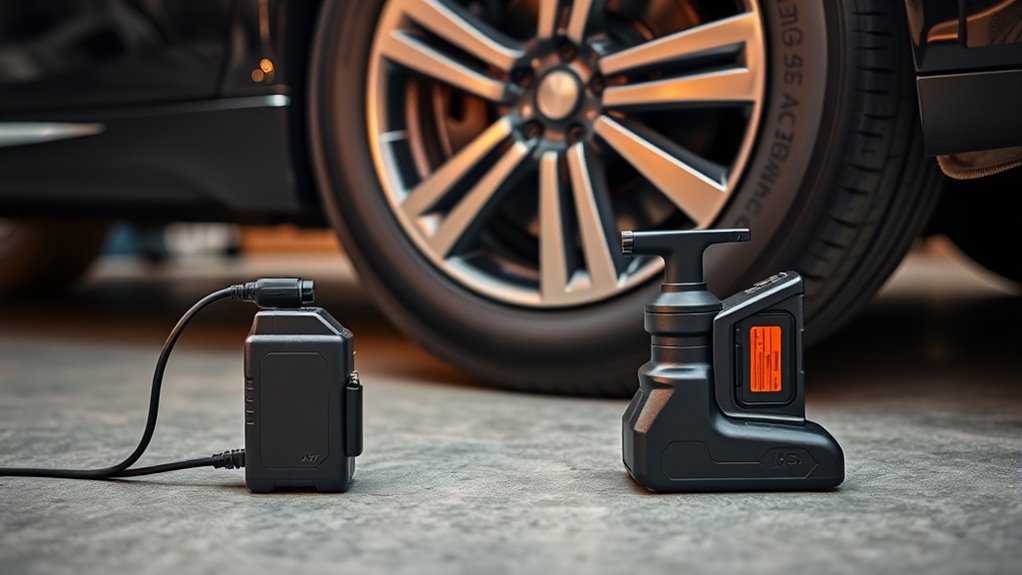
A 12V tire inflator runs from your vehicle’s 12-volt power supply, while a cordless tire inflator runs from a rechargeable battery. Neither type is automatically faster: inflation speed depends on the specific compressor, airflow, tire size, starting pressure, and power available. Choose 12V if you want a vehicle-based tool with no separate battery to keep charged; choose cordless if portability and quick setup matter more.
Key Takeaways
- 12V inflators use vehicle power, so they avoid a separate rechargeable battery but keep you tethered to the vehicle.
- Cordless inflators work away from the vehicle and are convenient for cars, bicycles, sports equipment, and other supported inflatables.
- Do not assume 12V is faster. Some modern cordless tool-platform inflators are very quick, while small 12V socket inflators can be slower.
- Runtime is model-specific. A 12V inflator can still have a duty-cycle limit, while a cordless model is limited by battery charge, heat, and its own duty cycle.
- For tire pressure, use the vehicle manufacturer’s recommended cold-tire pressure on the placard or in the owner’s manual, not the maximum pressure molded on the tire sidewall.
What Is a 12V Tire Inflator?
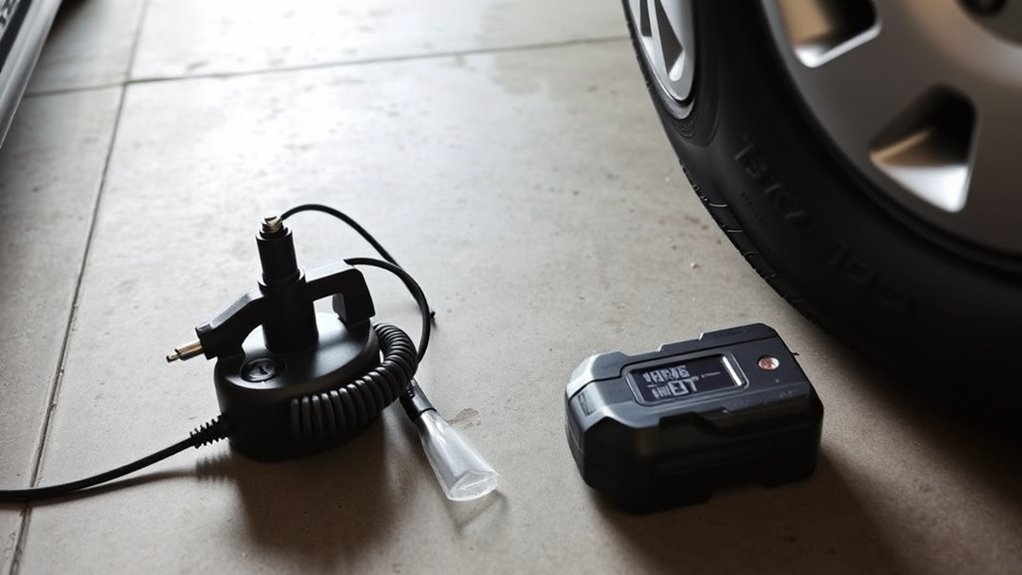
A 12V tire inflator takes power from a vehicle’s 12-volt electrical system. Small portable models commonly use an accessory socket, while heavier-duty 12V compressors may connect directly to the battery with clamps.
A socket-powered inflator is useful for routine tire top-offs because you do not need to remember to recharge a separate tool battery. However, you must stay within the vehicle outlet’s current rating and the inflator manufacturer’s instructions.
Do not assume a 12V inflator can run indefinitely. Portable compressors have model-specific duty cycles, which define how long they can operate before they need a cooling period. Some vehicles or inflators also call for the engine to be running during use, while others have different instructions, so check both manuals.
Many 12V models include a pressure gauge, preset pressure control, automatic shut-off, work lights, or valve adapters. These features vary by model rather than by power source alone.
What Is a Cordless Tire Inflator?
A cordless tire inflator uses a rechargeable battery instead of requiring a live vehicle connection during inflation. Some use removable power-tool batteries, while compact handheld models use built-in rechargeable cells.
The main advantage is portability. You can carry the inflator to a tire, bicycle, lawn equipment, or supported inflatable without routing a power cord from the car.
Battery charge, battery condition, compressor design, target pressure, and temperature can all affect runtime and speed. Some cordless models also offer a 12V backup connection, giving you both battery operation and vehicle power.
Cordless Power Source
Most current cordless inflators use lithium-ion battery technology. Battery capacity matters, but a milliampere-hour or amp-hour number by itself does not tell you exactly how long an inflator will run because voltage, motor efficiency, load, and operating pressure also matter.
| Feature | Effect |
|---|---|
| Rechargeable battery | Allows inflation without a vehicle connection |
| Compact design | Can improve portability and storage |
| Integrated pressure gauge | Lets you monitor or set target pressure when equipped |
| Automatic shut-off | Stops at a preset pressure on models that include the feature |
Cordless designs remove the power cord, but they add battery maintenance. If the inflator will sit unused for long periods, check and recharge it according to the manufacturer’s storage guidance so it is ready when needed.
Portable Inflation Benefits
Battery-powered inflation gives you more freedom to work away from a vehicle. That can be especially useful for bicycles, sports equipment, lawn equipment, or a tire positioned where a short 12V cord is awkward.
Built-in gauges and pressure presets can make inflation easier, but they are not exclusive to cordless tools. Likewise, cordless does not automatically mean lighter or smaller; removable-battery tool-platform inflators can be larger than compact 12V units.
For emergency use, portability is useful only if the battery is charged. A cordless inflator kept as roadside equipment should be checked periodically instead of being left forgotten for months.
How Do 12V and Cordless Inflators Compare?
The most important differences are power source, portability, battery maintenance, and where you can use the inflator. Speed and runtime must be compared model by model.
| Feature | 12V inflators | Cordless inflators |
|---|---|---|
| Power source | Vehicle 12V system | Rechargeable battery |
| Portability | Tethered to vehicle or battery connection | Works independently while charged |
| Runtime | Limited by compressor duty cycle and vehicle power | Limited by battery charge, heat, and model duty cycle |
| Inflation speed | Varies by compressor and power connection | Varies widely; some tool-battery models are very fast |
| Maintenance | No separate battery to recharge | Battery needs charging and proper storage |
A 12V unit is convenient if the inflator will live in the vehicle and you mainly top off the vehicle’s own tires. A cordless unit is more flexible if you regularly inflate items away from the car or already own compatible tool batteries.
For large truck, trailer, or RV tires, do not choose by “12V versus cordless” alone. Check the compressor’s rated pressure, airflow, duty cycle, hose reach, power connection, and the tire manufacturer’s requirements.
Which Tire Inflator Fills Tires Faster?
Neither power source always wins on speed. The original assumption that 12V inflators are generally faster is too broad. Current cordless tool-platform inflators can outperform small socket-powered 12V models, while heavy-duty 12V compressors can deliver much more airflow than compact handheld units.
For a fair speed comparison, look for inflation times measured on the same tire size, from the same starting pressure to the same target pressure. Also compare airflow at useful pressure, not only a maximum PSI number.
Maximum PSI tells you the highest pressure a compressor is designed to reach; it does not tell you how quickly it will move air. Duty cycle also matters because a fast compressor that overheats and needs frequent cooling may be less useful for several tires in a row.
Which Tire Inflator Is Easier to Store?
Cordless models often reduce cord clutter, but storage size varies widely. A compact built-in-battery inflator may fit into a small case, while a tool-platform cordless model with a large removable battery can take up more room than a small 12V plug-in unit.
Before buying, compare the actual dimensions, hose storage, cord storage, and whether the battery must be stored separately.
Size And Footprint
Compact cordless inflators can have a small footprint because they do not need a long vehicle power cord. Small 12V inflators can also be compact, although the cord and hose still need organized storage.
If space is tight, use the product dimensions rather than assuming one category is smaller. A carrying case can also matter because it keeps adapters, hoses, and power leads together.
Vehicle Storage Ease
A 12V inflator is simple for long-term vehicle storage because it has no separate rechargeable tool battery to maintain. The tradeoff is that its cord must reach the tire from the vehicle’s power connection.
A cordless inflator is quicker to grab and use, but a stored rechargeable battery still needs periodic attention. Follow the battery manufacturer’s instructions for charging and storage, especially if the vehicle experiences very hot or cold conditions.
Cordless Portability Benefits
Cordless portability is most valuable when you need to work away from the car. You can move from a vehicle tire to a bicycle, sports ball, or other supported inflatable without repositioning a power cable.
The tradeoff is readiness. If the battery is depleted when you need the tool, the portability advantage disappears unless the model also supports another power source.
Which Tire Inflator Works Best in Emergencies?
For emergencies, there is no universal winner. A 12V inflator can be dependable because it does not have its own battery to discharge in storage, while a charged cordless inflator gives you faster setup and more freedom around the vehicle.
| Factor | 12V inflators | Cordless inflators |
|---|---|---|
| Access | Needs a suitable 12V vehicle connection | Works independently while charged |
| Setup | Requires routing a power lead | Usually quicker to position |
| Speed of inflation | Model-specific | Model-specific |
| Portability | Limited by cord or clamp reach | High while battery is charged |
| Readiness after long storage | No separate inflator battery to recharge | Battery should be checked periodically |
Remember that an inflator restores air pressure; it does not repair a puncture, damaged sidewall, leaking valve, or tire that has come off the rim. If a tire is visibly damaged or will not hold pressure, do not treat repeated inflation as a permanent fix.
What Tire Inflator Features Matter Most?
Start with power source, inflation performance, and duty cycle. Then check whether the inflator can reach every tire on your vehicle without straining the hose or power lead.
Pressure control matters too. A preset with automatic shut-off can make topping off easier, while a clear gauge helps you monitor pressure.
Automatic shut-off is useful, but always confirm the final tire pressure and follow the vehicle manufacturer’s recommended cold-tire pressure.
For 12V socket models, check the inflator’s current draw against the vehicle outlet’s rating. For cordless models, compare battery compatibility, whether a battery and charger are included, and whether the tool can use another power source if the battery is empty.
Also compare airflow, hose length, cord length, thermal protection, storage, noise, valve-chuck design, and included adapters. Maximum PSI alone is a poor way to judge inflation speed.
Which Tire Inflator Is Right for You?
Choose a 12V inflator if you mainly service your vehicle’s tires, want a tool that can stay in the car without a separate rechargeable battery, and have a suitable 12V power connection.
Choose a cordless inflator if you want grab-and-go convenience, need to inflate items away from the vehicle, or already own batteries in a compatible power-tool system.
For frequent multi-tire work or large high-volume tires, compare actual compressor performance instead of choosing by power source alone. A heavier-duty compressor may be a better fit than either a small 12V socket inflator or a compact handheld cordless model.
Safe Tire Inflation Tips
- Check tire pressure when the tires are cold whenever practical.
- Use the vehicle manufacturer’s recommended pressure on the tire-information placard or in the owner’s manual. Do not use the tire sidewall’s maximum pressure as the vehicle’s target pressure.
- Check the inflator’s duty cycle and allow cooling time when required.
- For a 12V socket inflator, verify that the vehicle outlet can safely supply the required current.
- Inspect a tire that repeatedly loses air. An inflator can add air, but it cannot repair the cause of a leak.
Frequently Asked Questions
Who Makes the Best Cordless Tire Inflator?
No manufacturer is automatically the best for every driver. Compare exact models for inflation time, gauge accuracy, duty cycle, battery system, hose design, warranty, and the tire sizes you need to service.
If you already own a compatible power-tool battery platform, a cordless inflator from that same system can be convenient because you may not need to buy another battery and charger.
What Is the Best Portable Tire Inflator According to Consumer Reports?
The original article incorrectly stated that Consumer Reports named an AstroAI cordless model the best portable tire inflator. The Consumer Reports cordless-inflator comparison located during this update is dated September 2, 2017 and evaluated Ryobi, Craftsman, Stanley, and Ideaworks models; AstroAI was not part of that test.
In that 2017 comparison, Consumer Reports preferred the Ryobi One+ among the four tested models. Because that report is old, it should not be treated as a current 2026 ranking of today’s portable inflators.
What Is the Most Accurate Tire Inflator?
There is no single “most accurate” inflator that can be identified from gauge type alone. Digital displays can be easy to read, but accuracy depends on the sensor, calibration, valve connection, and the specific model.
If pressure accuracy matters, look for a model with documented accuracy or independent test results, then verify the final pressure with a trustworthy tire-pressure gauge until you know how the inflator behaves.
What Are the Different Types of Cordless Tire Inflators?
Common cordless designs include tool-battery inflators that use removable power-tool packs, built-in-battery handheld inflators that recharge by cable, and dual-power inflators that can run from a rechargeable battery plus a 12V or other corded source.
Choose among them based on portability, battery availability, tire size, inflation speed, duty cycle, and whether you need backup power when the rechargeable battery is empty.
Conclusion
When comparing a 12V tire inflator vs. cordless tire inflator, power source and portability are the clearest differences, but speed is not determined by the category alone. A 12V model is a practical vehicle-based choice with no separate battery to maintain, while cordless is more convenient away from the car.
Whichever type you choose, compare model-specific inflation performance, duty cycle, gauge features, hose reach, and power requirements. For your tires, always use the vehicle manufacturer’s recommended cold pressure rather than a generic PSI target.