
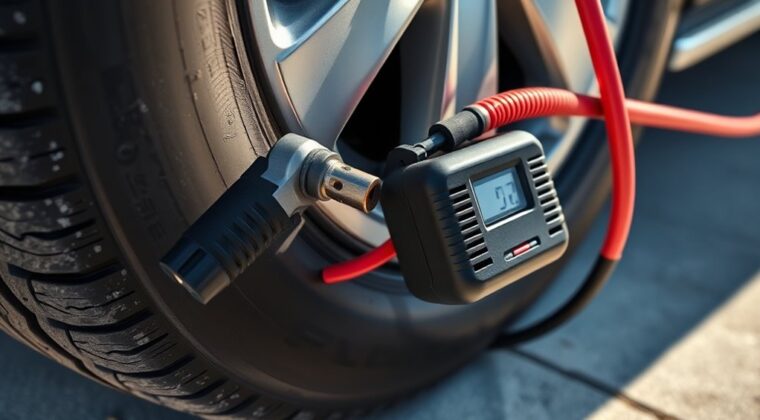
A 12V tire inflator is a portable air pump that plugs into your car’s accessory outlet and uses 12V DC to compress air. You can use it for topping off tires on the road, but performance depends on current draw, usually 7 to 18 amps. Higher-draw units inflate faster, run hotter, and may blow a 15A or 20A fuse. Choose one with accurate gauges, safe amperage, and the speed you need, and you’ll see the tradeoffs clearly.
Key Takeaways
- A 12V tire inflator plugs into a car’s accessory outlet and uses vehicle DC power to compress air for portable inflation.
- Typical power draw is 84–217 watts, with current often between 7 and 18 amps depending on the model.
- Inflation speed varies widely, from about 3 minutes to over 10 minutes, with higher-powered units usually faster.
- Check the vehicle’s fuse rating before use, because high peak current can blow 15A or 20A circuits.
- Prioritize gauge accuracy, noise level, and heat management, since long use can overheat some inflators.
What Is a 12V Tire Inflator?
A 12V tire inflator is a portable air pump that plugs into your car’s 12V accessory outlet, so you can inflate tires on the go without relying on a shop or stationary compressor.
You use it as a compact air compressor to restore tire pressure when you’re dealing with low pressure. Most 12V tire inflator models draw about 84 to 217 watts and 7 to 18 amps, so they stay within common vehicle limits.
Use it as a compact air compressor to restore tire pressure quickly, while staying within common vehicle power limits.
You can expect different speeds: a budget unit may fill a 15-inch tire to 35 PSI in under 5 minutes, while a premium model can do it in about 1.5 minutes.
Noise usually lands between 76.8 dB and 88.4 dB, so quieter units suit tighter spaces.
Gauge accuracy also varies; some read about 1 PSI off, which can affect precision.
How Does a 12V Inflator Get Power?
If you’re using a 12V tire inflator, it gets power from your vehicle’s 12V accessory outlet, which supplies direct current for portable devices. You plug the tire inflator into that outlet, and the car’s electrical system delivers energy at a nominal 12V DC. Most models convert that supply into the motor output needed to compress air.
- Typical power draw: 84–217 watts
- Typical current draw: 7–18 amps
- Check outlet specs before you buy
That load matters because different inflators demand different current levels. A smaller unit may run efficiently on standard 12V supply, while a higher-output model pulls more amperage.
Many designs include automatic shut-off, so you can fill tires without babysitting the process. To stay compatible, match your tire inflator to your vehicle’s outlet specifications and expected duty cycle. This keeps your setup efficient, portable, and under your control.
Will It Blow a Fuse?
Yes, a 12V tire inflator can blow a fuse if its amp draw exceeds your vehicle’s fuse rating, especially with units that pull 7 to 18 amps or more.
You also need to account for peak draw, since a high-startup surge can trip a fuse even when the running current seems acceptable.
Check your fuse amperage and match the inflator’s demand to it; for example, lower-draw models are safer on 15A circuits, while high-draw units like the NOK can overload 20A fuses.
Fuse Amps and Limits
Most 12V tire inflators draw enough current to matter for fuse protection, typically about 7 to 18 amps as power demand rises from roughly 84 to 217 watts.
You should match the tool to your vehicle’s fuse ratings and keep current draw below that limit. If you run a high-demand unit on a low-rated circuit, you risk a blown fuse and a dead compressor.
- DeWalt inflators stay under 10 amps, so they fit many 15 amp fuse ratings.
- The NOK inflator reaches 20.6 amps, which can exceed some 20 amp limits.
Check your fuse panel before you plug in; that’s how you protect your freedom to travel.
Higher power demand usually means faster inflation, but your electrical margin decides whether it’s safe.
Peak Draw vs Running
Peak draw matters because a tire inflator can pull more current at startup or under load than it does once it’s running steadily. You need to judge peak current, not just the label value, because brief surges can decide fuse safety. A unit like NOK can hit 20.6 amps, enough to threaten a 20 amp fuse if it keeps pulling hard. DeWalt stays under 10 amps, so it fits 15 amp circuits better. Slime shows strong power efficiency at 84 watts and 7 amps, while Young T and Asani climb to 15.3 and 17 amps.
| Inflator | Current |
|---|---|
| DeWalt | <10 A |
| Slime | 7 A |
Match demand to fuse rating, and you keep control.
Safe Use on 12V
Whether a 12V tire inflator will blow a fuse depends on its amperage draw and your vehicle’s outlet rating. You need to match power ratings with fuse compatibility before you plug in, or you risk a dead outlet and stalled inflation.
High-draw units like the NOK can pull 20.6 amps, which can trip a 20 amp fuse. Lower-demand models such as Slime at 7 amps or Carson at 11.4 amps usually fit standard fuses better.
- Check your outlet’s fuse rating first.
- Compare inflator amperage to vehicle capacity.
- Use safety precautions with higher-end units like Asani at 17 amps.
DeWalt-style inflators under 10 amps often work well with 15 amp fuses, giving you safer, freer roadside control.
How Fast and Hot Do They Run?
Inflator performance varies sharply in both speed and heat output. You’ll see inflation speed differ from about 10 minutes with Slime to 7 minutes with Carson, while Noco can finish a midsize tire in 2.9 minutes.
That gap matters when you’re making a performance comparison, because faster output often pairs with higher electrical load and more heat generation. Noco can draw up to 247 watts, while Slime uses only 84 watts, so efficiency and speed don’t move in lockstep.
You should also track thermal stress: FBK and DeWalt can push hose temperatures to 192°F and 183°F.
Noise varies too, from 88.4 dB on POW Wools to 76.8 dB on Asani. Many units tolerate about 15 minutes of continuous use, but exceeding that window can trigger overheating.
Read the spec sheet, then match the tool to the task.
When a 12V Inflator Makes Sense
You’ll want a 12V inflator when you need fast roadside inflation from your vehicle’s accessory outlet, especially for a flat tire emergency.
It works best for standard passenger tires and smaller tires, where budget models can still reach about 35 PSI reliably.
Check the unit’s amperage draw first, because high-demand inflators can exceed your fuse rating.
Quick Roadside Inflation
A 12V tire inflator makes the most sense when you need fast roadside recovery: models like the Noco Air15 can take a tire from 0 to 40 PSI in 2.9 minutes, and even budget units such as the Carson can bring a 15-inch tire to 35 PSI in under 5 minutes.
These portable solutions support emergency preparedness and user convenience when you’re stranded. You plug into the vehicle’s 12V outlet, inflate, and move on without waiting for outside help.
- Efficient units can draw only 84 watts.
- Noise can range from 76.8 dB to 88.4 dB.
- High-draw models may exceed 20-amp fuse limits.
For you, that means rapid, independent recovery with minimal delay, provided your vehicle can supply the needed current safely.
Best For Small Tires
For small tires, a 12V inflator makes sense when portability, fast top-offs, and moderate power draw matter more than high-volume output. You can carry compact models like the 1.14 lb Slime unit on a bike, motorcycle, or in a roadside kit without friction.
Their inflation speed is strong enough for small volumes; some 15-inch tires reach 35 PSI in under 5 minutes. Most draw about 94 watts, so they run from standard 12V accessory outlets without strain.
Expect noise levels around 85-88 dB, which is loud but tolerable for brief use. Use the built-in gauge as a guide, then verify pressure with a reliable gauge, since accuracy can still drift by a small margin.
How to Choose the Right One
Choosing the right 12V tire inflator comes down to five practical specs: power draw, inflation speed, pressure capability, noise, and gauge accuracy.
You should match power draw to your vehicle’s fuse limit; an 84-watt Slime unit is easier on circuits than a 247-watt Noco.
For performance comparison, check inflation speed next: NOK can fill a tire in 1.5 minutes, while Slime may need 11.5 minutes.
If you need higher pressures, choose models like Rock Gorald R8 or POW Wools, which reach 35 PSI efficiently.
For quieter operation, Asani at 76.8 dB beats louder units near 88.4 dB.
Gauge accuracy matters too; Rock Gorald R8 stays within 0.1 PSI, while Young T can drift 1 PSI.
Gauge accuracy matters too; Rock Gorald R8 stays within 0.1 PSI, while Young T can drift 1 PSI.
Use user reviews and maintenance tips to verify reliability.
- Check fuse compatibility before you buy.
- Balance speed against noise and accuracy.
- Pick a gauge you can trust.
Frequently Asked Questions
What Is the Maximum PSI of a Cordless Tire Inflator?
You’ll usually see a cordless tire inflator max out between 35 and 80 PSI, depending on the model.
Your inflator features and battery capacity shape that limit: a Slime unit tops out at 35 PSI, while a Noco Air15 reaches 80 PSI.
You should check the exact rating before use, especially for larger tires.
Follow maintenance tips, keep seals clean, and charge it fully for reliable performance.
What Is the 5 PSI Rule?
Aye, the 5 PSI rule means you set your tire pressure about 5 PSI below the vehicle’s recommended spec, then let your inflator efficiency finish the job.
You do this to offset gauge error and heat rise, so you hit the target safely.
Follow safety guidelines, check pressure again, and you’ll reduce overinflation, improve handling, and protect tire life without ceding control to guesswork.
What Are the Drawbacks of Using a Cordless Air Compressor?
You’ll face battery life limits, portability issues, and slower inflation speed with a cordless air compressor.
You may need frequent recharging, which interrupts work and delays tire fills. Some units draw enough current to stress a vehicle’s electrical system, and their pressure readings can drift, risking under- or over-inflation.
You often pay more upfront, yet get less consistent performance than a corded inflator delivers.
Is 40 PSI Too Much for 35 PSI Tires?
Yes—40 psi is too much for 35 psi tires.
Like a tight drumhead, excess tire pressure can strain the casing, reduce traction, and create safety concerns.
You should follow inflation guidelines on your door jamb or owner’s manual, and verify pressure with a reliable gauge, since inflators can read high or low.
Stay within spec to preserve handling, ride comfort, and tire life, and protect your freedom on the road.
Conclusion
In the end, your 12V tire inflator is a tiny roadside powerhouse, not a miracle machine. You plug it into your vehicle, and it pulls enough current to save your day, but not enough to thrill your fuse box or roast your wiring. It works fast enough for emergencies, yet it can run hot like it’s auditioning for a furnace. Choose wisely, use it correctly, and it’ll pump your tires with impressive, reliable grit.