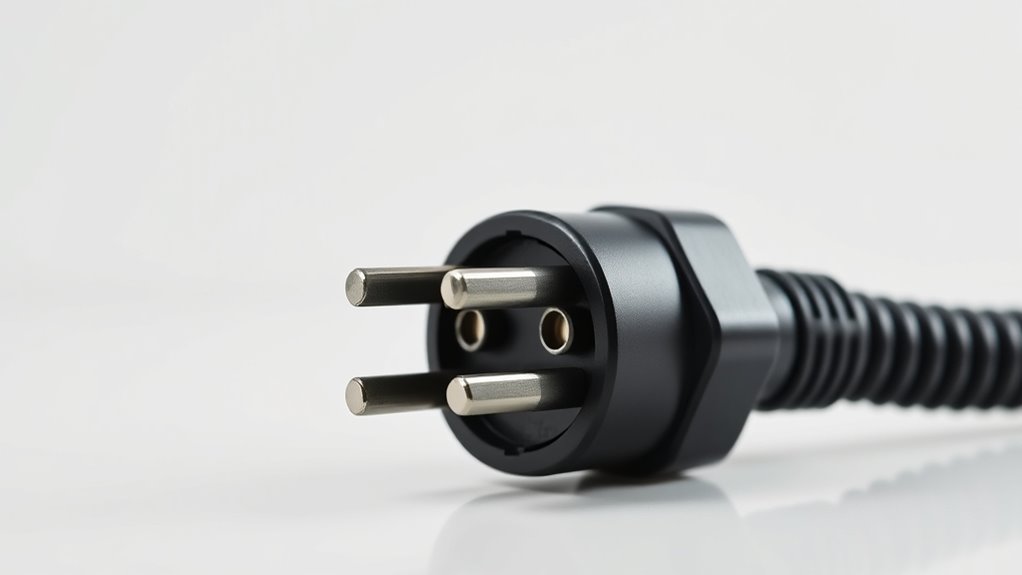
A NEMA 14-50 outlet is one of the most common 240-volt options for home EV charging. It is a 50-amp, 125/250-volt receptacle with four slots: two hot conductors, one neutral, and one ground. For EV charging, though, the safe continuous charging rate is usually lower than 50 amps. Most plug-in EV chargers on a NEMA 14-50 are set to 32 to 40 amps, depending on the charger, vehicle, breaker, and local electrical code.
Quick Answer
A NEMA 14-50 outlet can power a plug-in Level 2 EV charger from a 240-volt circuit. It is rated for 50 amps, but EV charging is a continuous load, so many setups charge at 32 to 40 amps. That often adds about 20 to 30 miles of range per hour, depending on the EV.
Key Takeaways
- A NEMA 14-50 is a wall receptacle; the EV charger or portable EVSE is the device that plugs into it.
- A 50-amp circuit usually supports up to 40 amps of continuous EV charging, but some portable chargers are capped at 32 amps.
- Installation should be handled by a licensed electrician because permits, GFCI protection, conductor type, and panel capacity vary by location.
- A hardwired Level 2 charger may be better for daily home charging if you want higher output, better weather resistance, or fewer plug-connection heat issues.
At a Glance
| Time Required | Usually a few hours for a straightforward install; longer if the panel needs upgrades, trenching, conduit, or permits. |
| Difficulty | Professional electrical work; not a casual DIY outlet swap. |
| Tools Needed | Licensed electrician, load calculation, permit where required, listed EVSE, proper breaker, conductors, box, and receptacle or hardwired charger. |
| Cost | Varies widely by panel location, distance, permits, GFCI needs, and upgrades. A short garage run is far cheaper than a panel upgrade or detached-garage install. |
What Is a NEMA 14-50 Plug for EV Charging?
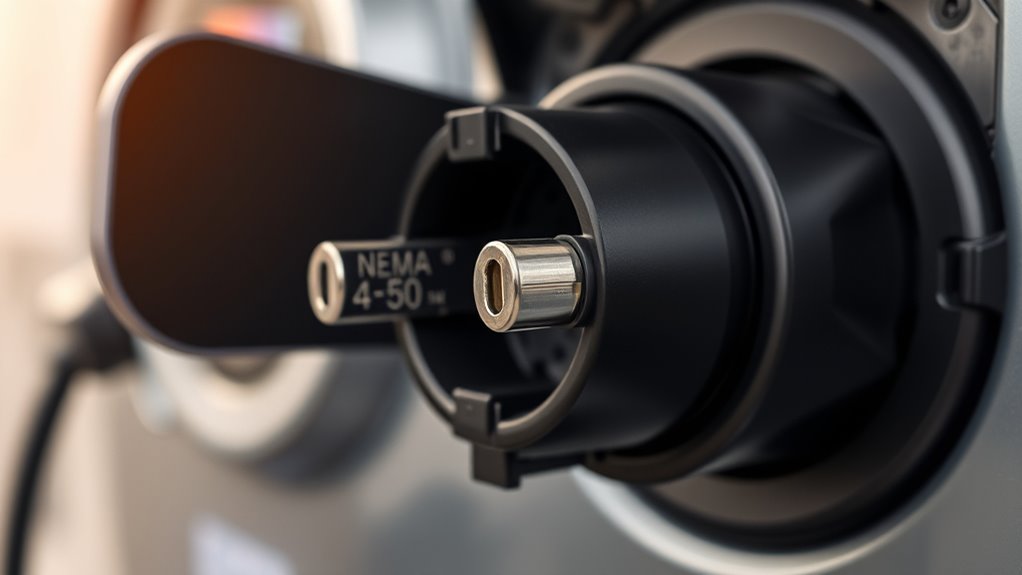
A NEMA 14-50 is a high-power receptacle style used for electric ranges, RV shore power, and plug-in EV chargers. The wall device is the receptacle or outlet. The cord end is the plug. The charging device that plugs into it is the EVSE, which stands for electric vehicle supply equipment.
The NEMA 14-50 configuration has four conductors: two hot wires, one neutral, and one equipment ground. In a typical North American home, the two hot wires provide 240 volts for Level 2 EV charging. The neutral is part of the 14-50 receptacle design, although many EV chargers do not use the neutral for charging.
For reference, Tesla lists its Mobile Connector with a NEMA 14-50 adapter as a 240-volt setup on a 50-amp breaker with a maximum 32-amp output. That is a good reminder that the receptacle rating, breaker size, EVSE setting, and vehicle limit are not always the same thing.
Note: People often say “NEMA 14-50 charger,” but the NEMA 14-50 is only the plug and outlet style. The actual charger electronics are inside your vehicle, while the wall unit or portable cord safely supplies power to it.
Benefits of the NEMA 14-50 Plug for EV Charging
A NEMA 14-50 outlet is popular because it offers a practical middle ground between slow Level 1 charging and a permanently hardwired Level 2 charger. It can work well if you want a plug-in EVSE, need some portability, or already have a correctly installed 14-50 circuit in the right location.
Fast Charging Capability
Level 1 charging from a standard 120-volt outlet is simple but slow. A NEMA 14-50 setup supplies 240 volts, so it can charge much faster when paired with the right EVSE and vehicle.
On many 50-amp circuits, a plug-in EV charger is set to 40 amps maximum continuous output, which equals about 9.6 kW at 240 volts. Some portable chargers are lower. Tesla’s Mobile Connector, for example, lists a 32-amp maximum output on NEMA 14-50, or about 7.7 kW at 240 volts.
A safe NEMA 14-50 EV setup is not about pulling the full 50 amps. It is about matching the charger setting, breaker, wiring, receptacle, vehicle, and local code.
In real use, that often means about 20 to 30 miles of range per hour for many EVs. The exact number depends on the vehicle’s efficiency, onboard charger limit, weather, battery temperature, and charge settings.
Versatile Compatibility Options
The NEMA 14-50 is common in garages, RV parks, and some commercial or utility spaces. That makes it familiar to electricians and compatible with many plug-in Level 2 EVSE cords.
It can serve Tesla vehicles, NACS-equipped vehicles, and J1772-equipped vehicles when you use the correct listed EVSE or adapter on the vehicle side. The wall outlet does not decide whether the car uses NACS or J1772; the EVSE cable and vehicle inlet do.
A NEMA 14-50 outlet can also be useful if you move or want to unplug the EVSE for travel. Still, frequent plugging and unplugging can wear a receptacle. If the charger will stay in one place for daily use, a hardwired charger may be the better long-term option.
How to Safely Install Your NEMA 14-50 Plug
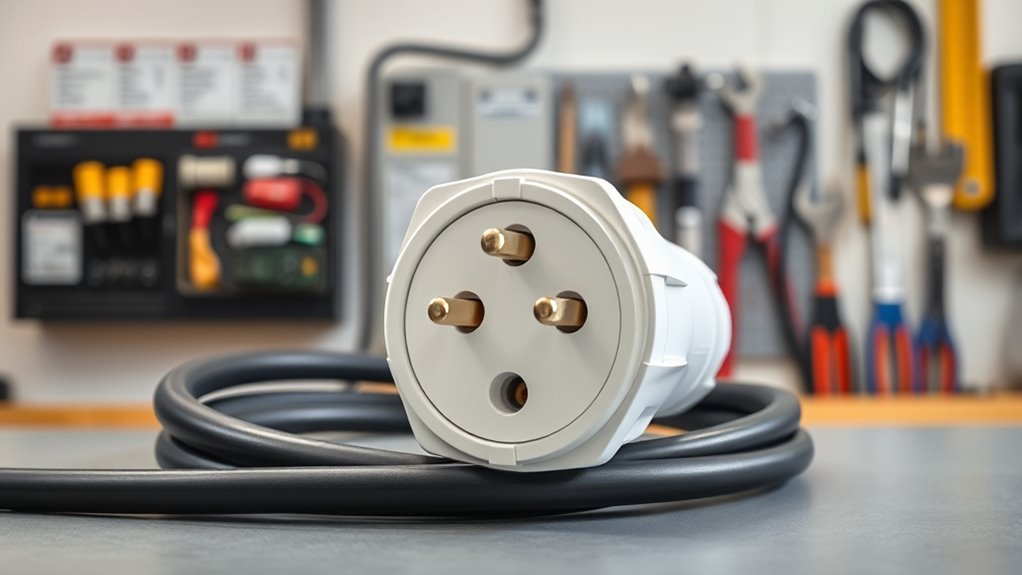
Installing a NEMA 14-50 outlet for EV charging is high-current electrical work. It should be planned and installed by a licensed electrician who understands EV charging loads, local code, permits, and inspection requirements.
Warning: Do not install a NEMA 14-50 outlet for EV charging as a simple DIY swap, and do not use extension cords, loose adapters, damaged receptacles, or undersized wiring. Stop charging and call an electrician if the outlet, plug, breaker, or EVSE cord feels hot.
A safe installation usually starts with a load calculation. Your electrician checks whether your electrical service and panel can handle the added EV load. A 50-amp breaker does not automatically mean your panel has enough spare capacity for a new 50-amp EV circuit.
The electrician will also choose the correct conductor type, breaker, box, cover, and mounting location. Some installations use cable inside a finished garage wall. Others require conduit, outdoor-rated equipment, or a weather-resistant enclosure. In many areas, a NEMA 14-50 receptacle in a garage or outdoors also needs GFCI protection under current local code.
Safe Installation Checklist
- Use a dedicated circuit: The EVSE should not share the circuit with a range, dryer, welder, or other appliance.
- Confirm panel capacity: Ask for a proper load calculation before adding a high-current EV load.
- Use listed equipment: Choose a listed EVSE and a quality receptacle rated for repeated high-load use.
- Set the correct amperage: A 50-amp circuit commonly means a 40-amp EVSE setting at most, unless the equipment is rated lower.
- Follow local code: Permit, inspection, GFCI, conductor, and enclosure rules vary by location.
- Place it within cord reach: The EVSE cord should reach the charge port without tension and without an extension cord.
Pro Tip: If the outlet will be used every day, ask your electrician about an industrial-grade receptacle or a hardwired charger. A cheap range receptacle may not hold up well to years of long EV charging sessions.
NEMA 14-50 vs. Hardwired Level 2 Charger
A NEMA 14-50 outlet is convenient, but it is not always the best home charging choice. A hardwired Level 2 charger connects directly to the circuit without a plug and receptacle. That removes one heat-prone connection point and may allow higher output if your panel, vehicle, and charger support it.
For example, Tesla lists its Wall Connector at up to 11.5 kW / 48 amps depending on vehicle, and Tesla states that it must be installed by a qualified electrician. A 48-amp hardwired charger usually needs a 60-amp circuit, not a NEMA 14-50 outlet.
| Setup | Best For | Main Tradeoff |
| NEMA 14-50 plug-in EVSE | Portable charging, renters with permission, RV-style flexibility, and 32–40A charging. | Receptacle can wear or overheat if low quality or frequently unplugged. |
| Hardwired Level 2 charger | Daily home charging, outdoor installs, higher amperage, smart charging, and cleaner permanent setup. | Less portable and may cost more if panel work is needed. |
Troubleshooting Installation Issues With NEMA 14-50
If a NEMA 14-50 EV charging setup does not work correctly, do not keep resetting the breaker and trying again. Heat, repeated trips, buzzing, flickering, or melted plastic can point to a serious wiring, breaker, receptacle, or EVSE problem.
Common Wiring Errors
Common problems include loose terminal connections, wrong conductor size or type, missing equipment ground, incorrect neutral handling, poor receptacle quality, and mismatched EVSE amperage settings. A NEMA 14-50 receptacle has four terminals, but EV charging still needs a correctly installed grounding path and a circuit that matches the EVSE instructions.
Another common issue is installing the outlet too far from the car’s charge port. EV charging cords are designed to plug directly into the vehicle. They should not be stretched tight, routed across sharp edges, driven over, or extended with a household extension cord.
Circuit Breaker Requirements
A NEMA 14-50 EV outlet is commonly installed on a dedicated 50-amp breaker, but the EVSE should not draw 50 amps continuously. For continuous EV charging, the common planning limit is 80% of the circuit rating, so a 50-amp circuit normally supports up to 40 amps of continuous charging. If your portable EVSE is rated for 32 amps, set it to 32 amps or lower.
In many modern installations, a GFCI breaker may be required for a plug-in EV receptacle. Rules vary by jurisdiction, so your electrician should follow the code adopted in your city or county.
Outlet Placement Considerations
Place the outlet or charger where the cable can reach the EV charge port without stress. The best height and location depend on your garage layout, parking direction, charger cord length, and whether the installation is indoors or outdoors.
Avoid areas where the cord becomes a trip hazard or where the receptacle can be hit by a bumper, lawn equipment, storage bins, or water. Outdoor installations need weather-appropriate boxes, covers, fittings, and EVSE equipment.
If the Plug or Outlet Gets Warm
A slight warmth at the EVSE body may be normal, but the plug, receptacle face, breaker, or cord should not become hot. If you smell burning plastic, see discoloration, hear crackling, or notice melted material, stop charging immediately and have the circuit inspected.
Heat often comes from loose connections, worn receptacles, low-quality devices, repeated plugging and unplugging, corrosion, or an EVSE set above the circuit’s safe continuous rating.
Common Misconceptions About the NEMA 14-50 Plug for EV Charging
Misconception 1: A NEMA 14-50 gives you 50 amps of EV charging. The receptacle is rated for 50 amps, but EV charging is a continuous load. Many plug-in EVSE units charge at 32 to 40 amps on this outlet.
Misconception 2: Any 240-volt outlet is fine. The outlet must match the EVSE plug, circuit rating, wiring, breaker, grounding, and local code. Do not force adapters into the setup.
Misconception 3: The neutral wire makes it charge faster. The neutral is part of the NEMA 14-50 design, but many EVSEs use only the two hot conductors and ground for 240-volt charging. A NEMA 6-50 outlet, which has no neutral, is also used for some EVSEs.
Misconception 4: A plug-in charger is always better than hardwired. Plug-in is convenient, but hardwired can be cleaner, safer for permanent use, and better suited to outdoor or higher-output charging.
Misconception 5: The wall outlet determines vehicle compatibility. The vehicle-side connector matters too. Your EV may use NACS, J1772, or an adapter. The NEMA 14-50 only describes the wall-side power connection.
Future-Proofing Your Charging Setup With NEMA 14-50
A NEMA 14-50 outlet can be a flexible choice, but the best future-proof setup starts with your panel capacity and charging habits. If you drive modest miles each day, a 32-amp or 40-amp plug-in EVSE may be more than enough. If you have multiple EVs, long daily driving, outdoor charging, or time-of-use utility rates, a hardwired smart charger may be a better investment.
When planning ahead, ask your electrician about these points:
- Panel capacity: Can your existing service handle a new EV load without upgrades?
- Charger output: Does your vehicle accept 32A, 40A, 48A, or more on AC Level 2?
- Load management: Would a smart charger or energy management system avoid a panel upgrade?
- Location: Will the cord reach future parking positions or a second EV?
- Weather exposure: Would a hardwired outdoor-rated charger be safer than a plug-in receptacle?
The NEMA 14-50 is still useful because it is familiar, widely supported, and powerful enough for overnight charging in many homes. Just avoid treating it as the only “best” answer. The best answer is the safest setup that matches your vehicle, panel, driving routine, and local code.
Frequently Asked Questions
What is a NEMA 14-50 outlet for charging cars?
A NEMA 14-50 outlet is a 240-volt, 50-amp receptacle style often used with plug-in Level 2 EV chargers. It can charge much faster than a normal 120-volt outlet, but the EVSE is usually set to 32 to 40 amps for continuous charging.
What EV charger does Volvo recommend?
Check the owner’s manual and current Volvo charging guidance for your exact model. In general, a listed Level 2 charger installed by a qualified electrician is the right home solution. It may be plug-in with a NEMA 14-50 or hardwired, depending on the charger and your electrical setup.
Can I just plug my EV into a 240V outlet?
Only if the outlet, breaker, wiring, and EVSE are compatible and code-compliant. Do not use a random 240-volt outlet with adapters. Your EVSE plug must match the receptacle, and the charger must be set to an amperage the circuit can safely support.
Is NEMA 14-50 the same as 240V?
No. NEMA 14-50 is a specific plug and receptacle configuration. A typical home NEMA 14-50 outlet supplies 240 volts between the two hot conductors, but not every 240-volt outlet is a NEMA 14-50.
How many amps can an EV charger use on a NEMA 14-50?
A 50-amp circuit commonly supports up to 40 amps of continuous EV charging. Some portable EV chargers are lower, such as 32 amps. Always follow the EVSE manual, vehicle limit, breaker size, wiring rating, and local code.
Is a NEMA 14-50 better than a hardwired charger?
It depends. NEMA 14-50 is better for portability and flexibility. A hardwired charger is often better for permanent daily charging, outdoor use, higher amperage, and fewer plug-connection heat concerns.
Can I use an extension cord with a NEMA 14-50 EV charger?
No. Plug the EVSE directly into the properly installed receptacle. Extension cords and loose adapters can overheat, create voltage drop, damage equipment, or cause a fire hazard.
Conclusion
A NEMA 14-50 outlet can be an excellent way to get Level 2 EV charging at home, especially if you want a plug-in charging option that can add meaningful range overnight. The key is using it correctly. A 50-amp receptacle does not mean 50 amps of continuous EV charging. In real installations, expect 32 to 40 amps from many plug-in EVSE setups.
For the safest result, have a licensed electrician check your panel capacity, install a dedicated circuit, follow local code, and use listed equipment. If you charge every day, park outdoors, or want higher output, compare NEMA 14-50 with a hardwired Level 2 charger before you commit.
Sources
- Tesla Mobile Connector Support — NEMA 14-50 adapter output, breaker rating, and estimated charging speed.
- Tesla Wall Connector — hardwired Level 2 charger output and qualified-electrician installation guidance.
- SAE J1772 Standard — North American conductive EV charging standard for AC Level 1 and Level 2 charging.
- NFPA 70: National Electrical Code — electrical code framework used by jurisdictions for EV charging circuits, receptacles, and safety requirements.
- NEMA WD 6 Wiring Devices Dimensional Specifications — NEMA plug and receptacle configuration standards.