
Reader disclosure: This roundup is reader-supported. When you click through Amazon links, we may earn a referral commission on qualifying purchases.
Last Updated: July 8, 2026
When you install or upgrade a Level 2 EV charger, the right 60 amp breaker helps keep the circuit safe, reliable, and compatible with your electrical panel. The key is not just amperage. You also need the correct breaker family, pole count, voltage rating, interrupting rating, and installation method for your exact load center.
This guide compares common 60 amp double-pole breaker options for EV charger circuits, so you can choose the model that matches your panel and avoids unsafe cross-brand guesswork.
Quick Verdict
If your charger needs a 60 amp branch circuit, choose the breaker that your panel label and charger manual allow. Pick the Siemens Q260 for compatible Siemens panels, the Square D HOM260 for Homeline panels, and the Eaton BR260 for Eaton BR-style load centers. Consider the Siemens QE260 only when your Siemens setup and local code call for breaker-level ground-fault equipment protection.
Top Picks
|
Category |
Product |
Best For |
|---|---|---|
|
🏆 Best for Siemens Panels |
Brand-matched 240V Siemens EV charger circuits |
|
|
⭐ Best for Homeline Panels |
Square D Homeline load centers |
|
|
💼 Best for Eaton BR Panels |
BR-style residential panels that list BR breakers |
|
|
🔰 Best Siemens Ground-Fault Option |
Siemens panels when breaker-level protection is required |
How We Picked
You need a 60 amp breaker that fits your panel, supports a 240V EV charger circuit, and matches the charger manufacturer’s installation instructions. We prioritized double-pole residential breakers from common panel families, straightforward plug-in mounting, interrupting rating, ground-fault protection where appropriate, and clear buyer guidance for matching the breaker to the load center.
We removed products that did not fit the core buyer intent for a typical 60 amp Level 2 EV charger circuit, including DC-only, single-pole, and three-pole specialty breakers. Those products can be useful in other electrical projects, but they can confuse EV charger buyers who need a standard residential 240V setup.
Before You Buy
- Check the label inside your electrical panel door for approved breaker types.
- Confirm your EV charger manual calls for a 60 amp breaker and a 240V double-pole circuit.
- Remember that a 60 amp EV charging circuit commonly supports up to 48 amps of continuous charging, not a full 60 amps of charging output.
- Have a licensed electrician confirm conductor size, torque settings, panel capacity, and local code requirements.
- Do not mix breaker brands or families unless the panel label specifically lists that breaker as approved.
Why You’ll Like It
The Siemens Q260 is the cleanest choice when your panel label lists Siemens QP-style breakers. It gives you a straightforward 60 amp, 240V double-pole option for a typical hardwired Level 2 EV charger circuit without relying on cross-compatible parts.
You’ll like it if you want an OEM-style breaker that electricians recognize and that keeps the installation path simple. It is not the right choice for non-Siemens panels unless your panel documentation specifically lists it as compatible.
Who Should Buy This
Choose this breaker if you have a compatible Siemens load center and your EV charger installation manual calls for a 60 amp, 2-pole 240V branch circuit.
Who Should Avoid This
Skip it if your panel is Square D, Eaton, GE, or another brand that does not list this breaker family on the panel label.
Durability
Built to standard thermal-magnetic specifications, this breaker is meant for routine residential use and long service life when installed correctly. It is not flashy, but it is built for normal load conditions in a compatible panel.
Energy Efficiency
Circuit breakers do not change how much energy your EV charger uses. The real efficiency benefit comes from correct sizing, clean terminations, and dependable protection that prevents downtime and nuisance trips.
Key Benefits
- Direct fit for compatible Siemens panels
- Double-pole 240V format for common Level 2 EV charger circuits
- Thermal-magnetic protection for overload and short-circuit safety
- Standard plug-in form factor for straightforward replacement
Why You’ll Like It
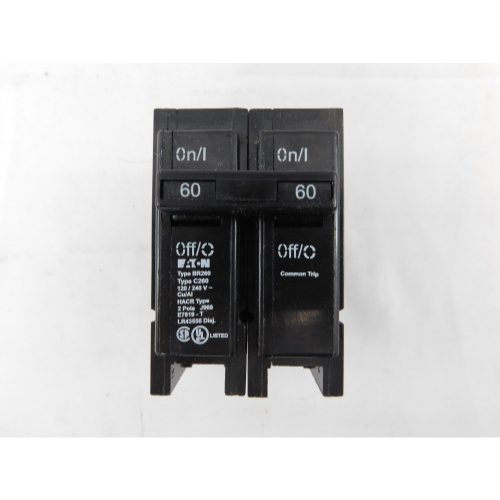
If your panel accepts Eaton BR breakers, the BR260 gives you a practical 60 amp double-pole option for a 240V EV charger circuit. It keeps the buying decision simple because you can match the breaker to the BR family rather than guessing based on physical appearance alone.
This is a good fit for homeowners who need a familiar residential breaker style and want a clear match for BR-style panels. Confirm the approved breaker type on your load center label before ordering.
Who Should Buy This
Choose the Eaton BR260 if your panel documentation lists Eaton BR or compatible BR-style breakers for a 60 amp two-pole circuit.
Who Should Avoid This
Skip it if your panel calls for CH, Homeline, QP, or another breaker family. A breaker that appears to fit is not enough for a safe or code-compliant installation.
Durability
Built to common residential specifications, the BR260 is designed for regular household feeder and appliance circuits. It should provide dependable service when installed in the correct panel and torqued to the manufacturer’s requirements.
Energy Efficiency
A breaker does not reduce charging costs by itself, but the right match helps prevent heat buildup, nuisance trips, and connection problems that interrupt charging.
Key Benefits
- Double-pole 240V layout for common Level 2 EV charger circuits
- Designed for BR-style residential load centers
- Standard thermal-magnetic protection for overload and short-circuit safety
- Familiar plug-in design that electricians commonly work with
Why You’ll Like It
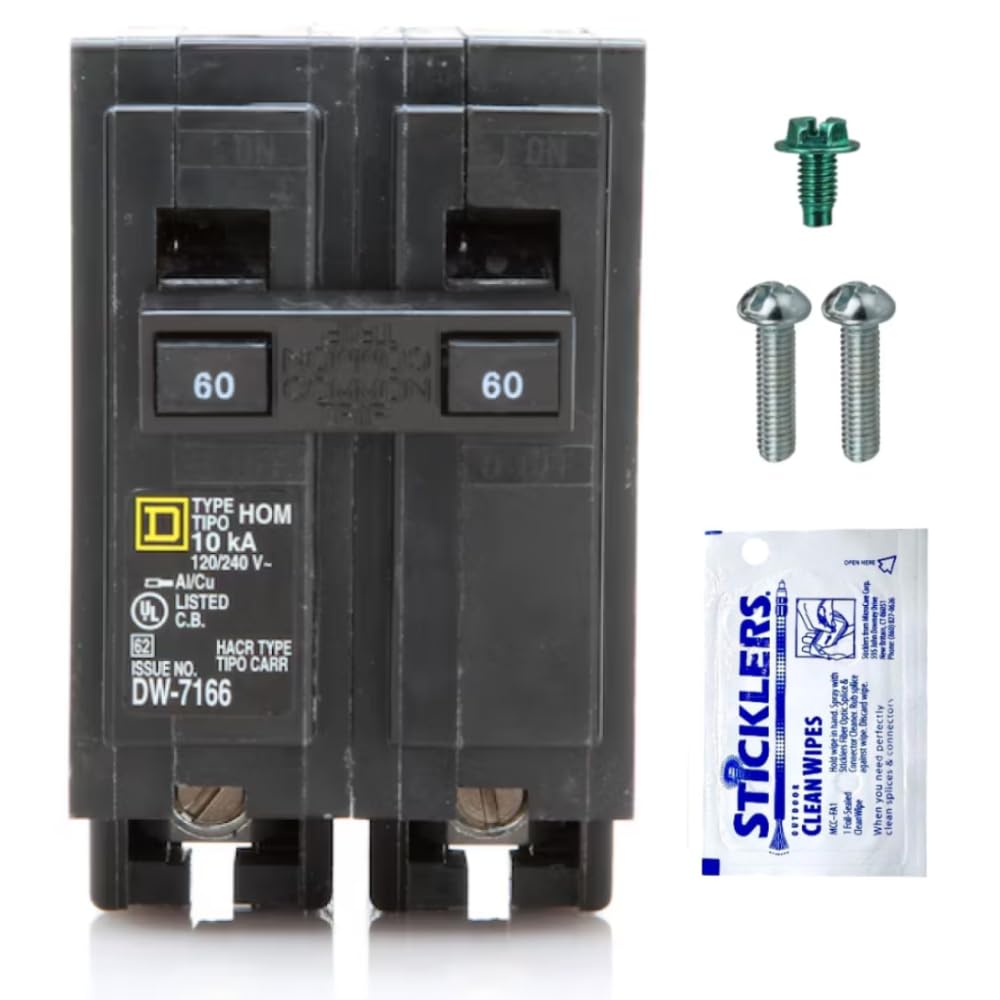
The Square D HOM260 is the strongest fit when your EV charger circuit will be installed in a Square D Homeline panel. It gives you the 60 amp, 2-pole, 120/240V format commonly used for high-load residential circuits while keeping the breaker family aligned with the panel.
You’ll like this pick if you want a straightforward Homeline-compatible option for a hardwired charger, subpanel feed, range, or other approved high-load residential circuit. Confirm package contents on Amazon because bundled hardware can vary by seller.
Who Should Buy This
Choose this breaker if your panel is a Square D Homeline load center and your charger manual specifies a 60 amp 240V branch circuit.
Who Should Avoid This
Skip it if you own a Square D QO panel or a non-Square D panel. Homeline and QO breakers are not interchangeable.
Durability
Constructed to Homeline standards with a listed residential interrupting rating, this breaker is built to handle normal residential fault conditions and regular load cycles when installed and sized correctly.
Energy Efficiency
The breaker does not change your charger’s energy draw. It helps the system run reliably by protecting the branch circuit and reducing the chance of avoidable downtime.
Key Benefits
- Direct fit for Square D Homeline panels
- Double-pole layout for 120/240V high-load circuits
- Plug-on design for familiar residential installation
- Useful for EV charger circuits when your panel and charger manual match
Why You’ll Like It
The Siemens QE260 is worth considering when your compatible Siemens panel and local code call for breaker-level ground-fault equipment protection on a 240V circuit. It adds protection that a standard thermal-magnetic breaker does not provide.
That extra protection can be useful in garages, damp locations, or installations where the charger manual or local inspection requires it. Still, you should confirm compatibility because some EV chargers already include internal ground-fault protection and can behave differently with certain protective devices.
Who Should Buy This
Choose the QE260 if your electrician confirms that your Siemens panel accepts it and that your EV charger installation needs this type of protection.
Who Should Avoid This
Skip it if your charger manual calls for a standard breaker, your panel does not accept the QE series, or your electrician warns that the added protection may cause nuisance tripping.
Durability
Manufactured to Siemens standards, this breaker is built for steady residential and light commercial duty when installed and sized correctly in a compatible load center.
Energy Efficiency
A ground-fault protective breaker does not lower charging energy use. Its value is safety and system protection when the installation calls for it.
Key Benefits
- Ground-fault equipment protection for compatible 240V circuits
- Useful when local code or the charger manual requires breaker-level protection
- Siemens fit for compatible load centers
- Double-pole 60A format for approved high-load circuits
Buying Guide: How to Choose a 60 Amp Breaker for an EV Charger
Match the Breaker to the Panel First
The panel label matters more than brand preference. Use the breaker family listed by the panel manufacturer, and do not assume that a breaker is safe just because it snaps into place.
Confirm the Charger’s Required Circuit
Many hardwired Level 2 chargers can be configured for different amperage settings. If your charger is set for 48 amps of continuous output, it commonly needs a 60 amp branch circuit. If you set the charger lower, the breaker and wire requirements may change.
Use the Correct Pole Count and Voltage
For a typical North American residential Level 2 EV charger, you usually need a 2-pole 240V breaker. A single-pole 120V breaker is for different loads, and specialty multi-pole breakers belong in specific commercial or engineered systems.
Check Panel Capacity Before You Buy
A 60 amp breaker is not just a small accessory. Your service size, load calculation, panel space, conductor route, and charger output setting all affect whether the installation is safe and code-compliant.
Ask About Ground-Fault Requirements
Some EV charger installations need specific ground-fault protection based on location, equipment, and local code. Ask your electrician whether protection should come from the charger, the breaker, or another approved method.
FAQ
Can I Use Any 60 Amp Breaker For My EV Charger?
No. You need a 60 amp double-pole 240V breaker that physically fits your panel and is listed for that load center. Some panels require brand-matched breakers, and using the wrong family can create safety, inspection, and warranty problems.
Check the panel label for supported breaker types and confirm the charger’s installation instructions before you buy. When in doubt, match the breaker family to your load center and confirm compatibility with a licensed electrician.
Do I Need Ground-Fault Or Other Special Protection?
It depends on the charger, location, wiring method, and local code. Some EV chargers include built-in protection, while some installations may require a ground-fault breaker or another approved protective device.
Verify the charger’s manual and ask your electrician what your local inspector expects. This helps you avoid both unsafe wiring and nuisance tripping.
What Wire Size And Breaker Type Should You Use?
A 60 amp EV charger circuit often uses copper conductors sized for the continuous load, but final conductor size depends on wire type, insulation rating, terminal temperature rating, conduit fill, run length, and local code. Do not size wire by guesswork.
Use a 2-pole 240V breaker that your panel lists as compatible, and have a licensed electrician calculate the conductor size and protective device selection.
Wrapping Up
The best 60 amp breaker for an EV charger is the one that matches your panel and charger instructions. Use the Siemens Q260 for compatible Siemens panels, the Square D HOM260 for Homeline panels, and the Eaton BR260 for BR-style panels.
Choose the Siemens QE260 only when your Siemens setup and code requirements call for breaker-level ground-fault equipment protection. Before you order, confirm the panel label, charger amperage setting, conductor sizing, and local code with a licensed electrician.
| Product Name | Image | Current Rating | Mounting Type | Number of Poles | Voltage | Best For | Action |
|---|---|---|---|---|---|---|---|
| Siemens Q260 60-Amp Double Pole Type QP Circuit Breaker |
 |
60 Amps | Panel Mount | 2 | 240 Volts | Compatible Siemens panels | Check Price |
| Eaton BR260 60 Amp Double Pole Circuit Breaker |
 |
60 Amps | Plug-In Mount | 2 | 240 Volts | Eaton BR-style panels | Check Price |
| Genuine Square D HOM260 Circuit Breaker Kit |
 |
60 Amps | Plug-In Mount | 2 | 120/240 Volts | Square D Homeline panels | Check Price |
| Siemens QE260 60-Amp Double Pole Ground Fault Circuit Breaker |
 |
60 Amps | Plug-In Mount | 2 | 240 Volts | Siemens panels needing breaker-level protection | Check Price |
This Roundup is reader-supported. When you click through links we may earn a referral commission on qualifying purchases.