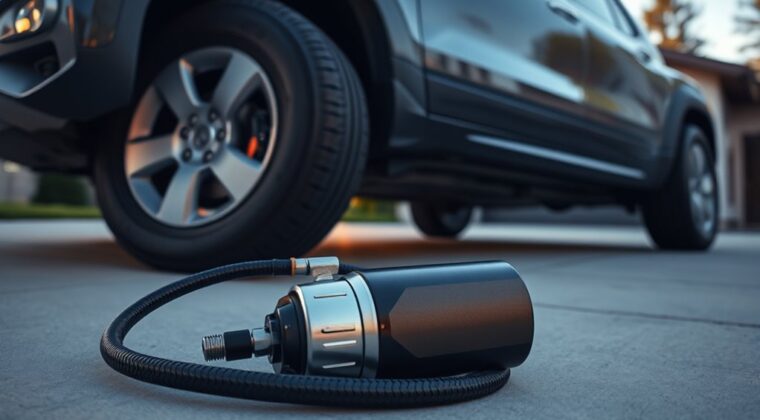
Yes, most tire inflators can inflate SUV tires if their max PSI matches your tire’s required 30 to 40 PSI range. But PSI alone doesn’t tell you speed; airflow rate in CFM matters more for larger tires, and a duty cycle limits how long the unit can run before cooling. For SUVs, choose a model with steady output, auto shut-off, and enough power to avoid slow fills and overheating, then compare the options below.
Key Takeaways
- Yes, most tire inflators can inflate SUV tires if their maximum PSI meets the tire’s required pressure, usually 30–40 PSI.
- Airflow rate matters more than PSI for speed; higher CFM inflators fill larger SUV tires faster.
- Many portable inflators work well for SUVs, but heavy-duty or dual-motor models handle larger tires more efficiently.
- Duty cycle limits how long an inflator can run before cooling, which affects repeated or long inflation sessions.
- Always check the inflator’s PSI, CFM, and tire specifications to avoid underinflation or overinflation.
Can a Tire Inflator Inflate SUV Tires?
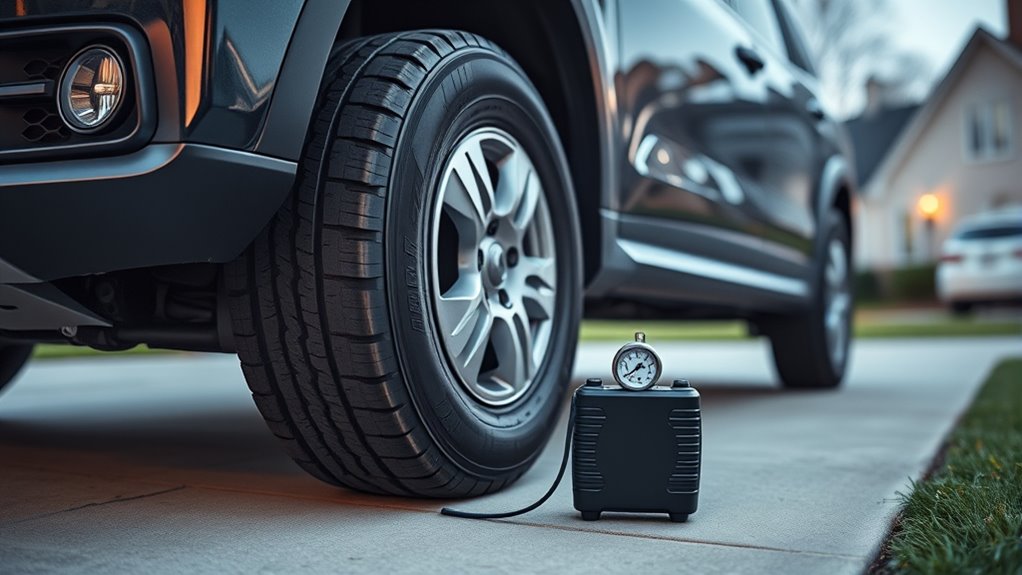
Yes—most tire inflators can inflate SUV tires if their maximum PSI matches your tires’ requirements, which are typically around 30 to 40 PSI. You can use a reliable tire inflator to reach correct tire pressure without relying on a shop.
Many portable tire inflators operate below 50 PSI, yet that range still suits most SUV tires. Check the unit’s maximum PSI and airflow rate before you buy; those specifications determine whether it can handle your vehicle’s load.
If you want faster inflation, heavy-duty tire inflators and dual-motor inflators move more air and work better on larger tires. They reduce wait time and help you stay independent from roadside delays.
Still, not every model fits every tire volume, so verify compatibility with your specific SUV tires. When you match capacity to demand, you control the process and keep your maintenance routine efficient, deliberate, and self-directed.
Why PSI Isn’t the Whole Story
PSI tells you the target pressure, but it doesn’t tell you how fast the inflator can move air.
So airflow rate can change how long you’ll wait for an SUV tire to fill.
You also need to check the inflator’s duty cycle, because sustained operation can overheat the unit and cut its effective output.
If you’re inflating larger SUV tires, those limits can matter as much as the PSI rating itself.
Airflow Matters Too
Even if an inflator is rated for the right PSI, airflow determines how efficiently it can actually fill an SUV tire.
You need to look beyond pressure and examine airflow, measured in CFM, because that rate governs inflation time. A tire inflator with strong CFM can move more air into SUV tires, so it reaches 30 to 60 PSI faster and with less waiting.
Lower-CFM units may still hit the target PSI, but they do it slowly and inefficiently. If you want control and mobility, choose a tire inflator that balances PSI capacity with enough airflow for your load.
Around 1.85 CFM can materially improve performance on larger tires, giving you quicker, more practical inflation without wasting your time.
Duty Cycle Limits
A tire inflator’s PSI rating tells you how much pressure it can reach, but its duty cycle tells you how long it can sustain that work before it needs a cooldown.
When you’re choosing portable inflators to inflate SUV tires, you can’t treat PSI as the only constraint. Many units run only 20–30 minutes of continuous use before they must rest, and that limit matters when you’re filling multiple tires back to back.
Higher airflow rates help because they shorten fill time, reducing heat buildup and protecting the motor. You should also verify that the inflator’s maximum PSI matches your SUV’s requirement; some models can’t safely reach it.
If you understand both PSI and duty cycle, you can choose equipment that works efficiently, reliably, and on your terms.
SUV Tire Inflator Airflow Needs
SUVs need more airflow than smaller cars because their tires hold more air volume. Therefore, you should look for an inflator rated around 1.0 to 2.0 CFM for efficient fill times. That range helps you move air fast enough to raise SUV tires from flat to their normal PSI without needless waiting or strain on the unit.
In practical terms, you want inflators that can sustain at least 35 PSI, since many SUV specs sit between 30 and 40 PSI. If you use portable tire inflators, check the airflow rates, not just the pressure gauge. Higher airflow lets you reach target pressure with more consistency, while automatic shut-off prevents overinflation and supports precise control.
Heavy-duty units can put a standard SUV tire at 35 PSI in minutes, which shows why capacity matters. You deserve tools that make inflation efficient, accurate, and independent.
What Makes an SUV Inflator Fast Enough
What makes an SUV inflator fast enough is mostly its airflow rate, motor output, and duty cycle, because those three factors determine how quickly it can move enough air into a larger tire volume without overheating. You should treat an Air Compressor as capable only when it sustains real output, not peak claims. Higher motor power, around 260W, can cut fill times sharply, while dual-cylinder designs improve throughput by pushing air continuously. Automatic shutoff keeps your target pressure exact, so you don’t trade speed for unsafe overfill.
| Factor | Effect | Why it matters |
|---|---|---|
| airflow rate | Faster fill | Moves more air per minute |
| higher motor power | Shorter inflation time | Drives stronger compression |
| continuous duty cycle | Longer runtime | Prevents heat shutdown |
A continuous duty cycle lets you service multiple tires in one session. If you want liberated mobility, choose a unit that combines speed, precision, and thermal endurance.
Cordless vs 12V vs AC Inflators
If you need maximum portability, a cordless inflator gives you easy access and fast setup, but its battery capacity can limit output on large SUV tires.
A 12V inflator gives you continuous vehicle power on the road, yet it usually delivers less airflow and slower fill rates than an AC unit.
An AC inflator provides the highest sustained power, so you’ll usually get faster inflation and better duty-cycle performance for larger SUV tires at home.
Cordless Inflator Portability
Cordless inflators give you the most freedom because you can use them anywhere without an outlet, which makes them especially useful for roadside emergencies.
A cordless inflator stays portable, so you can check your tire pressure and correct low tire pressure without tethering yourself to the vehicle. Its battery, however, limits runtime; in practice, you may inflate only one or two vehicle tires before recharging.
That constraint matters if your SUV needs repeated top-offs or starts well below spec. For liberation with control, verify the unit’s PSI range and match it to your vehicle’s requirements, which can reach 30 to 80 PSI.
When you need mobility first and speed second, a cordless inflator delivers decisive freedom with measured capability.
12V vs AC Power
When you compare cordless, 12V, and AC tire inflators, the main tradeoff is portability versus output: cordless models give you the most freedom for roadside use, 12V units draw power from your vehicle and are convenient on the go, and AC inflators plug into a wall outlet for the highest sustained performance.
For SUV tires, you’ll notice that 12V plug inflators depend on your vehicle’s power source, so they’re practical but can be slow under heavy load. AC inflators usually deliver stronger airflow and fewer usage limitations, making them better for repeated or larger-volume fills.
Cordless units maximize portability, but battery capacity can cap runtime and reduce consistency. If you want speed and freedom, choose based on where you’ll inflate, how often, and how demanding your tires are.
When Tire Inflators Struggle With SUV Tires
Tire inflators built for standard passenger cars often struggle with SUV tires because the higher pressure and greater air volume demand more output than many compact units can deliver.
You’ll see the limits fast when PSI requirements rise into the 30 to 80 range, especially if you start from near-flat. Many tire inflators top out around 100 PSI, yet that ceiling doesn’t guarantee usable performance under load. Inflation time can stretch beyond 20 minutes, which wastes energy and tests patience.
If you keep pushing an underpowered tire inflator, heat builds, output drops, and failure becomes more likely. You’re not missing discipline; you’re hitting hardware limits.
For reliable service, you need a high airflow rate and, ideally, dual motors so the unit can sustain volume without collapsing under demand. That combination gives you control, speeds recovery, and lets you maintain autonomy when roadside pressure becomes a practical constraint.
Best Use Cases for SUV Tire Inflators
For SUV tires, a dedicated tire inflator is most useful when you need fast roadside recovery, routine pressure maintenance, or off-grid inflation without access to an outlet.
SUV tire inflators usually deliver higher airflow and pressure capacities, so you can restore larger tires efficiently. In roadside emergencies, models like a Viair 88P can bring a tire from 0 to 35 PSI in under 7 minutes, while dual-motor portable tire inflators can push strong output for quicker recovery.
You can also use them for scheduled top-offs, which helps you avoid under-inflation hazards that reduce handling and increase wear. Battery-powered units add freedom because you aren’t tied to a wall socket.
Still, you should match the inflator’s maximum PSI rating to your SUV’s tire specification. That keeps inflation controlled and prevents over-inflation.
In practice, these tools give you precise, self-reliant pressure management wherever you drive.
How to Choose the Right Tire Inflator for Your SUV
How do you choose the right inflator for an SUV? You match the tire inflator to your vehicle’s PSI range, since most SUV tires need 30 to 80 PSI.
Check airflow rates first: faster filling reduces downtime, and units like the Viair 88P can reach 35 PSI in under 7 minutes.
Faster airflow cuts downtime; the Viair 88P can reach 35 PSI in under 7 minutes.
You’ll also want continuous duty cycles and dual motors, because larger tires generate heat and demand sustained output. A portable inflator with a rechargeable battery and 12V adapter gives you freedom during roadside failures, so you’re not tied to one power source.
- Verify the PSI range on the housing.
- Compare airflow rates for your tire size.
- Choose automatic shut-off and a digital pressure gauge.
- Favor models with heat management for long sessions.
If you want control, portability, and reliability, select a tire inflator that balances power with precision. That’s how you keep your SUV ready and independent.
Frequently Asked Questions
What Is a Good PSI for a Tire Inflator?
A good PSI for your tire inflator is 30–35 PSI for most SUV tires, though you should match the vehicle’s specs.
You’ll want inflator types that can reach at least 50 PSI for flexibility.
Check tire pressure cold, follow usage guidelines, and use safety features like auto shutoff.
These maintenance tips protect performance metrics, improve handling, and reduce wear, so you can drive with more control and less dependence.
What Are the Common Problems With Car Tire Inflators?
You’ll often face inflator reliability issues, noise level concerns, and weak power source types.
You’ll notice slower inflation speed comparison, especially when pressure rises.
You’ll also weigh size portability factors against cost effectiveness analysis, because compact units usually trade capacity for convenience.
You should check gauge accuracy, overheating limits, and battery endurance, since these faults can restrict performance and freedom.
Choose a model that matches your vehicle and duty cycle.
Is a 150 PSI Air Compressor Good for Car Tires?
Yes, a 150 psi air compressor is good for car tires, and you’ll usually have plenty of headroom above standard tire pressure.
You can compare compressor types by output, duty cycle, and inflator features like gauges and auto shutoff.
Follow maintenance tips to keep seals and hoses sound.
Check safety guidelines and manufacturer specs, since performance comparison matters less than accurate, controlled inflation for your vehicle.
Is 90 PSI Too High for Tires?
Yes—90 psi is usually too high for your tires. Last year, a driver I knew treated pressure like a free upgrade and ruined two sidewalls.
You should match tire pressure to SUV specifications, not guesswork. Ideal inflation follows safety standards, improves tire lifespan, and preserves handling.
Check your door-jamb sticker and owner’s manual, then set inflation frequency based on temperature and driving. Overinflation limits your control, not your freedom.
Conclusion
So, yes, you can use a tire inflator on SUV tires, but you need the right balance of PSI, airflow, and duty cycle. If you choose a weak unit, you’ll wait forever, and that’s no exaggeration. For dependable results, match the inflator to your tire size and inflation frequency. If you drive an SUV regularly, a higher-output 12V or cordless model usually gives you the best mix of speed, portability, and control.