
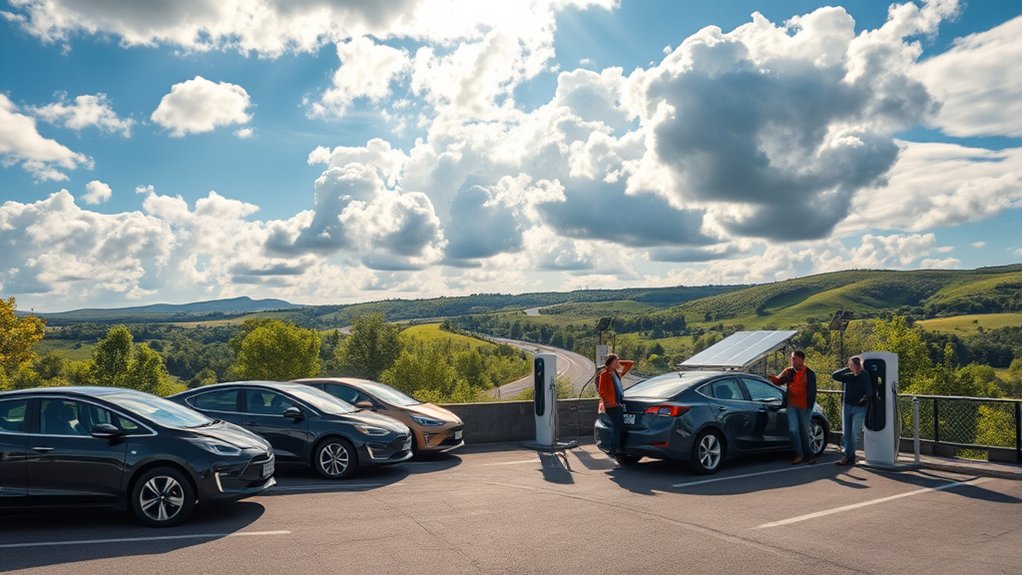
If you drive an electric vehicle on long highway trips, rest-stop charging can make the difference between a relaxed route and constant battery math. Some highway rest stops and service plazas do offer EV charging, but coverage is still uneven. Ordinary Interstate rest areas often face federal commercialization limits, power-capacity issues, and slow rollout timelines, so you should plan with more than one charging option before you leave.
Quick Answer
Some highway rest stops have EV chargers, especially toll-road service plazas, welcome centers, and newer corridor sites. Many ordinary Interstate rest areas still do not. Federal right-of-way rules, utility upgrades, funding delays, and charger reliability requirements all affect where chargers can be installed.
Key Takeaways
- EV charging at highway rest stops is growing, but it is not yet something you can assume on every route.
- Federal Interstate rules under 23 U.S.C. §111 limit many commercial services on Interstate rights-of-way, which can complicate private charging at ordinary rest areas.
- The federal NEVI program is designed to improve highway fast charging, but rollout varies by state and policy changes can affect timing.
- Before a road trip, check charger location, connector type, speed, live status, payment method, nearby amenities, and a backup stop.
At a Glance
| Time Required | 10 to 20 minutes of route planning before a long trip |
| Difficulty | Easy, but you need to verify live charger details |
| Tools Needed | Vehicle navigation, charging-network apps, and the DOE Alternative Fueling Station Locator |
| Cost | Varies by network, charger speed, state, and pricing method |
Why EV Charging Is Essential for Long-Distance Travel
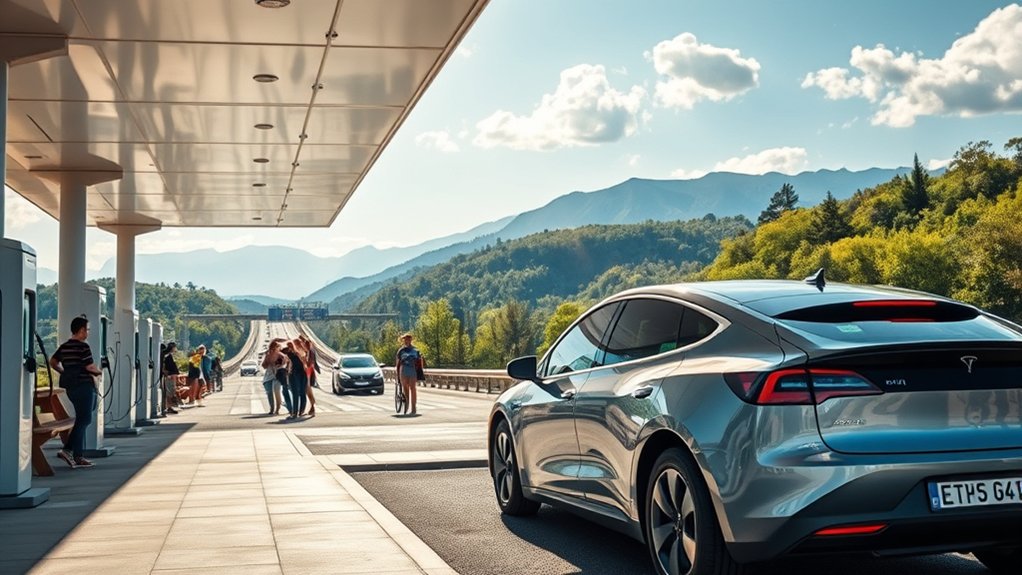
Long-distance EV travel works best when fast chargers are easy to find near the highway. A well-placed charger lets you stop for restrooms, food, and a short break while your battery reaches the next safe level.
Public charging matters most when you do not have home charging, when you cross rural corridors, or when your route has long gaps between towns. The National Renewable Energy Laboratory notes that public charging is critical for people without home charging and that charger reliability can affect EV adoption.
For highway drivers, the real goal is simple: chargers should be close to the route, easy to access, fast enough for a short stop, and reliable when you arrive.
Do Highway Rest Stops Offer EV Charging Now?
Some do, but not all. EV charging is more common at toll-road service plazas, turnpike travel plazas, welcome centers, and private travel centers near Interstate exits. It is less common at basic public rest areas that only have restrooms, vending machines, picnic tables, and parking.
This difference matters because drivers often use the phrase “rest stop” for several different places:
- Ordinary Interstate rest areas: usually state-run, noncommercial sites with restrooms and parking.
- Service plazas: often found on toll roads and older turnpikes, with fuel, food, retail, and sometimes EV charging.
- Welcome centers: state-run tourism stops that may have more space and sometimes charging.
- Truck stops and travel centers: private businesses near exits, often better suited for high-power chargers because they already have utilities, lighting, food, restrooms, and payment systems.
Note: A charger being “near a rest stop” is not the same as being inside the rest area. Always check whether you can reach the charger directly from the highway or whether you must exit and drive to a nearby private site.
Current Limitations of EV Infrastructure on Highways
You might expect every highway rest area to have chargers, but several barriers slow the rollout. The biggest issues are federal right-of-way rules, utility upgrades, construction cost, charger maintenance, and state-by-state funding timelines.
Federal Restrictions Impacting Access
Federal Interstate rules under 23 U.S.C. §111 restrict automotive service stations and other commercial establishments that serve motorists on Interstate rights-of-way. The law allows only limited commercial activities at rest areas, such as certain travel information, tourism materials, advertising displays, lottery machines, and state-operated vending machines.
That does not mean every EV charger is impossible at every rest area. It does mean that states, private charging companies, and site hosts must be careful about ownership, payment, access, operations, and whether the site counts as a commercial service on Interstate right-of-way.
Limited Charging Locations
Limited charging locations can increase range anxiety, especially on rural corridors. Drivers may see a charger on a map but still face real-world problems: the charger may be off route, occupied, out of service, too slow, blocked by another vehicle, or incompatible with the EV’s connector.
| Challenge | What It Means for Drivers |
|---|---|
| Few chargers at ordinary rest areas | You may need to exit to a private travel center, shopping area, or hotel. |
| Commercial-service restrictions | Public agencies and private networks may need special site structures or policy changes. |
| Utility capacity limits | High-power DC fast chargers may require new transformers, service lines, or grid upgrades. |
| Reliability problems | A charger on a map is only useful if it works, accepts payment, and is not blocked. |
Federal Programs and Rest-Area Policy Changes
The largest federal highway-charging program is the National Electric Vehicle Infrastructure Formula Program, usually called NEVI. It was created by the 2021 Bipartisan Infrastructure Law to help states build an interconnected public charging network along major corridors.
The Federal Highway Administration’s NEVI standards require important driver-facing features for covered chargers, including public access, payment options, mapping data, and reliability requirements. For corridor DC fast-charging sites, the rule calls for at least four network-connected DC fast-charging ports and a minimum 150 kW power level per port when serving designated Alternative Fuel Corridors.
The federal corridor target also pushes states toward chargers about every 50 miles and within 1 travel mile of the Interstate, unless an exception is approved. That target is important because it helps reduce long charging gaps on road trips.
Warning: Funding rules, state plans, and federal guidance can change. Before relying on a future rest-area charger, check your state DOT, your vehicle’s navigation system, and live charger apps close to your travel date.
Policy reform could make rest-area charging easier in the future, especially if Congress or federal agencies clarify how paid EV charging can operate at public rest areas. Until then, many new highway chargers may continue to appear just off the exit rather than inside the rest area itself.
Strategic Partnerships Fueling EV Charger Installations
EV highway charging usually requires more than a charger and a parking space. Strong sites often involve state transportation agencies, utilities, charging networks, vehicle makers, travel-center operators, and local governments.
Private travel centers and truck stops are especially important because they already serve highway drivers. They often have lighting, restrooms, food, security, and room for multiple stalls. These features make them practical locations for DC fast charging, even when the charger is not inside a public rest area.
Automakers and charging networks are also improving route planning and connector access. Still, drivers should check whether a station supports CCS, NACS, CHAdeMO, or adapter-based charging before choosing it as a required stop.
How to Navigate Charging Options on Your Route
Good route planning lowers stress before you ever reach a low battery warning. Start with your EV’s built-in navigation, then cross-check with one or two charging apps and the DOE Alternative Fueling Station Locator.
Before you depend on a charger, check these details:
- Connector: Confirm the station works with your vehicle or adapter.
- Power level: Look for DC fast charging on long trips, not just Level 2 charging.
- Live status: Check whether stalls are available, offline, occupied, or recently reviewed as broken.
- Payment: Make sure you can pay by card, app, plug-and-charge, or another supported method.
- Amenities: Restrooms, food, lighting, and safe parking matter during a 20- to 45-minute stop.
- Backup range: Keep enough battery to reach a second charger if the first one fails.
Pro Tip: For long trips, plan to arrive at each fast charger with a buffer instead of aiming for 0% battery. A 10% to 20% arrival target gives you room for wind, hills, traffic, cold weather, detours, and broken stalls.
Tackling Range Anxiety for EV Travelers
Range anxiety is not just about battery size. It is also about charger trust. Drivers feel more confident when chargers are easy to find, clearly priced, open at all hours, and likely to work when they arrive.
That is why reliability standards matter. NEVI-funded charging rules include a requirement for each charging port to have average annual uptime greater than 97%. That standard is helpful, but you should still check recent driver reviews and live network status because real-world conditions can change quickly.
A charger on a map does not solve range anxiety unless it is compatible, available, working, and close enough to your route.
What’s Next for EV Charging Infrastructure?
The next stage of highway EV charging will likely focus on three things: filling rural corridor gaps, improving charger reliability, and making payment and connector access easier for more drivers.
Expect more chargers near highway exits, at travel centers, and at service plazas where state rules allow them. Ordinary public rest areas may gain more charging only where legal, utility, funding, and operating issues are solved.
For now, the best approach is to treat rest-stop charging as a bonus, not a guarantee. Plan your route around confirmed fast chargers, keep a backup stop in range, and recheck live station details before each leg of the trip.
Frequently Asked Questions
Do rest stops offer EV charging?
Some do, but many ordinary Interstate rest areas still do not. EV charging is more common at toll-road service plazas, welcome centers, private travel centers, and charging sites near exits.
Can Google Maps show EV charging stations on a route?
Yes, many navigation tools can show EV charging stations, and some vehicle systems can plan charging stops based on battery level. Still, you should cross-check live status, connector type, charging speed, and recent driver reviews before depending on one charger.
How do I find EV charging stations on a road trip?
Use your vehicle’s route planner, a charging-network app, and the DOE Alternative Fueling Station Locator. Filter by connector, DC fast charging, open hours, payment method, and live availability. Always choose a backup charger within range.
Are rest stops federally funded?
Many Interstate rest areas are state-operated and may use federal-aid highway funds for eligible transportation purposes. Rules can vary by site, state, and road type, especially for toll-road service plazas and older facilities.
Why don’t all highway rest stops have fast chargers?
The main reasons are federal commercialization limits, utility service upgrades, construction cost, long permitting timelines, maintenance requirements, and the need for reliable payment and data systems.
Are service plazas different from regular rest areas?
Yes. Service plazas, especially on toll roads and turnpikes, often include food, fuel, retail, and EV charging. A regular Interstate rest area is usually more limited and may only offer parking, restrooms, vending machines, and travel information.
Conclusion
EV charging at highway rest stops is improving, but it is not universal yet. Federal right-of-way rules, utility upgrades, funding timelines, and reliability standards all shape where chargers appear. For a smoother electric road trip, use rest-stop chargers when they are available, but plan around confirmed fast chargers, verify live status, and keep a backup stop within range.
Sources
- Legal Information Institute, 23 U.S.C. §111 — Interstate right-of-way and rest-area commercial activity limits.
- Federal Register, National Electric Vehicle Infrastructure Standards and Requirements — NEVI charger standards, payment, access, mapping, uptime, and power requirements.
- Federal Highway Administration, Infrastructure Investment and Jobs Act — federal highway infrastructure program context.
- U.S. Department of Energy Alternative Fueling Station Locator — official tool for finding public EV charging stations.
- National Renewable Energy Laboratory, Impact of EV Charging Station Reliability, Resilience, and Location on EV Adoption — research on public charging reliability and EV adoption.