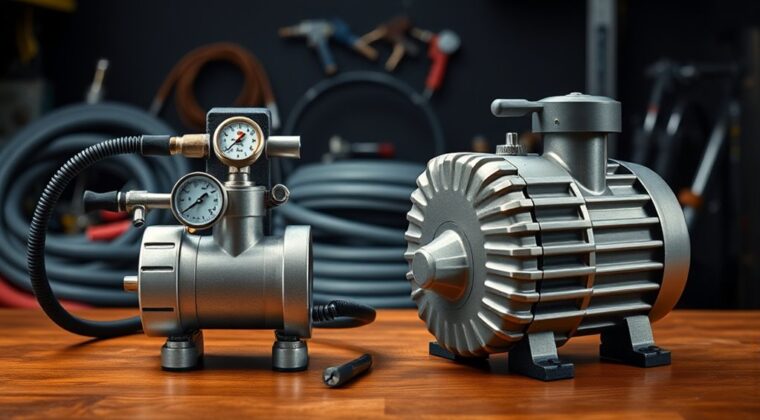
High-pressure air pumps are built to reach higher PSI, often 80 to 160, with a narrow barrel and stiffer bypass valve for controlled, efficient inflation. High-volume pumps move more air per stroke, so you can fill larger tires or inflatables faster at lower pressures, usually 5 to 100 psi. If you need precision for performance tires, choose high-pressure; if you want speed for mountain bike tires, choose high-volume, and the details get more useful from here.
Key Takeaways
- High-pressure air pumps deliver lower air volume but reach higher PSI, making them ideal for performance tires.
- High-volume air pumps move more air per stroke, filling larger tires faster at lower pressures.
- High-pressure pumps usually have narrower barrels and stronger construction for efficient high-PSI inflation.
- High-volume pumps typically have larger barrels and pistons for quicker airflow and faster filling.
- Choose high-pressure for precise tire pressure and high-volume for speed, larger tires, and casual inflation.
What Is a High-Pressure Air Pump?
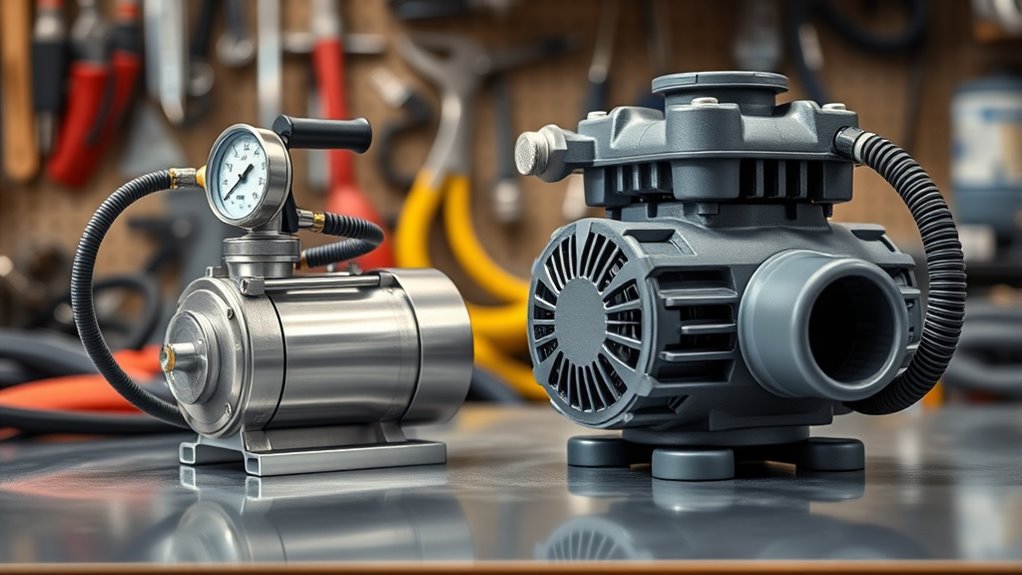
A high-pressure air pump is designed to exceed 80 psi, making it suitable for performance tires and other applications where precise inflation matters.
You use high-pressure pumps when you need controlled pressure delivery, not sheer air volume. Their bypass valve uses a stiffer spring, so you can raise tire pressure efficiently, often to 160 psi. That design reduces the effort you exert during inflation, which is why these pumps are often labeled “Easy Inflation.”
High-pressure pumps deliver controlled inflation with less effort, often reaching 160 psi for precision tire pressure.
You’ll find them in competitive cycling and high-performance vehicles, where exact pressure directly affects handling, speed, and efficiency. They’re typically heavier and built with durable materials, so you get a robust tool that withstands repeated high-load use.
If you want technical control over tire pressure, this pump gives you that freedom without unnecessary strain or imprecision.
What Is a High-Volume Air Pump?
A high-volume air pump prioritizes moving more air per stroke rather than building extreme pressure, so you can inflate larger tires and other high-capacity items faster. You get rapid fill rates from its larger barrel and piston, which increase displacement and reduce effort. Most models work in the 5–100 psi range, giving you enough capacity for low to moderate pressure tasks without chasing high pressure.
| Feature | Effect |
|---|---|
| Large barrel | More air per stroke |
| Wide piston | Faster inflation |
| 5–100 psi range | Low to moderate pressure |
| Mountain bike use | Efficient tire fill |
| Lezyne HV marking | Easy identification |
You can use this design for mountain bike and fat bike tires, plus other volume-heavy gear where speed matters. Compared with a high pressure pump, this setup favors throughput, not compression, so you stay free to move faster and ride sooner.
High-Pressure Vs High-Volume Pumps: What’s the Difference?
Although both pump types move air, they’re optimized for different jobs: high-pressure pumps are built to reach over 80 psi and can go as high as 160 psi, while high-volume pumps usually operate in the 5–100 psi range and move more air per stroke for faster filling of larger tires.
You use high-pressure pumps when you need controlled, efficient inflation above 80 psi; their narrow-barrel design reduces stroke effort and supports “Easy Inflation” under demanding conditions.
High-volume pumps use larger barrels to displace more air, so you can fill low-pressure, high-capacity tires faster, but they top out near 100 psi.
The difference isn’t abstract: it’s a pressure-and-volume tradeoff. You match the pump to the tire’s required maximum pressure, not to marketing language.
When you understand these limits, you choose with precision, keep your setup responsive, and retain the freedom to inflate on your terms, without wasting energy or compromising performance.
Which Pump Works Best for Your Tires?
Which pump works best for your tires depends on the pressure range you need to hit.
If you’re filling larger tires, a high-volume pump usually serves you better because its larger barrel and piston move more air per stroke, so you reach moderate pressure faster. It performs well from about 5 to 100 psi, which suits many mountain bike setups and lets you work with less effort.
If your tires demand high pressure, choose a high-pressure pump. It’s engineered for efficiency above 80 psi and can reach up to 160 psi, making it the correct tool for road tires and other performance-oriented setups.
You should match the pump to your tire specifications, not guess. Check the required pressure, then pick the pump that meets it cleanly. That way, you maintain performance, reduce wasted strokes, and keep your ride liberated from underinflation and overwork.
Common Uses for Each Pump Type
When you’re choosing between these pumps, match the use case to the required pressure and fill rate.
You’ll use a high-pressure pump for performance tires, pneumatic tools, and maintenance tasks that need precise psi control, while a high-volume pump works better for mountain bike tires, sports gear, and other larger inflatables.
In practice, you select the pump that best balances inflation speed with the target pressure range.
Tire Inflation Use Cases
For tire inflation use cases, high-volume pumps are best when you need to move a lot of air quickly, such as inflating mountain bike or fat bike tires in the 5 to 100 psi range, where rapid fill and low effort matter more than maximum pressure.
You can use them for pre-ride setup and quick repairs, because they deliver larger air volume per stroke and shorten inflation time.
By contrast, a high-pressure pump suits road bikes and other performance tires that need over 80 psi, with maximum output near 160 psi.
You’ll choose it when exact pressure and ease of pumping matter.
Your decision depends on tire demand: volume and speed favor HV, while pressure and control favor high-pressure tools for efficient, liberated riding.
Tool And Gear Uses
High-pressure pumps shine in applications that demand sustained PSI, while high-volume pumps are better suited to moving air quickly into large or low-resistance items.
You’ll use high-pressure pumps when your gear can’t compromise: performance tires above 80 PSI, pneumatic tools, pressure washing, and chemical injection all need stable output.
High-volume pumps, by contrast, free you from slow setup when you’re filling air mattresses, pool toys, or bike tires.
- Inflate sports equipment with exact pressure.
- Drive pneumatic tools with consistent force.
- Fill bulky inflatables fast, not hard.
This split matters because your workflow changes with resistance and target pressure.
Choose the pump that matches the task, and you’ll move with efficiency, control, and less wasted effort.
How Pump Design Affects Performance
You’ll see that pump geometry directly controls pressure output: smaller barrels and pistons concentrate force and let you reach higher PSI.
Larger barrels and pistons move more air per stroke, so you get greater airflow volume and faster inflation at lower pressures.
Design choices also affect power demand and structural load, since high-pressure units need stronger materials to handle the higher internal forces.
Pressure Output
Pressure output is one of the clearest ways pump design affects real-world performance: high-pressure air pumps are built to exceed 80 PSI for demanding applications like performance-oriented tires, while high-volume pumps typically operate across roughly 5 to 100 PSI and move more air per stroke through larger barrels.
You match the tool to your pressure requirements, not the other way around. High-pressure models use reinforced materials to contain internal force and help you reach target PSI with less effort.
High-volume models favor larger pistons, so you can fill bigger tires efficiently when moderate pressure matters.
- Choose high-pressure for precise inflation.
- Choose high-volume for broader fill needs.
- Prioritize performance that serves your ride.
Airflow Volume
Airflow volume depends largely on barrel diameter and piston size, which determine how much air each stroke can move and how quickly a tire or other inflatable fills.
When you choose a high-volume pump, you get a wider barrel that shifts more air per stroke, so pumps are commonly used for large tires, air mattresses, and other bulky inflatables. These designs can exceed 500 liters per minute, letting you inflate fast and move on.
High-pressure pumps use smaller airflow but maintain steady pressure, which matters when you need precise inflation for performance bike tires.
Because barrel and piston geometry directly shape efficiency, you can match the pump to the task instead of wasting effort or accepting slow fill times.
How to Choose the Right Pump
To choose the right pump, start by matching its pressure range to your tire requirements: high-pressure pumps suit tires that need more than 80 psi, while high-volume pumps handle a broader 5 to 100 psi range.
Then test your use case. If you ride performance bikes, race, or need quick inflation, high-pressure pumps cut effort and reach up to 160 psi. If you inflate larger, lower-pressure tires, high-volume models deliver adequate flow and stay lighter for transport.
- Check your target psi.
- Match pump type to frequency.
- Compare portability and max pressure.
You’ll gain control when you select equipment that fits your workload, not a generic compromise.
For casual service, portability can matter more than peak output; for demanding applications, precision and ceiling pressure matter more. Choose the tool that frees you from overexertion and keeps your tires exactly where you want them.
Frequently Asked Questions
What Is the Difference Between a Pressure Pump and a Volume Pump?
A pressure pump builds high psi with less effort, while a volume pump moves more air per stroke at lower pressure.
You’ll use a pressure pump for performance tires and a volume pump for larger tires that need fast inflation.
The key difference is Air Efficiency: one concentrates force, the other maximizes flow.
You choose based on your pressure target, and that choice frees you from wasting time and energy.
What Are the Key Differences Between a Low Pressure Pump and a High Pressure Pump?
Low pressure pumps handle lighter jobs below 50 PSI, while high pressure pumps can roar past 100 PSI and feel like tiny industrial beasts.
You’ll use low pressure units for inflatables and basic plumbing, but high pressure pumps drive pneumatic tools and hydraulic systems.
You’ll also notice tougher construction, bigger motors, higher maintenance, and lower Pump Efficiency under load.
Choose the pump that frees you from wasted effort and limits.
What Are the Differences Between a High Volume Oil Pump and a High Pressure Oil Pump in an LS Engine?
You’ll see a high-volume oil pump move more Oil Flow with larger gears, so it delivers more oil per revolution and suits LS engines with loose clearances, coolers, or remote filters.
A high-pressure oil pump doesn’t move as much volume; instead, it uses a stiffer bypass spring to raise pressure sooner, which helps protect bearings and maintain lubrication at high RPM.
Choose based on your engine’s clearance, load, and duty cycle.
What Are the Key Differences Between a High Volume Water Pump and a Standard Water Pump?
You’ll find a high-volume water pump moves far more water, often above 1,500 GPM, while a standard pump handles lower flow.
You get larger impellers and casings in the high-volume unit, plus optimized Pumping Efficiency for heavy-duty jobs like dewatering or flood control.
Standard pumps suit irrigation and household supply, and they usually need less maintenance.
Choose the pump that matches your flow demand, not your limits.
Conclusion
When you choose between a high-pressure pump and a high-volume pump, you’re really choosing between two tools for two different journeys. One is built to push force deep; the other to move air fast and wide. That’s the lesson: match design to purpose, or you’ll waste effort and wear the machine. If your tires demand pressure, choose compression. If they need bulk, choose flow. Precision, not power alone, keeps your gear performing.