
Choosing a Level 1 charger for your Kia EV6 starts with two questions: which charging port your EV6 has and whether your household outlet is suitable for continuous EV charging. J1772-equipped EV6 models can connect directly to the J1772 chargers below. However, newer NACS-equipped EV6 models require a compatible J1772-to-NACS AC charging adapter, so check the charge inlet on your exact model year and trim before ordering.
Level 1 charging is best for overnight mileage replacement, lower daily driving, travel backup, or emergency charging. A typical 120V setup adds only a few miles of driving range per hour, so it should not be confused with Level 2 home charging. The five options below were selected for useful EV6-related features such as portability, cable reach, adjustable output, smart controls, and clearer safety credentials.
Affiliate Disclosure: As an Amazon Associate I earn from qualifying purchases. This article contains affiliate links.
Quick Verdict
Best simple 120V choice: The Schumacher SEV1670 is a straightforward 12A Level 1 charger with a long cable and no app dependency.
Best smart Level 1 choice: The Lectron 12A WiFi model gives you app-based monitoring and scheduling while staying within a conventional 120V Level 1 setup.
Best 120V/240V flexibility: The EVDANCE and bokman chargers can work as Level 1 units on 120V and step up to 16A Level 2 charging when connected to the correct 240V outlet.
Important: If your EV6 has a native NACS inlet rather than J1772, verify that you have a compatible J1772-to-NACS adapter rated for AC charging before buying one of these J1772 EVSEs.
Quick Comparison
| Charger | Level 1 Setup | 240V Capability | Cable | Safety Credential | Best For |
|---|---|---|---|---|---|
| Lectron 15A J1772 | 120V, up to 15A | No | 16 ft | ETL | Higher-output Level 1 |
| EVDANCE Level 1/2 | 120V, 12A | Yes, up to 16A | 25 ft | ETL listed | Long reach and dual voltage |
| Lectron 12A WiFi | 120V, 12A, 1.44 kW | No | 16 ft | UL2594 / UL2231 | Smart Level 1 charging |
| bokman Level 1/2 | 120V via 5-15 adapter | Yes, up to 16A | 20 ft | ETL | Adjustable travel charging |
| Schumacher SEV1670 | 120V, 12A | No | 20.5 ft | ETL / ENERGY STAR | Simple plug-and-charge use |
Compatibility Note: These are J1772 EVSEs. They connect directly to a J1772-equipped EV6. An EV6 with a native NACS charge port needs a compatible J1772-to-NACS AC adapter. Always verify your exact vehicle, adapter, EVSE, outlet, and circuit requirements before charging.
Lectron Level 1 J1772 Portable EV Charger (WiFi, 120V 15A, 16 ft)
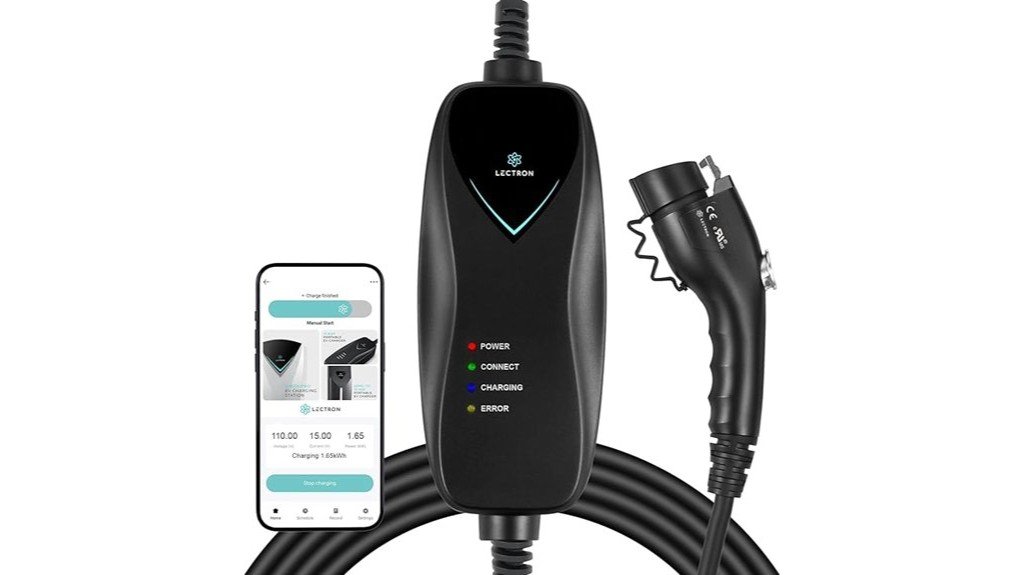
The Lectron Level 1 J1772 Portable EV Charger is a compact option for EV6 owners who want more output than a typical 12A Level 1 cord while still using 120V power. Lectron currently specifies up to 15A and 1.8 kW, a 16-foot J1772 cable, a NEMA 5-15 plug, ETL certification, IP65 weather resistance, and built-in electrical protection. The WiFi-enabled version adds app-based charging controls.
Its biggest attraction is simple portability without moving into a 240V Level 2 installation. However, do not assume that every household receptacle is appropriate for its maximum continuous load. Confirm the outlet, branch circuit, breaker, wiring condition, and Lectron instructions before using the full rated output.
Best For: J1772-equipped EV6 drivers who want a compact, smart 120V charger and have an electrical setup that meets the charger’s requirements.
Who Should Avoid It: Drivers who need rapid daily replenishment, need more than 16 feet of cable, or cannot confirm that their household circuit is appropriate for the charger’s rated load.
Pros:
- Up to 15A and 1.8 kW from a compatible 120V electrical setup.
- Compact 16-foot J1772 charging cable for home storage or travel.
- ETL certification, IP65 enclosure rating, and built-in electrical protections.
- WiFi-enabled version provides app-based charging management.
Cons:
- Still much slower than a 240V Level 2 charger.
- Shorter cable than the 20- to 25-foot alternatives in this roundup.
- The circuit and receptacle must be appropriate for the charger’s rated continuous load.
- A NACS-equipped EV6 requires a compatible J1772-to-NACS AC adapter.
EVDANCE Level 1 & 2 Portable EV Charger (25 ft, 12A 120V / 16A 240V)
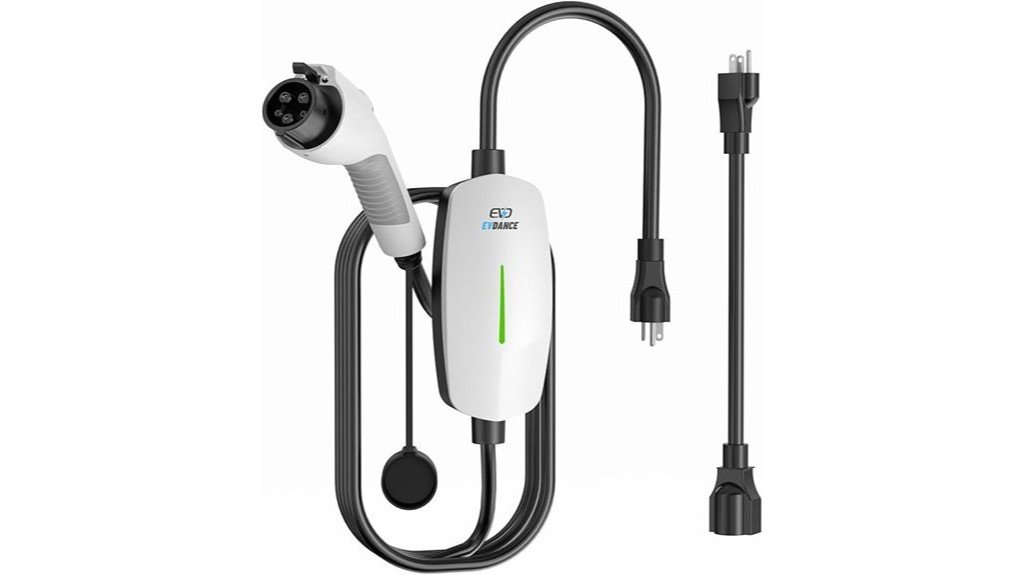
The EVDANCE Level 1 & 2 Portable EV Charger is the most flexible option here if you want ordinary 120V charging today but may also use a compatible 240V outlet later. The current listing specifies 12A at 120V through a NEMA 5-15 setup and up to 16A at 240V through NEMA 6-20, along with a long 25-foot J1772 cable.
The current variant is ETL listed and adds WiFi/Bluetooth app control, an LCD display, LED status information, and a weather-resistant enclosure. That combination makes it especially useful for garages or driveways where cable reach and charging-session visibility matter.
Best For: EV6 owners who want one portable EVSE for both conventional Level 1 charging and modest 240V Level 2 charging.
Who Should Avoid It: Buyers who only need the simplest possible 120V cord or drivers expecting the speed of a 32A, 40A, or 48A home Level 2 charger.
Pros:
- 12A/120V Level 1 and up to 16A/240V Level 2 operation.
- Long 25-foot cable helps with garages, driveways, and less-convenient outlet locations.
- Current listing identifies the unit as ETL listed.
- WiFi/Bluetooth app functions can monitor charging data and schedule sessions.
Cons:
- Full 240V capability requires the correct NEMA 6-20 electrical setup.
- 16A Level 2 charging is still considerably slower than higher-powered permanent home EVSEs.
- More features and a longer cable make it less minimal than a basic Level 1 cord.
- A NACS-equipped EV6 requires a compatible J1772-to-NACS AC adapter.
Lectron Level 1 J1772 Portable EV Charger (WiFi, 12A, App Control)

If you want a conventional 12A Level 1 EV charger with smart controls, this Lectron model is one of the clearest fits in the roundup. Lectron specifies 120V, 12A and up to 1.44 kW through a NEMA 5-15 plug, with a 16-foot J1772 cable.
The Lectron app can monitor charging status, schedule sessions, and manage the amount of energy delivered. The manufacturer currently lists UL2594 and UL2231 certification and built-in protection against conditions such as overvoltage, overcurrent, and short circuits. The control box is also designed for weather exposure, although outdoor electrical connections still need to be used according to manufacturer instructions.
Best For: Drivers who want predictable 12A Level 1 charging plus phone-based monitoring and scheduling.
Who Should Avoid It: Drivers who need fast recovery after long daily trips or need a cable substantially longer than 16 feet.
Pros:
- Straightforward 120V, 12A, 1.44 kW Level 1 configuration.
- Lectron app provides monitoring and charging-schedule controls.
- UL2594/UL2231 certification provides a clearer safety credential.
- Compact size and carrying case make storage and travel easier.
Cons:
- Level 1 output is slow for an EV6’s large traction battery.
- 16-foot cable provides less reach than the EVDANCE, bokman, and Schumacher options.
- Smart features depend on WiFi/app availability.
- A NACS-equipped EV6 requires a compatible J1772-to-NACS AC adapter.
bokman Portable Level 1 & Level 2 EV Charger (J1772)
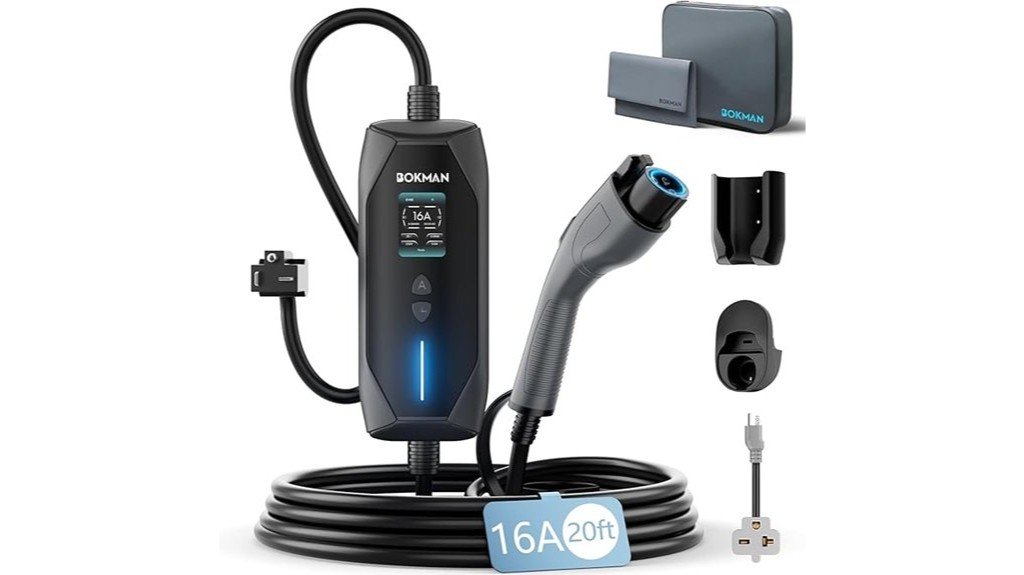
The bokman Portable Level 1 & Level 2 EV Charger is a useful travel-oriented alternative if you prefer physical controls instead of relying on a phone app. The current listing specifies a 20-foot cable, J1772 connector, NEMA 6-20 plug, NEMA 5-15 adapter, selectable current settings from 6A to 16A, and a 1–12-hour delay timer.
It can operate from 120V for Level 1 use or from an appropriate 240V NEMA 6-20 outlet for up to 16A Level 2 charging. The current listing also identifies ETL certification and IP65 protection. Its adjustable controls can be useful when traveling, but the selected current must always stay within the limits of the outlet, circuit, adapter, and manufacturer instructions.
Best For: EV6 owners who want adjustable current, dual-voltage capability, physical controls, and a travel-friendly package.
Who Should Avoid It: Buyers who want WiFi/app controls or a high-powered permanent Level 2 station for substantial daily mileage.
Pros:
- Supports both 120V Level 1 and 240V Level 2 charging.
- Selectable 6A, 8A, 10A, 12A, and 16A settings provide additional flexibility.
- 20-foot cable gives more reach than compact 16-foot chargers.
- ETL certification, IP65 enclosure, status display, and delay timer.
Cons:
- Maximum 16A Level 2 output is modest compared with fixed home Level 2 stations.
- 240V charging requires the correct NEMA 6-20 receptacle and circuit.
- No app-based remote management for buyers who prefer connected features.
- A NACS-equipped EV6 requires a compatible J1772-to-NACS AC adapter.
Schumacher Electric SEV1670 Portable Level 1 EV Charger (12A, 120V, J1772)

The Schumacher Electric SEV1670 is a strong choice if you want a straightforward Level 1 charger without WiFi, touch controls, or dual-voltage complexity. Schumacher specifies 12A at 120V, a NEMA 5-15P plug, a J1772 connector, and a 20.5-foot charging cable.
The main housing is IP66 rated and the manufacturer lists protections for leakage, under-voltage, overvoltage, overcurrent, over-temperature, ground faults, and relay faults. Schumacher also lists ETL and ENERGY STAR credentials and a three-year limited warranty. For buyers prioritizing simplicity and clearly documented manufacturer specifications, that is a compelling combination.
Best For: EV6 owners who want a simple, manufacturer-supported 12A Level 1 charger with good cable reach and no app requirement.
Who Should Avoid It: Drivers who want smart scheduling from their phone or need 240V capability from the same portable EVSE.
Pros:
- Simple 120V/12A Level 1 operation from a compatible household electrical setup.
- 20.5-foot cable offers useful reach for garages and driveways.
- ETL and ENERGY STAR credentials plus extensive electrical protection functions.
- IP66 main housing and a three-year limited manufacturer warranty.
Cons:
- No 240V Level 2 capability.
- No WiFi or app-based smart scheduling.
- Level 1 charging remains slow for replenishing a heavily depleted EV6 battery.
- A NACS-equipped EV6 requires a compatible J1772-to-NACS AC adapter.
Factors to Consider When Choosing a Level 1 Charger for Kia EV6
The best charger depends less on marketing features and more on your EV6 charge port, household electrical setup, daily mileage, cable reach, and safety requirements. Level 1 can work very well when you regularly replace a modest amount of driving overnight, but it is not a substitute for Level 2 if you frequently arrive home with a heavily depleted battery.
Check Your EV6 Charge Port First
Do not assume every Kia EV6 uses the same AC connector. Many earlier U.S. EV6 models use a J1772/CCS1 arrangement and can accept a J1772 Level 1 connector directly. Newer NACS-equipped models need an appropriate J1772-to-NACS adapter for AC charging. Look at the actual charge port on your vehicle and confirm compatibility for your exact model year and trim before ordering.
Charging Speed and Realistic Expectations
Level 1 charging normally adds only a few miles of driving range per hour. That makes it practical for a driver who parks for many hours and only needs to replace modest daily mileage, but a near-empty EV6 can require multiple days to return to a full charge on 120V power. Weather, battery temperature, charging losses, vehicle configuration, and the EVSE’s actual current all affect results.
If you regularly drive farther than Level 1 can replenish overnight, a properly installed 240V Level 2 setup is usually the more practical long-term solution.
Outlet and Circuit Condition
EV charging creates a long-duration electrical load, so the condition of the receptacle and branch circuit matters. Avoid using a loose, cracked, scorched, discolored, damaged, or unusually warm receptacle. Do not assume that an old garage outlet is suitable simply because the plug physically fits.
If you do not know the outlet’s circuit rating, wiring condition, grounding, or what other loads share the circuit, have a qualified electrician inspect it. Always follow the EVSE manufacturer’s electrical requirements and applicable local electrical code.
Safety Note: Avoid improvised adapters and extension-cord setups that are not specifically approved for the charger. Stop charging if the plug, receptacle, adapter, or EVSE becomes abnormally hot, damaged, or shows an error condition.
Safety Listing and Weather Protection
For a U.S. household EVSE, prioritize products with a clearly verifiable electrical safety listing such as UL or ETL rather than relying only on marketing language. FCC compliance relates to electromagnetic emissions, while CE markings and material flame ratings should not automatically be treated as substitutes for a complete U.S. EVSE safety listing.
If the charger will be used outdoors, also check its enclosure rating and the manufacturer’s instructions for the plug, receptacle, adapter, and connection point. An IP-rated control box does not make every connected household outlet weatherproof.
Cable Length Needs
Measure from the outlet to the EV6’s normal parking position before buying. A 16-foot cable is compact and easier to store, while a 20- to 25-foot cable can make charging much easier in a two-car garage or driveway. Choose enough reach to connect without stretching the cable or creating a trip hazard.
Level 1 Only vs. Dual-Voltage Charging
A dedicated 120V charger is often the simplest choice if Level 1 is all you need. A dual-voltage portable EVSE such as the EVDANCE or bokman can be more useful for travel or a future electrical upgrade because it can use 120V for Level 1 and an appropriate 240V outlet for Level 2.
Do not assume an adapter alone turns a 120V-only charger into a 240V charger. The EVSE itself must be designed and rated for the voltage, current, plug arrangement, and circuit being used.
Smart Features
WiFi, Bluetooth, scheduling, energy tracking, and delayed charging can be useful, but they are secondary to electrical compatibility and safety. The Lectron 12A and current EVDANCE variant offer app-based functions, while chargers such as the Schumacher and bokman can appeal to buyers who prefer physical controls or simpler operation.
Do not assume that an EVSE integrates with Apple Home, Google Home, Alexa, solar systems, or utility programs unless the manufacturer specifically documents that capability for the exact model.
Portability and Storage
If the EVSE will stay in the EV6 as a backup, consider the size of the control box, cable bulk, carrying case, and how easily the cable can be coiled. A longer cable is convenient in use but takes more cargo space. Travelers should also remember that finding an outlet does not guarantee that the outlet or circuit is suitable for EV charging.
Warranty and Support
Compare written manufacturer warranty terms rather than relying only on a marketplace return window. A longer warranty can be valuable for an EVSE because the cable, plug, connector, relay, electronics, and control box are all exposed to repeated use. Keep your purchase documentation and follow installation and operating requirements so warranty claims are less likely to be complicated by misuse.
Before You Buy
1. Confirm the EV6 connector: J1772 direct connection or NACS with a compatible AC adapter.
2. Identify the outlet: NEMA 5-15 for standard 120V Level 1, or the specific 240V receptacle required by a dual-voltage unit.
3. Confirm circuit suitability: Check breaker capacity, circuit sharing, receptacle condition, grounding, and manufacturer requirements.
4. Measure cable reach: Make sure the EVSE reaches the charge port without an extension cord or excessive cable tension.
5. Check safety credentials: Look for a clearly documented electrical safety listing and appropriate enclosure protection.
6. Be realistic about speed: Level 1 works best for overnight replacement of modest daily mileage, not rapid recovery from a nearly empty EV6 battery.
Frequently Asked Questions
Does Every Kia EV6 Use a J1772 Charging Port?
No. Connector type depends on model year and market. Many earlier U.S. EV6 models have a J1772/CCS1 charging inlet, while newer NACS-equipped EV6 models use a different physical connector. If your EV6 has NACS, the J1772 chargers in this article require a compatible J1772-to-NACS adapter for AC charging.
How Fast Will a Level 1 Charger Charge a Kia EV6?
Expect only a few miles of added driving range per charging hour under typical Level 1 conditions. Actual results depend on charging current, efficiency, battery temperature, weather, vehicle configuration, and other factors. Level 1 is most useful for overnight charging when your daily mileage is modest; recovering from a very low battery can take multiple days.
Will a Level 1 Charger Maintain My Kia EV6 Battery Long-Term?
Level 1 is a normal form of AC charging and can be used routinely when its speed meets your driving needs. You do not need to add fast-charging sessions simply to “balance” the battery. The vehicle’s battery-management system handles battery operation and protection. Follow Kia’s current owner’s-manual guidance for charging targets, long-term parking, and battery care.
Can I Use an Adapter to Plug a Level 1 Charger Into a Dryer Outlet?
Do not connect a 120V-only EVSE to a 240V dryer circuit with an improvised adapter. A dual-voltage EVSE can use 240V only when the charger itself is rated for that voltage and current and the receptacle, plug or manufacturer-approved adapter, branch circuit, and installation are all suitable. If you are unsure, have a qualified electrician evaluate the setup.
Do Level 1 Chargers Affect My Home Insurance or Vehicle Warranty?
Simply using a compatible Level 1 EVSE does not automatically mean your home insurance or vehicle warranty changes. However, insurance requirements vary, and damage related to improper wiring, unapproved modifications, misuse, or unsuitable equipment can create problems. Use properly listed equipment, follow Kia and EVSE manufacturer instructions, and check with your insurer or electrician when your policy or local requirements call for it.
Are There Smart-Home Integrations Beyond the Charger Apps?
It depends on the exact charger. Some EVSEs offer their own WiFi or Bluetooth applications, but support for Alexa, Google Home, Apple Home, utility demand-response programs, solar systems, or third-party automation platforms should be verified from the manufacturer before purchase. Do not assume that app control automatically means broad smart-home compatibility.
What Should I Check Before Regular Level 1 Charging?
Inspect the receptacle and plug for looseness, damage, discoloration, corrosion, or abnormal heat. Confirm that the circuit and grounding meet the charger’s requirements and that heavy appliances are not unexpectedly sharing the same circuit. If the outlet is old, repeatedly trips the breaker, becomes warm, or its wiring history is unknown, have a qualified electrician inspect it before relying on it for routine EV charging.
Final Recommendation
For a Kia EV6 owner who wants the simplest conventional 120V setup, the Schumacher SEV1670 is an appealing no-app choice, while the Lectron 12A WiFi charger adds smart monitoring and scheduling. The EVDANCE and bokman models make more sense if you want one portable unit that can handle Level 1 today and modest 240V Level 2 charging when the correct outlet is available. The Lectron 15A offers higher Level 1 output, but its rated load makes confirming your household circuit especially important.
Whichever charger you choose, start with compatibility rather than charging-speed claims: confirm your EV6’s J1772 or NACS inlet, verify the outlet and circuit, choose a charger with clear safety credentials, and use Level 1 for the job it does best—slow, convenient overnight charging and backup power rather than rapid battery replenishment.

