
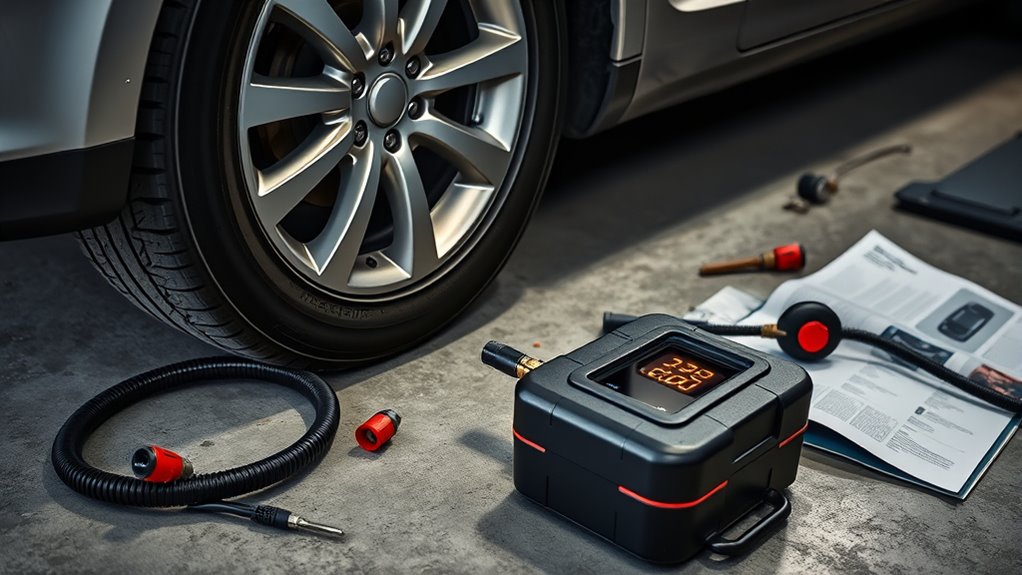
If your tire inflator is suddenly loud, stop and inspect it right away. Check the hose for kinks, cracks, or debris, verify the valve connection, and clean the air filter. Listen for grinding, whining, knocking, or chatter: grinding often means bearing wear, whining can signal electrical stress, and knocking points to piston or seal fatigue. Also test the battery, motor, and PSI sensor, because faults there can force nonstop strain and reveal the next fix.
Key Takeaways
- Stop immediately if you hear grinding, knocking, or a high-pitched whine, as these can signal internal damage or electrical stress.
- Check the hose, valve connection, and air filter for kinks, leaks, debris, or clogs that increase strain and noise.
- Inspect the motor and bearings for wear, loose parts, or friction, especially if the sound is cyclical grinding.
- Test the battery, fuse, and PSI sensor, since weak power or false readings can make the inflator run loud and continuously.
- Let the unit cool, clean it, and replace damaged parts before reuse if it overheats or the noise persists.
Why Is Your Tire Inflator So Loud?
If your tire inflator sounds unusually loud, the noise pattern can point to a specific fault. On tire inflators, a cyclical grinding that changes pitch with speed usually means failing ball bearings. Erratic valve chatter, often from debris, can spike noise for 15-20 seconds before it fades.
A high-pitched whine signals electrical stress, often tied to PWM controller faults and possible imminent failure. Rhythmic knocking points to piston or seal fatigue, which can destabilize compression and cut output.
If your portable tire inflator runs loudly without recovering, overheating is likely; stop it, let it cool, and inspect maintenance intervals. Don’t confuse these Motor Sounds with a faulty pressure gauge, which can mislead you about pressure and mask real stress.
Air leaks can also force the unit to work harder, and extreme temperatures can magnify every symptom. You deserve equipment that performs predictably, not one that keeps you guessing.
Check the Hose, Valve, and Air Filter
Start with the simple airflow path: inspect the hose, valve, and air filter for anything that can raise load or distort noise.
You should check the hose for kinks, cracks, pinches, or debris, because any restriction in the air hose can force the motor to work harder and sound harsher. Verify the hose connection at the inflator and at the valve stem; if it’s loose, air leaks will add hiss and reduce pressure transfer.
If you suspect a fault, inspect the fuse too, since an electrical issue can mimic a noisy overload. Remove and clean the air filter so dust can’t choke intake flow and create strain-induced noise.
Use a screwdriver stethoscope to touch the housing near the hose and valve; this helps you isolate where the sound concentrates. Replace damaged parts immediately.
Clean passages restore control, lower resistance, and let your inflator operate with less noise and more freedom.
Listen for Grinding, Whining, or Knocking
Listen closely as the inflator runs, because the sound pattern can point you to the fault. On a portable inflator, you’re mapping acoustic clues to internal components, not guessing. A cyclical grinding usually tracks motor speed and often means failing ball bearings, a clear mechanical issue. High-pitched whining can signal electrical stress and demands attention before the damage spreads. Rhythmic knocking points to piston or seal fatigue and possible compression chamber wear. Brief valve chatter may fade after 15–20 seconds, yet debris can still leave a hidden problem.
| Sound | Likely clue | Action |
|---|---|---|
| Grinding | Bearing wear | Inspect immediately |
| Whining | Electrical stress | Stop and assess |
| Knocking | Piston or seal fatigue | Check compression path |
| Chatter | Debris in valve | Clear and retest |
| Inconsistent hum | Impending failure | Diagnose further |
Track pitch, rhythm, and duration. Any deviation from the normal acoustic profile means you’re hearing a system asking for repair, and you can answer with informed action.
Troubleshoot Battery, Motor, and PSI Sensor Problems
When your inflator gets loud, check the battery first, because a weak battery can’t supply steady power and may force the motor to work harder than normal.
Test the battery voltage under load; if it drops sharply, replace it or recharge fully before more inflators use.
Next, inspect the motor for worn bearings, loose fasteners, or debris that raises friction and noise. A damaged motor often sounds rough during continuous use and can’t build pressure efficiently.
Then verify the PSI sensor. If it reports false pressure, the control circuit may keep the motor running continuously or cycling erratically, which increases noise and heat.
Compare the reading with a known gauge and recalibrate if needed.
Regular maintenance gives you control: check battery health, clean contacts, and inspect the motor before each session.
That way, you protect performance, restore accurate pressure control, and keep your inflator operating smoothly without unnecessary noise.
When a Loud Tire Inflator Is Unsafe to Use
If your inflator begins making cyclical grinding, stop it immediately, because that sound can signal irreversible internal damage and create a safety risk. A loud tire inflator with cyclical grinding sounds often has failing ball bearings, and you shouldn’t keep forcing it.
High-pitched whining points to electrical stress in the PWM controller, which means the unit may be operating outside safe limits. If you hear erratic valve chatter, check for debris interference; that instability can disrupt pressure control and compromise reliability.
Rhythmic knocking usually indicates piston fatigue or seal wear, and continued use can turn a minor defect into a hard failure. You’re not obligated to accept a compromised tool. Power it down, disconnect it, inspect the mechanism, and replace damaged parts before reuse.
When noise changes from normal operation to repeated mechanical warning signs, the inflator’s safety margin is gone, and keeping it running isn’t liberation; it’s exposure.
Frequently Asked Questions
Why Is My Air Compressor Suddenly Making a Loud Noise?
Your air compressor’s sudden loud noise usually means a failing bearing, valve debris, piston wear, or electrical stress.
You should perform compressor parts inspection, check air compressor maintenance records, and use proper lubrication methods to rule out friction.
Then test for troubleshooting air leaks and compressor vibration issues.
Apply noise reduction techniques only after you isolate the fault, because that lets you repair the machine safely and keep it working freely.
How to Fix a Tire Inflator?
You fix your tire inflator by checking power, hose, and airflow first—no, you don’t need a replacement yet.
Follow common troubleshooting steps: inspect bearings, clean vents, clear kinks, and test the battery and charger.
Use proper usage techniques, apply tire inflator maintenance, and follow safety precautions.
For noise reduction tips and inflator lifespan extension, verify electrical stress and keep the unit cool, dry, and unobstructed.
Why Is My Air Compressor Making a Knocking Sound?
Your air compressor’s knocking sound usually means worn piston rings, failing seals, or loose bearings, so you should inspect the compression chamber first.
Check compressor component inspection points, then verify compressor operating pressure and look for debris or valve chatter.
Use air compressor maintenance, noise reduction techniques, vibration damping solutions, and troubleshooting air leaks to reduce stress.
If the knock changes with speed, you’re likely hearing bearing failure and shouldn’t keep running it.
What Could Be Causing My Air Compressor to Make a High-Pitched Noise?
Your compressor’s high-pitched noise usually points to electrical stress, worn bearings, or valve chatter.
You can trace high pitched causes to a failing PWM controller, mechanical issues, or debris in the valves.
Check for air leaks, overheating, and user errors like running past duty cycle.
For noise reduction, inspect lubrication, intake filters, and cooling.
With disciplined compressor maintenance, you’ll restore reliable operation and reclaim quiet, efficient performance fast.
Conclusion
If your tire inflator suddenly sounds like a coffee grinder, don’t ignore it. A clogged hose, failing motor, or bad PSI sensor can turn a simple top-off into a breakdown. I once heard a compressor hiss like a snake before its hose split at 35 PSI—right when I needed it most. Treat new noise as a diagnostic clue: inspect, test, and stop using it if the sound gets harsher or the unit vibrates excessively.

