
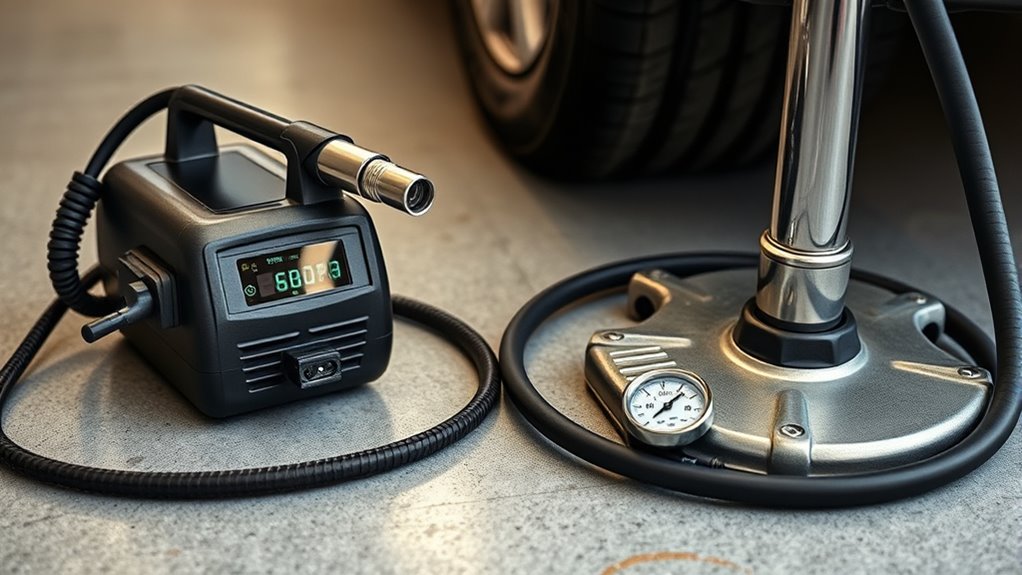
A tire inflator gives you fast, precise inflation with a built-in gauge and automatic shut-off, so you can set the PSI and walk away. A tire pump is usually manual or simpler electric equipment that needs more effort and closer pressure checking. Inflators are better for quick car top-offs and emergencies, while pumps work well for bikes or basic use. If you want the right fit, there’s more to compare.
Key Takeaways
- A tire inflator is a compact electric device for quick, precise tire inflation with automatic shut-off.
- A tire pump is usually manual or basic electric and often requires physical effort or separate pressure checking.
- Tire inflators are faster and more accurate, often letting you set a target PSI and stop automatically.
- Tire pumps are simpler and useful for bikes or emergencies, but they are slower and less convenient.
- Tire inflators are better for cars and frequent top-offs, while tire pumps suit small tires and power-free use.
What Is a Tire Inflator?
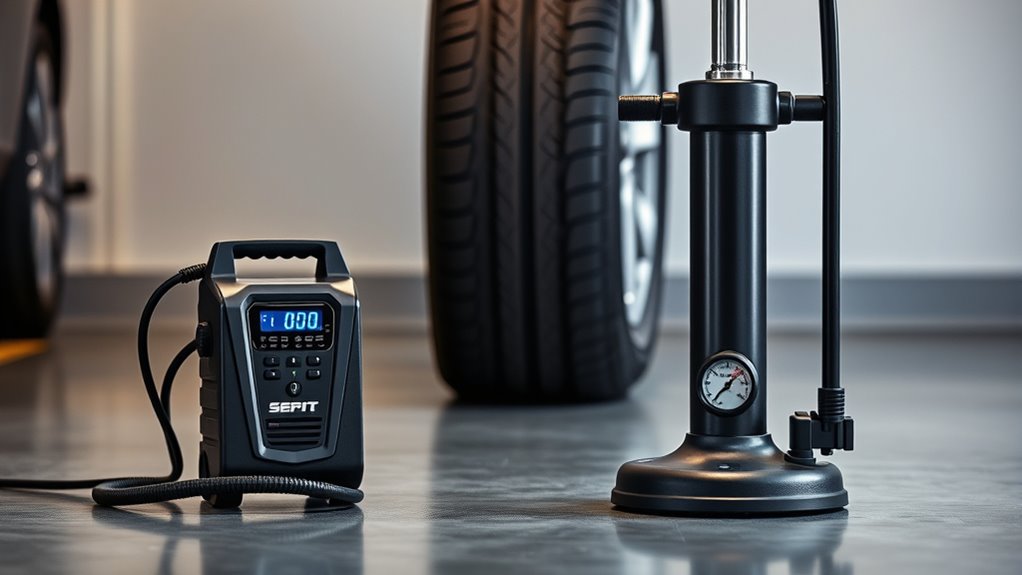
A tire inflator is a compact, portable device designed to inflate vehicle tires quickly and efficiently, often with features like automatic shut-off and a digital pressure display.
You use tire inflators to handle everyday inflation without wasting time or energy. They usually run on lower power than larger equipment, so they fit your routine better and keep you moving freely.
Many models connect to a 12-volt outlet in your vehicle, and some use battery power, which gives you more control on the road. You can rely on them for roadside emergencies, because they’re easy to carry and simple to use.
Many models plug into your 12-volt outlet or run on battery power, making roadside inflation simple and portable.
Modern units often include automatic shut-off, so they stop when the set pressure is reached. Some also add LED lights and nozzle attachments for extra flexibility.
With tire inflators, you get portable, practical support for vehicle tires and beyond.
What Is a Tire Pump?
Tire pumps are manual or electric devices that force air into vehicle tires, often requiring either physical effort or an external power source. You can use a tire pump to inflate a flat or low tire when you need control and independence.
Models include foot pumps, hand pumps, and electric versions, so you can choose what fits your routine. Most use a hose and nozzle that lock onto the valve stem, helping you move air efficiently.
Unlike many tire inflators, a traditional tire pump doesn’t shut off on its own, so you’ll need to watch pressure closely and stop at the right point. That manual control can suit you if you want direct oversight.
A tire pump is often portable, making it useful for roadside emergencies, travel, or quick top-offs. It gives you a practical way to keep your tires ready without relying on a shop or compressor.
How Tire Inflators and Pumps Work
You’ll see tire inflators and tire pumps work very differently because they use different power sources and activation methods.
An inflator uses an electric motor to compress air and push it into the tire, while a manual or foot pump relies on your effort to create airflow through each stroke.
Many inflators also include pressure gauges and auto shutoff, so you can monitor PSI and stop filling at the right level.
Power Sources and Activation
When it comes to power and activation, tire inflators are usually the more convenient option because they run on electricity from a wall outlet, a 12V car port, or a rechargeable battery. You get flexible power sources and fast setup.
A portable tire inflator uses an electric motor, so you only connect it and start. Many models include automatic shut-off and a digital gauge, helping you protect tire pressure without constant guessing.
Manual tire pumps, by contrast, depend on your effort and rhythm, so you control every stroke and keep checking pressure yourself.
- Plug in or charge.
- Set your target psi.
- Let the tool stop or keep pumping by hand.
Air Compression Cycle
Both tire inflators and manual tire pumps work on the same basic air compression cycle: they pull in ambient air through an intake valve, use a piston to compress it, and send that pressurized air through a hose into the tire. You control tire inflation by matching the tool’s output to the job; portable tire inflators are best for topping up underinflated tires, not rebuilding a fully flat one. | Step | What Happens | Result |
| — | — | — |
|---|---|---|
| Intake | Air enters cylinder | Ready to compress |
| Stroke | Piston moves up | Pressure rises |
| Delivery | Air flows to tire | Correct tire pressure |
In air compressors and tire setups, this cycle keeps you moving with less strain. Inflators also run in short bursts, so you can work safely and keep the system from overheating while you reclaim dependable mobility.
Auto Shutoff and Gauges
Because tire inflators often include auto shutoff and digital gauges, you can set a target pressure and let the tool stop once it reaches that level. This helps prevent overinflation and keeps tire maintenance accurate.
Tire inflators give you preset pressure settings and visible readings, so you can track accurate tire pressure without guesswork. Their gauges usually stay within ±1 PSI, which supports safer handling and less tire wear.
- Set the pressure you want.
- Watch the digital gauges as air flows.
- Let auto shutoff end the job.
Speed and Power Differences
You’ll usually get faster inflation from a tire inflator, since its motor and airflow output can fill a tire in just a few minutes.
A tire pump depends on your manual effort, so it often takes longer and can feel less consistent, especially with larger tires.
For high-volume air tasks, the inflator’s higher CFM and automatic shut-off give you more power and control than a hand pump.
Inflation Speed Comparison
When speed matters, tire inflators and tire pumps perform differently because of their power output and airflow. You’ll see that inflators usually deliver lower PSI output, so they’re slower on a dead-flat tire, while tire pumps can push air faster for bigger jobs.
For tire maintenance, portable inflators still shine when you just need a quick top-off.
- A Fanttik X8 Apex inflator can take a 215/55R17 tire from 0 to 35 PSI in about 3 minutes.
- Many 12V portable inflators need 5–10 minutes for routine checks or minor inflation.
- Tire pumps, especially compressor-driven ones, offer higher airflow and quicker inflation speed for heavy-duty tasks.
Choose inflators for convenience; choose tire pumps when high PSI output and faster recovery matter most.
Motor Power Output
Motor power output helps explain why tire inflators and tire pumps perform differently at the wheel. You’ll usually find tire inflators using 60W to 260W motors, while air compressors rely on higher power for broader use.
That lower motor power output keeps tire inflators efficient and portable, with an airflow rate around 1.5 to 2.0 CFM at 0 PSI. You can inflate a standard car tire to 35 PSI in about 5 to 10 minutes, and automatic shut-off helps you hold the set pressure without constant checking.
Tire inflators also run at lower RPMs, which reduces heat and supports safety. Air compressors use stronger motors and faster airflow, so they demand more attention and deliver more force.
High-Volume Air Tasks
For high-volume air tasks, the speed and power gap becomes obvious fast: tire inflators are built for quick, low-pressure jobs and typically move about 1.85 CFM, while air compressors can deliver 4 to 5+ CFM at higher PSI for tools and heavier applications.
You’ll feel the difference when you need freedom from delay and downtime.
- Use tire inflators for portable tire checks and low-pressure tasks.
- Choose air compressors when you need sustained airflow for pneumatic tools.
- Expect tire inflators to fill a car tire in 5-10 minutes, while air compressors can do it much faster.
Tire inflators stay compact and mobile for emergencies.
Air compressors are bulkier, but they handle demanding work, higher pressure, and real high-volume air tasks with ease.
Portability and Convenience
Tire inflators are generally more portable and convenient than traditional tire pumps. You can keep one in your vehicle, ready for emergencies, because it’s compact and lightweight. Many tire inflators run on battery power or your 12V outlet, so you don’t need to hunt for a separate source. That gives you freedom on the road and faster pressure control.
| Feature | Tire Inflator |
|---|---|
| Size | Compact, portable |
| Power | Battery or 12V |
| Pressure check | Digital display |
| Inflation | Quick |
| Operation | Automatic shut-off |
With a digital display, you can monitor pressure clearly instead of guessing. Automatic shut-off also reduces hassle, so you can set it and move on. Traditional tire pumps often demand more effort, more monitoring, and more time. If you value convenience and want quick inflation without unnecessary strain, tire inflators give you a cleaner, simpler experience.
Best Uses for Each Driver
Your best choice depends on how you drive and what you need most. If you want quick inflation and portable solutions, tire inflators fit everyday driving. They help you handle roadside emergencies, top off pressure on trips, and support larger vehicles that need fast, on-the-go fixes. For long-distance travel or off-road use, you’ll appreciate their convenience and speed.
- Daily commuters: choose tire inflators for easy, fast use when pressure drops.
- Cyclists and low-power setups: choose tire pumps when you need a simple tool without electricity.
- Drivers of trucks and SUVs: choose high-capacity inflators for frequent adjustments and quicker recovery.
Tire pumps work best when you’re inflating bike tires or small vehicle tires and don’t have access to power. They’re dependable, but they take longer, so they’re less practical when time matters.
If you value freedom on the road, match the tool to your vehicle and your pace.
Pressure Control and Accuracy
When you care about exact pressure, tire inflators usually give you more control than traditional tire pumps. You can set specific PSI levels, and many tire inflators stop automatically when they hit your target, so you don’t have to guess or keep checking.
Digital displays also help you track current pressure and target pressure at the same time, which improves accuracy during inflation. Most tire inflators stay within about ±1 PSI, giving you dependable pressure control for different tires and conditions.
Digital displays track current and target pressure, making inflation more accurate and dependable.
By comparison, tire pumps often lack that level of precision, so you may need to monitor them more closely. That difference matters because correct inflation supports ideal tire performance, reduces uneven wear, and helps your vehicle handle more predictably.
If you want steady results and less manual effort, tire inflators make accurate pressure control much easier than tire pumps.
Which One Should You Choose?
Now that pressure accuracy is clear, the better choice depends on how you plan to use it. If you’re a daily driver, tire inflators give you portability, quick setup, and easy control. They’re ideal for vehicle owners who want simple maintenance without carrying bulky equipment.
Tire pumps, especially larger models, make more sense when you need stronger airflow for heavy-duty applications or repeated use.
- Choose a tire inflator if you want a compact tool for roadside fixes and routine checks.
- Choose a tire pump if you need higher output for shop work, fleets, or industrial tasks.
- Choose based on cost-wise value: tire inflators are usually cheaper, while heavy-duty pumps cost more but handle bigger demands.
For most vehicle owners, a tire inflator delivers freedom, convenience, and enough power to stay independent.
If your needs go beyond basic car care, a tire pump can give you the muscle you need.
Frequently Asked Questions
Should I Buy a Tire Inflator or Air Compressor?
You should buy a tire inflator if you want fast, simple roadside help; choose an air compressor if you need broader utility.
Compare tire inflator features, air compressor types, portability comparison, power sources, inflation speed, and noise levels.
You’ll get easier storage and quicker setup with an inflator, but more power and flexibility with a compressor.
If you mostly top off tires, the inflator frees you.
What Are the Common Problems With Car Tire Inflators?
Car tire inflators can feel like tiny traitors when they overheat, misread pressure, or die mid-job.
You’ll also face limited power, slow inflation speed differences, and battery limits. Check pressure gauge accuracy often, and watch for tire deflation causes like leaks or valve issues.
Follow inflator maintenance tips to reduce failures. Their portability advantages and low noise level comparison help, but they won’t replace a stronger compressor.
Can a Tire Inflator Be Used as an Air Compressor?
No, you usually can’t use a tire inflator as a full air compressor.
You can rely on it for portable air and quick tire top-offs, but it won’t drive tools or sustain heavy jobs. Its inflation speed, power source, and airflow stay limited, though inflation accuracy is often good.
Expect lower noise levels and follow maintenance tips, but choose a real compressor when you need broader, freer performance.
Can I Run My Car While Using a Tire Inflator?
Yes, you can run your car while using a tire inflator, and it can improve inflation speed while protecting the battery.
You’ll usually want the engine on for better engine performance and emergency readiness, especially with power-hungry units.
Keep the cord clear of moving parts for tire safety. If the inflator draws little power, you may not need to start the car.
Expect more inflator noise, but smoother tire maintenance overall.
Conclusion
So, when you’re choosing between a tire inflator and a tire pump, you’re really choosing speed or simplicity. An inflator gets you back on the road fast, while a pump asks for a bit more effort but keeps things basic and reliable. Which matters more to you: convenience or control? Either way, you’ll be better prepared, more confident, and less likely to get stuck with low tire pressure when you need to move.

