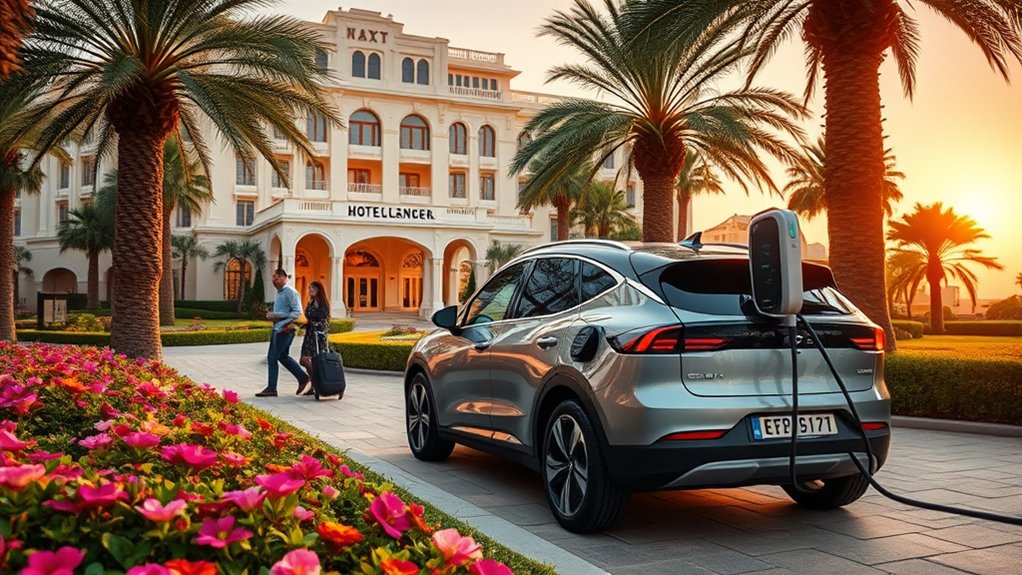
Finding EV charging at hotels can turn a long road trip into a much easier drive. Instead of spending extra time at a public charger before bed or first thing in the morning, you can plug in while you sleep, eat, or check in for the night. The key is to confirm the charger type, connector, cost, access rules, and backup options before you arrive.
Quick Answer
To use hotel EV charging on a road trip, filter hotels by EV charger availability, confirm the charger type with the hotel, check connector compatibility, arrive with a 10% to 20% battery reserve, and move your vehicle as soon as charging is complete.
Key Takeaways
- A hotel with Level 2 charging is often the best overnight option because it can add meaningful range while your car is parked.
- Always confirm the charger type, connector, access hours, payment method, and whether the charger can be reserved.
- Level 1 outlets are slow, Level 2 chargers are ideal for overnight stays, and DC fast chargers are best for short charging stops.
- Bring the adapters and mobile apps your EV needs, especially during the CCS1 to NACS/J3400 transition.
- Have a nearby backup charger saved in case the hotel charger is occupied, blocked, offline, or incompatible.
At a Glance
| Time Required | 5 to 10 minutes to verify the hotel charger before booking; several hours or overnight to charge on Level 2 |
| Difficulty | Easy, if you verify access, connector type, and payment ahead of time |
| Tools Needed | EV route planner, hotel booking filter, charging network apps, phone charger, and any approved adapter for your vehicle |
| Cost | Often free at some hotels, but some charge per kWh, per hour, flat session fee, parking fee, or idle fee |
Why Hotel EV Charging Matters on a Road Trip
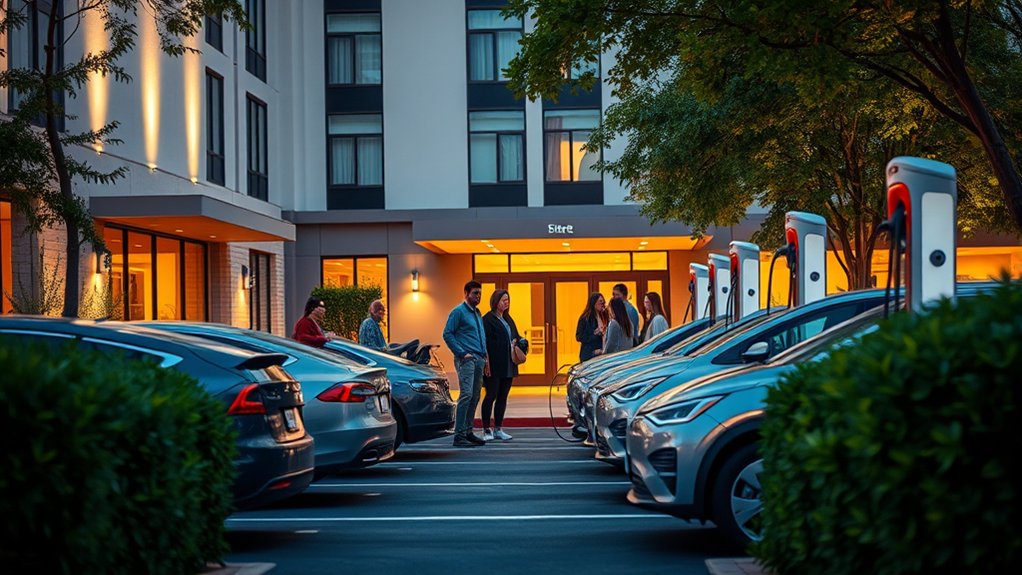
Hotel charging matters because your vehicle is already parked for hours. That makes overnight charging one of the easiest ways to recover range without adding another stop to your route.
The Alternative Fuels Data Center explains that Level 2 charging is commonly used at public destinations and workplaces, and it can charge a typical EV battery overnight. That is why hotels, parking garages, resorts, and extended-stay properties are useful stops for EV drivers.
Hotel charging also reduces range anxiety. If you wake up with enough charge to reach your next destination or a reliable fast charger, you can spend more time enjoying the trip and less time searching for emergency charging.
A Level 2 hotel charger can add about 25 miles of range per charging hour, but your actual range gain depends on the charger output, your EV, battery temperature, and starting state of charge.
Before You Book, Confirm These Charger Details
Do not rely on a single “EV charging available” icon. Some hotel listings are outdated, and a property may have only one shared charger for many guests. Before you book, call the front desk or message the property and ask specific questions.
- How many chargers are on-site? One charger can be enough on a quiet night, but it may be a problem during weekends or holidays.
- What charging level is available? Ask whether it is Level 1, Level 2, or DC fast charging.
- What connector does it use? Ask about J1772, Tesla/NACS/J3400, CCS1, or CHAdeMO.
- Can the charger be reserved? Some hotels assign a charging space at check-in; others use first-come, first-served access.
- Is charging free or paid? Ask about per-kWh fees, hourly fees, parking fees, valet fees, and idle fees.
- Is the charger public, guest-only, or valet-only? A charger shown in an app may not always be open to every driver.
- Is it working today? Ask the staff to confirm that the charger is online and not blocked.
Pro Tip: Save the hotel’s phone number, the charger network support number, and one nearby backup charger before you start the day’s drive.
How to Find Hotels With Reliable EV Chargers
Start with hotel booking filters, then verify the result with a charging-specific tool. Many booking sites show EV charging as an amenity, but a dedicated charging app can help you see connector type, speed, network, user notes, photos, and recent check-ins.
Use the AFDC Alternative Fueling Station Locator to find public and private charging stations in the United States and Canada. You can also use apps such as PlugShare and ChargePoint to review station details, pricing, nearby amenities, and user feedback.
For the best results, check at least two sources:
- Hotel booking page: Confirms whether the hotel claims EV charging as an amenity.
- Charging app: Shows charger type, network, photos, reviews, and recent activity.
- Front desk: Confirms current availability, access rules, and whether a charger can be reserved.
If the hotel has only one charger, treat it as a bonus rather than your only plan. Find a nearby DC fast charger or public Level 2 station within comfortable range.
Types of Hotel Charging Stations You Can Expect
Hotel charging stations vary widely. A small inn may offer a basic outlet, while a larger hotel or resort may have multiple networked Level 2 chargers. A few properties near highways may also offer DC fast charging.
Level 1 Charging
Level 1 charging uses a 120-volt outlet. It is the slowest option and usually adds about 3 to 5 miles of range per hour. During a long overnight stay, it may add roughly 30 to 50 miles, depending on your EV and charging time.
Use Level 1 only when you have plenty of time, a safe outlet approved by the property, and a portable cord that is rated for your vehicle. Never run a cord across a walkway, driveway, or wet area.
Level 2 Charging
Level 2 charging is the most common hotel charging option and usually the most useful for overnight stays. It uses 208-volt or 240-volt power and can add about 25 miles of range per hour in many cases, according to the Alternative Fuels Data Center.
If you plug in after dinner and move your vehicle in the morning, Level 2 charging may add enough range for the next day’s drive. It is not always as fast as a highway DC fast charger, but it works well because your car is parked for several hours anyway.
DC Fast Charging
DC fast charging is the quickest hotel charging option, but it is less common at hotels than Level 2 charging. AFDC estimates that DC fast chargers can add about 100 to 200+ miles of range in 30 minutes, but actual speed depends on the charger power, your EV’s fast-charging limit, battery temperature, and state of charge.
Use DC fast charging when you need a short stop. Use Level 2 when you are staying overnight.
Note: Charging usually slows as the battery gets closer to full. For road trips, it is often faster to charge enough to reach the next stop instead of waiting for 100% every time.
Check Connector Compatibility Before You Arrive
A hotel can have EV charging and still be the wrong fit for your vehicle. Before you book, match the hotel charger’s connector to your EV’s charge port or approved adapter.
The Joint Office of Energy and Transportation explains that EV charging connectors in North America include CCS1, CHAdeMO, and J3400/NACS for DC fast charging, while Level 1 and Level 2 charging commonly use J1772 or J3400/NACS depending on the vehicle and charger.
- J1772: Common for Level 1 and Level 2 charging on many non-Tesla EVs in North America.
- NACS/J3400: Tesla-style connector that is moving toward wider North American adoption. Some EVs may need an adapter during the transition.
- CCS1: Common DC fast-charging connector for many non-Tesla EVs.
- CHAdeMO: Older DC fast-charging connector used by some vehicles, most notably certain Nissan Leaf models.
- Adapters: Only use adapters approved by your vehicle manufacturer or charging provider.
Warning: Do not assume every Tesla, NACS, J3400, J1772, CCS1, or CHAdeMO charger will work with your vehicle. Check your owner’s manual, adapter rules, and the charging network’s access policy before relying on a hotel charger.
Step-by-Step Guide to Using Hotel Charging Stations
Using hotel charging stations is simple when you plan ahead. Follow this process to avoid delays at check-in and range stress the next morning.
- Plan the hotel stop before you leave. Pick a hotel with charging, then save a backup charger nearby.
- Confirm the charger directly with the hotel. Ask about charger count, connector type, access hours, payment, parking rules, and reservation options.
- Arrive with a 10% to 20% battery reserve. This gives you enough range to reach a backup charger if the hotel charger is occupied, blocked, or offline.
- Check in before you plug in. Some hotels require a room key, parking pass, app activation, front-desk code, or valet access.
- Park correctly. Use only the marked EV space, avoid blocking another charger, and keep the cable flat and tidy.
- Start the session. Follow the charger screen, hotel instructions, or network app. Confirm that charging has actually started before walking away.
- Monitor the session. Use your vehicle app or charging app to watch charge level, charging speed, cost, and session status.
- Move your car when finished. Once you have enough range or the battery is full, unplug and relocate so another guest can charge.
What to Do if the Hotel Charger Is Unavailable
Even a well-reviewed hotel charger can be busy, broken, blocked by a gas vehicle, or reserved by another guest. Your road-trip plan should include a backup before you arrive.
- Check your saved backup charger. Open your route planner or charging app and look for a nearby charger with recent successful check-ins.
- Ask the front desk for help. The hotel may know whether another guest can move soon or whether a second charger is available in overflow parking.
- Use a nearby DC fast charger if needed. If your battery is low, a short fast-charging session may be safer than waiting overnight.
- Adjust your morning route. Add a reliable charger as your first stop if you cannot charge at the hotel.
- Report a broken charger. Tell hotel staff and use the charging app’s report function so the next driver has better information.
Do not unplug another vehicle unless hotel staff clearly confirms that the vehicle is yours to move or the charger has a posted sharing policy that allows it. In most cases, unplugging another guest’s EV creates conflict and may stop their planned trip charge.
Essential Etiquette for Using Hotel EV Chargers
Hotel EV chargers are shared resources. Good etiquette keeps the charger useful for every guest and helps hotels justify adding more charging spaces.
- Charge only while you need to charge. Do not use an EV charging spot as premium parking after your session is done.
- Move promptly. If your app says charging is complete, relocate your car when practical.
- Keep cables neat. Do not leave cords across walkways, drive lanes, landscaping, or puddles.
- Respect posted rules. Follow time limits, parking fees, valet rules, and guest-only access signs.
- Do not unplug others. Ask hotel staff for help if another vehicle is blocking the charger.
- Report damage. Tell the front desk if the screen, plug, cable, payment reader, or parking space is damaged.
Charging etiquette is especially important at hotels because many drivers depend on overnight charging to leave on schedule the next morning.
Frequently Asked Questions
Are hotel charging stations free or do they have fees?
Some hotel charging stations are free for guests, while others charge per kWh, per hour, per session, or through a parking fee. Always check the hotel listing, charging app, and front desk before you plug in. Also ask about idle fees if the charger is networked.
Can I charge my EV overnight at hotels?
Yes, many hotels allow overnight EV charging, especially with Level 2 chargers. Confirm access rules before you arrive because some chargers are first-come, first-served, valet-only, guest-only, or controlled through a charging network app.
What if the hotel charger is unavailable upon arrival?
Ask the front desk whether the charger can be freed soon, then check your saved backup charger. Keep a 10% to 20% battery reserve so you can reach a nearby public charger if the hotel charger is occupied, offline, blocked, or incompatible.
Do I need to bring my own charging cable?
For most public Level 2 and DC fast chargers in North America, the charging cable is attached to the station. Still, you should bring your portable charging cord for approved 120-volt use and any manufacturer-approved adapter your EV may need.
Are charging speeds different at various hotel brands?
Yes. Charging speed depends more on the installed charger, power supply, connector, network settings, and your EV than on the hotel brand itself. One hotel may offer a slow outlet, while another location from the same brand may offer several Level 2 chargers or a DC fast charger.
Can I reserve a hotel EV charger?
Sometimes. Some hotels allow charging reservations, some assign spaces at check-in, and others use first-come, first-served access. Call the property directly because the booking page may not show the real charger policy.
Can a non-Tesla EV use a Tesla or NACS hotel charger?
It depends on the charger, your vehicle, and your adapter. Some Tesla-style destination chargers may work with a compatible adapter, while others may be limited by network rules or hardware. Check your vehicle manual, hotel charger details, and charging network instructions before relying on it.
Conclusion
Hotel EV charging can make an electric road trip easier, cheaper, and less stressful, but only when you verify the details before you arrive. Look beyond the amenity icon. Confirm the charger level, connector, cost, access rules, reservation policy, and backup options. Then use the charger courteously, move your car when finished, and keep a backup charger saved for peace of mind.
Sources
- Alternative Fuels Data Center: Electric Vehicle Charging Stations — charging levels, range-per-hour estimates, connector types, and DC fast charging guidance
- Alternative Fuels Data Center: Alternative Fueling Station Locator — public and private charging station lookup for the United States and Canada
- Joint Office of Energy and Transportation: SAE J3400 Charging Connector — NACS/J3400, CCS1, CHAdeMO, adapters, and connector terminology
- ChargePoint App — station search, filters, pricing details, navigation, and payment features
- PlugShare — EV charging map and station discovery tool