
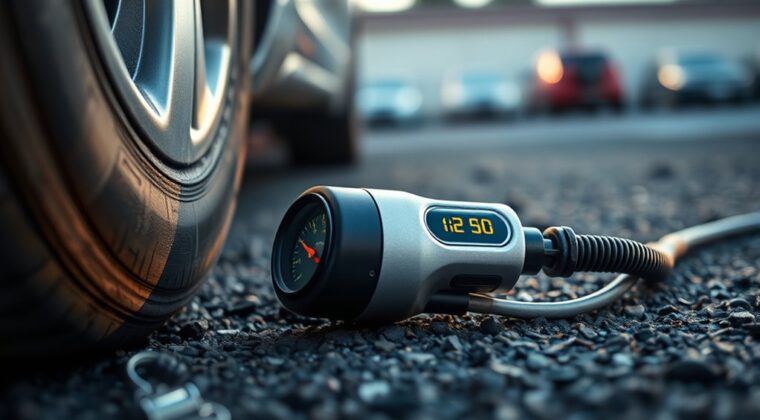
L per minute on a tire inflator tells you how much air the unit can move, not how much pressure it can create. A higher L/min rating usually means faster inflation, especially for larger tires or low starting pressures. You should match flow rate to tire size, since small car tires need less than trucks or SUVs. Hose length, diameter, and cold temperatures can also affect real-world speed, and more details can help you choose wisely.
Key Takeaways
- L/min shows how much air the inflator moves each minute, not its maximum pressure.
- Higher L/min usually means faster tire inflation, especially for larger tires.
- Small car tires need less flow than SUVs, trucks, or very low-pressure tires.
- Hose length, hose width, and cold temperatures can reduce real-world inflation speed.
- Choose an inflator with enough L/min for your tire size to save time and improve efficiency.
What Does L Per Minute Mean On a Tire Inflator?
L per minute (L/min) on a tire inflator measures the air flow rate it delivers, which tells you how quickly it can fill a tire. When you read the L per minute value, you’re seeing the tire inflator’s flow rate, not its pressure output. That number helps you judge whether the tool can inflate your tires efficiently and reach the recommended tire pressure without unnecessary delay.
Lower ratings often suit small jobs, while higher ratings support larger tires that need more air volume. Manual pumps usually deliver 5 to 15 L/min, and electric models can exceed 120 L/min. You can use this specification to select equipment that matches your tire size, starting pressure, and inflation demands.
How L Per Minute Affects Inflation Speed
Higher L/min ratings reduce inflation time because the inflator moves more air into the tire each minute. When you compare tire inflators, the flow rate tells you how fast an air pump can inflate a tire under similar conditions.
A unit rated at 20 to 120 L per minute pushes air far faster than a manual pump at 5 to 15 L/min, so you spend less time waiting and more time moving. That higher output matters most when you’re filling larger tires or recovering from low pressure, because the tire reaches target pressure with fewer cycles.
Temperature and tire size still affect the effective rate, so cold conditions can slow progress even when the spec looks strong. For precise, efficient inflation, choose tire inflators with a L per minute rating that matches your vehicle’s tires and your need for speed.
How Much L Per Minute Do You Need?
You need to match L/min to your tire size and inflation demand, since small car tires typically work well around 20 to 40 L/min while larger tires often need 40 L/min or more.
Choose a flow rate that fits your use case: if you want faster inflation, higher L/min helps, but it usually means more size, noise, or power draw.
Tire Size Matters
Tire size sets the airflow demand: small car tires typically inflate efficiently at 20–40 L/min, while larger SUV and truck tires often need 40–80 L/min to move enough air in a practical time.
Your tire size directly drives the L/min target, so you can match flow rate to the job and avoid wasted time. Air compressors with higher output reduce inflation time because air volume rises faster.
- Small tires: 20–40 L/min
- SUV tires: 40–60 L/min
- Truck tires: 60–80 L/min
- Severely under-inflated tires: choose more flow
A higher flow rate won’t change pressure limits, but it does help you inflate faster.
When you know your tire size, you make a precise, liberated choice instead of accepting underpowered tools.
Match Flow To Use
To match flow to use, compare the inflator’s L/min output with the tire’s size and pressure demand, because that flow rate determines how quickly the tire reaches usable pressure.
For small car tires, 20 to 40 L/min usually lets you inflate efficiently without waste. For larger tires, target 40 to 80 L/min so you can restore pressure with fewer delays.
Manual pumps at 5 to 15 L/min suit small tasks, but they’re slow for car tires. Electric and cordless models span 20 to over 120 L/min, so you can select a unit that fits your workload.
Don’t overbuy if your tires are modest; do match output to demand, and you’ll gain control, accuracy, and practical freedom.
Speed Versus Portability
Higher L/min ratings inflate tires faster, but they usually come with more size, weight, and power demand. The right choice depends on how often and where you’ll use the inflator. Your ideal flow rate balances speed and portability without locking you into needless bulk.
- 20-40 L per minute suits most car tires.
- 80-120 L/min boosts speed for larger tires or repeat fills.
- Cordless inflators give you freedom, but their lower flow rate trims performance.
- Choose higher output if you need quick, frequent inflation; choose lighter units for occasional use.
Larger tires need more air volume, so low-output models take longer. If you want mobility and independence, prioritize portability; if you want rapid service, prioritize speed.
L Per Minute vs. CFM
L/min and CFM both describe airflow, but they’re used in different contexts: L/min is common for tire inflators and shows how much air they deliver per minute, while CFM is more often used for larger compressors and pneumatic tools. When you compare specs, you’re comparing flow rate, not hype. A tire inflator rated in L per minute tells you more directly about inflation time. Since 1 L/min equals about 0.0353 cubic feet per minute, you should convert units before judging value.
| Metric | Typical Use | Meaning |
|---|---|---|
| L/min | Tire inflator | Air delivered per minute |
| CFM | Compressor | Air delivered per minute |
| 80–120 L/min | Large tires | Faster inflation |
Higher L/min usually cuts inflation time, especially on bigger or low-pressure tires. Use the number to choose equipment that matches your needs, not someone else’s.
Manual vs. Cordless: Which Inflates Faster?
When you’re comparing tire inflators, L/min tells you not just the airflow rate but also how quickly you can get back on the road. For tire inflation, you’ll usually see manual inflators at 5 to 15 L per minute and cordless inflators at 15 to 35 L per minute, so the cordless option will generally inflate faster.
- Manual inflators: 10 to 20 minutes for a typical tire
- Cordless inflators: 3 to 7 minutes for a standard car tire
- Fully deflated tires need more time and effort with manual pumps
- Cordless inflators often add digital gauges and auto shut-off
If you want less waiting and more control, cordless inflators free you from hand pumping and cut downtime sharply.
Manual inflators still work, but their lower L per minute output makes them slower for routine maintenance.
In practice, you’ll gain speed, precision, and convenience with cordless inflators, especially when you need to restore pressure quickly and keep moving.
What Affects Tire Inflator Flow Rate?
You’ll see tire inflator flow rate change as hose length and diameter alter airflow resistance; longer or narrower hoses reduce delivered L/min.
Tire size and starting pressure also matter, since larger tires or lower initial pressures demand more air and extend inflation time.
When you evaluate an inflator, compare these variables together, because they directly determine real-world performance.
Hose Length And Diameter
Hose geometry is a major constraint on tire inflator flow rate, because longer hoses add resistance and can reduce air delivery in liters per minute (L/min). You can treat hose length and diameter as linked variables that shape airflow during the inflation process.
- Longer hose length increases friction losses.
- Wider diameter supports higher volume transfer.
- Both factors alter measured flow rate.
- Proper hose sizing improves efficiency.
If you want faster inflation, choose a hose that minimizes unnecessary length and preserves diameter. A restrictive hose throttles output, so your inflator can’t deliver its rated performance.
With the right specification, you gain more consistent airflow, less wasted energy, and quicker tire service. This is practical control: you’re not waiting on weak plumbing to decide your pace.
Tire Size And Pressure
Tire size and starting pressure directly shape inflator flow rate, because larger tires need more air volume and severely under-inflated tires take longer to reach the target PSI.
You’ll see this immediately: a big tire demands more mass of air, so the inflator must work longer to inflate it. When you begin with under-inflated tires, the flow rate effectively slows, since the system has to move more air before pressure rises.
Topping off a tire is faster than filling from flat. As pressure climbs, resistance increases, and the inflator’s output can taper. Colder ambient air can also contract, reducing effective flow rate.
To stay in control, match your inflator to tire size, starting pressure, and operating conditions.
Tire Inflator Features That Speed Things Up
When speed matters, the inflator’s flow rate, measured in liters per minute (L/min), is the primary performance factor because higher output moves more air in less time. You’ll see the difference immediately: a higher flow rate lets you inflate faster and recover from pressure drops with less waiting.
A cordless tire inflator in the 15 to 35 L/min range usually fills a standard car tire in about 3 to 7 minutes, while electric models can push 20 to over 120 L/min for even faster results.
- Longer hoses can reduce effective flow.
- Wider hose diameter can improve throughput.
- Cold ambient temperatures can slow delivery.
- Manual pumps, at 5 to 15 L/min, demand more effort.
Choose the tool that matches your use case, and you’ll reclaim time without sacrificing control or precision.
Frequently Asked Questions
What Is a Good PSI for a Tire Inflator?
A good PSI for your tire inflator should exceed your tire pressure target, usually 30–35 PSI for standard cars.
You’ll want inflator types or air compressors rated above 50 PSI for SUVs and trucks, so you’ve got margin.
Check the sidewall maximum, follow safety guidelines, and use maintenance tips like regular pressure checks and automatic shut-off.
That way, you’ll avoid over-inflation and keep performance precise.
How Fast Is Speed Rating L?
Speed rating L tells you how much air you move per minute, so you can judge inflation efficiency.
You’ll see faster compressor types at 20–120 L/min, while manual pumps may only deliver 5–15 L/min.
In tire maintenance, that means you can fill a standard car tire in about 3–7 minutes with good pressure regulation.
Check safety standards, because tire size and starting pressure still affect your actual speed.
Is 30 PSI Too Low?
Yes, 30 psi can be too low for you, depending on your vehicle’s recommended tire pressure.
You should check the placard, because proper ideal inflation affects handling, braking, and fuel economy. Low pressure raises safety concerns and edge wear.
Use accurate gauges and, if needed, suitable inflator types or air compressors to restore spec.
Always measure cold, since heat skews readings and can mask underinflation.
Is 70 PSI Too High for Tires?
Yes, 70 psi is too high for most tires, and you should avoid it.
You’ll exceed recommended tire pressure, which creates safety concerns, reduces grip, and can cause blowouts. Your vehicle’s performance impact worsens as wear becomes uneven and fuel efficiency drops.
Check the sidewall and adjust for seasonal adjustments. Use a gauge often, because inflation frequency matters, and keep pressure within the manufacturer’s limits for your tires.
Conclusion
When you check an inflator’s L per minute rating, you’re really measuring how fast it can move air into your tire. Higher flow rates usually mean shorter inflation times, but pressure, hose design, power source, and leaks still affect real-world performance. You should compare L/min with your tire size and use case, not in isolation. Choose a model with enough output, and you’ll cut waiting time to a blink and keep your inflation routine efficient.
