
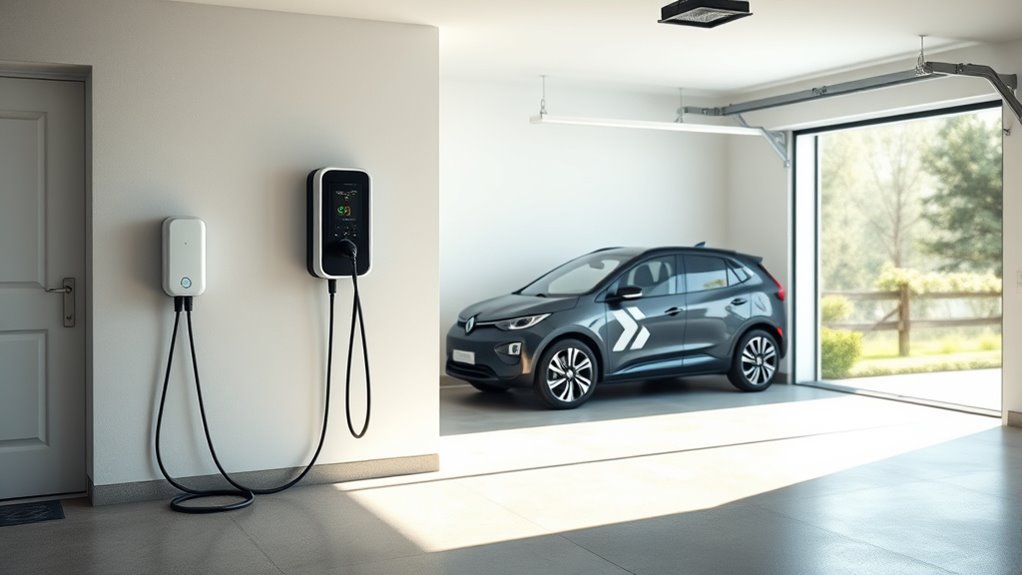
Mount your home EV charger at a height that matches three things: the charger manual, your vehicle’s charge port, and the way you move around the garage. For many residential wall chargers, a body height around 42 to 48 inches works well, with about 45 inches being a common sweet spot for reach, screen visibility, and cable handling. One height range does not cover every product or every code jurisdiction. Always confirm the final height with the manufacturer’s instructions, local electrical rules, and a qualified electrician.
Quick Answer
For most garage installations, mount the EV charger body about 42 to 48 inches above the floor, or near the manufacturer’s recommended height. Put the plug holster near waist height, keep the cable off the floor, and place the unit where the cord reaches your charge port without stretching.
Key Takeaways
- A practical home EV charger height is often 42 to 48 inches, but the charger manual and local code control the final answer.
- NEC Article 625, Section 625.50, sets a default coupling-means height of 18 to 48 inches indoors (24 to 48 inches outdoors) — but a listed product can carry a different manufacturer-approved range instead.
- Measure from your parked vehicle’s charge port before drilling, especially if the port is on the rear quarter panel or front fender.
- Keep the cable clear of tires, door swings, storage bins, and walking paths.
- Use a qualified electrician for hardwired chargers, new circuits, breaker sizing, permits, and inspection.
At a Glance
| Time Required | 15 to 30 minutes to plan and mark the location; longer for electrical installation |
| Difficulty | Easy for planning; professional-level for wiring or hardwired installation |
| Tools Needed | Tape measure, painter’s tape, level, stud finder, charger manual, vehicle parked in its normal position |
| Cost | Planning is free; electrical installation cost depends on panel distance, circuit size, permits, wall type, and charger model |
What Is the Best EV Charger Height?
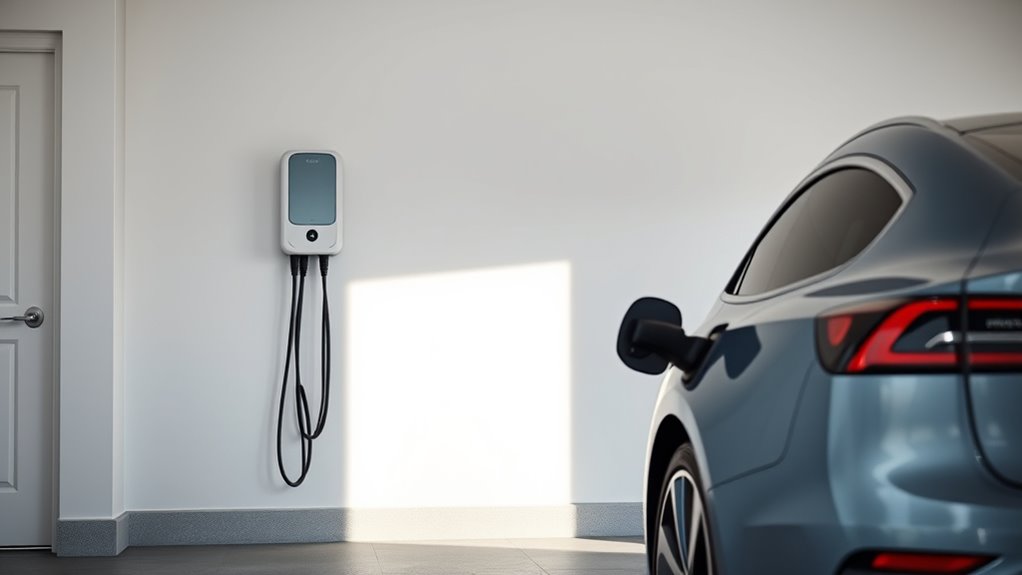
The best EV charger height for a residential garage is usually the height that lets you reach the controls, wrap the cable, and plug in without bending or stretching. For many wall-mounted Level 2 chargers, that means placing the charger body around 42 to 48 inches above the finished floor.
That range is a starting point, not a universal law. For example, the Tesla Gen 3 Wall Connector manual lists a recommended height of about 45 inches, a maximum height of 60 inches, a minimum indoor height of 18 inches, and a minimum outdoor height of 24 inches. Your charger may have different instructions, so check the exact model manual before drilling.
Other manufacturers land in a similar zone with their own numbers. ChargePoint’s Home Flex installation guide instructs installers to mark the mounting centerline between 39 and 43 inches above the floor, which puts the top of the unit around 50 inches. If you already own a charger, or know which model you’re buying, look up that specific manual rather than relying on one number for every brand.
If your charger has a screen or status lights, mount it high enough to read without crouching. If cable handling matters more, keep the plug holster around waist height so the connector docks cleanly and the cord stays off the floor.
Warning: Do not hardwire an EV charger, add a breaker, modify a circuit, or open an energized panel unless you are qualified to do that work. EV chargers use high-current circuits. Follow the product manual, shut off power when required, and use a licensed electrician when permits, wiring, or inspection are involved.
What Does NEC Article 625 Actually Require?
NEC Article 625 covers electric vehicle power transfer systems, but it doesn’t hand every residential installer one single wall height to mount to. What it does set, in Section 625.50, is a default height range for the coupling means — the plug or handle end of the cable, not necessarily the charger’s body. Unless the equipment is specifically listed and marked for a different height, the coupling means must be stored or located at least 18 inches above the floor indoors, or 24 inches above grade outdoors, and generally no higher than about 48 inches. That listing exception is exactly why a product like the Tesla Wall Connector can carry a manufacturer-approved maximum of 60 inches — the listing itself overrides the default range.
In plain terms, the electrical code side governs safe installation and where the plug is stored, not the perfect ergonomic height for your body. The final mounting decision is usually a mix of code compliance, product listing, accessibility, cable reach, impact protection, and daily comfort.
| Factor | What to Verify | Why It Matters |
|---|---|---|
| Charger manual | Minimum, maximum, and recommended mounting height | The product listing and warranty may depend on following the manual |
| Local code | Permits, inspection, circuit requirements, and location rules | Local adoption can differ from national model code language |
| NEC edition | Which edition — 2017, 2020, 2023, or the newly released 2026 NEC — your city or state has adopted | Section numbering and requirements shift between editions, and adoption timing varies widely by jurisdiction |
| Electrical panel path | Wire run, conduit route, breaker size, and service capacity | A shorter, cleaner path can reduce complexity and installation cost |
| Vehicle clearance | Door swing, mirrors, bumpers, tires, and storage zones | The charger and cable need protection from impact and abrasion |
Note: For public or shared charging spaces, accessibility rules can be much more specific than a private home garage. Under general ADA reach-range guidance, operable parts like a connector or payment screen should typically sit between 15 and 48 inches above the ground. The U.S. Access Board has also proposed formal EV-charging accessibility guidelines — including a charger screen viewable at around 40 inches — though as of this writing that rule is still moving through the federal process. Review current guidance from the U.S. Access Board when a charger must serve the public, tenants, employees, or guests.
How High Should You Mount the Charger?
Start with the charger manual. If the manual gives a recommended height, use that as your baseline. If it gives only a minimum and maximum, choose a height that keeps the controls easy to reach, the screen easy to see, and the cord easy to store.
For many private garages, 42 to 48 inches works well for the main charger body. A lower point, often around 36 to 42 inches, can work better for the holster if the connector is heavy or if shorter users charge the vehicle often.
Recommended Mounting Range
A good practical plan is to mark three heights with painter’s tape before installation:
- 36 inches: Easier plug reach for shorter users and low-mounted vehicle ports.
- 42 to 45 inches: A balanced range for most garage wall chargers and cable loops.
- 48 inches: Better for display visibility and keeping the unit above clutter.
Stand where you will plug in, hold the connector at the marked positions, and mimic your normal charging routine. If the cable pulls downward, crosses a tire path, or forces you to twist your wrist, adjust the height before the electrician starts.
Comfort and Accessibility
Comfort depends on who uses the charger. A tall driver may prefer the charger body near 48 inches. A shorter driver, an older user, or anyone with limited shoulder movement may prefer the plug holster lower.
Do not mount the unit so high that you need to lift the cable above shoulder level. Do not mount it so low that the cable rests on the floor. The best setup lets you lift the connector, plug in, and return the cord without strain.
Code and Clearance
Keep enough open space around the charger for safe use and service. If your garage allows it, aim for a working zone of about 30 inches wide and 36 inches deep around the charger face — the same footprint the NEC’s general working-space rule (Section 110.26) sets for electrical equipment that may need to be examined or serviced. A plug-in home charger isn’t always classified the same way as a hardwired panel, so treat this as a strong usability target rather than an automatic legal requirement for every private garage, and let your electrician confirm what applies to your specific setup.
Also check overhead and side clearance. The charger should not sit where a car door, mirror, bicycle handlebar, trash bin, lawn tool, or garage shelf can strike it.
How Does Your Car’s Port Affect Placement?
Your car’s charge port location is one of the biggest placement factors. The same wall height can work well or poorly depending on whether the port is front-left, front-right, rear-left, rear-right, or near the nose.
The right charger height is only right if the cable reaches the charge port without crossing a tire path or pulling tight.
Charge port location often tracks a vehicle’s drivetrain layout, though it varies by model and model year, so always confirm with your own owner’s manual before drilling. Many rear-wheel-drive and all-wheel-drive platforms — Tesla being the clearest example — place the port toward the rear, while several front-wheel-drive-based models place it near the front. Tesla’s own charging support page notes that it encourages other automakers to standardize charge port locations to the rear driver side or front passenger side, which is part of why placement still varies so much across brands today.
If your port sits near the front fender, a charger closer to the front wall or front side wall may work best. If the port is on the rear quarter panel, the charger may need to sit farther back in the garage. In a two-car garage, a centered charger can work if the cable is long enough and both vehicles park consistently.
Many home charger cables are roughly 18 to 25 feet long, but you should verify your exact model. A longer cable gives you more placement freedom, but it also needs better storage so it does not drag, kink, or create a trip hazard.
Where Should You Mount an EV Charger?
Mount the EV charger on a wall or post that gives you a short, clean cable route to the vehicle and a sensible electrical path back to the panel. The best wall is not always the closest wall. It is the wall that balances charge-port reach, cable storage, parking clearance, and wiring practicality.
- Park the vehicle exactly where it usually sits.
- Open the charge-port door.
- Measure from the port to the intended charger wall.
- Add slack for the cable loop, hand movement, and future parking variation.
- Check that the cable does not cross a main walkway or tire path.
- Confirm that the charger will not block shelves, doors, bins, or garage controls.
When two EVs may share one charger, test both parking positions before choosing the final height and wall location.
How Do You Measure Before Drilling?
Before anyone drills holes, build a simple mockup with painter’s tape. Mark the charger body height, the holster height, and the expected cable loop on the wall. Then test the full movement.
- Mark the charger body: Start near 45 inches unless your manual says otherwise.
- Mark the holster: Place it around waist height or slightly below the charger body.
- Check the cable loop: Make sure the stored cable will not touch the floor.
- Open the car door: Confirm the door does not hit the charger or plug.
- Walk the garage path: Make sure the cable will not cross your normal walking route.
- Check Wi-Fi signal: Smart chargers may need a stable signal for setup, updates, or scheduling.
- Review the panel route: Ask the electrician whether the chosen wall creates a clean wiring path.
Pro Tip: Tape the charger outline to the wall and live with it for a day before installation. Open the vehicle door, move storage bins, walk past it, and pretend to plug in. Small placement problems are much easier to fix before holes and conduit go in.
How Do You Keep Cables Safe and Accessible?
To keep EV charging cables safe and accessible, control the cable path from the charger to the vehicle. Use the built-in holster, a wall hook, or a cable organizer so the cable stays elevated, visible, and easy to return after charging.
A safe cable route should avoid:
- Tire paths
- Sharp shelf edges
- Garage door tracks
- Door swing areas
- Wet floor spots
- Walkways used by children, pets, or guests
Inspect the cable regularly for cuts, crushed spots, heat marks, loose connector fit, or damaged insulation. Stop using the charger and contact the manufacturer or a qualified electrician if the cord, plug, or charger body looks damaged.
What If Your Charger Is Already Mounted at the Wrong Height?
If the charger is already installed and the height feels off, you don’t always need to relocate the whole unit. Work through the easiest fixes first, then decide whether a re-mount is worth an electrician’s time.
- Too high to read the screen or reach comfortably: Add a small step stool near the charger, or install an aftermarket cable-management arm or holster lower on the wall so at least the plug end drops within easy reach.
- Too low, and the cable drags on the floor: Add a wall hook, magnetic cable clip, or overhead reel a few feet away to lift the middle of the cable off the ground, even if the charger body stays put.
- Cable barely reaches the port: Check whether the charger can shift along the same wall or stud run — usually far cheaper than moving the circuit. If not, ask an electrician about extending the conduit run a short distance rather than rewiring the whole circuit.
- The unit sits outside the manufacturer’s listed height range: This is the one situation worth a full re-mount. Mounting outside a listed height can affect the product’s certification and, in some cases, warranty or insurance coverage, so have an electrician move it to a compliant height rather than living with it.
In most cases, a few dollars of cable-management hardware solves the day-to-day annoyance without touching the wiring at all.
What Clearance Do Doors, Bins, and Cars Need?
You need enough open space around the charger to plug in without bumping the car, wall, or storage. The charger should not sit behind a trash bin, next to a swinging car door, or where a side mirror can clip it during parking.
- Open the nearest vehicle door fully and check for contact.
- Turn the front wheels as you normally park and check the tire path.
- Move trash bins, bikes, strollers, and ladders into their normal storage spots.
- Stand in front of the charger and confirm you can read labels and reach the plug.
- Make sure the stored cable hangs cleanly without touching the floor.
If the garage is narrow, the charger may need to go higher, farther forward, or on a post instead of the side wall. The goal is simple: nothing should hit the charger, and the cable should not become an obstacle.
How High Should You Mount a Screened Charger?
For a screened charger, place the display where you can read it while standing naturally. For many people, that means the charger body lands around 42 to 48 inches above the floor.
Screen Visibility
A screened charger should not be hidden behind a mirror, shelf, open door, or coiled cable. If the display is small, mount the unit high enough to check charging status without bending. If the screen is bright or glossy, test glare from garage lights before the final install.
Reachable Control Height
The screen and buttons should stay within easy reach. For most single-family installs this isn’t a legal requirement, but staying within roughly 15 to 48 inches — the same general reach range used in accessibility guidelines — is a good practical ceiling if more than one person in the household uses the charger. If your household includes shorter users, keep the controls lower within the allowed manufacturer range. If the charger mostly runs from an app, cable handling may matter more than screen height.
Does Plug-In or Hardwired Installation Change Height?
Yes, it can. A hardwired charger gives the electrician more freedom to route conduit and place the unit cleanly, as long as the install follows the manual and local code. A plug-in charger must also match the receptacle location, cord length, and plug orientation.
Do not place a plug-in unit so the short input cord is stretched or twisted. Do not use extension cords with EV chargers unless the manufacturer specifically allows it. For many Level 2 home chargers, the safer and cleaner approach is a dedicated, properly installed circuit that matches the charger rating.
Does Outdoor Mounting Change the Height?
Outdoor installs need extra attention. The charger may need to sit high enough to avoid snow, splash, yard tools, standing water, and vehicle impact. The manual may also list a higher minimum outdoor height than indoor height.
For outdoor walls, check:
- Minimum outdoor mounting height in the charger manual
- Weatherproof fittings and enclosure rating
- Drainage and splash exposure
- Snow buildup or drifting
- Sun exposure and screen readability
- Impact risk from vehicles, trailers, bikes, or lawn equipment
If the charger is outside or in a carport, ask your electrician whether bollards, wheel stops, conduit protection, or a different mounting surface is needed.
How Do You Future-Proof Charger Height?
Future-proofing means choosing a height and location that can work with your next vehicle, not only your current one. Your next EV may have a different port location, a taller body, a lower nose, or a different connector standard.
- Favor a central wall position if two parking spots may share the charger.
- Keep the cable long enough to reach front and rear charge ports without strain.
- Place the charger away from door swing and mirror impact zones.
- Leave room for a cable organizer or second holster later.
- Keep the charger visible and easy to service.
- If you live in a condo, townhome, or shared garage, check with your HOA or property manager before drilling — many require pre-approval for wall penetrations or exterior-visible equipment.
If you expect a larger SUV, truck, or second EV, do not mount the charger in a tight corner that only works for today’s charge-port location.
When Should You Call an Electrician?
Call a qualified electrician before installing a new Level 2 charger, changing breaker size, hardwiring a charger, adding a 240-volt receptacle, running conduit, or modifying the electrical panel. You should also ask about permits, inspection, load calculation, wire size, breaker compatibility, grounding, and whether your service panel has enough capacity.
You can plan the height and wall location yourself, but the electrical work must match the charger rating, the manual, and your local rules. A good installer can also tell you whether your preferred wall creates an expensive wire run or a simpler installation path.
Frequently Asked Questions
What height should an EV charger be mounted in a garage?
A practical garage height is often 42 to 48 inches for the charger body, with the plug holster around waist height. Check your charger manual first because some products list their own minimum, maximum, and recommended heights.
Does NEC Article 625 require a specific EV charger height?
NEC Article 625, Section 625.50, sets a default coupling-means height of at least 18 inches above the floor indoors (or 24 inches outdoors) and generally no more than about 48 inches, unless the charger is specifically listed and marked for a different height. Manufacturers like Tesla use that listing exception to allow taller installs, so check both your local code and your charger’s manual instead of assuming one universal number applies everywhere.
Should an EV charger go in the front or back of the garage?
Place it where the cable reaches your vehicle’s charge port without stretching or crossing a tire path. Front-port EVs often work better near the front wall. Rear-port EVs may need the charger farther back on the side wall.
How high should the EV charger cable holster be?
Place the holster near waist height or slightly below the charger body. The connector should dock without lifting the cable above your shoulder, and the stored cable should not drag on the floor.
Can I install a home EV charger myself?
You can plan the location and mark the height, but circuit work should be handled by a qualified electrician. A Level 2 charger may require a dedicated circuit, correct breaker sizing, permits, inspection, and service-capacity checks.
Can I move an EV charger to a different height after installation?
Yes, but treat it as an electrical job rather than a DIY project. Moving a hardwired charger usually means extending or rerouting conduit and re-anchoring the wirebox, so it’s best handled by an electrician who can confirm the new spot still meets the manufacturer’s height range and local code.
What is the 80/20 rule for EV charging?
For home planning, the 80/20 rule is a rough idea that many EV owners do most charging at home and use public charging for trips, emergencies, or unusual driving days. It is not a code rule and does not decide mounting height.
Conclusion
Your ideal EV charger height balances the charger manual, local electrical code — including NEC 625.50’s coupling-means height range — your body height, and your vehicle’s charge-port location. For many garage setups, a charger body around 42 to 48 inches and a holster near waist height will feel natural, though your specific charger’s manual always has the final word. The best location keeps the cable off the floor, away from tires and doors, and close enough to plug in without strain. Plan the height and wall location yourself, but let a qualified electrician confirm the circuit, permits, and installation details before anything is energized.
Sources
- Tesla Gen 3 Wall Connector Installation Manual — backs model-specific mounting height, cable reach, clearance, and safety guidance.
- ChargePoint Home Flex Installation Guide — backs a second manufacturer’s recommended mounting height range.
- NFPA 70, National Electrical Code — official code source for NEC requirements related to electrical installations.
- EC&M: Mounting Height Requirement for EV Coupler — plain-language explanation of NEC 625.50’s coupling-means height rule.
- U.S. Department of Energy Alternative Fuels Data Center: Electric Vehicle Charging — backs general EV charging equipment and charging-level context.
- U.S. Access Board: Design Recommendations for Accessible Electric Vehicle Charging Stations — backs accessibility considerations for public or shared EV charging spaces.