
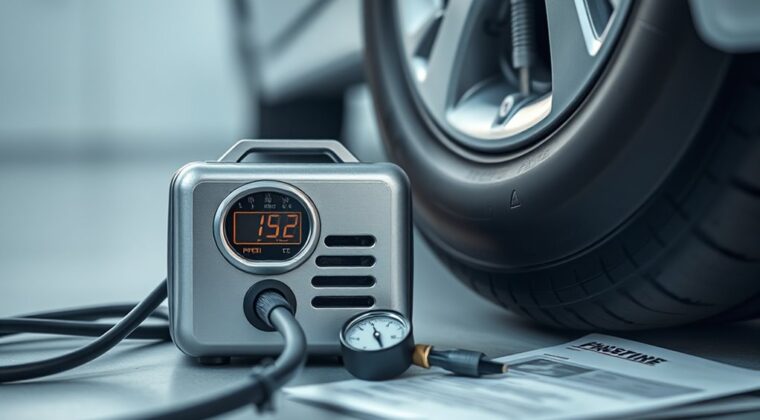
Your tire inflator slows as PSI rises because the tire’s internal pressure adds resistance, so each added pound takes more time and work. Check the hose, valve stem, and seal for leaks or misalignment first, then confirm the inflator is rated for your target PSI and duty cycle. Verify pressure with a cold tire and a stable gauge reading. If speed keeps dropping or pressure won’t hold, a leak may be hiding.
Key Takeaways
- Inflation slows as tire pressure rises because the inflator must overcome greater internal resistance.
- Check for a poor seal at the valve, loose hose connection, or air leaks that reduce airflow.
- Verify the inflator’s PSI rating, airflow capacity, and duty cycle to ensure it can reach the target pressure.
- Use a reliable gauge and recheck after 15–20 seconds, since readings can fluctuate near the final PSI.
- Inspect the tire and valve stem for punctures, debris, or slow leaks if pressure keeps dropping or won’t stabilize.
Why Tire Inflator Speed Drops at Higher PSI
As the tire pressure gets closer to your target PSI, the inflator has to work against higher internal resistance because the air inside the tire is already compressed.
You’ll see portable tire inflators slow as the pressure reading rises, because each stroke moves less air into the correct tire. That’s normal physics: gas compresses, so the pump needs more energy and time to adjust pressure in the final range.
If the connection at the valve is loose, air can escape and the unit may seem weaker or stop early. A tool that isn’t rated for your target PSI can also stall before completion.
Watch the gauge, confirm the seal, and keep the hose straight so you don’t waste effort. When you need accurate tire pressure, steady inflation beats speed, and a well-matched inflator gives you control instead of dependence.
Why the Last Few PSI Take Longer
As you approach the target PSI, rising internal pressure makes each added unit of air face more resistance, so your inflator has to work harder and slower.
Heat buildup can trigger motor protection and shift pressure readings, while the Schrader valve seal can tighten and add more restriction.
If the last few PSI drag on, check the gauge behavior, valve condition, and airflow capacity of the inflator.
Rising Resistance At Higher PSI
When tire pressure climbs, inflation resistance rises too, so the last few PSI usually take longer to add than the first. You’re compressing denser air inside the tire, and pressure affects how hard your inflators must work. That’s why pressure changes slow near the target PSI, even with capable equipment.
- Higher internal pressure means greater backpressure.
- More backpressure reduces flow from compact models.
- Stronger inflators with higher airflow handle the load better.
- Some units may trigger protection if you run them nonstop.
Treat this like the final breaths into a balloon: each added PSI needs more force. Check your tire pressure often, know your inflator’s limits, and plan extra time for the last few PSI so you stay in control and keep moving.
Heat And Pressure Changes
Once the tire nears your target PSI, the air inside is more compressed, so each added pound of pressure faces more resistance and the last few PSI take longer to inflate. You’re pushing against denser air, so the inflator must work harder to raise tire pressure.
That extra work creates heat during inflation, and heat can temporarily lift the reading before the tire stabilizes. If you check PSI immediately, you may read a higher number than the cold pressure you’ll actually keep.
Compact inflators often slow here because they can’t move as much air against rising pressure. Let the unit cool between runs, and you’ll reduce heat buildup, protect performance, and get a more accurate final inflation.
Seal, Gauge, And Flow Checks
The last few PSI often take longer for a few practical reasons, and the first one is simple resistance: as the tire fills, the compressed air inside pushes back harder, much like a balloon that gets tougher to inflate near full.
- Check the seal at the valve; a poor fit leaks air and slows inflation.
- Hold the connector square to the valve stem to keep flow steady and reduce loss.
- Watch the digital gauge closely; near target tire pressure, readings can jump as airflow becomes turbulent.
- If the inflator slows, thermal protection may be limiting output, so pause and continue.
A tight seal, stable gauge readings, and clean flow help you finish the last PSI faster.
Check the Hose, Valve, and Seal First
Check the hose connection first and make sure it’s fully seated on the tire valve.
Then inspect the valve core and the inflator seal for debris, damage, or leakage that can restrict airflow.
If the hose, valve, or seal isn’t tight and clear, you’ll lose pressure and slow inflation at higher PSI.
Hose Connection Check
Before you chase a slower inflation rate at higher PSI, make sure the hose connection is secure and aligned with the valve, since even a small air leak can cut airflow and delay pressure buildup.
Keep the inflator square on the valve stem, then use a Push-Twist-Lock motion to lock it in place.
- Inspect the hose connection for looseness.
- Check the valve stem for debris or damage.
- Confirm the chuck grips the Schrader valve firmly.
- Look for cracks in the hose that can lower inflation efficiency.
If the inflator slips, air leaks skew the pressure reading and waste time.
Tighten the fit before you start, because a clean seal keeps pressure rising fast and lets you work with control, not friction.
Valve And Seal Fit
When the hose sits squarely on the Schrader valve, airflow stays efficient and pressure climbs faster. But even a slight misalignment can leak air and slow inflation at higher PSI. You need a proper seal at every step of the inflation process, so press the chuck firmly and verify that air leakage isn’t escaping around the rim.
Inspect damaged hoses for cracks, soft spots, or worn couplers, because they can choke flow. Check the valve stem for wear or cracking; a compromised stem won’t hold pressure well.
After you disconnect, tap the valve core gently if it seems stuck or unseated, then reconnect and test again. A tight hose-to-valve fit frees you from wasted motion and restores fast, controlled inflation.
Is Your Inflator Built for Higher PSI?
Is your inflator actually built to handle higher PSI, or is it only suited for quick top-offs at lower pressures? Check the specs before you trust it with your tire pressure monitoring system or larger tires.
Many portable inflators deliver enough airflow volume for a fast fill, then slow hard once resistance rises, so inflation speed drops near target pressure.
Portable inflators can fill fast at first, then bog down as pressure climbs near the target.
- Look for dual motors or higher wattage.
- Verify max PSI and duty cycle.
- Compare airflow volume, not just pressure claims.
- Match the tool to your tire size and higher PSI needs.
If your unit struggles from 30 to 40 PSI, it probably lacks the power reserve you need. Quality models keep moving air efficiently, while compact units often can’t.
You deserve gear that works without friction, so inspect the label, read the manual, and choose an inflator that can actually reach the pressure you set.
How Tire Temperature Changes PSI
Tire pressure rises as temperature climbs, and even a 10°F increase can add about 1–2 PSI because the air inside expands. You’re seeing thermal expansion of air at work, not a mystery in the system.
As heat builds, the gas inside your tire volume pushes harder on the casing, so your tire pressure can read 3–5 PSI above the cold baseline after driving or inflation. That’s why a hot tire can look fine while still being improperly inflated once it cools.
If you check pressure right after driving, you risk a false sense of control. Let the tire cool for at least three hours so the reading reflects ambient conditions.
Then track changes regularly, because weather swings and driving habits keep shifting the numbers. Precise monitoring gives you freedom from guesswork, protects performance, and helps you keep each tire in its correct operating range.
How to Check PSI the Right Way
To check PSI accurately, measure your tires when they’re cold, ideally after the vehicle has sat for at least three hours, so heat doesn’t skew the reading. Use a quality gauge and remove the valve cap. Press it straight onto the stem with an airtight seal; a poor connection will misread tire pressure.
Drivers should compare the result with the manufacturer’s recommended PSI on the door jamb or in the owner’s manual.
- Let digital gauges stabilize for 15-20 seconds.
- Recheck if the first reading looks inconsistent.
- Inflate only to the specified target, not beyond it.
- After filling, confirm the PSI again.
That final check helps you verify you’ve reached the correct setting and can reveal a slow leak or a valve issue.
When tires are cold and you measure correctly, you get reliable data, better control, and the freedom to drive without guesswork or wasted air.
When Slow Inflation Means a Leak
If your inflator slows down noticeably as the PSI climbs, that drop in speed can point to a leak, because compressed air creates more resistance and any escape path becomes harder to overcome.
You should check the tire for embedded debris, a puncture, or a weak valve stem. Apply soapy water to the valve and tread; bubbles mean air loss.
If pressure won’t stabilize, or it falls again within 48 hours after you inflate, treat it as a real leak, not normal seepage. Don’t ignore a slow puncture: it can reduce performance, waste air, and compromise safety.
Tighten the valve core if it’s loose, but replace damaged parts instead of forcing them. Regular inspections give you control and keep the tire ready for the road.
When you verify pressure often, you catch problems early, protect your freedom to drive, and avoid being stranded by a hidden leak.
Frequently Asked Questions
Why Is My PSI Going Down so Fast?
Your PSI’s dropping fast because you’ve likely got air leaks, temperature effects, or valve issues.
Check tire pressure with a reliable gauge, then inspect the tread for nails, screws, and the sidewalls for bubbles.
Test the valve stem with soapy water. If losses keep happening, your compressor performance may be masking the problem.
Follow maintenance tips: monitor weekly, rotate tires, and repair leaks before they weaken your control.
Will It Ruin Tires if You Inflate Them to 40 PSI Instead of 35 PSI When the Recommended PSI Is 35?
Yes, inflating your tires to 40 psi when the recommendation is 35 psi can damage them over time.
You’ll raise tire pressure effects beyond ideal inflation levels, increasing safety concerns, uneven tire wear, and performance impact. Higher pressure can reduce grip and add heat generation, especially in hot conditions.
You should set pressure to the manufacturer’s spec, check it cold, and keep your setup within safe limits.
What Is the 5 PSI Rule?
The 5 PSI rule means you’ll often inflate the first 5 PSI faster than the next 5, because tire pressure resistance rises as the tire fills.
You might see 4-5 “elephants” for 0-5 PSI, then 6-8 for 5-10 PSI. That drop in inflator efficiency can reflect compressor type, air leakage, and temperature effects.
For practical maintenance tips, check gauge accuracy, hose seals, and valve cores.
What Is the Best PSI for a Tire Inflator?
You’ll want the best PSI to match your tire’s sidewall or vehicle placard, typically 30-35 PSI for passenger cars.
That ideal pressure preserves tire lifespan, reduces safety concerns, and keeps performance impact predictable.
For inflator efficiency, set the target PSI correctly and avoid overinflation.
Your inflation frequency depends on leaks and use, so check pressure regularly and maintain secure connections for accurate, fast fills.
Conclusion
If your tire inflator slows at higher PSI, you’re usually seeing normal physics, not a failure. The last few PSI always take longer, especially as hose losses, small leaks, or a weak seal add resistance. Check the valve, hose, and chuck first, then confirm your inflator’s pressure rating. You should also compare cold and warm tire readings. When the slowdown is extreme, you’re probably dealing with a leak or underpowered inflator.