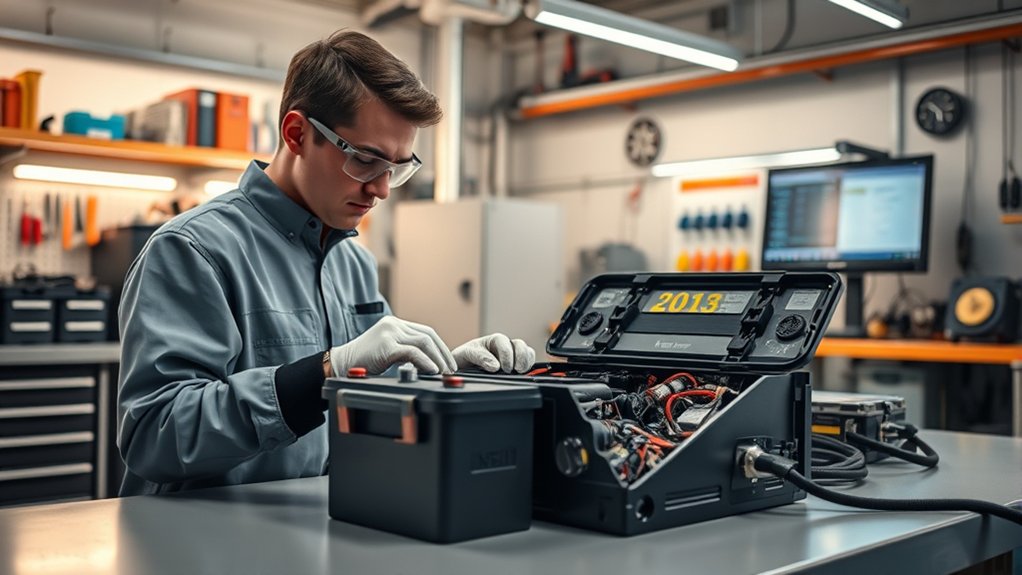
Reconditioning an EV battery safely does not mean opening the high-voltage pack in your garage. For most owners, it means improving battery care, checking battery health, correcting range-estimate errors when the manufacturer recommends it, and getting professional diagnostics when the pack shows signs of imbalance, damage, or rapid capacity loss.
Quick Answer
You can safely recondition an EV battery only through owner-safe steps: monitor battery health, keep daily charging within the maker’s recommended range, avoid long storage at 0% or 100%, update vehicle software, and use professional service for pack faults. Never open, disassemble, or replace high-voltage battery parts yourself.
Key Takeaways
- Safe EV battery reconditioning is mostly charging discipline, software updates, health checks, and professional diagnostics.
- Use your owner’s manual as the final rule. Many EVs prefer an 80% daily limit, while some LFP packs may need periodic 100% charges for accurate estimates.
- AC charging is best for routine use. DC fast charging is fine for trips, but frequent high-power DC charging can increase long-term wear.
- Do not open the high-voltage battery, touch orange cables, add coolant, or attempt module replacement unless you are a trained high-voltage technician.
At a Glance
| Time Required | 30 to 60 minutes for an owner health check; several weeks of improved charging habits to spot a trend; professional diagnostics vary by vehicle. |
| Difficulty | Easy for owner-safe charging and monitoring; advanced and professional-only for high-voltage battery diagnosis or repair. |
| Tools Needed | Owner’s manual, vehicle app, charging-limit settings, Level 1 or Level 2 charger, software update access, and a compatible battery-health report or OBD2 tool if your EV supports it. |
| Cost | Usually free for owner habits and software checks; battery-health reports, diagnostic scans, and professional repairs vary by model, warranty, and fault type. |
What EV Battery Reconditioning Really Means
In a modern EV, “battery reconditioning” is often the wrong word for what an owner can safely do. The high-voltage pack is sealed, monitored by a battery management system, and cooled by vehicle-specific hardware. You should not open the pack, replace cells, add coolant, or touch high-voltage cables.
For an owner, safe reconditioning means three things:
- Conditioning: using better charging and storage habits to reduce stress on the battery.
- Balancing support: allowing the car’s own battery management system to balance cells when the owner’s manual or app calls for it.
- Calibration support: helping the range estimate become more accurate when the manufacturer recommends a specific process.
Pack repair, module replacement, coolant service, isolation-fault diagnosis, and high-voltage testing belong to a trained EV technician. Tesla’s high-voltage battery guidance states that high-voltage service must be done only by trained technicians and that owners should not disassemble or replace high-voltage components.
Warning: Do not open an EV battery pack, touch orange high-voltage cables, bypass safety interlocks, add battery coolant, or attempt module replacement at home. If the vehicle has warning lights, smoke, burning odor, flood exposure, crash damage, or unusual heat, stop using it and contact the manufacturer, dealer, or a qualified EV battery technician.
How EV Battery Degradation Affects Performance
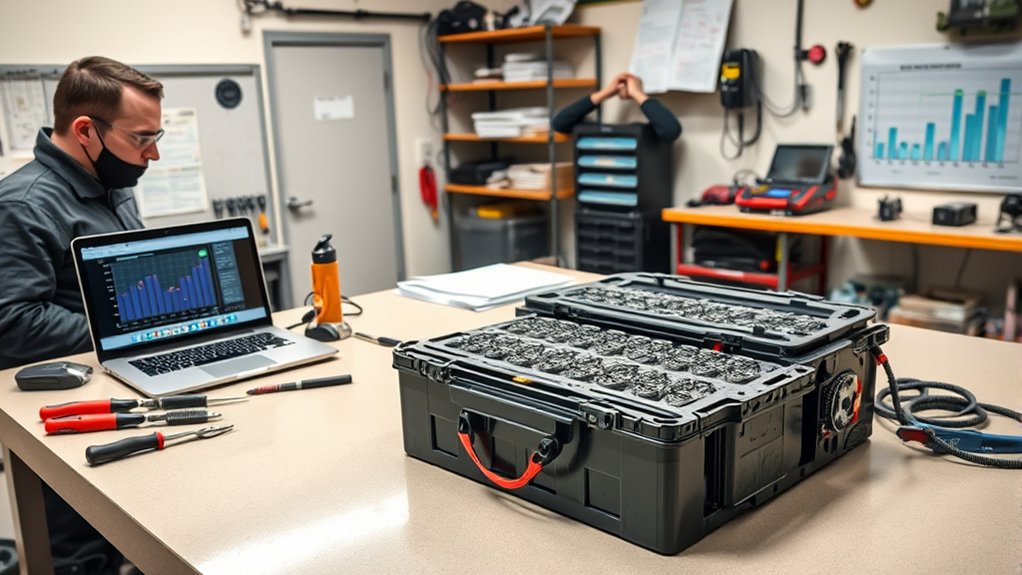
EV battery degradation is the gradual loss of usable capacity and power as the cells age. You may notice a shorter driving range, a larger gap between displayed range and real-world range, slower fast-charging sessions, or more frequent charging stops on the same route.
Real-world battery wear varies by vehicle design, chemistry, climate, charging power, and usage. Geotab’s 2026 analysis of more than 22,700 EVs found an average annual degradation rate of 2.3%, but that number is not a promise for every EV. Vehicles that relied heavily on high-power DC fast charging degraded faster on average than vehicles charged mostly at lower power.
Battery health is not one fixed number. A pack’s useful life depends on heat, charging power, time spent near empty or full, software control, chemistry, and the vehicle’s cooling system.
State of health, or SOH, is useful, but it is not perfect. A 2026 battery-health study found that SOH reporting and availability vary across manufacturers, so use it as one clue rather than the only proof of battery condition.
Before You Start: Safety, Warranty, and Recall Checks
Before you try to improve battery performance, check the basics that protect your warranty and safety.
- Read your owner’s manual: Use the charging limits, storage advice, and battery-care instructions written for your exact model and battery type.
- Check the battery warranty: Many EV warranties cover the high-voltage battery for a set number of years, miles, and minimum capacity. Do not do anything that could void coverage.
- Check open recalls: Battery software, charging limits, or pack repairs may already be covered by the manufacturer.
- Look for warning messages: High-voltage battery, isolation fault, coolant, charging, or reduced-power warnings need professional diagnosis.
- Inspect the history: Crash damage, flood exposure, salvage history, or repeated overheat warnings should be handled by a qualified EV service center.
Note: California’s Advanced Clean Cars II program, beginning with the 2026 model year, includes zero-emission vehicle assurance measures. That does not replace your warranty, but it shows why battery durability and battery-health transparency are becoming more important for EV owners.
Best Practices for Extending Your EV Battery Life
The best way to “recondition” an EV battery over time is to reduce the habits that speed up wear. These steps will not reverse chemical aging, but they can slow avoidable stress.
- Use the maker’s daily charge limit: For many EVs with nickel-based batteries, a daily limit near 80% is a good default. Charge to 100% only before longer trips, then drive soon after charging.
- Know your battery chemistry: Some LFP battery vehicles may ask you to charge to 100% periodically for accurate range estimates. Follow your manual instead of using one rule for every EV.
- Avoid long storage at very low or very high charge: Do not leave the car sitting near 0% or 100% for days if you can avoid it. For long storage, many manufacturers prefer a moderate charge level and staying plugged in if the car can manage the pack automatically.
- Use AC charging for routine charging: Level 1 or Level 2 charging is gentler for daily use. DC fast charging is useful for road trips and tight schedules, but frequent high-power DC charging can increase wear.
- Keep software current: Battery management, charging curves, thermal control, and range estimates can improve through software updates.
- Control heat when practical: Park in shade or a garage during very hot weather, precondition while plugged in, and avoid repeated fast charging when the pack is already hot.
- Avoid running the pack to empty: Charging regularly is usually better than waiting until the battery is very low.
Pro Tip: If your EV lets you schedule charging, set it to finish shortly before departure. This reduces the time the battery spends at a high state of charge and can let the vehicle warm or cool the pack while plugged in.
Step-by-Step Guide to Safely Condition Your EV Battery
Use this owner-safe process when your EV has lost some range, the displayed range seems inaccurate, or you want to improve long-term battery care. Stop and get professional help if the vehicle shows high-voltage warnings, charging faults, or physical damage.
- Record your baseline: Note odometer mileage, displayed range at a known charge level, average energy use, recent weather, tire pressure, and any warning messages.
- Check the manual and app: Confirm your recommended daily charge limit, storage advice, and any model-specific calibration or balancing instructions.
- Install pending software updates: Update the vehicle before judging battery performance, because charging behavior and range estimates may change.
- Set a daily charge limit: Use the manufacturer’s recommended daily limit. If your manual gives no specific number, 70% to 80% is a practical daily target for many EVs, with higher charges reserved for trips.
- Use AC charging for the next several sessions: Charge at home or work on Level 1 or Level 2 when possible. Avoid repeated high-power DC fast charging during your conditioning period unless you need it.
- Let the car manage balancing: If your EV manual or app recommends a full charge for balancing, do it shortly before driving. Do not leave the car sitting at 100% for long periods unless your manufacturer specifically tells you to.
- Use calibration only when needed: If the range estimate is clearly inaccurate, follow the official calibration process for your vehicle. Do not repeatedly cycle from 100% to below 10% as a routine habit.
- Recheck after two to four weeks: Compare range, charging behavior, energy use, and warning messages under similar weather and driving conditions.
- Escalate if the problem remains: If range loss is sudden, SOH drops quickly, charging slows without an obvious temperature reason, or the car reports a battery fault, schedule professional diagnostics.
When Professional EV Battery Repair Is Needed
Some battery problems cannot be fixed with better charging habits. A professional battery-health report or dealer scan is the safer next step when you see these signs:
- Sudden range loss: A sharp drop over days or weeks can point to a fault, software issue, or failing module.
- Battery warning lights: High-voltage, charging, coolant, isolation, or reduced-power alerts need proper diagnostic tools.
- Repeated charging failures: If multiple chargers fail with the same vehicle, the issue may be inside the car, not the charger.
- Crash or flood exposure: A battery pack can be unsafe even if the vehicle still drives.
- Large cell-voltage spread: If a compatible diagnostic tool shows a large or growing cell delta, compare it with model-specific service data instead of using a universal threshold.
- Capacity below warranty threshold: If SOH appears low, document it and contact the manufacturer before paying for repairs.
Module replacement can restore some packs, but it depends on the vehicle design, parts availability, warranty rules, and whether the fault is limited to one section of the pack. In other cases, software repair, cooling-system service, contactor repair, a battery management component, or full pack replacement may be required.
Troubleshooting Common EV Battery Problems
Use this table to separate normal EV behavior from warning signs that need service.
| Problem | Likely Cause | Safe Next Step |
| Range drops in cold weather | Cold battery, cabin heat use, winter tires, dense air, or wet roads | Precondition while plugged in and compare range again in moderate weather. |
| DC fast charging slows near 80% or in cold weather | Normal charge taper, cold pack, hot pack, or battery protection logic | Use battery preconditioning before DC charging and avoid charging to 100% on fast chargers unless needed. |
| Displayed range seems inaccurate | Recent driving style, weather, tire pressure, or BMS estimate drift | Check tires, update software, drive normally for several cycles, and follow only official calibration guidance. |
| Battery warning or reduced-power message | High-voltage system fault, cooling issue, isolation issue, or pack protection mode | Stop relying on DIY checks and schedule professional service. |
| Vehicle will not charge after sitting empty | Deep discharge, low-voltage battery issue, or pack protection mode | Follow the manufacturer’s recovery instructions and contact roadside assistance or service. |
| Smoke, burning odor, hissing, swelling, or heat after crash or flood | Possible high-voltage battery damage or thermal event | Move away from the vehicle, call emergency services if needed, and do not charge or drive it. |
Debunking Myths About EV Battery Reconditioning
Myth 1: Reconditioning can make an old EV battery like new. It cannot. Better charging habits, balancing, and software updates may improve usable performance or displayed range, but they cannot reverse permanent chemical aging.
Myth 2: Every EV should be charged from 0% to 100% for calibration. No. Deep cycling is not routine maintenance. Use it only when your manufacturer recommends a specific calibration procedure.
Myth 3: A low SOH number always proves the pack is failing. Not always. SOH reporting varies by vehicle, and some vehicles do not expose reliable battery-health data. Confirm with a professional battery-health test when the number affects a purchase, warranty claim, or repair decision.
Myth 4: DC fast charging ruins EV batteries. DC fast charging does not automatically ruin a battery, but frequent high-power sessions can increase wear over time. Use it when it helps your schedule, and use AC charging when the vehicle is parked for hours anyway.
Myth 5: Module replacement is a simple DIY fix. It is not. Even if only one module is weak, high-voltage handling, pack sealing, thermal management, software pairing, and warranty rules make this professional work.
Frequently Asked Questions
Can you recondition an EV battery?
You can safely condition an EV battery through charging habits, software updates, battery-health monitoring, and manufacturer-approved balancing or calibration steps. You should not open the high-voltage battery or replace cells yourself. Internal battery repair is professional-only work.
What is the 80/20 rule for an EV battery?
The 80/20 rule means using roughly 20% to 80% charge for normal daily driving. It reduces time spent near the battery’s stressful extremes. It is a useful default for many EVs, but your owner’s manual comes first because some battery chemistries and models use different recommendations.
Can an EV battery last 20 years?
It is possible for some EV batteries to remain useful for 20 years, but it is not guaranteed. Longevity depends on vehicle design, chemistry, cooling, climate, charging habits, mileage, and whether the pack develops faults. A battery can still be usable even after it has lost some range.
How do you prolong the life of an EV battery?
Use the recommended daily charge limit, avoid long storage near empty or full, use AC charging for routine charging, limit repeated high-power DC fast charging, park out of extreme heat when practical, keep software updated, and address battery warnings quickly.
Should I leave my EV plugged in after it reaches 100%?
Only do this if your vehicle’s manual or app recommends it for balancing or battery management. Many EVs should not sit at 100% for long periods. If you need a full charge for a trip, schedule charging so it finishes close to departure.
When should I replace an EV battery instead of reconditioning it?
Replacement may be needed when the pack has severe physical damage, unsafe electrical faults, repeated charging failures, major capacity loss below warranty limits, or cell/module faults that are not economical to repair. Get a professional diagnosis before assuming the whole pack is bad.
Conclusion
Safe EV battery reconditioning is really about protecting the pack you already have. Monitor battery health, follow your owner’s manual, avoid long periods near empty or full, use AC charging for routine use, keep software current, and treat sudden warning signs seriously. If the problem involves high-voltage components, crash damage, flood exposure, module replacement, or unexplained rapid range loss, stop the DIY process and get professional EV battery service.
Sources
- Tesla Model 3 Owner’s Manual: High Voltage Battery Information — battery care, charge limits, storage cautions, and high-voltage safety warnings.
- Geotab: EV Battery Health, 22,700 Vehicle Data Analysis — real-world degradation rates, DC fast-charging effects, hot-climate effects, and SOC exposure findings.
- California Air Resources Board: Advanced Clean Cars — current Advanced Clean Cars II context and zero-emission vehicle assurance measures.
- Battery Health Reporting Fails Independent Validation Across Manufacturers — research on SOH reporting limitations and manufacturer differences.
- Lithium-ion Battery Degradation: How to Model It — technical background on lithium-ion degradation mechanisms.