

To wrap an EV charging cable, stop charging, disconnect only the ends your equipment is designed for you to unplug, let existing twists relax, and form large, loose loops. The over/under wrap method is a useful general technique because alternating loop direction reduces built-up twist. If your vehicle or EVSE manual specifies a different storage method, holder, reel, or minimum bend radius, follow that instruction first.
Last updated: September 8, 2026
Quick Answer
To wind an EV charging cable, end the charging session, release the connector as your vehicle or EVSE manual directs, shake out twists, and make large, loose loops. Use the over/under method when the cable naturally accepts it. Avoid elbow wrapping, knots, sharp bends, and tight coils. Keep the connector supported, clean, and off traffic paths.
Key Takeaways
- Use the over/under wrapping technique when it matches the cable’s natural lay, but follow the exact EVSE or vehicle manual if it specifies another storage method.
- Make large, soft loops. Tight coils and sharp bends can stress the cable jacket and internal conductors.
- Stop using a charging cable that is cracked, frayed, swollen, corroded, has exposed wiring, or shows unusual heat or burn damage.
- Store the cable on the holder, holster, or in the bag specified or approved for your equipment when available, with the connector protected and off traffic paths.
At a Glance
| Time Required | Varies with cable length, stiffness, and storage setup |
| Difficulty | Easy once you practice the over/under motion |
| Tools Needed | Your hands plus the holder, holster, reel, or bag specified or approved for your equipment |
| Cost | No special tool is required; optional storage hardware varies by setup |
How to Properly Wrap Your EV Charging Cable
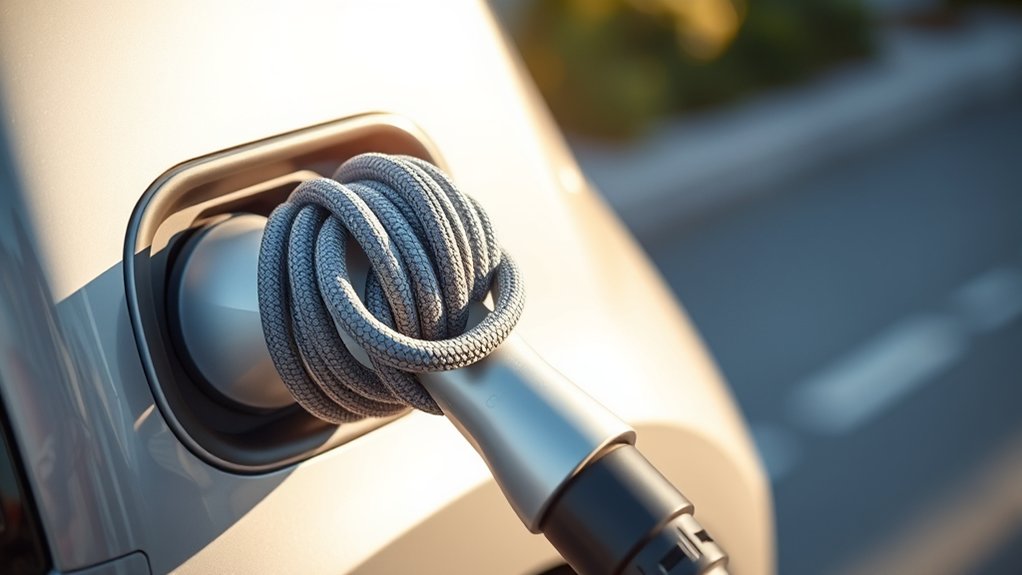
To properly wrap your EV charging cable, first end the charging session and disconnect the cable only where the equipment is designed to be disconnected. A tethered wall charger stays attached to the EVSE; an untethered or portable cable may have one or more removable ends. Follow the disconnect sequence in the exact vehicle and EVSE manual before coiling.
A strong general-purpose method is the over/under wrap. It alternates the direction of each loop, which helps prevent twist from building in one direction. The same technique is widely used for long power and signal cables. WIRED’s over/under cable guide explains the basic principle. For EV equipment, the manufacturer’s storage instructions still take priority.
Make each loop wide and relaxed, and let the cable choose a natural curve instead of forcing a fixed loop size. There is no single safe coil diameter for every EV charging cable because construction and bend limits vary. For example, an EV-cable manufacturer lists different minimum bend radii for fixed and flexible use, so check the specification for your exact cable when one is provided. Keep the connector supported while you work, and do not pull against the strain relief where the cable enters the connector. See Sumcab’s EV charging-cable bend-radius specifications for an example of why bend limits are cable-specific.
Warning: Do not use an EV charging cable that is cracked, frayed, melted, swollen, corroded, missing pins, or unusually hot. For covered portable cord-and-plug equipment in workplaces, OSHA 1910.334 requires visual inspection and removal from service when damage may expose an employee to injury. For home EV charging, follow the vehicle and EVSE manufacturer’s instructions and local electrical requirements.
Before You Wrap the Cable
A neat coil starts before the first loop. Take a few seconds to check the cable and remove tension from it.
- Stop charging and disconnect correctly: End the session first, then release only the connector ends your vehicle and EVSE instructions say to unplug. Do not try to disconnect a hardwired or permanently tethered cable from the charger body.
- Check unusual heat: If the cable, plug, outlet, adapter, or connector is hotter than normal, stop using the equipment until you have followed the manufacturer’s troubleshooting guidance and ruled out damage or a poor connection.
- Shake out twists: Hold one end and gently walk the cable out so loops and twists relax.
- Clean only as directed: Use the cleaning method in the equipment manual. A soft, dry cloth is a conservative choice for exterior surfaces; do not spray liquid into connector contacts.
- Check the jacket: Look for cuts, flattening, bubbles, cracks, crushed areas, or exposed wire.
Note: EV charging equipment is not just a generic extension cord. EVSE controls power delivery and communicates with the vehicle. The U.S. Department of Energy’s Alternative Fuels Data Center explains charging levels and common connector types.
Step-by-Step Guide to the Over/Under Wrapping Technique
The over/under method may feel awkward the first few times, but it becomes quick with practice. The goal is simple: one loop follows the cable’s natural curve, and the next loop reverses the twist.
- Hold a supported end: Hold the cable near a connector with your non-dominant hand without letting the connector’s weight pull on the strain relief.
- Make the first loop over: With your other hand, slide along the cable far enough to form a large, relaxed loop. Let the loop follow the cable’s natural curve into your holding hand.
- Make the second loop under: For the next loop, rotate your wrist slightly in the opposite direction as you bring the cable back. This creates the “under” loop.
- Alternate each loop: Continue over, under, over, under until the cable is fully coiled.
- Keep tension light: Hold the loops together, but do not pull tight. The cable should look relaxed, not stretched.
- Secure the coil: Use a Velcro strap or soft cable tie around the coil. Do not cinch it so tightly that it dents the jacket.
Pro Tip: If the cable forms a figure-eight or wants to twist while you coil it, stop and let the free end spin out. Fighting the twist usually makes the next charging session messier.
Common Mistakes to Avoid When Wrapping Cables
Small handling habits can add repeated mechanical stress to the jacket, strain relief, and conductors. For broader maintenance beyond wrapping, see our EV charging cable care guide.
- Wrapping around your elbow: This forces repeated twists into the cable and can create tight bends.
- Making tiny loops: Small loops create sharper bends and are harder to unroll.
- Pulling the cable tight: Excess tension can stress the plug end and strain relief.
- Dragging the connector: Dragging plug ends across concrete can damage the latch, pins, or plastic housing.
- Storing it dirty or wet: Moisture and grit can affect plug connections and make corrosion more likely.
- Ignoring heat: A cable that feels unusually hot needs inspection before you coil or reuse it.
Can You Charge While the Cable Is Coiled?
Do not assume an EV charging cable is safe to energize while tightly coiled or wound on a reel. Follow the exact cable, EVSE, and vehicle instructions. Some vehicle manuals explicitly tell drivers to fully uncoil the charging cord to limit heating; Renault’s current online charging manual gives that instruction directly.
If your manual requires full uncoiling, do that every time. If it does not address the issue, the conservative approach is to lay unused cable in broad, loose curves where it can stay clear of tires, foot traffic, puddles, sharp edges, and hot surfaces. Do not energize a cable while it is tightly wound on a storage reel unless the reel or EVSE manufacturer specifically permits charging in that configuration.
Reference: Renault charging guidance.
Top Storage Tips for EV Charging Cables
After wrapping your EV charging cable, return it to the storage setup intended for your equipment so the connector is supported and the cable stays out of traffic paths. If you need the correct disconnect sequence first, see how to unplug an EV charger safely.
- Use the intended holder or cable dock: Prefer the holster, hanger, enclosure, reel, or bag supplied or approved for the equipment. This keeps cable weight off the connector and helps reduce trip hazards.
- Protect the connector: Use the factory dust cap, holster, or storage position if your equipment includes one.
- Avoid improvised sharp hooks: If a separate holder is allowed by the manufacturer, it should support the cable without forcing a tight bend or denting the jacket.
- Stay away from chemicals: Do not store the cable beside solvents, fuel, oil, paint thinner, or harsh cleaners.
- Protect from weather: Outdoor chargers should use weather-rated equipment and a storage spot that reduces direct sun and standing water exposure.
OSHA’s construction rule says workplace walkways should be kept clear of cords so they do not create employee hazards. That rule is a workplace standard, not a home-garage code requirement, but the physical lesson is still useful: keep an EV cable out of normal walking and driving paths. See OSHA 1926.416.
How to Inspect and Maintain Your EV Charging Cable
A quick visual check can catch obvious damage before the next charging session. Inspect the cable whenever it has been driven over, pinched, dropped, exposed to abnormal conditions, or involved in repeated charging faults, and follow any inspection interval in the manufacturer’s manual.
Regular Visual Inspections
Look over the full cable length. Pay close attention to areas near the plug, strain relief, and any spot that rests on the ground.
- Check for fraying, cracks, flattening, cuts, or exposed conductor.
- Look for melted spots, brown marks, bubbling, or a burnt smell.
- Make sure the connector latch moves normally.
- Check that pins are straight, clean, dry, and not corroded.
- Stop using the cable if it sparks, trips breakers repeatedly, or feels unusually hot.
Clean Plug Connections
Keep plug connections dry and debris-free using the method your equipment manufacturer specifies. Do not insert metal tools, paper clips, or screwdrivers into the connector. For a separate cleaning workflow, see how to clean an EV charging connector, then compare any cleaning product or method with the instructions for your exact connector before use.
If dirt is stuck inside the connector, follow the charger maker’s instructions or contact the manufacturer. If you see corrosion, burn marks, loose pins, or cracked plastic, stop using the cable until it is inspected or replaced.
How the Environment Impacts Your Cable’s Lifespan
Storage conditions matter because EV charging cables have product-specific temperature, weather, and bend limits. Use the limits in your cable or EVSE manual rather than assuming every charging cable tolerates the same conditions.
- Sunlight: Follow the cable’s outdoor and UV-exposure rating. Use shade or the intended storage position when the manufacturer calls for it.
- Cold weather: If the cable becomes stiff, use larger loops and do not force it into tight bends.
- Heat: Keep the cable within the storage-temperature limits in its manual and away from obvious heat sources.
- Moisture: Follow the equipment’s water-ingress and storage instructions; keep connector contacts out of standing water and do not seal wet equipment into a bag.
- Dirt and salt: Road salt, sand, and grit can wear the jacket and contaminate connectors.
If your charger is outdoors, use weather-rated equipment and follow the manufacturer’s storage instructions. A covered cable dock can make daily use easier and reduce exposure.
How to Handle Long EV Charging Cables Without Damage
Long EV charging cables are convenient because they can reach different parking positions, but they also need more careful handling. The longer the cable, the easier it is to twist, drag, or trip over.
Proper Coiling Techniques
Keep loops large, alternate over and under when the cable naturally accepts that pattern, and keep connector weight supported. If the cable fights the twist or the manual specifies a different storage method, stop and follow the cable’s natural lay or the manufacturer’s instructions instead.
If the cable is very stiff in winter, do not force it into a small coil. Make wider loops and store it where it can warm slightly before the next use.
Cable Length Considerations
Do not stretch a charging cable to its limit. If it barely reaches the vehicle, move the car closer or change the parking angle. A cable under tension can pull on the connector, charger housing, wall mount, or vehicle charge port.
Keep extra length out of tire paths. A vehicle tire can crush the jacket or deform the cable even if the damage is not easy to see at first.
Cable Management Options: What to Use and What to Check
Cable-management hardware can help, but compatibility matters more than convenience. Check the EVSE or cable manual before adding a third-party holder, reel, cap, or tie.
- Wall-mounted cable holder: Use one only if it can support the cable without violating the manufacturer’s bend, load, or storage instructions.
- Connector holster: Prefer the factory or manufacturer-approved holster when available so the connector is supported in its intended position.
- Reusable soft strap: Use only if permitted, and fasten it loosely enough that it does not dent or sharply bend the jacket.
- Cable reel: Use only when the reel is compatible with the cable and charging setup. Fully uncoil when the vehicle, EVSE, cable, or reel instructions require it, and never assume a storage reel is rated for charging while wound.
- Outdoor cover: Helpful for reducing direct rain and sun exposure when the charger is outside.
Which Storage Method Fits Your EV Charging Setup?
The correct routine depends on whether the cable is tethered to a wall charger, removable from both ends, or part of a portable EVSE. Use this decision framework before choosing a coil, hook, reel, or bag.
| Setup | Best Storage Routine | Main Risk to Avoid |
|---|---|---|
| Tethered wall charger | Leave the cable attached to the EVSE and return it to the manufacturer’s cable holder or holster. Use broad loops if the unit is designed to be wrapped. | Pulling on the EVSE housing, forcing tight bends, or leaving cable in a tire or walking path. |
| Untethered charging cable | Disconnect in the specified order, form broad relaxed loops, use over/under if it suits the cable, then use the intended bag or holder. | Dirty connector faces, knots, tight coils, and unsupported plug weight. |
| Portable EVSE | Follow the portable unit’s shutdown and storage instructions, support the control box, then pack the dry cable and adapters in the specified case or bag. | Letting the control box hang by a cord, packing wet equipment, or crushing it under cargo. |
Hyundai publishes dedicated charging-cable storage guidance, and Tesla provides product-specific manuals for its charging equipment and adapters. Use the instructions for your exact hardware when they are more specific than a general coiling technique.
Troubleshooting Common Wrapping Mistakes
If your cable keeps tangling, the wrapping method is usually not the only issue. Look at how the cable is unrolled, where it lies during charging, and whether the same twists are being added every day.
Common Wrapping Errors
| Problem | Likely Cause | Fix |
|---|---|---|
| Cable twists every time you unroll it | Straight coiling in the same direction | Use the over/under method and let the free end spin out before storing. |
| Cable has tight bends near the plug | Pulling from the connector or wrapping too tightly | Hold the cable body, make larger loops, and avoid pulling against the strain relief. |
| Plug gets dirty or wet | Connector stored on the floor or outside uncovered | Use a connector holster, cap, or covered dock. |
| Cable feels hot after charging | Heat buildup, damage, poor connection, or equipment issue | Stop charging and follow the manufacturer’s troubleshooting guidance. If heat, discoloration, looseness, or repeated faults remain, have the equipment inspected before reuse. |
Improper Coiling Techniques
The biggest mistake is treating an EV charging cable like a rope or garden hose. A charging cable has conductors, insulation, strain relief, and connector parts that need gentle handling.
Do not tie knots in the cable. Do not hang the whole cable weight from the connector. Do not use zip ties so tightly that they leave marks in the jacket. If you need a tie, use a soft reusable strap.
Cable Damage Risks
Cable damage is not always obvious. A jacket can look mostly fine while internal conductors or strain relief have been stressed. Watch for these red flags:
- Repeated charging errors or interrupted sessions
- Visible copper, torn insulation, or deep cuts
- Loose connector latch
- Heat marks or melted plastic
- Crackling, buzzing, burning smell, or sparks
- Plug pins that look bent, darkened, wet, or corroded
If any of these appear, stop using the equipment and follow the charger or vehicle manufacturer’s fault guidance. Contact the manufacturer, installer, dealer, or a qualified electrician when the fault involves damaged electrical equipment, a hot or loose outlet, repeated breaker trips, or anything the manual says requires service.
Frequently Asked Questions
How do you wind an EV charging cable?
End the charging session, disconnect only the ends your equipment is designed for you to unplug, let twists relax, and make broad, loose loops. Use the over/under method when it matches the cable’s natural lay. Store the connector in its intended holster, cap, holder, or bag.
Can I leave my EV charging cable coiled while charging?
Do not leave it tightly coiled unless the exact equipment instructions permit that setup. Some vehicle and charger guidance explicitly says to fully uncoil the cable to limit heating. Follow your manual; otherwise, laying unused length in broad, loose curves is the conservative choice.
Should an EV charging cable be fully uncoiled before charging?
If the vehicle, EVSE, cable, or reel instructions say to fully uncoil it, yes. Renault’s online vehicle manual is one example that explicitly says to fully uncoil the charging cord to limit heating. Check the instructions for your exact equipment because requirements can differ.
Is the over/under method safe for every EV charging cable?
It is a useful general cable-handling method, but it is not a substitute for the exact cable or EVSE manual. Use broad loops, do not force the cable against its natural curve, and follow any stated minimum bend radius or required storage pattern.
How should I store a portable EV charging cable in the trunk?
Disconnect it using the manufacturer’s sequence, inspect it, let it dry if needed, coil it in broad relaxed loops, and place it in the specified bag or protected storage area. Keep the control box, plug blades, connectors, and adapters from being crushed by tools or cargo.
How often should I inspect my EV charging cable?
Follow the inspection guidance for your exact equipment. As a practical routine, look for obvious damage before charging and recheck after the cable is pinched, driven over, dropped, exposed to severe weather, or involved in repeated charging faults. Stop using damaged equipment.
Conclusion
The best general way to wind an EV charging cable is to end the session correctly, let twists relax, form broad loops, and use the over/under method when it suits the cable’s natural lay. The exact vehicle, EVSE, cable, or reel manual overrides any general coiling technique. Avoid knots, tight bends, unsupported connector weight, and charging with a tightly wound cable when the equipment instructions require it to be uncoiled.
Make storage part of the same routine: inspect for obvious damage, keep connectors protected, and return the cable to its intended holder, holster, reel, or bag. If you see burn damage, exposed conductors, corrosion, loose parts, repeated charging faults, or abnormal heat, stop using the equipment and follow the manufacturer’s service guidance before the next charge.
Sources
- U.S. Department of Energy Alternative Fuels Data Center — EV charging levels and common connector types.
- OSHA 1910.334 Use of Equipment — workplace visual-inspection and damaged cord guidance.
- OSHA 1926.416 General Requirements — workplace cord and walkway hazard guidance.
- Renault Charging User Manual — instruction to fully uncoil the charging cord to limit heating.
- Hyundai Charging Cable Storage Tips — manufacturer storage guidance for Hyundai charging cables.
- Tesla Charging & Adapter Product Guides — product-specific charging equipment manuals and safety information.
- Sumcab Sumflex EVC — example EV charging-cable bend-radius specifications showing fixed and flexible installation differences.
- WIRED: Coiling a Cable — practical explanation of the over/under coiling method.